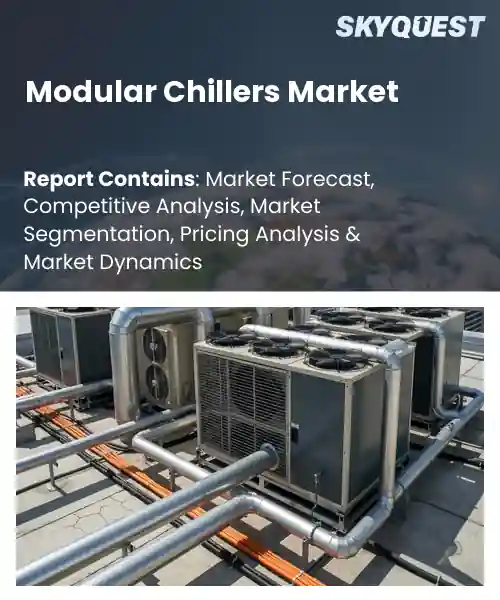
Modular Chillers Market
Report ID: SQMIG20I3007
Report ID: SQMIG20I3007
[email protected]
USA +1 351-333-4748
Report ID:
SQMIG20I3007 |
Region:
Global |
Published Date: May, 2026
Pages:
157
|Tables:
178
|Figures:
79


Global Modular Chillers Market size was valued at USD 3.55 Billion in 2024 and is poised to grow from USD 3.77 Billion in 2025 to USD 6.15 Billion by 2033, growing at a CAGR of 6.3% during the forecast period (2026-2033).
Growing demand for scalable, energy efficient cooling to meet variable thermal loads in commercial buildings, data centers and industrial facilities is the primary driver of the modular chillers market. Modular chillers are factory built packaged units that can be installed incrementally to match capacity needs, offering staged investment and simplified maintenance appealing to owners seeking resilience and cost control. Over decades adoption rose as digital controls, variable speed compressors and improved heat exchanger designs reduced operating costs. Examples in large data center campuses and hospital expansions show how modular systems enable phased commissioning, redundancy and faster timelines than monolithic chillers.Technological integration and regulatory pressure form the key factor accelerating modular chiller growth because smart controls, IoT sensors and predictive maintenance tools reduce energy use and downtime, making modular installations more economically attractive. As efficiency standards tighten and carbon targets rise, facility managers choose modular units to simplify phased retrofits and meet compliance without disruption. In practice, data centers deploy N plus one modular banks to scale capacity while maintaining uptime, hospitals adopt redundant modules to protect services, and prefabricated modular HVAC in hotels shortens construction schedules, which together expand service contracts, modular as a service financing and aftermarket opportunities.
How is IoT improving efficiency in the modular chillers market?
IoT is improving efficiency in the modular chillers market by linking sensor rich modules to building controls and cloud based analytics. Key aspects are real time monitoring, remote fault detection and predictive maintenance. Operators can sequence modules to match load, tune set points remotely and simplify commissioning. In a market driven by growing data center demand and electrification, embedded connectivity helps facility teams extend equipment life, speed troubleshooting and optimize operations for greater reliability and smoother service delivery.
Johnson Controls in Feb 2026, launched Smart Ready YORK Chillers with factory installed connectivity and AI enabled analytics that deliver broader telemetry and faster fault detection. This shows how embedded IoT accelerates commissioning, reduces unplanned downtime and supports wider adoption by proving clear operational benefits for owners and operators.
Market snapshot - (2026-2033)
Global Market Size
USD 3.55 Billion
Largest Segment
Air-Cooled Modular Chillers
Fastest Growth
Heat Pump Modular Chillers
Growth Rate
6.3% CAGR
To get more insights on this market click here to Request a Free Sample Report
Global modular chillers market is segmented by product type, capacity, compressor type, application, end user, distribution channel and region. Based on product type, the market is segmented into Air-Cooled Modular Chillers, Water-Cooled Modular Chillers, Heat Pump Modular Chillers and Others. Based on capacity, the market is segmented into Below 100 kW, 100–300 kW and Above 300 kW. Based on compressor type, the market is segmented into Scroll Compressors, Screw Compressors, Centrifugal Compressors and Others. Based on application, the market is segmented into Commercial Buildings, Industrial Facilities, Data Centers, Healthcare Facilities, Hospitality and Others. Based on end user, the market is segmented into Commercial, Industrial, Residential, Institutional and Others. Based on distribution channel, the market is segmented into Direct Sales, Distributors & Dealers and Online Sales. Based on region, the market is segmented into North America, Europe, Asia Pacific, Latin America and Middle East & Africa.
Air-cooled modular chillers segment dominates with large modular chillers market share because their simplified installation and outdoor deployment reduce infrastructure complexity and enable rapid capacity scaling, making them a default choice for many facilities. Their lower reliance on centralized water systems and easier maintenance translate into more predictable uptime, and modular integration allows phased expansion; these characteristics drive broad adoption across building types and support lower operational barriers that reinforce market preference.
As per modular chillers market outlook, heat pump modular chillers segment is the fastest growing in the market. Improvements in efficiency for heat pumps, and their integration with renewable energy sources, provide opportunities for replacing older equipment with newer models and installing heat pump modular chillers in both retrofit and new construction applications. Thereby, creating increased lifetime value and providing additional opportunities for applications that benefit from both heating and cooling simultaneously.
As per modular chillers market analysis, screw compressors segment leads because of its very robust and durable continuous duty design and excellent performance at partial loads, allowing for successful multi-module installations to consistently provide chilled water to very demanding environments. The fact that these compressors integrate very well with variable speed drives and have predictable maintenance cycles greatly reduces the amount of time that equipment will be out of service and simplifies planning for the life of the equipment.
As per modular chillers market forecast, scroll compressors segment is experiencing the greatest momentum in growth due to their small and compact construction along with their quiet operation, which meet the requirements of small modular applications used in commercial and institutional markets. Ongoing inverter based scroll innovations and lower initial costs are driving higher levels of adoption through both the replacement and the new construction markets and are creating many new opportunities for manufacturers focused on targeting distributed cooling applications.
To get detailed segments analysis, Request a Free Sample Report
Asia Pacific region is experiencing tremendous growth because of the concentration of industrial growth and rapid growth of metropolitan areas, coupled with the popularity of modular chiller products in commercial, industrial, and data center applications. Therefore, there is a lot of demand for flexible, scalable chiller products. Local manufacturers and engineering consultants offer modular designs to provide quick customisation and substantial after-sales networks to reduce the total cost of ownership of chillers. There are also energy efficiency objectives and green building initiatives driving the use of compact, high-performing chillers that have been designed to work with building management systems. In addition, nearby supply chains and competition for component sourcing also increase the accessibility of the chiller products to the owners in each locality by decreasing barriers to deployment and integrating digital controls and remote monitoring increases operational reliability.
As per modular chillers market regional outlook, Japan has advanced manufacturing skills due to high levels of energy efficiency, compact design, and will use additional restrictions to ensure good-quality goods. The commercial and industrial buildings have refurbishment programs which need to replace equipment and the electronic industry has requirements for exact cooling of its products, including data centers. Japanese manufacturers are providing products that excel in reliability and quality, operate quiet and provide integration to a facility's central control system. After-market support for modular, scalable chiller installations provides the services needed to maintain the systems and help to create the proper environment for their widespread implementation.
As per modular chillers market regional forecast, South Korea strong electronics and semiconductor manufacturing base, the process of commercialisation for modular chillers can be successfully accomplished due to their ability to deliver very precise, effective cooling solutions. The use of modular chiller technology will continue to be enhanced due to the requirements for compact, efficient systems with a small footprint that are also designed to integrate into a factories automation and facility management systems. Systems installed by the manufacturer are characterised as delivering superior performance, arranged for rapid installation, and responding promptly to any customer needs. The increased amount of urban construction and new data centres will result in an increased interest in the use of modular chiller solutions, because future capacity increases can easily be accommodated and because of simplified installation and maintenance processes.
As per modular chillers industry analysis, a number of elements are creating the need for modular and flexible cooling options in the commercial, institutional and industrial segments of the North America market. The aging of central plant facilities as well as the strong retrofit market are creating opportunities for modular chillers that provide reduced downtime through phased capacity upgrades. As energy efficiency and performance become more prevalent during facility planning, it is important to utilize systems that provide redundancy and are easy to maintain. The growing need for mission-critical facilities also supports compact and reliable cooling systems that can be integrated into advanced controls and building management systems. Strong manufacturer and service provider support, as well as the technical assistance provided by engineering consultants, will help accelerate the delivery of projects and provide lifecycle support. Collectively, these factors will create a market environment where modular chillers are the preferred solution due to their rapid deployment, scalability and ability to meet sustainability and resiliency goals.
United States is driven by demand from commercial buildings, large data centers, and industrial plants that require scalable, redundant cooling. Retrofits of aging central plants favor modular solutions that shorten installation and reduce disruption. Established OEMs and service providers offer engineering and aftercare support, facilitating rapid deployment. Integration with building controls and energy management enhances operational efficiency and helps corporate facilities meet sustainability and resilience objectives.
Canada is influenced by a focus on energy efficiency, environmental performance, and reliable operation across climates. Owners prefer modular systems for phased capacity growth and reduced installation disruption in commercial and institutional facilities. Engineering firms and service providers enable integration with building automation and district energy systems. Market demand favors low global warming potential refrigerants and strong maintenance support, reflecting priorities for sustainability and operational resilience.
In Europe, a combination of regulatory focus on energy efficiency and environmental impact, extensive expertise in engineering, and development of a large-sized retrofitting market has helped create opportunities for modular-type solutions. Building codes and sustainability initiatives at the regional level promote compact and energy-efficient chiller systems that can be integrated into district energy systems and advanced building management systems. Manufacturers and service providers continue to invest heavily in low-GWP refrigerants as well as digital controls and lifecycle services that meet the needs of energy- and cost-conscious facility operators. Cross-border supply chains and partnerships between engineering firms provide opportunities for tailored solutions based upon different climates and types of construction. Public procurement and corporate sustainability commitments continue to accelerate the adoption of modular solutions that reduce the complexity of installations and support optimal long-term performance. Demonstration projects and evolving business models will demonstrate additional value and assist with creating greater acceptance within the marketplace. Focus on circular economy principles will support equipment lifecycles and add to supply chain robustness.
Germany is driven by a strong engineering tradition, rigorous energy performance standards, and a large industrial base requiring dependable cooling. Facility managers favor modular systems for retrofit programs and integration with district energy and combined heat and power. Domestic manufacturers emphasize efficiency, low global warming potential refrigerants, and digital control integration. Service networks and expertise facilitate tailored solutions and operational reliability across commercial and industrial segments.
United Kingdom modular chillers market has been influenced by both a stock of aging commercial structures needing efficient retrofits and the continuing need for modular chillers by data centers and medical facilities. They also continue to prefer compact and low-noise modular chiller units that can be integrated with other building management systems while assisting decarbonization efforts. Most local manufacturers provide custom solutions along with service offerings to fulfil the retrofit and build requirements associated with modular chillers in institutional projects. Numerous public and private investments into both the existing infrastructure and new sustainability initiatives will continue to drive demand for modular chillers across the institutional sector of the UK.
French modular chillers market has been influenced by regulations that have focused on energy performance along with needs for energy efficient cooling systems in both commercial and industrial sectors. Additionally, there is also a preference by buyers for compact systems that can provide efficient energy solutions for urban sites. They are also strongly interested in integrating heat recovery and energy networks with modular chillers. Many local manufacturers and engineering companies are providing modular chillers with low GWP refrigerants, integrated digital controls, and service packages. All of these capabilities are assisting with the wide acceptance of and ongoing demand for modular chillers in retrofit and new build projects.
To know more about the market opportunities by region and country, click here to
Buy The Complete Report
Demand For Energy Efficient Systems
Scalability And Installation Flexibility
High Initial Capital Costs
Complex Integration With Existing Systems
Request Free Customization of this report to help us to meet your business objectives.
As the global modular chillers industry becomes more competitive, successful incumbents will use consolidation and differentiation strategies to establish market dominance through acquisitions and product development in order to meet the growing demand for capacity projects and data centers. Strategies will include large anOEM's acquirine other large OEM's and rolling out modem (prefab manufactured) modules that integrate liquid cooling and controls systems, along with forming channel partnerships to expand regional scale and shorten lead times.
SkyQuest’s ABIRAW (Advanced Business Intelligence, Research & Analysis Wing) is our Business Information Services team that Collects, Collates, Correlates, and Analyses the Data collected by means of Primary Exploratory Research backed by robust Secondary Desk research.
As per SkyQuest analysis, the global modular chillers market growth is propelled primarily by growing demand for scalable, energy-efficient cooling that enables phased capacity increases and reduced operating costs, while a major restraint remains high upfront capital costs that can deter smaller buyers. Asia Pacific leads the market, supported by rapid urbanization, manufacturing concentration and strong local supply chains, and air-cooled modular chillers dominate due to simplified installation and lower infrastructure needs. A secondary driver is rapid technological integration including IoT-enabled controls, predictive maintenance and tighter efficiency regulations that together improve lifecycle economics and drive retrofit and new-build adoption across commercial and data center applications.
| Report Metric | Details |
|---|---|
| Market size value in 2024 | USD 3.55 Billion |
| Market size value in 2033 | USD 6.15 Billion |
| Growth Rate | 6.3% |
| Base year | 2024 |
| Forecast period | (2026-2033) |
| Forecast Unit (Value) | USD Billion |
| Segments covered |
|
| Regions covered | North America (US, Canada), Europe (Germany, France, United Kingdom, Italy, Spain, Rest of Europe), Asia Pacific (China, India, Japan, Rest of Asia-Pacific), Latin America (Brazil, Rest of Latin America), Middle East & Africa (South Africa, GCC Countries, Rest of MEA) |
| Companies covered |
|
| Customization scope | Free report customization with purchase. Customization includes:-
|
To get a free trial access to our platform which is a one stop solution for all your data requirements for quicker decision making. This platform allows you to compare markets, competitors who are prominent in the market, and mega trends that are influencing the dynamics in the market. Also, get access to detailed SkyQuest exclusive matrix.
Table Of Content
Executive Summary
Market overview
Parent Market Analysis
Market overview
Market size
KEY MARKET INSIGHTS
COVID IMPACT
MARKET DYNAMICS & OUTLOOK
Market Size by Region
KEY COMPANY PROFILES
Methodology
For the Modular Chillers Market, our research methodology involved a mixture of primary and secondary data sources. Key steps involved in the research process are listed below:
1. Information Procurement: This stage involved the procurement of Market data or related information via primary and secondary sources. The various secondary sources used included various company websites, annual reports, trade databases, and paid databases such as Hoover's, Bloomberg Business, Factiva, and Avention. Our team did 45 primary interactions Globally which included several stakeholders such as manufacturers, customers, key opinion leaders, etc. Overall, information procurement was one of the most extensive stages in our research process.
2. Information Analysis: This step involved triangulation of data through bottom-up and top-down approaches to estimate and validate the total size and future estimate of the Modular Chillers Market.
3. Report Formulation: The final step entailed the placement of data points in appropriate Market spaces in an attempt to deduce viable conclusions.
4. Validation & Publishing: Validation is the most important step in the process. Validation & re-validation via an intricately designed process helped us finalize data points to be used for final calculations. The final Market estimates and forecasts were then aligned and sent to our panel of industry experts for validation of data. Once the validation was done the report was sent to our Quality Assurance team to ensure adherence to style guides, consistency & design.
Analyst Support
Customization Options
With the given market data, our dedicated team of analysts can offer you the following customization options are available for the Modular Chillers Market:
Product Analysis: Product matrix, which offers a detailed comparison of the product portfolio of companies.
Regional Analysis: Further analysis of the Modular Chillers Market for additional countries.
Competitive Analysis: Detailed analysis and profiling of additional Market players & comparative analysis of competitive products.
Go to Market Strategy: Find the high-growth channels to invest your marketing efforts and increase your customer base.
Innovation Mapping: Identify racial solutions and innovation, connected to deep ecosystems of innovators, start-ups, academics, and strategic partners.
Category Intelligence: Customized intelligence that is relevant to their supply Markets will enable them to make smarter sourcing decisions and improve their category management.
Public Company Transcript Analysis: To improve the investment performance by generating new alpha and making better-informed decisions.
Social Media Listening: To analyze the conversations and trends happening not just around your brand, but around your industry as a whole, and use those insights to make better Marketing decisions.
REQUEST FOR SAMPLE
 REQUEST FREE CUSTOMIZATION
Global Modular Chillers Market size was valued at USD 3.55 Billion in 2024 and is poised to grow from USD 3.77 Billion in 2025 to USD 6.15 Billion by 2033, growing at a CAGR of 6.3% during the forecast period (2026-2033).
Market competition in the global modular chillers market is driven by consolidation and product differentiation as incumbents pursue acquisitions, joint ventures, and targeted product launches to capture capacity projects and data center contracts. Examples include large OEM acquisitions and modular product rollouts that pair factory prefabrication with liquid cooling and controls integration, while firms also form channel partnerships to accelerate regional scale and shorten lead times. 'Trane Technologies plc', 'Carrier Global Corporation', 'Daikin Industries, Ltd.', 'Johnson Controls International plc', 'Mitsubishi Electric Corporation', 'LG Electronics Inc.', 'Danfoss A/S', 'Smardt Chiller Group Inc.', 'Multistack LLC', 'Climaveneta S.p.A.', 'Blue Star Limited', 'Airedale International Air Conditioning Ltd.', 'Midea Group Co., Ltd.', 'Gree Electric Appliances Inc.', 'Dunham-Bush Holding Bhd', 'Frigel Firenze S.p.A.', 'Thermax Limited', 'Haier Smart Home Co., Ltd.', 'Systemair AB', 'Mammoth Inc.'
Modular chillers respond to rising emphasis on energy efficiency by enabling right sized capacity and staged operation that minimizes waste during partial loads, which encourages facility managers to replace or retrofit older plants. Their compatibility with advanced control systems and ability to be configured for optimal part load performance make them attractive for long term operational savings and regulatory compliance. The modular approach also simplifies upgrades and lifecycle management, supporting procurement decisions based on predictable performance and reduced disruption, thereby accelerating adoption across commercial and industrial sectors.
𝗗𝗲𝗰𝗲𝗻𝘁𝗿𝗮𝗹𝗶𝘇𝗲𝗱 𝗖𝗼𝗼𝗹𝗶𝗻𝗴 𝗔𝗱𝗼𝗽𝘁𝗶𝗼𝗻: Businesses and facility operators increasingly favor decentralized modular chillers positioned close to end loads, enabling phased deployment and localized redundancy. This approach supports operational resilience, simplifies maintenance, and shortens project timelines by reducing reliance on extensive distribution networks. Modular units facilitate retrofit strategies and tailored capacity scaling for mixed-use developments, industrial campuses, and critical facilities. Manufacturers are responding with compact, configurable packages that emphasize rapid installation, minimal site disruption, and alignment with evolving site-specific cooling requirements.
Why does Asia Pacific Dominate the Global Modular Chillers Market? |@12


Want to customize this report? This report can be personalized according to your needs. Our analysts and industry experts will work directly with you to understand your requirements and provide you with customized data in a short amount of time. We offer $1000 worth of FREE customization at the time of purchase.
Feedback From Our Clients


 USA (+1) 351-333-4748

