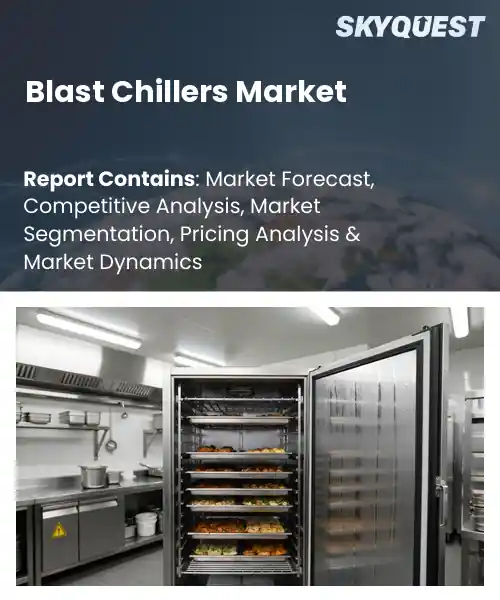
Blast Chillers Market
Report ID: SQMIG20F2040
Report ID: SQMIG20F2040
[email protected]
USA +1 351-333-4748
Report ID:
SQMIG20F2040 |
Region:
Global |
Published Date: May, 2026
Pages:
157
|Tables:
241
|Figures:
81


Global Blast Chillers Market size was valued at USD 1.6 Billion in 2024 and is poised to grow from USD 1.72 Billion in 2025 to USD 2.99 Billion by 2033, growing at a CAGR of 7.2% during the forecast period (2026-2033).
The primary driver of the blast chiller market is the accelerating demand for food safe cooling across commercial foodservice, retail and industrial processing, which has evolved alongside stricter food safety regulations and consumer expectations. Blast chillers are specialized refrigeration units that reduce product temperature quickly to inhibit bacterial growth, preserve texture and extend shelf life, so their adoption matters for supply chain efficiency and regulatory compliance. Historically, adoption began in large industrial processors and airline catering, then spread to hotels, restaurants and cloud kitchens as efficient compact models emerged and scaled, exemplified by European manufacturers supplying units to foodservice chains.Consequently, one key factor propelling market growth is the convergence of regulatory pressure and economics that drives operators to invest in blast chillers because faster cooling reduces waste and labor costs while ensuring compliance with cold chain standards. When cafeterias, food processors and meal providers implement blast chillers, they can extend product shelf life, enabling longer distribution windows and higher inventory turns which increases revenue potential. Moreover, efficient inverter compressors and IoT enabled temperature monitoring create opportunities for retrofitting existing kitchens so manufacturers partnering with logistics firms and franchisors can scale deployment and capture recurring service and software revenue streams.
How is IoT improving operational efficiency in the blast chillers market?
IoT improves operational efficiency in the blast chillers market by enabling continuous remote monitoring, automated cycle tuning, predictive maintenance and end to end traceability. Key aspects are sensor based temperature and humidity control, cloud analytics for performance trending and secure connectivity with kitchen management systems. In the current market many vendors embed connectivity to reduce food waste, speed throughput and ease regulatory reporting. In practice chefs adjust programs remotely, technicians receive early fault alerts and managers view utilisation dashboards. Real world examples show faster turnaround, fewer service interruptions and more consistent product quality which makes connected chillers more compelling for large kitchens and cold chain operators.Irinox December 2025, announced VIS IO integrated with its FreshCloud IoT platform to recognise products inside conservators and automate optimal chilling cycles. This AI enabled IoT feature reduces manual checks, prevents incorrect programs and shortens processing time, and supports scalable deployment across multi site operations which helps boost throughput and lower operating cost.
Market snapshot - (2026-2033)
Global Market Size
USD 1.6 Billion
Largest Segment
Roll-In Blast Chillers
Fastest Growth
Modular / Custom Blast Chillers
Growth Rate
7.2% CAGR
To get more insights on this market click here to Request a Free Sample Report
Global blast chillers market is segmented by product type, cooling technology, capacity, operational mode, installation type, application, end user, distribution channel and region. Based on product type, the market is segmented into Roll-In Blast Chillers, Reach-In Blast Chillers, Roll-Through Blast Chillers, Undercounter Blast Chillers and Modular / Custom Blast Chillers. Based on cooling technology, the market is segmented into Air-Cooled Blast Chillers, Water-Cooled Blast Chillers and Hybrid / Combination Systems. Based on capacity, the market is segmented into Below 50 Kg, 50–100 Kg, 101–200 Kg, 201–500 Kg and Above 500 Kg. Based on operational mode, the market is segmented into Blast Chilling, Blast Freezing and Multi-Function Systems. Based on installation type, the market is segmented into Freestanding Units, Built-In / Integrated Units and Mobile / Portable Units. Based on application, the market is segmented into Food Processing & Manufacturing, Commercial Kitchens, Bakery & Confectionery, Catering Services, Hospitality & Restaurants, Institutional Foodservice, Cold Chain & Food Logistics, Healthcare & Pharmaceutical Storage and Retail & Supermarkets. Based on end user, the market is segmented into Quick Service Restaurants (QSRs), Full-Service Restaurants (FSRs), Hotels & Resorts, Bakeries, Food Manufacturers, Central Kitchens & Cloud Kitchens, Hospitals & Healthcare Facilities, Catering Companies and Supermarkets & Hypermarkets. Based on distribution channel, the market is segmented into Direct Sales, Distributor & Dealer Sales and Online Sales. Based on region, the market is segmented into North America, Europe, Asia Pacific, Latin America and Middle East & Africa.
[Roll-In Blast Chillers] segment dominates because roll-in units align with high-volume kitchen workflows, enabling large trays and trolleys to be cooled without repackaging, which reduces handling time and contamination risk. Their compatibility with central production lines and ease of loading improve throughput and labor efficiency, prompting preference among large caterers and manufacturers. This operational alignment drives procurement decisions and integration into new kitchen layouts, reinforcing their market leadership.
However, Undercounter Blast Chillers are emerging as the fastest growing sub-segment due to rising demand from compact kitchens and cloud operations seeking space-efficient cooling. Their modular footprint, ease of integration under counters, and improving performance make them attractive for upgrades and new builds, accelerating adoption across smaller foodservice establishments and creating retrofit opportunities.
[Water-Cooled Blast Chillers] segment dominates because water-cooled systems provide superior heat rejection for continuous high-load applications, enabling stable core temperatures in heavy-use environments. Their reduced reliance on ambient air conditions and lower acoustic footprint make them preferable in dense production facilities and hospitals where operational reliability matters. Integration with existing water infrastructure and predictable thermal performance drive specification by engineering teams, cementing their lead in demanding industrial and institutional installations.
However, Hybrid / Combination Systems are emerging as the fastest growing sub-segment due to their flexible deployment in sites lacking water infrastructure and their ability to optimize energy consumption through dynamic cooling mode switching. Continued innovation in controls and regulatory attention on water usage accelerate adoption, opening opportunities for retrofits and versatile installations across varied foodservice and processing environments.
To get detailed segments analysis, Request a Free Sample Report
Europe commands leadership through a combination of mature food safety regimes, strong demand from diverse foodservice and retail channels, and concentrated manufacturing expertise that drives product innovation. Regulatory emphasis on rapid cooling and hygiene in commercial kitchens, together with well developed cold chain logistics, encourages adoption of advanced blast chilling solutions. Large presence of institutional customers and high standards for energy efficiency stimulates suppliers to offer tailored, efficient systems. Established distribution networks and service ecosystems facilitate installation and maintenance across multiple markets, reinforcing buyer confidence. Culinary tradition and premium food production sectors also foster demand for precision temperature control. The convergence of regulatory pressure, technical capability, and commercial appetite underpins a durable competitive advantage that supports market depth and leadership across the region.
Blast Chillers Market in Germany is shaped by rigorous food safety oversight, sophisticated manufacturing capacity, and a discerning base of institutional buyers. Demand is driven by professional kitchens, specialty food producers, and logistics providers seeking reliable, energy efficient solutions. Local engineering expertise and a strong supplier network support customization and rapid service response, helping vendors address complex installation requirements. Preference for high quality, long lifecycle equipment favors established brands and encourages continuous product refinement to meet exacting operational standards.
Blast Chillers Market in the United Kingdom reflects a dynamic hospitality sector and a broad retail landscape focused on freshness, safety, and operational efficiency. Buyers prioritize systems that integrate with existing kitchen workflows and meet strict safety guidelines, prompting suppliers to emphasize usability and aftercare services. The market favors flexible configurations suitable for varied venue sizes and for producers seeking to extend product shelf life without compromising quality. Strong distributor relationships and service coverage are important considerations that influence procurement choices.
Blast Chillers Market in France is influenced by a deep culinary culture and a strong artisanal food production segment that values precise temperature control to preserve texture and flavor. Demand stems from both fine dining establishments and specialty food manufacturers that require consistent chilling performance. Suppliers focus on products that combine gentle handling with rapid cooling capabilities to support quality-sensitive operations. Local service presence and equipment reliability are key purchasing criteria, as buyers seek solutions that protect product integrity and support culinary standards.
Expansion in North America is propelled by evolving foodservice models, increasing emphasis on food safety, and growing adoption of advanced cold chain practices among retailers and processors. Market growth is supported by a fragmented set of buyers ranging from large institutional kitchens to small specialty producers, all seeking efficient cooling solutions that enhance throughput and maintain product quality. Innovation in control systems and energy management aligns with operator priorities for simplified operation and total cost reduction. Robust distribution channels and aftermarket service capabilities reduce adoption barriers, while manufacturers tailor offerings to varied regulatory and operational requirements across regions. Combined, these factors create a conducive environment for accelerated deployment of blast chilling technology across multiple end use segments.
Blast Chillers Market in the United States is characterized by diverse demand across restaurants, large scale processors, and food retail chains focused on product safety and shelf life extension. Operators look for scalable systems that accommodate varied volumes and integrate with existing production lines. Emphasis on operator training, remote monitoring features, and reliable aftersales support shapes supplier offerings. The market rewards solutions that balance operational efficiency with ease of use, enabling rapid adoption in both centralized food production centers and decentralized foodservice operations.
Blast Chillers Market in Canada is driven by a combination of regional food processing activity and a burgeoning specialty food sector seeking higher quality control. Buyers value equipment that performs reliably in different operational settings and climatic conditions, with particular attention to energy efficiency and service accessibility. Distributors offering strong technical support and tailored financing options help overcome procurement hurdles for smaller operators. The market favors vendors able to provide flexible configurations and prompt maintenance coverage to ensure continuity across supply chains.
Asia Pacific is enhancing its role through targeted investments in cold chain infrastructure, rising demand from modern retail and foodservice expansion, and increasing local manufacturing capabilities that adapt global technologies to regional needs. Growing awareness of food safety standards and consumer preference for fresh, high quality products spur adoption among processors and hospitality operators. Regional OEMs and international suppliers collaborate to localize features such as compact footprints and flexible control interfaces suited to diverse operational contexts. Improvements in logistics and service networks reduce barriers to adoption beyond major urban centers. Together, these developments broaden market accessibility and foster incremental innovation that elevates the region contribution to global market dynamics.
Blast Chillers Market in Japan emphasizes precision, compact design, and high reliability to meet the needs of dense urban kitchens and meticulous food production practices. Buyers prioritize systems that preserve texture and flavor while fitting constrained spaces and integrating with automated processes. Suppliers respond with refined control capabilities and durable components that align with local expectations for craftsmanship and performance. Service quality and rapid technical support are important factors that influence procurement decisions in both commercial and artisanal segments.
Blast Chillers Market in South Korea is shaped by a vibrant foodservice industry and an increasingly sophisticated processing sector seeking rapid cooling solutions for quality preservation. Demand centers on equipment that offers intuitive controls, energy management, and compatibility with high turnover operations. Local manufacturers and distributors emphasize responsiveness to evolving culinary trends and provide strong aftersales networks to support continuous operation. Preference for modern, compact systems that deliver consistent results fosters steady uptake across restaurants and food production facilities.
To know more about the market opportunities by region and country, click here to
Buy The Complete Report
Increasing Adoption In Foodservice Industry
Regulatory Focus on Food Safety
High Initial Investment and Ownership Costs
Limited Skilled Technical Support Availability
Request Free Customization of this report to help us to meet your business objectives.
Competitive pressure in the global blast chillers market is being shaped by sustainability mandates and buyers demanding faster, quality-preserving cooling, which drives incumbents to pursue concrete tactics such as OEM partnerships, targeted acquisitions and rapid product updates to secure low-GWP and modular advantages; for example Welbilt partnered with Nuovair to add high-flow blast-chilling capability and Everidge launched an R290 undercounter model.
Top Player’s Company Profile
Recent Developments
SkyQuest’s ABIRAW (Advanced Business Intelligence, Research & Analysis Wing) is our Business Information Services team that Collects, Collates, Correlates, and Analyses the Data collected by means of Primary Exploratory Research backed by robust Secondary Desk research. As per SkyQuest analysis, the global blast chillers market benefits from one key driver which is accelerating demand for food-safe cooling due to stricter regulations and shelf life economics, and one restraint is high initial investment and limited skilled technical support that can slow adoption among smaller operators. The dominating region is Europe thanks to mature food safety regimes and concentrated manufacturing, and the dominating segment is Roll-In Blast Chillers which suit high-volume workflows. A second driver is growing IoT and smart cold chain integration that enables remote monitoring, predictive maintenance and new service revenues, supporting retrofit and multi site deployment.
| Report Metric | Details |
|---|---|
| Market size value in 2024 | USD 1.6 Billion |
| Market size value in 2033 | USD 2.99 Billion |
| Growth Rate | 7.2% |
| Base year | 2024 |
| Forecast period | (2026-2033) |
| Forecast Unit (Value) | USD Billion |
| Segments covered |
|
| Regions covered | North America (US, Canada), Europe (Germany, France, United Kingdom, Italy, Spain, Rest of Europe), Asia Pacific (China, India, Japan, Rest of Asia-Pacific), Latin America (Brazil, Rest of Latin America), Middle East & Africa (South Africa, GCC Countries, Rest of MEA) |
| Companies covered |
|
| Customization scope | Free report customization with purchase. Customization includes:-
|
To get a free trial access to our platform which is a one stop solution for all your data requirements for quicker decision making. This platform allows you to compare markets, competitors who are prominent in the market, and mega trends that are influencing the dynamics in the market. Also, get access to detailed SkyQuest exclusive matrix.
Table Of Content
Executive Summary
Market overview
Parent Market Analysis
Market overview
Market size
KEY MARKET INSIGHTS
COVID IMPACT
MARKET DYNAMICS & OUTLOOK
Market Size by Region
KEY COMPANY PROFILES
Methodology
For the Blast Chillers Market, our research methodology involved a mixture of primary and secondary data sources. Key steps involved in the research process are listed below:
1. Information Procurement: This stage involved the procurement of Market data or related information via primary and secondary sources. The various secondary sources used included various company websites, annual reports, trade databases, and paid databases such as Hoover's, Bloomberg Business, Factiva, and Avention. Our team did 45 primary interactions Globally which included several stakeholders such as manufacturers, customers, key opinion leaders, etc. Overall, information procurement was one of the most extensive stages in our research process.
2. Information Analysis: This step involved triangulation of data through bottom-up and top-down approaches to estimate and validate the total size and future estimate of the Blast Chillers Market.
3. Report Formulation: The final step entailed the placement of data points in appropriate Market spaces in an attempt to deduce viable conclusions.
4. Validation & Publishing: Validation is the most important step in the process. Validation & re-validation via an intricately designed process helped us finalize data points to be used for final calculations. The final Market estimates and forecasts were then aligned and sent to our panel of industry experts for validation of data. Once the validation was done the report was sent to our Quality Assurance team to ensure adherence to style guides, consistency & design.
Analyst Support
Customization Options
With the given market data, our dedicated team of analysts can offer you the following customization options are available for the Blast Chillers Market:
Product Analysis: Product matrix, which offers a detailed comparison of the product portfolio of companies.
Regional Analysis: Further analysis of the Blast Chillers Market for additional countries.
Competitive Analysis: Detailed analysis and profiling of additional Market players & comparative analysis of competitive products.
Go to Market Strategy: Find the high-growth channels to invest your marketing efforts and increase your customer base.
Innovation Mapping: Identify racial solutions and innovation, connected to deep ecosystems of innovators, start-ups, academics, and strategic partners.
Category Intelligence: Customized intelligence that is relevant to their supply Markets will enable them to make smarter sourcing decisions and improve their category management.
Public Company Transcript Analysis: To improve the investment performance by generating new alpha and making better-informed decisions.
Social Media Listening: To analyze the conversations and trends happening not just around your brand, but around your industry as a whole, and use those insights to make better Marketing decisions.
REQUEST FOR SAMPLE
 REQUEST FREE CUSTOMIZATION


Want to customize this report? This report can be personalized according to your needs. Our analysts and industry experts will work directly with you to understand your requirements and provide you with customized data in a short amount of time. We offer $1000 worth of FREE customization at the time of purchase.
Feedback From Our Clients


 USA (+1) 351-333-4748

