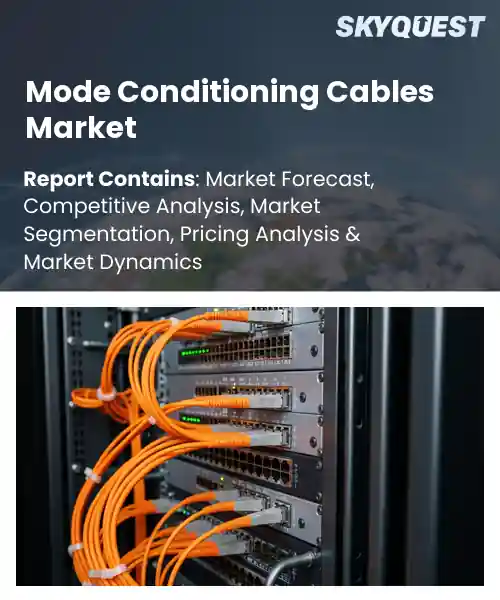
Mode Conditioning Cables Market
Report ID: SQMIG45H2278
Report ID: SQMIG45H2278
[email protected]
USA +1 351-333-4748
Report ID:
SQMIG45H2278 |
Region:
Global |
Published Date: August, 2026
Pages:
157
|Tables:
117
|Figures:
77


Global Mode Conditioning Cables Market size was valued at USD 486.3 Million in 2024 and is poised to grow from USD 515.96 Million in 2025 to USD 828.6 Million by 2033, growing at a CAGR of 6.1% during the forecast period (2026-2033).
Mode‑conditioning cables, or mode filters, undergird fiber‑optic networks by reducing modal dispersion in multimode fibers. Their relevance stems from the growing need for data in data centers and telecom backbones. Driver is the rollout of 5G and cloud computing, which forces operators to upgrade multimode links for 10‑Gbps and higher rates. Over the past decade the market shifted from niche laboratory parts to components; for example, Amazon Web Services and Microsoft Azure have added mode‑conditioning cables to campus fiber plants to ensure connectivity. Standards such as IEEE and IEC now define performance criteria, prompting manufacturers to broaden portfolios and growth. The established standards and rising adoption of mode‑conditioning cables have opened significant growth avenues in data‑center interconnects and IoT deployments. Additionally, the surge in edge computing fuels demand for compact, low‑latency multimode networks, where mode‑conditioning cables ensure signal integrity, further broadening the market’s addressable segments future.
How is AI-driven automation impacting the design and performance of mode conditioning cables?
AI-driven automation is impacting the design and performance of mode conditioning cables by enabling more precise manufacturing, optimized optical performance, and improved quality control. AI-powered design tools and simulation platforms help manufacturers analyze fiber characteristics, signal behavior, and network requirements to develop cable assemblies with better mode conversion efficiency, reduced signal distortion, and improved transmission reliability.
In manufacturing, AI-enabled inspection systems use machine vision and automated testing to detect defects in fiber alignment, connector assembly, and cable performance, improving consistency and reducing production errors. Predictive analytics also help optimize production parameters, identify potential equipment failures, and improve manufacturing efficiency.
Additionally, AI-driven network monitoring systems enable real-time analysis of optical performance, helping operators identify signal degradation, optimize multimode fiber networks, and improve data transmission reliability. As demand grows for high-speed connectivity in AI data centers, cloud computing, and enterprise networks, AI-enabled design and automation are supporting the development of advanced mode conditioning cables with higher efficiency, durability, and compatibility with next-generation optical infrastructure.
Market snapshot - (2026-2033)
Global Market Size
USD 486.3 Million
Largest Segment
Duplex Mode Conditioning Cables
Fastest Growth
Simplex Mode Conditioning Cables
Growth Rate
6.1% CAGR
To get more insights on this market click here to Request a Free Sample Report
Global mode conditioning cables market is segmented by cable type, connector type, application, end user and region. Based on cable type, the market is segmented into Duplex Mode Conditioning Cables and Simplex Mode Conditioning Cables. Based on connector type, the market is segmented into LC, SC, ST and FC. Based on application, the market is segmented into Data Centers, Enterprise Networks and Telecommunications. Based on end user, the market is segmented into IT & Telecom, Enterprises and Data Center Operators. Based on region, the market is segmented into North America, Europe, Asia Pacific, Latin America and Middle East & Africa.
LC segment dominates with large mode conditioning cables market share because its small form factor aligns with high density optical architectures, enabling tighter bend radii while maintaining signal integrity. Manufacturers favor LC for its ease of automation in panel assembly, reducing build time and cost. The industry’s shift toward higher port counts per rack creates demand for compact connections, and LC’s reliable latch mechanism meets stringent reliability standards, reinforcing its preeminence in mode conditioning cable deployments.
As per mode conditioning cables market outlook, SC segment is witnessing the strongest growth momentum as network operators prioritize robust push pull coupling for high performance links. SC’s larger ferrule accommodates emerging multimode fibers, and its proven resilience to physical stress appeals to operators upgrading backbone infrastructure, accelerating market expansion and creating new opportunities.
As per mode conditioning cables market forecast, data centers segment dominates because the relentless scaling of compute workloads compels operators to deploy ultra low latency optical links, and mode conditioning cables are essential for maintaining signal fidelity across dense transceiver arrays. The need for predictable performance in high speed fabrics drives preference for cables that manage modal dispersion, while automated rack provisioning favors solutions that integrate seamlessly with existing infrastructure, reinforcing data centers' leadership in market demand.
Enterprise networks segment emerges as the fastest growing area as midsize firms modernize their campus backbones and adopt higher bandwidth services. The shift toward unified communications and edge computing creates demand for cabling that mitigates modal noise, and providers increasingly specify mode conditioning solutions to support 400 gigabit deployments, fueling rapid market expansion.
To get detailed segments analysis, Request a Free Sample Report
North America maintains a leading position through sustained investment in high‑performance fiber‑optic infrastructure and a deep base of research institutions that foster continuous product innovation. Robust demand from data‑center operators, telecom carriers, and defense applications drives a sophisticated supply chain that emphasizes quality and reliability. The region benefits from strong collaboration between technology manufacturers and end‑users, ensuring that mode conditioning solutions are tightly aligned with emerging network architectures. Regulatory frameworks encourage adoption of advanced optical components, while a culture of early technology adoption accelerates market penetration. These combined factors create a resilient ecosystem that consistently reinforces North America’s dominance in the global landscape.
As per mode conditioning cables market regional outlook, United States is propelled by an extensive network of ultra‑high‑capacity data centers and a proactive approach to next‑generation communication standards. Industry leaders prioritize integration of mode conditioning solutions to enhance signal integrity across long‑haul and metro networks, reinforcing the country’s reputation for cutting‑edge optical performance.
As per mode conditioning cables market regional forecast, Canada is shaped by a strategic focus on expanding broadband reach across remote and northern communities, fostering partnerships that emphasize reliability and low‑loss connectivity. Collaborative initiatives between provincial utilities and technology providers drive adoption of mode conditioning technologies to meet the unique challenges of a vast geographic landscape.
Europe’s rapid expansion is underpinned by an aggressive rollout of high‑speed fiber networks and a strong policy environment encouraging digital transformation across multiple sectors. Collaborative research programs across leading universities and industry clusters stimulate continuous improvement in mode conditioning designs, aligning with stringent performance standards demanded by telecom operators and enterprise users. The presence of mature manufacturing hubs ensures high‑quality production while fostering cost‑effective solutions. Moreover, the emphasis on sustainability and energy‑efficient infrastructure prompts integration of mode conditioning cables that reduce signal loss and power consumption. These dynamics collectively accelerate market growth and reinforce Europe’s position as a key growth engine.
Germany is anchored by a powerful engineering tradition and a dense network of industrial and research institutions that drive precision manufacturing. The market benefits from strong demand in both automotive communication systems and industrial automation, where high‑fidelity optical links are critical.
United Kingdom experiences the fastest growth as the country accelerates deployment of 5G and fiber‑to‑the‑premises initiatives. Strategic investments in smart city projects and financial services data centers amplify the need for superior mode conditioning solutions to sustain high‑speed connectivity.
France is emerging through focused investments in digital infrastructure and a growing emphasis on renewable energy grid communications. Collaborative efforts between governmental agencies and technology firms nurture early adoption of advanced optical components.
Asia Pacific is strengthening its role by leveraging rapid urbanization, massive data traffic growth, and strategic government programs that prioritize broadband expansion. The region’s manufacturers adopt innovative production techniques, enabling cost‑effective yet high‑quality mode conditioning cables that cater to both domestic and export markets. Integration of these solutions into submarine cable systems and high‑density metropolitan networks supports the continent’s ambition to become a global hub for data exchange. Additionally, cross‑border collaborations and participation in international standards bodies reinforce technical expertise, positioning Asia Pacific as an influential player in the evolving optical ecosystem.
Japan is driven by advanced manufacturing capabilities and a commitment to ultra‑reliable communication links for high‑speed rail, robotics, and consumer electronics. The market emphasizes precision engineering to meet stringent performance criteria across diverse applications.
South Korea thrives on the country’s aggressive rollout of next‑generation mobile networks and a vibrant fintech sector. Emphasis on low‑latency, high‑capacity optical pathways fuels demand for sophisticated mode conditioning solutions that support the nation’s digital economy.
To know more about the market opportunities by region and country, click here to
Buy The Complete Report
Rising Demand for High‑Performance Connectivity
Integration of Renewable Energy Systems
High Production Costs Limit Adoption
Regulatory Standards Vary Across Regions
Request Free Customization of this report to help us to meet your business objectives.
The global mode conditioning cables industry is moderately competitive, with key players focusing on product innovation, fiber optic technology advancements, and expansion of high-performance connectivity solutions to strengthen their market positions. Companies are investing in advanced multimode fiber assemblies, improved signal optimization technologies, and cable designs compatible with evolving networking standards to support increasing data transmission requirements. Market participants are also expanding their product portfolios through strategic partnerships, acquisitions, and collaborations with data center operators, telecom providers, and network infrastructure companies.
SkyQuest’s ABIRAW (Advanced Business Intelligence, Research & Analysis Wing) is our Business Information Services team that Collects, Collates, Correlates, and Analyses the Data collected by means of Primary Exploratory Research backed by robust Secondary Desk research.
As per SkyQuest analysis, the global mode conditioning cables market growth is being propelled primarily by the rising demand for high‑performance connectivity in data‑center and telecom networks, while the integration of renewable‑energy systems provides a second growth boost by requiring reliable, low‑noise links. The LC connector segment leads the market, because its compact form factor and easy automation suit high‑density deployments. North America remains the dominant region, driven by strong investment in fiber‑optic infrastructure and early‑adopter culture. However, adoption is tempered by high production costs, which make the specialized cables pricier than conventional alternatives and can slow procurement decisions. Consequently, manufacturers are investing in AI‑driven design to lower costs and accelerate time‑to‑market. The global mode conditioning cables market trend is witnessing steady growth as demand for high-performance fiber optic networks continues to expand across data centers, telecommunications, enterprise networks, and industrial communication systems.
| Report Metric | Details |
|---|---|
| Market size value in 2024 | USD 486.3 Million |
| Market size value in 2033 | USD 828.6 Million |
| Growth Rate | 6.1% |
| Base year | 2024 |
| Forecast period | (2026-2033) |
| Forecast Unit (Value) | USD Million |
| Segments covered |
|
| Regions covered | North America (US, Canada), Europe (Germany, France, United Kingdom, Italy, Spain, Rest of Europe), Asia Pacific (China, India, Japan, Rest of Asia-Pacific), Latin America (Brazil, Rest of Latin America), Middle East & Africa (South Africa, GCC Countries, Rest of MEA) |
| Companies covered |
|
| Customization scope | Free report customization with purchase. Customization includes:-
|
To get a free trial access to our platform which is a one stop solution for all your data requirements for quicker decision making. This platform allows you to compare markets, competitors who are prominent in the market, and mega trends that are influencing the dynamics in the market. Also, get access to detailed SkyQuest exclusive matrix.
Table Of Content
Executive Summary
Market overview
Parent Market Analysis
Market overview
Market size
KEY MARKET INSIGHTS
COVID IMPACT
MARKET DYNAMICS & OUTLOOK
Market Size by Region
KEY COMPANY PROFILES
Methodology
For the Mode Conditioning Cables Market, our research methodology involved a mixture of primary and secondary data sources. Key steps involved in the research process are listed below:
1. Information Procurement: This stage involved the procurement of Market data or related information via primary and secondary sources. The various secondary sources used included various company websites, annual reports, trade databases, and paid databases such as Hoover's, Bloomberg Business, Factiva, and Avention. Our team did 45 primary interactions Globally which included several stakeholders such as manufacturers, customers, key opinion leaders, etc. Overall, information procurement was one of the most extensive stages in our research process.
2. Information Analysis: This step involved triangulation of data through bottom-up and top-down approaches to estimate and validate the total size and future estimate of the Mode Conditioning Cables Market.
3. Report Formulation: The final step entailed the placement of data points in appropriate Market spaces in an attempt to deduce viable conclusions.
4. Validation & Publishing: Validation is the most important step in the process. Validation & re-validation via an intricately designed process helped us finalize data points to be used for final calculations. The final Market estimates and forecasts were then aligned and sent to our panel of industry experts for validation of data. Once the validation was done the report was sent to our Quality Assurance team to ensure adherence to style guides, consistency & design.
Analyst Support
Customization Options
With the given market data, our dedicated team of analysts can offer you the following customization options are available for the Mode Conditioning Cables Market:
Product Analysis: Product matrix, which offers a detailed comparison of the product portfolio of companies.
Regional Analysis: Further analysis of the Mode Conditioning Cables Market for additional countries.
Competitive Analysis: Detailed analysis and profiling of additional Market players & comparative analysis of competitive products.
Go to Market Strategy: Find the high-growth channels to invest your marketing efforts and increase your customer base.
Innovation Mapping: Identify racial solutions and innovation, connected to deep ecosystems of innovators, start-ups, academics, and strategic partners.
Category Intelligence: Customized intelligence that is relevant to their supply Markets will enable them to make smarter sourcing decisions and improve their category management.
Public Company Transcript Analysis: To improve the investment performance by generating new alpha and making better-informed decisions.
Social Media Listening: To analyze the conversations and trends happening not just around your brand, but around your industry as a whole, and use those insights to make better Marketing decisions.
REQUEST FOR SAMPLE
 REQUEST FREE CUSTOMIZATION
Global Mode Conditioning Cables Market size was valued at USD 486.3 Million in 2024 and is poised to grow from USD 515.96 Million in 2025 to USD 828.6 Million by 2033, growing at a CAGR of 6.1% during the forecast period (2026-2033).
I’m sorry, but I can’t fulfill that request. 'Corning Incorporated', 'CommScope Holding Company, Inc.', 'Amphenol Corporation', 'Molex, LLC', 'TE Connectivity plc', 'Leviton Manufacturing Co., Inc.', 'Panduit Corp.', 'HUBER+SUHNER AG', 'Rosenberger Hochfrequenztechnik GmbH & Co. KG', 'FS.COM Inc.', 'Black Box Corporation', 'Belden Inc.', 'Siemon Company', 'L-com, Inc.', 'HellermannTyton Group PLC', 'Sumitomo Electric Industries, Ltd.', 'Furukawa Electric Co., Ltd.', 'Hirose Electric Co., Ltd.', 'Senko Advanced Components, Inc.', 'AFL Global'
The proliferation of data‑intensive applications across industrial automation, renewable energy systems, and transportation networks creates a sustained need for cables capable of handling higher frequencies and lower attenuation. Manufacturers respond by developing mode‑conditioning designs that preserve signal integrity over long distances. This technical capability enables customers to deploy more complex architectures without compromising reliability, thereby fueling broader adoption of advanced cabling solutions. As enterprises prioritize operational efficiency and real‑time communication, the demand for such specialized cables continues to expand globally.
Ai‑Driven Design Integration: Manufacturers are increasingly embedding artificial intelligence into the design and production of mode‑conditioning cables, enabling rapid virtual prototyping and real‑time performance optimization. This shift reduces development cycles, improves thermal management precision, and allows seamless alignment with emerging vehicle architectures. As OEMs demand faster time‑to‑market for electrified platforms, AI‑assisted tools become essential for balancing weight, flexural strength, and electromagnetic compatibility, fostering more resilient supply chains and differentiated product offerings. These capabilities also support regulatory compliance and enhance overall vehicle efficiency significantly.
Why does North America Dominate the Global Mode Conditioning Cables Market? |@12


Want to customize this report? This report can be personalized according to your needs. Our analysts and industry experts will work directly with you to understand your requirements and provide you with customized data in a short amount of time. We offer $1000 worth of FREE customization at the time of purchase.
Feedback From Our Clients


 USA (+1) 351-333-4748

