
Mocha Coffee Machine Market
Report ID: SQMIG25H2069
Report ID: SQMIG25H2069
[email protected]
USA +1 351-333-4748
Report ID:
SQMIG25H2069 |
Region:
Global |
Published Date: March, 2026
Pages:
157
|Tables:
117
|Figures:
77


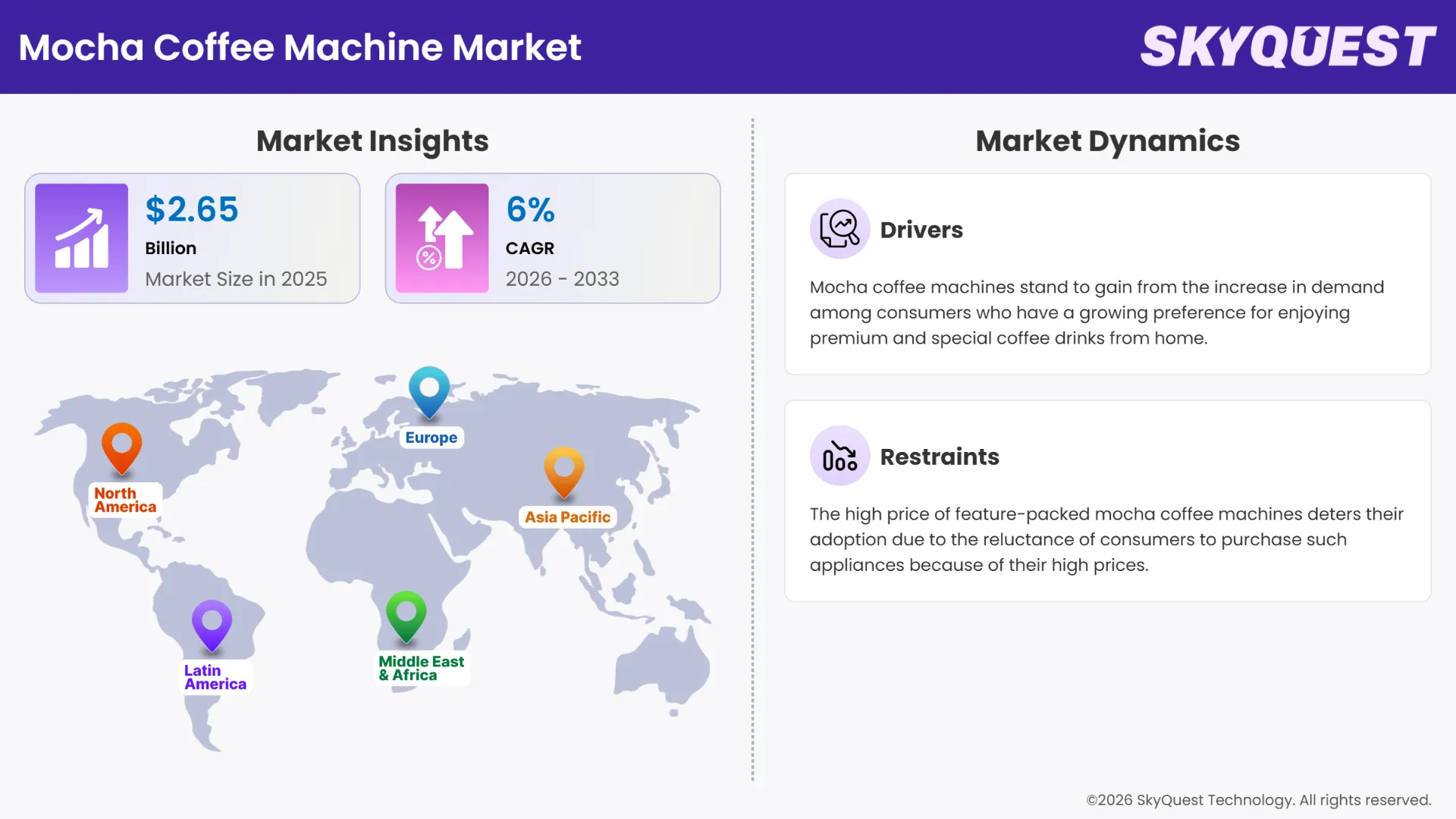
Global Mocha Coffee Machine Market size was valued at USD 2.50 Billion in 2024 and is poised to grow from USD 2.65 Billion in 2025 to USD 4.22 Billion by 2033, growing at a CAGR of 6% during the forecast period (2026-2033).
Key Takeaways: Market Trends & Insights
Growing demand for premium coffee experiences at home, increasing coffee consumption, rising adoption of automated coffee machines, expanding café culture, and advancements in smart brewing technologies are driving sales of mocha coffee machines.
Innovation in the areas of automation is one of the major factors driving the mocha coffee machine market trends. Single touch operation, with built-in capabilities for the highest quality. Furthermore, pod-based systems combined with diagnostics are being used by manufacturers to earn continuous income and prevent machine downtime. Sustainable pods, partnerships with the coffee companies, and value-added service are just some of the many other sectors which present opportunities for profitable gains. Rising consumer taste for café-quality drinks in their own homes and offices combined with a trend towards convenience and automation are bolstering mocha coffee machine market growth. Surge in popularity of mocha and specialty coffee drinks, along with rising disposable incomes, ensure sustained mocha coffee machine sales.
On the contrary, high costs of advanced machines, dependency on proprietary pods, maintenance and cleaning requirements, environmental concerns related to pod waste, and competition from traditional coffee-making methods are anticipated to slow down mocha coffee machine market penetration in the long run.
How is IoT Adoption Impacting the Mocha Coffee Machine Market?
The development of IoT technologies is revolutionizing the market of the mocha coffee machine, offering additional opportunities to connect, remotely control, and personalize coffee brewing. The current models have integrated Wi-Fi capabilities and applications for smartphones, which enable users to create their own recipes and get instructions for the brewing process. In addition, manufacturers can collect statistics about the consumption of products by connected devices, which can help them to introduce subscription models, improve the quality of goods, and promote repurchase.
To get more insights on this market click here to Request a Free Sample Report
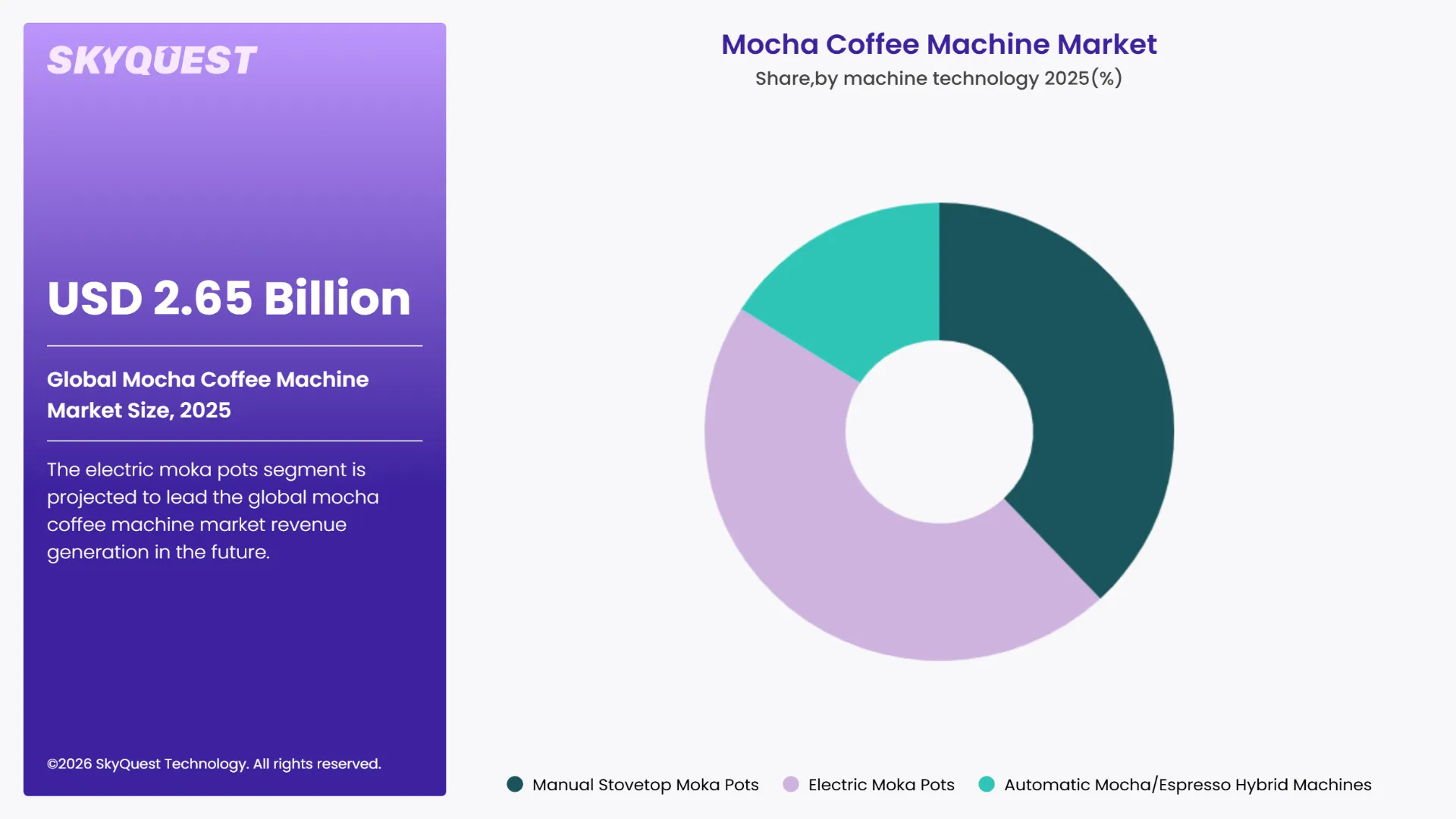
The mocha coffee machine market is segmented by machine technology, material base, capacity/cup size, distribution channel, and region. Based on machine technology, the market is segmented into manual stovetop moka pots, electric moka pots, and automatic mocha/espresso hybrid machines. Based on material base, the market is segmented into aluminum, stainless steel, and glass/transparent upper units. Based on capacity/cup size, the market is segmented into personal, standard family, and large/commercial. Based on distribution channel, the market is segmented into specialty coffee equipment stores, online retail & marketplace, and departmental stores & home appliances. Based on region, the market is segmented into North America, Europe, Asia Pacific, Latin America, and Middle East & Africa.
The electric moka pots segment is projected to lead the global mocha coffee machine market revenue generation in the future. Its balance of automated heating control, plug and play convenience, and consistent extraction allows this segment to maintain its dominance. Electric models have priority for easier regulation and simpler manufacturing processes, leading to better availability at retailers and after-sales services. These factors contribute to the inclusion in more conventional distribution channels, consistency in brewing performance, and easier access for consumers seeking convenience.
However, automatic mocha/espresso hybrid machines are the most rapidly expanding segment as per this mocha coffee machine market forecast. Consumers seek multifunctional, specialty brewing in one unit, which creates new business scope via this segment. Improved grinding technology, programmability, and ease of maintenance have made products more attractive to enthusiasts and small operators, providing opportunities for supplementary services and consumables sales which contribute to further product development and market growth.
The online retail & marketplace segment is slated to account for the highest global mocha coffee machine market share going forward. Digital platforms offer wide range of product portfolios, facilitates direct delivery to consumers. The brands ensure that they put in maximum effort in terms of their listings and logistics capabilities to distribute on a large scale and respond immediately to any variation in demands. This makes online channels the preferred medium for launches and price competitions.
Nevertheless, specialty coffee equipment stores have emerged as the fastest growing distribution channel owing to increasing popularity for experiential shopping and specialty coffee preparation. Product demonstrations, selective product assortments, and professional assistance help boost trials and premium sales which help create a customer base that is more likely to generate service-related revenue for better brand distinction.
To get detailed segments analysis, Request a Free Sample Report
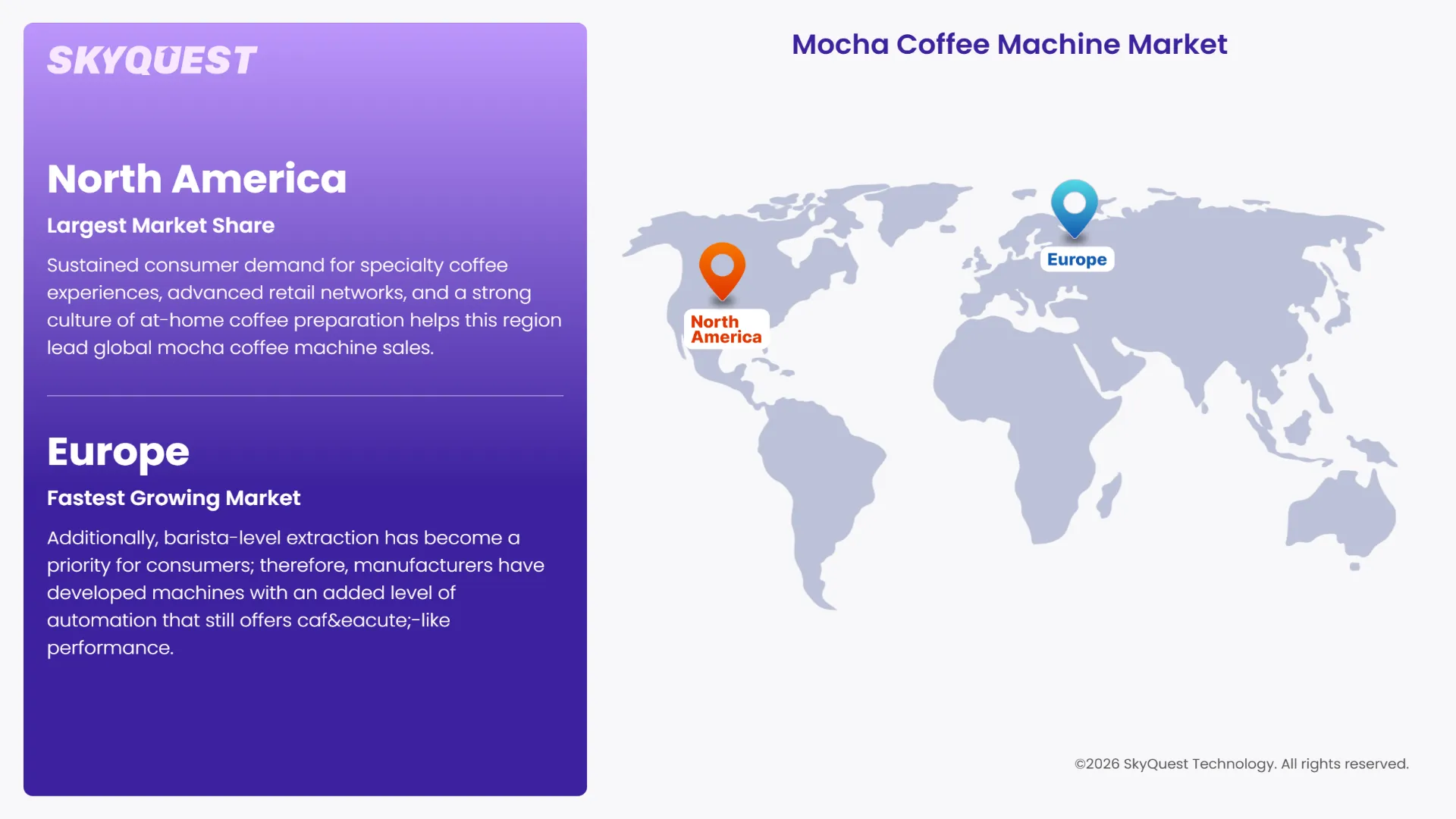
Sustained consumer demand for specialty coffee experiences, advanced retail networks, and a strong culture of at-home coffee preparation helps this region lead global mocha coffee machine sales. Ongoing innovation by established manufacturers through design, convenience and integrated beverage ecosystems further strengthens their positions as leaders in the market. Strong after-sale support and a high level of consumer awareness concerning both single-serve coffee machines and multifunctional units serve to solidify market positions. Strategic partnerships between brands and operators of hospitality facilities to enhance product adoption at the point of sale in urban and suburban markets make North America an important launching location for new mocha coffee machine products and premiumization trends within this category.
High consumer affinity for specialty beverages, broad retail access and established brand loyalty are shaping mocha coffee machine demand in the United States. Post-sales servicing and business tie-ups ensure its adoption, making the country an ideal launching platform for innovative mocha coffee machines. Consumer preference, design, and functional innovations make it an attractive choice for in-house and out-of-home consumption. Premium placement and promotional efforts from manufacturers ensure market visibility.
Determination of quality conscious consumers and convenience determines the success of sales of mocha coffee machines in Canada. The aspect of easy maintenance and efficient use of energy is one factor that influences vendors when buying the products, making it easy to replace them in the households and catering businesses. Marketing through the retail stores utilizes specialized stores as well as e-commerce sites where different products are available.
High consumer interest in premium and craft coffee and specialty mocha coffee machine demand in Europe. Numerous local appliance brands and design-driven manufacturers have developed product differentiation based on aesthetic, sustainable, and functional features. In addition to traditional retail channels, the digital retail environment and the associated post-sales support networks are improving consumer awareness of mocha coffee machines and encouraging repeat purchase of these products. As energy efficiency and waste management issues are trending in the eyes of regulators in Europe, manufacturers have focused their efforts in these areas when designing durable, repairable, and refillable mocha coffee machines.
Additionally, barista-level extraction has become a priority for consumers; therefore, manufacturers have developed machines with an added level of automation that still offers café-like performance. Manufacturers have established marketing partnerships with coffee roasters and lifestyle brands, which adds premium quality narrative support to their products, regardless of whether they are consumed at boutique or mass-market retailers across European countries.
Preference for engineering driven appliances that combine robust performance with reliability shapes mocha coffee machine adoption in Germany. Brand prestige and technical support services hold key positions in influencing buyer choices in urban areas throughout the country. Precision, durability, and energy-conscious operations appeal to consumers, making manufacturers focus on product quality and maintainability. Distribution channels span from specialist kitchenware stores to hotel supplies vendors, catering to consumer and industrial markets.
Vibrant specialty coffee culture, strong consumer interest in at home brewing innovation, and mocha coffee machine sales in the United Kingdom. Cooperation between the roaster companies and household appliance manufacturers ensures selection of relevant products. The service component and modularity are attractive to both households and specialty hospitality providers. Robust retail enables launch of small appliances that fit urban living needs.
High consumer adoption of specialty coffee within café culture is primarily shaping mocha coffee machine demand in France. The retailer and roaster team up to launch products, and stories around sustainability and local customization help capture the imagination of choosy customers. The focus on designing coffee grinders to fit well into the kitchen helps manufacturers adopt a more compact and luxurious look. The growing trend towards machines that combine aesthetics with ease of use is attracting style-conscious consumers.
Technological adaptation, rising urban coffee culture and targeted product localization are forecasted to shape mocha coffee machine demand in Asia Pacific through 2033. Collaborative efforts among roasters, retailers and appliance manufacturers will create tailored experiences for consumers based on their region’s taste base. As the growth of e commerce and experiential retail continue to drive discovery of new mocha products, consumer education and barista training will enhance consumer appreciation of mocha craft and spur activity for higher-end appliances.
By partnering with companies outside of their local area, the Asia Pacific has created an incredible opportunity to increase the quality of mocha products and the features of those products through local research and development with global brands. This evolution will support a transition in the region from cost-based competition to design-led differentiation. The combination of the region’s available competitive manufacturing capacity, efficient supply chains, and an extensive network of after sales and service capabilities will support product development cycles and allow for rapid iterations and scalability in production while providing stronger ownership experiences and greater levels of consumer trust.
Emphasis on precision, compact engineering and aesthetics, reflecting local appreciation for craftsmanship is driving mocha coffee machine adoption in Japan. Specialty stores and digital marketing are used as sales routes. Energy savings, silent performance, and elegant design factor into consumer decisions. Effort is made by manufacturers in ensuring that the systems are compatible and easy to integrate for both groups of consumers.
Tech-forward consumer preferences, compact living spaces, and a dynamic café culture are influencing mocha coffee machine sales in South Korea. High penetration rates are achieved via digital and physical retail distribution. Collaboration with local experts in coffee allows them to understand tastes and calibrate the machines accordingly. mocha coffee machine companies stress intelligent connectivity and aesthetically pleasing designs that reflect their understanding of the market.
To know more about the market opportunities by region and country, click here to
Buy The Complete Report
Rising Premium Coffee Consumption
Technological Advancements In Machines
High Price Sensitivity Among Consumers
Supply Chain Vulnerabilities
Request Free Customization of this report to help us to meet your business objectives.
Competitive dynamics in the global mocha coffee machine market centre on premium design, ingredient flexibility and labour efficiency. Established groups drive consolidation through M&A for scale, for example Groupe SEB's professional coffee acquisitions, while startups pursue partnerships and tech innovation exemplified by LIGRE's design collaboration with Relvãokellermann.
Premiumization And Experiential Demand
Rise in demand for café-quality mocha experiences at homes is expected to emerge as a popular mocha coffee machine market trend. Companies are working on research and development projects for machines emphasizing craft, personalization, and sensory experience. They leverage the concept of unique ingredient ecosystems, co-creation of exclusive editions, and the service concept, which includes personalized recipes and maintenance solutions. The in-store experience, product demonstration, and education help customers understand how they can live with these products.
Smart Connectivity and Ecosystems
Integration of wireless connectivity and cloud services is also gaining traction among mocha coffee machine companies. mocha coffee machine vendors are offering remote operation, customization of brews, and even predictive maintenance solutions to stand out from the competition. This mocha coffee machine industry trend not only allow the machine to become part of a bigger ecosystem, providing ongoing revenue streams from product sales.
SkyQuest’s ABIRAW (Advanced Business Intelligence, Research & Analysis Wing) is our Business Information Services team that Collects, Collates, Correlates, and Analyses the Data collected by means of Primary Exploratory Research backed by robust Secondary Desk research.
As per SkyQuest analysis, increasing adoption of automated coffee machines and growing coffee culture across residential and commercial sectors are anticipated to drive the demand for mocha coffee machines going forward. However, maintenance requirements and environmental concerns related to pod waste are slated to slow down the adoption of mocha coffee machines in the future. North America is slated to spearhead the demand for mocha coffee machines owing to strong coffee consumption culture, presence of leading coffee brands, and high adoption of advanced kitchen appliances. Integration of IoT-enabled smart brewing features, development of personalized coffee solutions, and advancements in sustainable pod technologies are anticipated to be key trends driving the mocha coffee machine industry going forward.
| Report Metric | Details |
|---|---|
| Market size value in 2024 | USD 2.50 Billion |
| Market size value in 2033 | USD 4.22 Billion |
| Growth Rate | 6% |
| Base year | 2024 |
| Forecast period | 2026-2033 |
| Forecast Unit (Value) | USD Billion |
| Segments covered |
|
| Regions covered | North America (US, Canada), Europe (Germany, France, United Kingdom, Italy, Spain, Rest of Europe), Asia Pacific (China, India, Japan, Rest of Asia-Pacific), Latin America (Brazil, Rest of Latin America), Middle East & Africa (South Africa, GCC Countries, Rest of MEA) |
| Companies covered |
|
| Customization scope | Free report customization with purchase. Customization includes:-
|
To get a free trial access to our platform which is a one stop solution for all your data requirements for quicker decision making. This platform allows you to compare markets, competitors who are prominent in the market, and mega trends that are influencing the dynamics in the market. Also, get access to detailed SkyQuest exclusive matrix.
Table Of Content
Executive Summary
Market overview
Parent Market Analysis
Market overview
Market size
KEY MARKET INSIGHTS
COVID IMPACT
MARKET DYNAMICS & OUTLOOK
Market Size by Region
KEY COMPANY PROFILES
Methodology
For the Mocha Coffee Machine Market, our research methodology involved a mixture of primary and secondary data sources. Key steps involved in the research process are listed below:
1. Information Procurement: This stage involved the procurement of Market data or related information via primary and secondary sources. The various secondary sources used included various company websites, annual reports, trade databases, and paid databases such as Hoover's, Bloomberg Business, Factiva, and Avention. Our team did 45 primary interactions Globally which included several stakeholders such as manufacturers, customers, key opinion leaders, etc. Overall, information procurement was one of the most extensive stages in our research process.
2. Information Analysis: This step involved triangulation of data through bottom-up and top-down approaches to estimate and validate the total size and future estimate of the Mocha Coffee Machine Market.
3. Report Formulation: The final step entailed the placement of data points in appropriate Market spaces in an attempt to deduce viable conclusions.
4. Validation & Publishing: Validation is the most important step in the process. Validation & re-validation via an intricately designed process helped us finalize data points to be used for final calculations. The final Market estimates and forecasts were then aligned and sent to our panel of industry experts for validation of data. Once the validation was done the report was sent to our Quality Assurance team to ensure adherence to style guides, consistency & design.
Analyst Support
Customization Options
With the given market data, our dedicated team of analysts can offer you the following customization options are available for the Mocha Coffee Machine Market:
Product Analysis: Product matrix, which offers a detailed comparison of the product portfolio of companies.
Regional Analysis: Further analysis of the Mocha Coffee Machine Market for additional countries.
Competitive Analysis: Detailed analysis and profiling of additional Market players & comparative analysis of competitive products.
Go to Market Strategy: Find the high-growth channels to invest your marketing efforts and increase your customer base.
Innovation Mapping: Identify racial solutions and innovation, connected to deep ecosystems of innovators, start-ups, academics, and strategic partners.
Category Intelligence: Customized intelligence that is relevant to their supply Markets will enable them to make smarter sourcing decisions and improve their category management.
Public Company Transcript Analysis: To improve the investment performance by generating new alpha and making better-informed decisions.
Social Media Listening: To analyze the conversations and trends happening not just around your brand, but around your industry as a whole, and use those insights to make better Marketing decisions.
REQUEST FOR SAMPLE
 REQUEST FREE CUSTOMIZATION
Global Mocha Coffee Machine Market size was valued at USD 2.5 Billion in 2024 and is poised to grow from USD 2.65 Billion in 2025 to USD 4.22 Billion by 2033, growing at a CAGR of 6.0% during the forecast period (2026-2033).
Key vendors in the Mocha Coffee Machine Market include major global appliance and coffee equipment companies such as De'Longhi, Breville Group, Nestlé Nespresso, Keurig Dr Pepper, Philips, Hamilton Beach Brands, JURA Elektroapparate AG, Gaggia, Smeg, and Melitta Group.
The key driver of the Mocha Coffee Machine Market is the increasing consumer preference for premium and café-style coffee at home. Rising coffee culture, growing disposable income, and demand for convenient, high-quality brewing solutions are significantly driving the adoption of mocha coffee machines.
A key market trend in the Mocha Coffee Machine Market is the increasing adoption of smart and connected coffee machines, allowing users to customize and control brewing via mobile apps. Additionally, there is a growing focus on premiumization, automation, and personalized brewing experiences to enhance convenience and quality.
Europe accounted for the largest share in the Mocha Coffee Machine Market, driven by a strong coffee culture, high consumption of specialty coffee, and widespread adoption of premium home coffee machines across countries such as Italy, Germany, and France.


Want to customize this report? This report can be personalized according to your needs. Our analysts and industry experts will work directly with you to understand your requirements and provide you with customized data in a short amount of time. We offer $1000 worth of FREE customization at the time of purchase.
Feedback From Our Clients


 USA (+1) 351-333-4748

