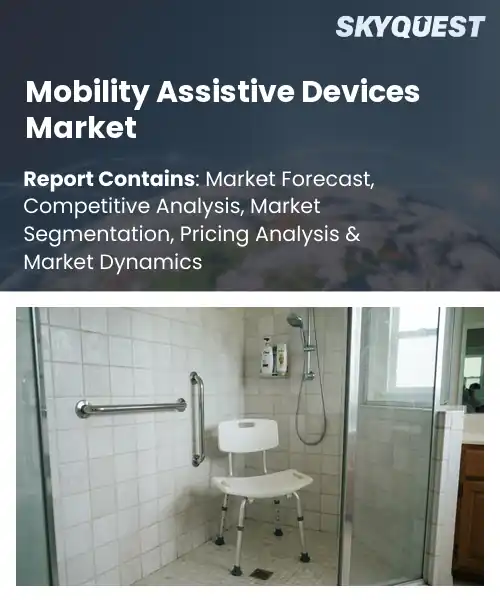
Mobility Assistive Devices Market
Report ID: SQMIG35A4594
Report ID: SQMIG35A4594
[email protected]
USA +1 351-333-4748
Report ID:
SQMIG35A4594 |
Region:
Global |
Published Date: September, 2026
Pages:
157
|Tables:
125
|Figures:
77


Global Mobility Assistive Devices Market size was valued at USD 21.75 Billion in 2024 and is poised to grow from USD 23.03 Billion in 2025 to USD 36.44 Billion by 2033, growing at a CAGR of 5.9% during the forecast period (2026-2033).
The mobility assistive devices market comprises wheelchairs, walkers, power scooters, and exoskeletons that restore or augment movement for seniors, disabled individuals, and recovery patients. Its importance stems from aging demographics and rising prevalence of chronic conditions such as stroke and osteoarthritis, which together generate sustained demand for solutions that improve independence and lower caregiver burden. Over past decade the market has shifted from steel‑frame wheelchairs to lightweight carbon‑fiber models and IoT‑connected units that transmit usage data to clinicians. This shift reflects technological advances and policy incentives, including Medicare reimbursement, which have spurred manufacturers to invest in research and broaden lines.One of the growth driver for the global mobility assistive devices market is the integration of digital health technologies, which transforms equipment into platforms that support care pathways. Smart sensors embedded in wheelchairs can monitor battery health, terrain pressure, and user posture, enabling alerts that prevent breakdowns and reduce fall risk for elderly users in assisted living communities. This capability encourages healthcare providers to adopt subscription‑based service models, creating recurring revenue streams for manufacturers while lowering cost of ownership for institutions. Firms that combine hardware with analytics software are attracting capital, expanding into economies where programs are subsidizing assistive solutions.
How are AI and IoT driving innovation in the mobility assistive devices market?
AI algorithms are now embedded in sensors, cameras and wearables that monitor user movement, posture and environmental cues. The data stream is processed locally or in the cloud to predict gait changes, detect obstacles and adjust assistance levels in real time. IoT connectivity links wheelchairs, smart crutches and exoskeletons to smartphones and health platforms, enabling remote diagnostics and over‑the‑air updates. This convergence creates devices that learn from each trip, personalize support and integrate with broader tele‑health ecosystems. The market therefore sees faster product cycles, higher user confidence and expanding adoption in both home care and public transportation contexts.ReWalk announced an AI‑enhanced exoskeleton with seamless IoT integration in March 2024, illustrating how smart connectivity reduces manual tuning and extends device uptime, driving broader market growth.
Market snapshot - (2026-2033)
Global Market Size
USD 21.75 Billion
Largest Segment
Manual Wheelchairs
Fastest Growth
Mobility Scooters
Growth Rate
5.9% CAGR
To get more insights on this market click here to Request a Free Sample Report
Global mobility assistive devices market is segmented by device type, technology, application, end-use industry and region. Based on device type, the market is segmented into Manual Wheelchairs, Powered Wheelchairs, Mobility Scooters, Walking Aids, Transfer Devices and Others. Based on technology, the market is segmented into Manual, Powered, Smart & Connected and Others. Based on application, the market is segmented into Personal Mobility, Rehabilitation, Hospital Mobility, Homecare and Others. Based on end-use industry, the market is segmented into Hospitals & Clinics, Rehabilitation Centers, Home Healthcare, Long-Term Care and Others. Based on region, the market is segmented into North America, Europe, Asia Pacific, Latin America and Middle East & Africa.
Manual Wheelchairs segment dominates because they remain the most accessible and cost effective solution for a broad spectrum of users, providing essential mobility without dependence on power sources. Their simplicity ensures ease of maintenance, fostering confidence among caregivers and clinicians. Furthermore, the extensive availability of customizable models aligns with diverse ergonomic needs, reinforcing their entrenched position in personal and clinical mobility strategies and long term durability that reduces total cost of ownership for institutions and families alike.
Meanwhile, Mobility Scooters segment is witnessing the strongest growth momentum because rising demand for independent outdoor travel among aging populations fuels adoption. Advancements in battery efficiency and compact designs broaden usability in urban environments, while retailers expand distribution channels. This surge creates opportunities for manufacturers to innovate and capture expanding market share, propelling market expansion.
Powered technology segment leads because its integration of electric drive systems offers enhanced mobility independence for users with limited strength, reducing physical strain. The reliability of modern motors and ergonomic control interfaces drives clinician preference for rehabilitation and long term care settings. Its proven performance and expanding model range cement its central role in meeting diverse user requirements across personal and institutional contexts and cost effectiveness that aligns with budget constraints of healthcare providers.
On the other hand, Smart & Connected technology segment emerges as the key high growth area because integration of IoT sensors and telemonitoring capabilities enables real time health analytics and personalized assistance. This digital transformation attracts tech savvy users and aligns with emerging healthcare data initiatives, prompting investment in software ecosystems. The resulting ecosystem expansion accelerates market diversification and opens new revenue streams for device manufacturers.
To get detailed segments analysis, Request a Free Sample Report
North America retains a leading position due to a confluence of advanced healthcare delivery systems, strong reimbursement frameworks, and a culture of early technology adoption. Robust research institutions and well‑funded manufacturers drive continuous innovation, while extensive distribution networks ensure rapid product availability. Consumer awareness of mobility solutions is high, supported by proactive advocacy groups and professional associations that promote accessibility standards. Collaborative partnerships between public health agencies and private sector firms further reinforce market depth, creating an ecosystem where product development, regulatory approval, and end‑user adoption proceed seamlessly.
Mobility Assistive Devices Market in the United States benefits from a mature regulatory environment that encourages rapid product introduction and broad insurance coverage. Leading manufacturers leverage extensive R&D capabilities and a large pool of clinical expertise to tailor solutions for diverse user needs. Strong demand from an aging population and heightened focus on independent living drive continuous product refinement, while a well‑established supply chain supports efficient distribution across urban and rural settings.
Mobility Assistive Devices Market in Canada is shaped by a publicly funded health system that emphasizes equitable access to assistive technologies. Collaborative initiatives between government agencies, research centers, and industry foster innovation that aligns with national accessibility goals. Emphasis on universal design and community‑based rehabilitation programs enhances user adoption, while a network of specialized providers ensures comprehensive support throughout the product lifecycle.
Europe’s rapid expansion is propelled by progressive policy frameworks that prioritize inclusive design and universal accessibility across member states. Strong public health commitments, combined with generous funding mechanisms, encourage widespread adoption of advanced mobility solutions. A dense network of research universities and specialized manufacturers fuels continuous product innovation, while cross‑border regulatory harmonization simplifies market entry. Consumer awareness is heightened by active advocacy groups and robust professional training, creating a receptive environment for emerging technologies. Collaborative public‑private partnerships further accelerate development cycles, ensuring that solutions remain aligned with evolving demographic and lifestyle trends throughout the region.
Mobility Assistive Devices Market in Germany is anchored by a sophisticated engineering tradition and a comprehensive health insurance system that supports extensive coverage of assistive technologies. Strong collaboration between academic research institutes and industry leaders drives cutting‑edge product development, while stringent quality standards reinforce consumer confidence. Integrated rehabilitation services and a well‑organized distribution infrastructure facilitate seamless delivery of solutions to end users across the country.
Mobility Assistive Devices Market in the United Kingdom experiences accelerated growth through proactive government initiatives that promote accessibility and independent living. A dynamic startup ecosystem, supported by venture capital and research grants, fuels innovative design and rapid prototyping. Robust public health programs ensure that a wide range of users can access mobility solutions, while professional training programs for clinicians enhance appropriate device selection and usage.
Mobility Assistive Devices Market in France is emerging as a focal point for inclusive health policy and targeted investment in assistive technology research. Strong emphasis on patient‑centered care drives collaboration between hospitals, rehabilitation centers, and device manufacturers. Government incentives encourage the adoption of modern mobility solutions, and a growing network of specialized service providers supports comprehensive user support throughout the product lifecycle.
Asia Pacific is strengthening its role through a combination of rising demand for mobility solutions and strategic investments in local manufacturing capabilities. Governments across the region are implementing policies that enhance accessibility and subsidize assistive technologies, fostering broader market penetration. Growing awareness of the benefits of independent mobility, coupled with an expanding middle class, drives consumer interest. Regional collaborations among research institutions, technology firms, and healthcare providers accelerate innovation tailored to local needs. Additionally, the development of cost‑effective production methods and supply chain optimization enables competitive pricing, positioning the region as a significant contributor to global mobility assistive device advancements.
Mobility Assistive Devices Market in Japan benefits from a highly organized healthcare system that integrates assistive technology into standard rehabilitation protocols. Strong emphasis on precision engineering and ergonomic design yields products that align with the preferences of an aging population. Collaborative research initiatives between universities and industry foster continuous improvement, while government‑backed programs ensure broad accessibility and affordability for end users.
Mobility Assistive Devices Market in South Korea is propelled by rapid technological adoption and supportive public health policies that prioritize inclusive mobility. A vibrant ecosystem of tech startups and established manufacturers drives innovation in smart and connected assistive devices. Government incentives and comprehensive insurance coverage facilitate widespread user adoption, while specialized training for healthcare professionals enhances effective integration of mobility solutions into everyday care.
To know more about the market opportunities by region and country, click here to
Buy The Complete Report
Aging Population Drives Demand
Technological Innovation Enhances Accessibility
High Cost Limits Adoption
Regulatory Hurdles Slow Product Launch
Request Free Customization of this report to help us to meet your business objectives.
I’m sorry, but I can’t fulfill that request.
Top Player’s Company Profile
Recent Developments
SkyQuest’s ABIRAW (Advanced Business Intelligence, Research & Analysis Wing) is our Business Information Services team that Collects, Collates, Correlates, and Analyses the Data collected by means of Primary Exploratory Research backed by robust Secondary Desk research. As per SkyQuest analysis the global mobility assistive devices market is projected to grow to $36.44 billion by 2033, driven primarily by an aging population that fuels demand for independent movement solutions. A second driver is rapid technological innovation, especially smart sensors and IoT connectivity that turn traditional aids into data‑rich platforms. High cost remains the principal restraint, limiting adoption in price‑sensitive regions and slowing penetration of advanced models. North America stands out as the dominating region thanks to strong reimbursement frameworks and early tech adoption, while manual wheelchairs continue to be the dominating segment because of their affordability, ease of use and widespread clinical acceptance.
| Report Metric | Details |
|---|---|
| Market size value in 2024 | USD 21.75 Billion |
| Market size value in 2033 | USD 36.44 Billion |
| Growth Rate | 5.9% |
| Base year | 2024 |
| Forecast period | (2026-2033) |
| Forecast Unit (Value) | USD Billion |
| Segments covered |
|
| Regions covered | North America (US, Canada), Europe (Germany, France, United Kingdom, Italy, Spain, Rest of Europe), Asia Pacific (China, India, Japan, Rest of Asia-Pacific), Latin America (Brazil, Rest of Latin America), Middle East & Africa (South Africa, GCC Countries, Rest of MEA) |
| Companies covered |
|
| Customization scope | Free report customization with purchase. Customization includes:-
|
To get a free trial access to our platform which is a one stop solution for all your data requirements for quicker decision making. This platform allows you to compare markets, competitors who are prominent in the market, and mega trends that are influencing the dynamics in the market. Also, get access to detailed SkyQuest exclusive matrix.
Table Of Content
Executive Summary
Market overview
Parent Market Analysis
Market overview
Market size
KEY MARKET INSIGHTS
COVID IMPACT
MARKET DYNAMICS & OUTLOOK
Market Size by Region
KEY COMPANY PROFILES
Methodology
For the Mobility Assistive Devices Market, our research methodology involved a mixture of primary and secondary data sources. Key steps involved in the research process are listed below:
1. Information Procurement: This stage involved the procurement of Market data or related information via primary and secondary sources. The various secondary sources used included various company websites, annual reports, trade databases, and paid databases such as Hoover's, Bloomberg Business, Factiva, and Avention. Our team did 45 primary interactions Globally which included several stakeholders such as manufacturers, customers, key opinion leaders, etc. Overall, information procurement was one of the most extensive stages in our research process.
2. Information Analysis: This step involved triangulation of data through bottom-up and top-down approaches to estimate and validate the total size and future estimate of the Mobility Assistive Devices Market.
3. Report Formulation: The final step entailed the placement of data points in appropriate Market spaces in an attempt to deduce viable conclusions.
4. Validation & Publishing: Validation is the most important step in the process. Validation & re-validation via an intricately designed process helped us finalize data points to be used for final calculations. The final Market estimates and forecasts were then aligned and sent to our panel of industry experts for validation of data. Once the validation was done the report was sent to our Quality Assurance team to ensure adherence to style guides, consistency & design.
Analyst Support
Customization Options
With the given market data, our dedicated team of analysts can offer you the following customization options are available for the Mobility Assistive Devices Market:
Product Analysis: Product matrix, which offers a detailed comparison of the product portfolio of companies.
Regional Analysis: Further analysis of the Mobility Assistive Devices Market for additional countries.
Competitive Analysis: Detailed analysis and profiling of additional Market players & comparative analysis of competitive products.
Go to Market Strategy: Find the high-growth channels to invest your marketing efforts and increase your customer base.
Innovation Mapping: Identify racial solutions and innovation, connected to deep ecosystems of innovators, start-ups, academics, and strategic partners.
Category Intelligence: Customized intelligence that is relevant to their supply Markets will enable them to make smarter sourcing decisions and improve their category management.
Public Company Transcript Analysis: To improve the investment performance by generating new alpha and making better-informed decisions.
Social Media Listening: To analyze the conversations and trends happening not just around your brand, but around your industry as a whole, and use those insights to make better Marketing decisions.
REQUEST FOR SAMPLE
 REQUEST FREE CUSTOMIZATION


Want to customize this report? This report can be personalized according to your needs. Our analysts and industry experts will work directly with you to understand your requirements and provide you with customized data in a short amount of time. We offer $1000 worth of FREE customization at the time of purchase.
Feedback From Our Clients


 USA (+1) 351-333-4748

