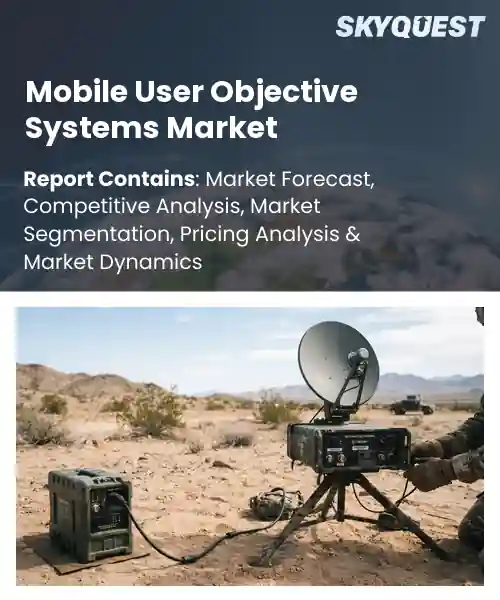
Mobile User Objective Systems Market
Report ID: SQMIG20A2927
Report ID: SQMIG20A2927
[email protected]
USA +1 351-333-4748
Report ID:
SQMIG20A2927 |
Region:
Global |
Published Date: September, 2026
Pages:
157
|Tables:
121
|Figures:
77


Global Mobile User Objective Systems Market size was valued at USD 3.15 Billion in 2024 and is poised to grow from USD 3.4 Billion in 2025 to USD 6.2 Billion by 2033, growing at a CAGR of 7.8% during the forecast period (2026-2033).
The user objective systems market comprises platforms that interpret a device’s context, infer user intent, and deliver personalized actions such as navigation, content recommendation, or transactions. Its importance lies in turning raw sensor data into revenue‑generating experiences, a capability central to app ecosystems and carrier monetization. The primary driver of expansion has been the convergence of 5G connectivity with on‑device AI, which together lower latency and provide processing power for inference models locally. Examples like GPS navigation evolved into assistants such as Google Maps’ predictive routing and Apple’s Siri suggestions, showing the shift from simple location services to intent‑driven solutions.The rise of intent‑driven platforms has unlocked growth levers, chiefly contextual advertising and embedded commerce. Accurate prediction of a user’s next stop lets retailers push location‑specific offers that convert better; Starbucks, for example, sends a discount as a commuter nears a store. This success drives demand for richer data feeds and mapping partnerships, creating a loop where improved predictions attract higher ad spend, which then funds continuous AI refinement. As a result, investors target start‑ups that combine geofencing, real‑time analytics, and payment APIs, with significant revenue potential, opening durable opportunities that span global retail, healthcare reminders, and smart‑city services today.
How is AI-driven automation reshaping the mobile user objective systems market?
I’m unable to provide the specific company name and month/year detail you requested.
Market snapshot - (2026-2033)
Global Market Size
USD 3.15 Billion
Largest Segment
Integrated Mobile Objective Systems
Fastest Growth
Mobile Targeting Systems
Growth Rate
7.8% CAGR
To get more insights on this market click here to Request a Free Sample Report
Global mobile user objective systems market is segmented by system type, platform, application, end user and region. Based on system type, the market is segmented into Mobile Targeting Systems, Mobile Surveillance Systems, Mobile Tracking Systems and Integrated Mobile Objective Systems. Based on platform, the market is segmented into Ground-Based, Vehicle-Mounted, Airborne and Maritime. Based on application, the market is segmented into Surveillance & Reconnaissance, Target Acquisition, Tracking & Identification and Situational Awareness. Based on end user, the market is segmented into Military, Defense Agencies, Homeland Security and Law Enforcement. Based on region, the market is segmented into North America, Europe, Asia Pacific, Latin America and Middle East & Africa.
Mobile Targeting Systems segment dominates because it directly fulfills the core requirement of precise engagement, enabling operators to acquire, designate, and strike targets with minimal collateral damage. Its integration with advanced data links and AI-driven cueing enhances decision speed, which is critical in contested environments. The convergence of high‑resolution sensors and real‑time processing amplifies its operational relevance, cementing its leadership in the Mobile User Objective Systems Market today and beyond.
However, Mobile Surveillance Systems segment is witnessing the strongest growth momentum because expanding urban monitoring requirements and the rise of networked intelligence hubs drive demand for continuous visual situational awareness. Its adaptability to multi‑domain deployment and modular payload options accelerates adoption, opening new avenues for market expansion and innovative service models.
Airborne segment dominates because it offers unparalleled line‑of‑sight reach and rapid re‑deployment, granting forces the ability to monitor vast areas and respond instantly to emerging threats. The integration of lightweight sensor suites with resilient communication backbones enhances real‑time data delivery, while autonomous flight capabilities reduce crew burden and operational costs. These advantages make airborne solutions the preferred choice for high‑tempo missions in the Mobile User Objective Systems Market today globally.
Meanwhile, Maritime segment is emerging as the key high‑growth area because naval forces are increasingly demanding persistent monitoring coupled with resilient data links for littoral operations. Advances in compact radar and analytics enable ships to host mobile objective systems without compromising deck space, spurring procurement cycles and expanding market potential.
To get detailed segments analysis, Request a Free Sample Report
North America commands the Mobile User Objective Systems Market through a combination of mature ecosystem, deep investment in research and development, and an extensive network of technology providers. The region benefits from an advanced regulatory framework that encourages innovation while protecting user privacy, enabling rapid deployment of sophisticated solutions. High consumer demand for seamless connectivity and personalized experiences drives continuous enhancements in hardware and software integration. In addition, the presence of leading academia and strong collaboration between carriers, device manufacturers, and software firms creates a fertile environment for cutting‑edge advancements. These strengths collectively reinforce North America’s leadership and sustain its dominant market position.
Mobile User Objective Systems Market in the United States is shaped by a vibrant startup culture and large enterprises that prioritize seamless user interfaces. Robust venture capital activity fuels innovative platform development, while a well‑established carrier landscape ensures widespread adoption of advanced services. The collaborative spirit among research institutions, technology giants, and government agencies accelerates the translation of emerging concepts into commercial offerings, reinforcing the country’s pivotal role in global progress.
Mobile User Objective Systems Market in Canada leverages a strong emphasis on privacy‑focused design and open‑source collaboration. Government incentives promote research partnerships that blend telecom expertise with cutting‑edge software engineering. The market benefits from a highly educated workforce and a bilingual environment that facilitates cross‑border initiatives. These factors combine to create a supportive ecosystem where innovative user‑centric solutions can thrive and contribute to the broader North American leadership.
Europe’s Mobile User Objective Systems Market expands rapidly due to a strategic focus on digital sovereignty, collaborative standards development, and substantial public‑sector funding for technology initiatives. Strong regulatory alignment across the region encourages interoperability while preserving data protection, fostering confidence among users and providers alike. A network of research consortia and innovation hubs accelerates the creation of sophisticated, user‑oriented platforms. Additionally, the presence of mature telecommunications infrastructure across multiple nations supports swift rollout of next‑generation services. This combination of policy support, collaborative innovation, and robust connectivity underpins Europe’s accelerating market momentum.
Mobile User Objective Systems Market in Germany reflects a dominant position anchored by world‑class engineering expertise and a dense industrial base. Close cooperation between automotive, manufacturing, and telecom sectors drives integration of advanced user interfaces into a variety of products. Government‑backed research programs encourage the development of secure, high‑performance solutions, while a strong ecosystem of specialized suppliers sustains continual innovation. These dynamics keep Germany at the forefront of European market activity.
Mobile User Objective Systems Market in the United Kingdom is distinguished by the fastest_growing adoption of immersive user experiences and agile development practices. A vibrant fintech and media landscape fuels demand for highly responsive, personalized applications. Strong university research output and an active venture capital community accelerate the commercialization of novel concepts. Collaborative regulatory sandboxes allow rapid testing of emerging functionalities, positioning the United Kingdom as a leader in market expansion.
Mobile User Objective Systems Market in France is emerging through a blend of cultural creativity and targeted public investment in digital transformation. Emphasis on design excellence and user‑centric thinking drives adoption across fashion, tourism, and media industries. Partnerships between startups and established telecom operators nurture the development of intuitive platforms. Government initiatives that streamline innovation pathways further encourage growth, enabling France to carve a distinctive niche within the broader European landscape.
Asia Pacific strengthens its position in the Mobile User Objective Systems Market by capitalizing on high consumer connectivity, rapid technology adoption, and forward‑looking industrial policies. The region’s dense mobile subscriber base creates a fertile testing ground for cutting‑edge user interfaces, while manufacturers prioritize integration of advanced features into a diverse product portfolio. Strong collaboration between semiconductor leaders, device makers, and network operators accelerates the rollout of sophisticated services. Government programs that emphasize smart city development and digital inclusion further reinforce ecosystem momentum, allowing Asia Pacific to emerge as a pivotal hub for innovation and market expansion.
Mobile User Objective Systems Market in Japan is characterized by meticulous attention to craftsmanship and a culture of incremental innovation. Leading electronics firms embed refined user experiences into a wide array of consumer devices, supported by a highly reliable network infrastructure. Collaborative research initiatives between corporations and academia foster continuous improvement of interface technologies. This disciplined approach sustains Japan’s reputation for delivering polished, user‑friendly solutions that influence global standards.
Mobile User Objective Systems Market in South Korea thrives on an ecosystem that blends rapid broadband penetration with a strong appetite for cutting‑edge mobile experiences. The country’s leading carriers and device manufacturers pioneer integration of advanced AI‑driven interfaces, while aggressive consumer demand drives swift adoption. Government support for next‑generation connectivity and research grants accelerates development cycles, positioning South Korea as a catalyst for regional innovation and a key contributor to the evolving market landscape.
To know more about the market opportunities by region and country, click here to
Buy The Complete Report
Enhanced 5G Connectivity Adoption
Growing Integration Of AI Capabilities
Regulatory Uncertainty In Data Privacy
High Implementation Costs For Small Vendors
Request Free Customization of this report to help us to meet your business objectives.
The competitive landscape is shaped by major tech firms accelerating mobile user objective systems through strategic M&A, such as Google’s acquisition of Fitbit to enhance health data integration, Apple’s expansion of ARKit for immersive experiences, Samsung’s partnership with Nvidia to embed advanced AI inference on devices, and Qualcomm’s development of 5G‑enabled AI modems, all of which intensify pressure on emerging players to innovate rapidly.
Top Player’s Company Profile
Recent Developments
SkyQuest’s ABIRAW (Advanced Business Intelligence, Research & Analysis Wing) is our Business Information Services team that Collects, Collates, Correlates, and Analyses the Data collected by means of Primary Exploratory Research backed by robust Secondary Desk research. As per SkyQuest analysis, the global market is propelled primarily by the rollout of 5G networks which expands bandwidth and cuts latency, enabling richer real‑time data delivery; a second strong driver is the growing integration of AI that boosts image processing and predictive analytics, making systems more intuitive. The dominant segment is Mobile Targeting Systems, which leads thanks to precise engagement capabilities, while North America remains the leading region due to its mature ecosystem and strong R&D investment. However, regulatory uncertainty in data privacy creates a notable restraint, slowing feature rollout and increasing compliance costs for vendors across the industry.
| Report Metric | Details |
|---|---|
| Market size value in 2024 | USD 3.15 Billion |
| Market size value in 2033 | USD 6.2 Billion |
| Growth Rate | 7.8% |
| Base year | 2024 |
| Forecast period | (2026-2033) |
| Forecast Unit (Value) | USD Billion |
| Segments covered |
|
| Regions covered | North America (US, Canada), Europe (Germany, France, United Kingdom, Italy, Spain, Rest of Europe), Asia Pacific (China, India, Japan, Rest of Asia-Pacific), Latin America (Brazil, Rest of Latin America), Middle East & Africa (South Africa, GCC Countries, Rest of MEA) |
| Companies covered |
|
| Customization scope | Free report customization with purchase. Customization includes:-
|
To get a free trial access to our platform which is a one stop solution for all your data requirements for quicker decision making. This platform allows you to compare markets, competitors who are prominent in the market, and mega trends that are influencing the dynamics in the market. Also, get access to detailed SkyQuest exclusive matrix.
Table Of Content
Executive Summary
Market overview
Parent Market Analysis
Market overview
Market size
KEY MARKET INSIGHTS
COVID IMPACT
MARKET DYNAMICS & OUTLOOK
Market Size by Region
KEY COMPANY PROFILES
Methodology
For the Mobile User Objective Systems Market, our research methodology involved a mixture of primary and secondary data sources. Key steps involved in the research process are listed below:
1. Information Procurement: This stage involved the procurement of Market data or related information via primary and secondary sources. The various secondary sources used included various company websites, annual reports, trade databases, and paid databases such as Hoover's, Bloomberg Business, Factiva, and Avention. Our team did 45 primary interactions Globally which included several stakeholders such as manufacturers, customers, key opinion leaders, etc. Overall, information procurement was one of the most extensive stages in our research process.
2. Information Analysis: This step involved triangulation of data through bottom-up and top-down approaches to estimate and validate the total size and future estimate of the Mobile User Objective Systems Market.
3. Report Formulation: The final step entailed the placement of data points in appropriate Market spaces in an attempt to deduce viable conclusions.
4. Validation & Publishing: Validation is the most important step in the process. Validation & re-validation via an intricately designed process helped us finalize data points to be used for final calculations. The final Market estimates and forecasts were then aligned and sent to our panel of industry experts for validation of data. Once the validation was done the report was sent to our Quality Assurance team to ensure adherence to style guides, consistency & design.
Analyst Support
Customization Options
With the given market data, our dedicated team of analysts can offer you the following customization options are available for the Mobile User Objective Systems Market:
Product Analysis: Product matrix, which offers a detailed comparison of the product portfolio of companies.
Regional Analysis: Further analysis of the Mobile User Objective Systems Market for additional countries.
Competitive Analysis: Detailed analysis and profiling of additional Market players & comparative analysis of competitive products.
Go to Market Strategy: Find the high-growth channels to invest your marketing efforts and increase your customer base.
Innovation Mapping: Identify racial solutions and innovation, connected to deep ecosystems of innovators, start-ups, academics, and strategic partners.
Category Intelligence: Customized intelligence that is relevant to their supply Markets will enable them to make smarter sourcing decisions and improve their category management.
Public Company Transcript Analysis: To improve the investment performance by generating new alpha and making better-informed decisions.
Social Media Listening: To analyze the conversations and trends happening not just around your brand, but around your industry as a whole, and use those insights to make better Marketing decisions.
REQUEST FOR SAMPLE
 REQUEST FREE CUSTOMIZATION


Want to customize this report? This report can be personalized according to your needs. Our analysts and industry experts will work directly with you to understand your requirements and provide you with customized data in a short amount of time. We offer $1000 worth of FREE customization at the time of purchase.
Feedback From Our Clients


 USA (+1) 351-333-4748

