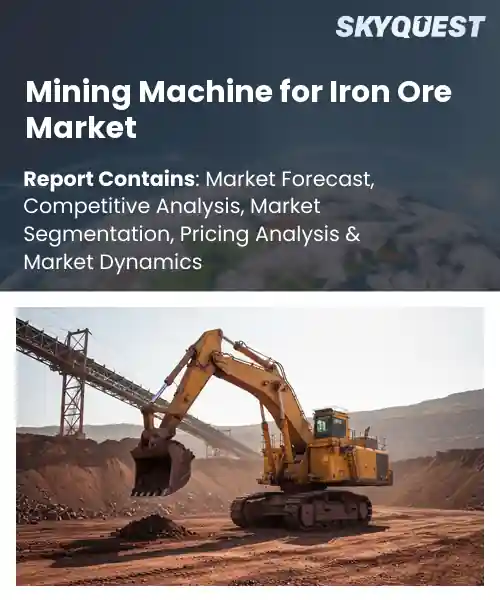
Mining Machine for Iron Ore Market
Report ID: SQMIG20I2771
Report ID: SQMIG20I2771
[email protected]
USA +1 351-333-4748
Report ID:
SQMIG20I2771 |
Region:
Global |
Published Date: March, 2026
Pages:
157
|Tables:
116
|Figures:
77


Global Mining Machine For Iron Ore Market size was valued at USD 144.0 Billion in 2024 and is poised to grow from USD 153.94 Billion in 2025 to USD 262.52 Billion by 2033, growing at a CAGR of 6.9% during the forecast period (2026-2033).
Key Takeaways: Market Trends & Insights
The primary driver of the mining machine for iron ore market is sustained demand for steel from urbanization and infrastructure investment, forcing miners to scale production and modernize fleets. Heavy mobile machinery, large haul trucks, fixed plants that both crush and beneficiate ore are the major focus of the mining sector. As a result of this, all the various parts of the supply chain directly impact unit cost, throughput, and export return. Mining operations have been changing over the past several decades. Early operations relied upon manual labor to accomplish their processes, while subsequently the industry progressed toward using mechanical equipment and ultimately came to rely heavily on automation.
Technological adoption, automation and electrification is the key trend driving the global mining machine for iron ore sector because operators under cost and compliance pressure are buying larger, smarter fleets. As companies deploy autonomous haulage, remote drilling and predictive maintenance, equipment uptime improves and ore recoveries increase, which triggers reinvestment in new machines and retrofit programs seen in collaborations between major miners and OEMs. The push to reduce diesel use creates demand for battery electric equipment and charging networks, opening aftermarket, software and service revenue streams while enabling measurable emissions reductions that further justify capital deployment.
How is AI-Driven Automation Improving Efficiency in the Iron Ore Mining Machine Market?
AI driven automation is changing how iron ore mining machines operate by combining autonomous control with machine learning based optimization and predictive maintenance. Key aspects include autonomous haulage, automated drilling, sensor driven condition monitoring and fleet orchestration. The current state shows pilots scaling into broader deployments as equipment makers and miners collaborate on retrofits and new fleets. In market context the repetitive cycles and high volumes of iron ore operations make them well suited to automation for improved uptime, safer operations and more consistent extraction. Examples from major projects illustrate faster decision making and reduced unplanned downtime.
In April 2025, Epiroc announced its largest contract for autonomous and electric powered mining equipment, highlighting how AI driven automation improves efficiency by enabling predictive maintenance, raising equipment availability and refining drill accuracy which supports market growth and faster adoption of modern mining machines.

To get more insights on this market click here to Request a Free Sample Report
Global mining machine for iron ore market is segmented by equipment type, propulsion/power source, operational mode, mining phase and region. Based on equipment type, the market is segmented into surface mining equipment, underground mining equipment, crushing & screening machinery and drills & breakers. Based on propulsion/power source, the market is segmented into diesel powered and electric/battery powered. Based on operational mode, the market is segmented into manual operated and autonomous/remote controlled units. Based on mining phase, the market is segmented into exploration & drilling, extraction/excavation and material handling & processing. Based on region, the market is segmented into North America, Europe, Asia Pacific, Latin America and Middle East & Africa.
Based on the global mining machine for iron ore market growth, surface mining equipment segment dominates because large open pit iron ore operations favor heavy duty excavators and haul trucks that enable continuous high throughput and efficient material movement. Downtime and cycle times are improved by using well-proven equipment designs with OEM and aftermarket support, as well as being integrated into bulk handling systems. These operational advantages reduce unit costs, which makes using large-scale mechanised extraction a preferred method of iron ore producers.
However, crushing & screening machinery is witnessing the strongest growth momentum as miners move processing closer to the pit to meet tighter product specifications and reduce low grade haulage. Comminution systems and energy-efficient mobile and modular crushers utilize smarter control systems to allow for quick deployment to enable greater flexibilities in processing that will create aftermarket service opportunities while also speeding up investments in onsite integrated processing across a wide range of Iron Ore operations.
Diesel powered segment dominates because diesel propulsion provides the energy density and continuous power required for heavy excavation and long haul cycles common in iron ore operations. The establishment of refueling logistics, a mature maintenance system/ecosystem, and a well-versed operator substantially reduce risks associated with day-to-day tasks. This benefit combined with the current supply chain leads to diesel being regarded as the leading fuel source for large iron ore mining machinery.
However, electric/battery powered is emerging as the most rapidly expanding area due to improving battery energy density, onsite charging infrastructure, and corporate decarbonization driving fleet electrification. Advances in hybridization and total cost of ownership modeling make electric drivetrains more commercially attractive, unlocking new deployment patterns, operational cost optimization, and green financing opportunities for iron ore operators.

To get detailed segments analysis, Request a Free Sample Report
As per the global mining machine for iron ore market share, Asia Pacific dominates the industry due to a convergence of demand concentration, manufacturing capability and deep mining ecosystems. Due to the fact that it is located near large ore mining operations and steel consumers each country will experience a high level of demand sustained by positive communication between the OEMs and the operators. Japan and South Korea are at the top of the advanced industrial supplier industry regarding both engineering/automation/component integration. The dense supplier networks allow for quick customization to be made as well as aftermarket support. Being near large ore mining companies and steel consuming companies reduces logistics friction. Integrated supply chains create cost efficiencies for all companies involved. The strong relationship with suppliers coupled with their joint focus on R&D; this leads to rapid adoption of technology; thus reinforcing their ability to be market leaders in various products and services.
Mining machine for iron ore market in Japan is shaped by advanced manufacturing and precision engineering capabilities that favor quality equipment and component integration. Strong industrial clusters support OEM innovation in automation systems while established suppliers provide reliable spare parts and maintenance services. Close collaboration between manufacturers and mine operators enables tailored solutions for efficiency and safety, and focus on reliability and lifecycle support bolsters domestic deployment and international competitiveness.
Mining machine for iron ore market in South Korea benefits from a strong industrial base in heavy machinery and automation that enables integrated equipment solutions and component production. In addition, strong collaborative relationships with mining operations and a focus on engineering customization enhance the ability of the machine to perform efficiently across a range of different operating environments. Furthermore, by focusing on exporting their products, they reinforce the aftermarket network in which they operate.
Based on global mining machine for iron ore market regional forecast, rapid expansion of the industry in North America is being driven by a combination of modernization imperatives, technological adoption and an emphasis on operational resilience. Mining operators are emphasizing fleet replacement and upgrades to increase safety, productivity and environmental performance resulting in high demand for new equipment. OEMS and service providers are expanding local manufacturing and maintenance capability, and introducing automation/electrification/remote monitoring into product lines. The aftermarket networks and technology company partnerships support deployment and lifecycle maintenance. Capital availability and skilled labour at the regional level support project execution, while close collaboration between suppliers and operators speeds up customization for different geological/regulatory environments, providing additional momentum in the market.
Mining machine for iron ore market in United States is underpinned by a mature mining industry with extensive aftermarket capability and strong supplier ecosystem. Manufacturer's designs for machinery, new OEMs from within Canada, are primarily focused on making all these designs durable, integrating them into existing facilities and adapting them to stringent operations and regulations. There appears to be demand for dependable machines that include enhanced safety measures, have automated operating systems and operate efficiently.
Mining machine for iron ore market in Canada is characterized by reliability, adaptability and resilience for remote operating environments. Mines and manufacturers or other service providers have really stressed cold-weather ability, being modular, and having very good maintenance support. The final user of the equipment wants a machine that meets or exceeds efficiency standards, provides emissions management solutions and has diagnostics capabilities built-in. The close working relationships between engineers and operators help to develop a more customized equipment package and aftermarket support.
As per global mining machine for iron ore market regional forecast, Europe is strengthening its position in the industry through a blend of engineering excellence, regulatory-driven innovation and integrated supply chain development. In Germany, the UK and France manufacturers focus on building strong mechanical designs, completing electrification paths and utilizing digital systems that meet strict environmental and safety requirements. The manufacturing sector is supporting new and innovative technologies through investment in research and pilot projects with technical institutes, with an emphasis on accelerating the uptake of low emission and energy efficient equipment. Large clusters of component manufacturers and equipment builders have made it possible for the region's industry to provide a tailored solutions for so many ore types – this has been aided by financing and procurement models that support the deployment of higher capital, lower emission equipment throughout the region.
Mining machine for iron ore market in Germany is driven by capabilities in heavy machinery engineering and precision manufacturing that emphasize durability and efficiency. The local engineering talent and technical colleges can help validate new products, while mature service & spare parts networks will provide lifecycle longevity. The competitive advantage of export-oriented manufacturers is driven by their focus on quality, in an increasingly competitive, operationally and regulatory challenging environment.
Mining machine for iron ore market in United Kingdom benefits from strong services and engineering consultancies that accelerate adoption of digitalization, predictive maintenance and retrofits. Fleet operators can find suppliers who specialize in extended system integration, software assisted performance monitoring and customized upgrades. Flexible implementation models are supported by a healthy maintenance and rental network, and partnerships with research facilities and financial institutions help support pilot programs and expand the use of lower emissions and more efficient equipment.
Mining machine for iron ore market in France is shaped by strong engineering capabilities with equipment innovation emphasizing energy efficiency and environmental performance. Collaborative research and development partnerships between manufacturers and technical institutes provide manufacturers with a method to test prototypes and adapt their equipment to accommodate different ore conditions. Service networks and refurbishment specialists extend equipment life and offer tailored maintenance models for export customers overseas.

To know more about the market opportunities by region and country, click here to
Buy The Complete Report
Rising Global Steel Demand
Major expansion in steel production requirements has increased the requirement for a reliable and large scale supply of iron ore, prompting mining operators to invest in additional and specialized mining machines. This elevates procurement of heavy loaders, excavators, and haulage fleets to maintain continuous extraction and processing capacity. Higher operational uptime and increased productivity from purchasing equipment will enable manufacturers to provide customized solutions and service agreements, thereby helping to increase demand for new and/or upgrade equipment in the mining industry and thus provide planning for long-term capital investment.
Advances In Mining Automation
The increasing use of automation in the mining industry is improving productivity levels and safety during extraction activities, leading businesses to change their traditional mineral extraction methods to newer, more advanced automated equipment. Companies that make mining machines are developing autonomous haulage systems, tele remote control solutions and integration monitors that require both new equipment and retrofitting of older machines. Operators see these purchases as a way to improve throughput, decrease operational hazards, and extend maintenance cycles, all of which leads to the acquisition of new mining equipment that is specifically designed to work in conjunction with digital control systems and remote-controlled capabilities.
High Capital Expenditure Needs
Significant upfront investment required for heavy mining machines and associated infrastructure often constrains procurement decisions, causing operators to delay fleet replacement and capacity expansion. A high amount of capital that a company needs to operate creates a scenario where they will put more of their resources towards maintaining their current equipment and making minor improvements rather than investing in new machinery, particularly if they are smaller players in this industry, as smaller companies have less access to funding or capital. Extended payback perceptions and long procurement cycles reduce immediate market uptake, causing manufacturers to face fluctuating demand and to offer financing or leasing solutions, which only partially mitigate the effect and leave adoption rates subdued.
Environmental Regulation And Compliance
Due to stricter environmental regulations and permitting through more strict processes, operational complexity increases and project timelines become longer, thus limiting the amount of immediate investment in new mining equipment. Environmental controls, land restoration, water management, and protecting biodiversity require purchasing special equipment and making changes to operations which increase implementation costs. Many firms have delayed investing in added capacity until regulatory issues are clear, while increased compliance obligations divert capital from purchasing new extraction equipment to implementing environmental mitigation projects. These factors collectively restrain demand growth for standard mining machines and encourage cautious capital deployment.
Request Free Customization of this report to help us to meet your business objectives.
Competition in the global mining machine for iron ore market outlook centres on autonomy, electrification and data integration. Firms pursue consolidation and alliances, for example the acquisition of core scanning specialist Minalyze by a geoscience software group, and large autonomy deployment deals such as the Pronto agreement with Heidelberg Materials. Product innovation includes tiered autonomous haulage systems and OEM partnerships that reconfigure procurement choices.
SkyQuest’s ABIRAW (Advanced Business Intelligence, Research & Analysis Wing) is our Business Information Services team that Collects, Collates, Correlates, and Analyses the Data collected by means of Primary Exploratory Research backed by robust Secondary Desk research.
As per SkyQuest analysis, the global mining machine for iron ore industry is being driven primarily by rising steel demand from urbanization and infrastructure investment, which compels miners to expand and modernize fleets. Adoption of automation and electrification acts as a second powerful driver by improving uptime, lowering emissions and opening aftermarket services. Growth is limited by the need for a high level of capital spending, which will delay the replacement of fleets for many companies. The Asia Pacific market leads in terms of concentrated demand, a strong manufacturing base and integrated supply chains. In addition, Surface Mining Equipment dominates as large open pit operations tend to have a higher volume of production with heavy duty excavators and haul trucks and can produce continuously for a long period of time.
| Report Metric | Details |
|---|---|
| Market size value in 2024 | USD 144.0 Billion |
| Market size value in 2033 | USD 262.52 Billion |
| Growth Rate | 6.9% |
| Base year | 2024 |
| Forecast period | 2026-2033 |
| Forecast Unit (Value) | USD Billion |
| Segments covered |
|
| Regions covered | North America (US, Canada), Europe (Germany, France, United Kingdom, Italy, Spain, Rest of Europe), Asia Pacific (China, India, Japan, Rest of Asia-Pacific), Latin America (Brazil, Rest of Latin America), Middle East & Africa (South Africa, GCC Countries, Rest of MEA) |
| Companies covered |
|
| Customization scope | Free report customization with purchase. Customization includes:-
|
To get a free trial access to our platform which is a one stop solution for all your data requirements for quicker decision making. This platform allows you to compare markets, competitors who are prominent in the market, and mega trends that are influencing the dynamics in the market. Also, get access to detailed SkyQuest exclusive matrix.
Table Of Content
Executive Summary
Market overview
Parent Market Analysis
Market overview
Market size
KEY MARKET INSIGHTS
COVID IMPACT
MARKET DYNAMICS & OUTLOOK
Market Size by Region
KEY COMPANY PROFILES
Methodology
For the Mining Machine for Iron Ore Market, our research methodology involved a mixture of primary and secondary data sources. Key steps involved in the research process are listed below:
1. Information Procurement: This stage involved the procurement of Market data or related information via primary and secondary sources. The various secondary sources used included various company websites, annual reports, trade databases, and paid databases such as Hoover's, Bloomberg Business, Factiva, and Avention. Our team did 45 primary interactions Globally which included several stakeholders such as manufacturers, customers, key opinion leaders, etc. Overall, information procurement was one of the most extensive stages in our research process.
2. Information Analysis: This step involved triangulation of data through bottom-up and top-down approaches to estimate and validate the total size and future estimate of the Mining Machine for Iron Ore Market.
3. Report Formulation: The final step entailed the placement of data points in appropriate Market spaces in an attempt to deduce viable conclusions.
4. Validation & Publishing: Validation is the most important step in the process. Validation & re-validation via an intricately designed process helped us finalize data points to be used for final calculations. The final Market estimates and forecasts were then aligned and sent to our panel of industry experts for validation of data. Once the validation was done the report was sent to our Quality Assurance team to ensure adherence to style guides, consistency & design.
Analyst Support
Customization Options
With the given market data, our dedicated team of analysts can offer you the following customization options are available for the Mining Machine for Iron Ore Market:
Product Analysis: Product matrix, which offers a detailed comparison of the product portfolio of companies.
Regional Analysis: Further analysis of the Mining Machine for Iron Ore Market for additional countries.
Competitive Analysis: Detailed analysis and profiling of additional Market players & comparative analysis of competitive products.
Go to Market Strategy: Find the high-growth channels to invest your marketing efforts and increase your customer base.
Innovation Mapping: Identify racial solutions and innovation, connected to deep ecosystems of innovators, start-ups, academics, and strategic partners.
Category Intelligence: Customized intelligence that is relevant to their supply Markets will enable them to make smarter sourcing decisions and improve their category management.
Public Company Transcript Analysis: To improve the investment performance by generating new alpha and making better-informed decisions.
Social Media Listening: To analyze the conversations and trends happening not just around your brand, but around your industry as a whole, and use those insights to make better Marketing decisions.
REQUEST FOR SAMPLE
 REQUEST FREE CUSTOMIZATION
Global Mining Machine For Iron Ore Market size was valued at USD 144.0 Billion in 2024 and is poised to grow from USD 153.94 Billion in 2025 to USD 262.52 Billion by 2033, growing at a CAGR of 6.9% during the forecast period (2026-2033).
Competition in the global iron ore mining machine market centres on autonomy, electrification and data integration. Firms pursue consolidation and alliances, for example the acquisition of core scanning specialist Minalyze by a geoscience software group, and large autonomy deployment deals such as the Pronto agreement with Heidelberg Materials. Product innovation includes tiered autonomous haulage systems and OEM partnerships that reconfigure procurement choices. 'Caterpillar Inc.', 'Komatsu Ltd.', 'Sandvik AB', 'Hitachi Construction Machinery Co., Ltd.', 'Epiroc AB', 'Terex Corporation', 'Volvo Construction Equipment', 'Atlas Copco', 'Joy Global (now part of Komatsu)', 'Metso Outotec', 'Liebherr Group', 'FLSmidth', 'Parker Hannifin Corporation', 'Astec Industries, Inc.', 'Weir Group', 'BHP Billiton', 'Vale S.A.', 'Rio Tinto', 'Anglo American plc', 'Fortescue Metals Group Ltd.'
Major expansion in steel production requirements has increased the requirement for a reliable and large scale supply of iron ore, prompting mining operators to invest in additional and specialized mining machines. This elevates procurement of heavy loaders, excavators, and haulage fleets to maintain continuous extraction and processing capacity. Equipment purchases support higher operational uptime and production efficiency, and encourage manufacturers to offer tailored solutions and service contracts, thereby stimulating demand for new machines and upgrades across the mining industry and supporting long term capital planning.
Autonomous And Digital Operations: Integration of autonomous hauling, remote monitoring and advanced telemetry is accelerating operational efficiency across iron ore mining. Operators adopt digital twins, predictive maintenance and fleet orchestration platforms to reduce downtime, enhance safety and optimize asset utilization. This trend drives closer collaboration between equipment manufacturers and software providers, reshapes workforce skill requirements toward data and systems management, and enables more flexible production scheduling and mine planning. Adoption is guided by practical productivity gains and risk reduction rather than regulatory prompts altogether.
Asia Pacific Dominate the Global Mining Machine for Iron Ore Market.
Mining machines for iron ore are used for exploration, drilling, excavation, hauling, crushing, screening, and material handling during iron ore extraction and processing operations.
Surface Mining Equipment dominates the market because large-scale open-pit iron ore operations require high-capacity excavators, haul trucks, and loaders for continuous bulk material movement and higher productivity.
AI-driven automation is improving operational efficiency through autonomous haulage systems, predictive maintenance, remote drilling, fleet orchestration, and real-time equipment monitoring, helping mining companies reduce downtime and improve safety.


Want to customize this report? This report can be personalized according to your needs. Our analysts and industry experts will work directly with you to understand your requirements and provide you with customized data in a short amount of time. We offer $1000 worth of FREE customization at the time of purchase.
Feedback From Our Clients


 USA (+1) 351-333-4748

