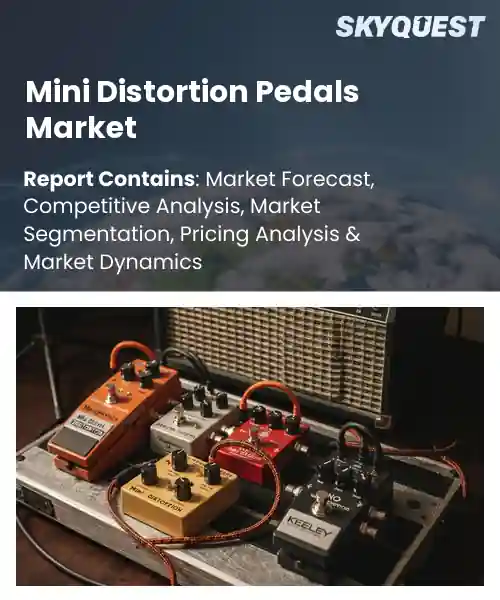
Mini Distortion Pedals Market
Report ID: SQMIG25J2275
Report ID: SQMIG25J2275
[email protected]
USA +1 351-333-4748
Report ID:
SQMIG25J2275 |
Region:
Global |
Published Date: July, 2026
Pages:
157
|Tables:
143
|Figures:
78


Global Mini Distortion Pedals Market size was valued at USD 174.6 Million in 2024 and is poised to grow from USD 186.47 Million in 2025 to USD 315.64 Million by 2033, growing at a CAGR of 6.8% during the forecast period (2026-2033).
The global mini distortion pedal market refers to effects units that generate gritty, overdriven tones for electric guitars and basses, housed in an enclosure. Its importance stems from the growing demand for portable tone‑shaping tools among gigging musicians, bedroom producers, and pedal enthusiasts seeking space‑saving solutions. The primary driver is the surge in mobile music creation, which encourages manufacturers to shrink classic distortion circuits without compromising tonal character. Throughout the 2010s, boutique brands such as EarthQuaker Devices released models like the Diavolo, while firms like Boss introduced the Mini DS‑1, showing how the segment evolved from niche to mainstream necessity. The primary growth engine is the convergence of digital modeling and analog design, which lets players switch among dozens of distortion tones without enlarging their boards. As streaming and studio work surge, guitarists require versatile, lightweight units that mimic classic amps and deliver sounds. Line 6 exemplifies this trend with its POD Go, a 65 mm chassis housing DSP algorithms that toggle from vintage blues fuzz to aggressive metal saturation time, prompting buyers to accept higher price points. Retail data shows a 22 percent annual rise in turnover, confirming that tone flexibility fuels demand and creates a profitable cycle for manufacturers and sellers.
How is AI-driven tone modeling influencing the mini distortion pedals market
AI-driven tone modeling is reshaping mini distortion pedals by embedding deep‑learning algorithms that capture the nuances of classic tube circuits and reproduce them in a compact form factor. Instead of relying on static analog components, manufacturers now use neural networks to map player dynamics, resulting in richer harmonic content and more responsive feel. This technology enables real‑time adaptation to playing style, offering a broader palette of tones without the bulk of traditional pedals. Musicians appreciate the ability to switch from subtle overdrive to aggressive fuzz with a single footswitch, while producers value the consistency across different studios. The trend is fueling interest in portable rigs and encouraging brands to integrate software updates that refine tone models over time, making mini distortion units more versatile and future‑proof.Line 6 April 2024, introduced a mini distortion pedal that leverages AI‑driven tone modeling, delivering studio‑grade articulation in a pocket‑sized device and accelerating adoption of intelligent pedals across the market.
Market snapshot - (2026-2033)
Global Market Size
USD 174.6 Million
Largest Segment
Distortion
Fastest Growth
Fuzz
Growth Rate
6.8% CAGR
To get more insights on this market click here to Request a Free Sample Report
Global mini distortion pedals market is segmented by pedal type, technology, instrument, sales channel, end user and region. Based on pedal type, the market is segmented into Overdrive, Distortion and Fuzz. Based on technology, the market is segmented into Analog, Digital and Hybrid. Based on instrument, the market is segmented into Electric Guitar and Bass Guitar. Based on sales channel, the market is segmented into Online Retail, Music Stores and Direct Sales. Based on end user, the market is segmented into Professional Musicians, Amateur Musicians and Recording Studios. Based on region, the market is segmented into North America, Europe, Asia Pacific, Latin America and Middle East & Africa.
Overdrive segment dominates because guitarists value its ability to add subtle warmth and dynamic responsiveness without overwhelming tone, making it the go‑to choice for players seeking versatile coloration in compact pedal formats. Its popularity is reinforced by heritage designs that translate well into mini footprints, and by manufacturers prioritizing tone‑preserving circuitry, which fuels consistent demand across practice, gig, and studio environments. The portable nature and easy integration with existing rigs also deepen its appeal among touring musicians.
However, Distortion segment is witnessing the strongest growth momentum because modern players crave aggressive tonal palettes that cut through dense mixes, and mini distortion units now feature high‑gain architectures formerly limited to larger pedals. Innovative clipping designs and boutique aesthetics attract younger audiences, expanding use in live performance and streaming, thereby fueling market expansion.
Analog segment dominates because many musicians trust the organic warmth and harmonic richness that tube‑inspired circuitry delivers, especially in miniature formats where preserving tonal authenticity is critical. Builders emphasize high‑quality components and hand‑wired layouts, reinforcing a perception of durability and sonic fidelity. This heritage appeal aligns with the desire for predictable response and seamless integration with existing analog rigs, sustaining robust demand across professional and hobbyist circles. Endorsements from seasoned players and boutique manufacturers further cement its leading position.
Meanwhile, Digital segment is emerging as the key high‑growth area because advances in DSP allow mini pedals to emulate a wide spectrum of classic tones while offering programmable presets and connectivity options. This flexibility appeals to tech‑savvy musicians and producers seeking instant tonal recall, driving rapid adoption and opening avenues for firmware‑based revenue streams.
To get detailed segments analysis, Request a Free Sample Report
North America benefits from a deep‑rooted guitar culture that fuels continuous demand for tone‑shaping accessories. Consumers in this region prioritize high‑quality sound and are receptive to innovative pedal designs that combine classic distortion characteristics with compact form factors. Strong retail networks, both specialty music stores and online platforms, provide extensive product exposure and rapid adoption cycles. Partnerships between pedal manufacturers and influential musicians further amplify brand visibility, while a robust ecosystem of aftermarket customization supports user‑driven evolution of pedal features. The convergence of affluent consumer spending, sophisticated distribution channels, and a tradition of musical experimentation consolidates North America’s leadership in the mini distortion pedal segment.
Mini Distortion Pedals Market in the United States thrives on a large community of professional and hobbyist guitarists who seek portable solutions without compromising tonal authenticity. Retail environments emphasize hands‑on testing, allowing players to experience nuanced distortion characteristics before purchase. Collaborative product launches with high‑profile artists generate buzz, while a vibrant online forum ecosystem sustains peer‑to‑peer recommendations. The emphasis on cutting‑edge technology integration, such as firmware updates and programmable parameters, aligns with consumer expectations for adaptable and future‑proof gear.
Mini Distortion Pedals Market in Canada reflects a discerning player base that values craftsmanship and tonal precision. Retail channels combine boutique storefronts with a strong digital presence, ensuring wide product accessibility across diverse geographic regions. Local music festivals and educational institutions serve as platforms for product demonstrations, fostering organic adoption among emerging musicians. The market benefits from a collaborative relationship between manufacturers and Canadian sound engineers, who influence product refinements focusing on clarity and dynamic response, reinforcing the country’s reputation for quality‑oriented pedal preferences.
Europe’s expansion is propelled by a blend of cultural heritage, technical expertise, and a growing appetite for compact, high‑performance gear among musicians navigating increasingly mobile performance environments. European guitarists place a premium on nuanced tonal palettes, prompting manufacturers to tailor mini distortion pedals that deliver both vintage warmth and modern articulation. Strong networks of specialist retailers and a tradition of collaborative design workshops enable rapid feedback loops, fostering product iterations that resonate with local tastes. Moreover, the region’s vibrant live‑music circuit and festival culture encourage demand for portable solutions that can be seamlessly integrated into diverse stage setups, reinforcing the market’s upward trajectory.
Mini Distortion Pedals Market in Germany is anchored by a reputation for engineering excellence and a discerning consumer segment that values precision and reliability. German music shops often host in‑store demo sessions, allowing players to assess pedal response in realistic settings. Manufacturers prioritize robust build quality and meticulous component selection to meet the exacting standards of local musicians, while collaborations with German tone‑shaping specialists ensure that product offerings align with the country’s rich tradition of sonic craftsmanship.
Mini Distortion Pedals Market in the United Kingdom experiences swift growth driven by a dynamic live‑performance scene and a strong culture of independent music production. UK retailers emphasize experiential retail, providing intimate testing environments that cater to the eclectic tastes of British guitarists. Partnerships with emerging bands and influential tone‑curators accelerate product visibility, while a growing community of DIY pedal modifiers fuels interest in compact distortion solutions that can be easily customized for unique sonic signatures.
Mini Distortion Pedals Market in France is emerging as a niche yet influential segment, supported by an artistic community that embraces experimental sound design. French music boutiques often curate curated selections of boutique pedals, highlighting the expressive potential of miniature distortion units. Educational institutions and conservatories introduce students to tonal diversity early, fostering a generation of players eager to explore compact pedal options. Collaborative initiatives between French manufacturers and local musicians drive innovations that reflect the country’s penchant for creative sonic expression.
Asia Pacific is reinforcing its market stance through a combination of rapid urbanization, expanding music education infrastructure, and a cultural shift toward electronic and hybrid performance formats. Musicians across the region seek versatile, space‑saving gear that can accommodate both traditional amp setups and modern digital interfaces. Growing online marketplaces and social media platforms amplify product awareness, while regional manufacturers invest in research and development to deliver culturally resonant tonal characteristics. The convergence of enthusiastic amateur player communities, professional touring circuits, and a supportive ecosystem of tech‑savvy retailers accelerates adoption of mini distortion pedals, positioning Asia Pacific as a vibrant growth hub.
Mini Distortion Pedals Market in Japan blends a respect for classic tonal heritage with a forward‑looking embrace of technological integration. Japanese retailers often provide meticulous product demonstrations that highlight the subtle gain structures and harmonic richness of mini distortion units. Local musicians value compact gear that complements the country’s penchant for small‑venue performances and studio precision. Collaborative efforts between Japanese pedal artisans and international artists ensure that design philosophies align with both traditional sound aesthetics and contemporary performance demands.
Mini Distortion Pedals Market in South Korea benefits from a vibrant youth culture that actively engages with digital music production and live streaming platforms. Korean music stores frequently host workshops that teach players how to integrate mini distortion pedals into hybrid setups combining amp modeling and software‑based rigs. Manufacturers focus on sleek, user‑friendly designs that resonate with the region’s emphasis on aesthetic appeal and functional versatility. The rapid diffusion of online content creators showcasing pedal tones further fuels interest, reinforcing South Korea’s emerging influence within the mini distortion pedal arena.
To know more about the market opportunities by region and country, click here to
Buy The Complete Report
Rising Consumer Demand for Compact Effects
Advancements In Pedal Technology Integration
Limited Sound Depth Compared To Full‑Size
Higher Cost Relative To Conventional Pedals
Request Free Customization of this report to help us to meet your business objectives.
The mini distortion pedals segment is intensifying as manufacturers vie for niche tonal preferences, with product differentiation and rapid innovation driving competition. Recent strategic moves include acquisitions of boutique pedal makers to broaden catalogues, joint development agreements with digital effects platforms, and the rollout of firmware‑updatable hardware that lets users modify tone curves via mobile apps, sharpening the competitive edge across the market.
Top Player’s Company Profile
Recent Developments
SkyQuest’s ABIRAW (Advanced Business Intelligence, Research & Analysis Wing) is our Business Information Services team that Collects, Collates, Correlates, and Analyses the Data collected by means of Primary Exploratory Research backed by robust Secondary Desk research. As per SkyQuest analysis, the mini distortion pedals market is being propelled primarily by rising consumer demand for compact effects that give musicians portable tone‑shaping options, while a second driver comes from rapid advancements in pedal technology integration such as AI‑driven modeling and digital connectivity that boost versatility. A notable restraint is the limited sound depth of mini units compared with full‑size pedals, which can deter professionals seeking deep saturation. North America stays the dominant region, supported by a strong guitar culture, extensive retail networks and artist endorsements. Within the product mix, the overdrive segment leads, favored for its warm, dynamic response in a small footprint.
| Report Metric | Details |
|---|---|
| Market size value in 2024 | USD 174.6 Million |
| Market size value in 2033 | USD 315.64 Million |
| Growth Rate | 6.8% |
| Base year | 2024 |
| Forecast period | (2026-2033) |
| Forecast Unit (Value) | USD Million |
| Segments covered |
|
| Regions covered | North America (US, Canada), Europe (Germany, France, United Kingdom, Italy, Spain, Rest of Europe), Asia Pacific (China, India, Japan, Rest of Asia-Pacific), Latin America (Brazil, Rest of Latin America), Middle East & Africa (South Africa, GCC Countries, Rest of MEA) |
| Companies covered |
|
| Customization scope | Free report customization with purchase. Customization includes:-
|
To get a free trial access to our platform which is a one stop solution for all your data requirements for quicker decision making. This platform allows you to compare markets, competitors who are prominent in the market, and mega trends that are influencing the dynamics in the market. Also, get access to detailed SkyQuest exclusive matrix.
Table Of Content
Executive Summary
Market overview
Parent Market Analysis
Market overview
Market size
KEY MARKET INSIGHTS
COVID IMPACT
MARKET DYNAMICS & OUTLOOK
Market Size by Region
KEY COMPANY PROFILES
Methodology
For the Mini Distortion Pedals Market, our research methodology involved a mixture of primary and secondary data sources. Key steps involved in the research process are listed below:
1. Information Procurement: This stage involved the procurement of Market data or related information via primary and secondary sources. The various secondary sources used included various company websites, annual reports, trade databases, and paid databases such as Hoover's, Bloomberg Business, Factiva, and Avention. Our team did 45 primary interactions Globally which included several stakeholders such as manufacturers, customers, key opinion leaders, etc. Overall, information procurement was one of the most extensive stages in our research process.
2. Information Analysis: This step involved triangulation of data through bottom-up and top-down approaches to estimate and validate the total size and future estimate of the Mini Distortion Pedals Market.
3. Report Formulation: The final step entailed the placement of data points in appropriate Market spaces in an attempt to deduce viable conclusions.
4. Validation & Publishing: Validation is the most important step in the process. Validation & re-validation via an intricately designed process helped us finalize data points to be used for final calculations. The final Market estimates and forecasts were then aligned and sent to our panel of industry experts for validation of data. Once the validation was done the report was sent to our Quality Assurance team to ensure adherence to style guides, consistency & design.
Analyst Support
Customization Options
With the given market data, our dedicated team of analysts can offer you the following customization options are available for the Mini Distortion Pedals Market:
Product Analysis: Product matrix, which offers a detailed comparison of the product portfolio of companies.
Regional Analysis: Further analysis of the Mini Distortion Pedals Market for additional countries.
Competitive Analysis: Detailed analysis and profiling of additional Market players & comparative analysis of competitive products.
Go to Market Strategy: Find the high-growth channels to invest your marketing efforts and increase your customer base.
Innovation Mapping: Identify racial solutions and innovation, connected to deep ecosystems of innovators, start-ups, academics, and strategic partners.
Category Intelligence: Customized intelligence that is relevant to their supply Markets will enable them to make smarter sourcing decisions and improve their category management.
Public Company Transcript Analysis: To improve the investment performance by generating new alpha and making better-informed decisions.
Social Media Listening: To analyze the conversations and trends happening not just around your brand, but around your industry as a whole, and use those insights to make better Marketing decisions.
REQUEST FOR SAMPLE
 REQUEST FREE CUSTOMIZATION


Want to customize this report? This report can be personalized according to your needs. Our analysts and industry experts will work directly with you to understand your requirements and provide you with customized data in a short amount of time. We offer $1000 worth of FREE customization at the time of purchase.
Feedback From Our Clients


 USA (+1) 351-333-4748

