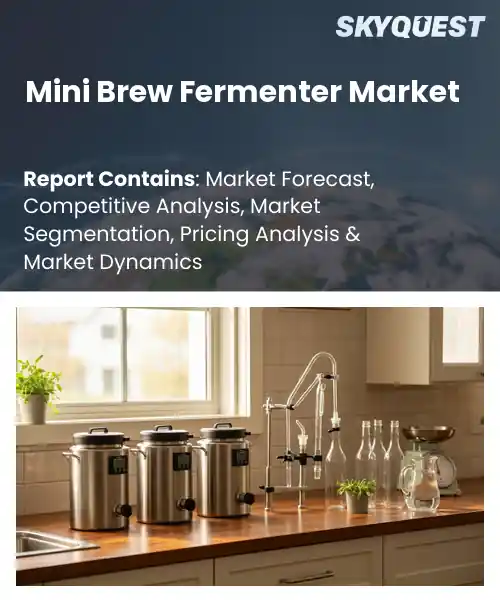
Mini Brew Fermenter Market
Report ID: SQMIG25I2097
Report ID: SQMIG25I2097
[email protected]
USA +1 351-333-4748
Report ID:
SQMIG25I2097 |
Region:
Global |
Published Date: June, 2026
Pages:
157
|Tables:
117
|Figures:
77


Global Mini Brew Fermenter Market size was valued at USD 282.5 Million in 2024 and is poised to grow from USD 306.29 Million in 2025 to USD 582.4 Million by 2033, growing at a CAGR of 8.42% during the forecast period (2026-2033).
The key driver in the market for mini-brew fermenters lies in the growing trend of home craft brewing, turning beer enthusiasts into micro entrepreneurs. This particular market comprises small and controlled fermentation tanks that allow consumers to brew ales, lagers, and experimental mixtures at home. The importance of the market is based on consumer interest in unique flavors and authenticity of home-crafted drinks. The history of the market begins from the wave of DIY culture during the early 2010s, when affordable plug-and-play fermenters were introduced via Kickstarter projects. With growing popularity on social media platforms fueled by suburban breweries’ success stories, the demand increased significantly, leading to further product development and scaling in 2025.
The advent of IoT technology, which allows turning basic fermentation tanks into devices that enhance yeast performance and ensure consistency of batches, is another factor augmenting growth of the mini brew fermenter market. The collection of information on temperature, pH levels, and gravities in mobile applications enables instant action from brewers and leads to decreased spoilage rates and minimized production time. This process creates an incentive for café owners to incorporate small-scale solutions in their menus, as was proved by the experience of the Seattle coffee shop, which started producing sour ales four times per year based on its fermenters' network.
How is IoT Integration Improving Efficiency in the Mini Brew Fermenter Market?
Integration of IoT technology is revolutionizing mini brew fermenters by transforming them into smart stations that continuously track temperature, pressure, and yeast activities. The data collected from sensors is uploaded on cloud-based dashboard, allowing operators to observe any trends and make necessary changes in the settings without opening the fermenter. Continuous flow of information ensures that there is less variability in batches and minimizes the effort required for monitoring. The mobile applications enable brewers to receive alerts on their devices whenever the parameters differ from what was originally planned.
Market snapshot - (2026-2033)
Global Market Size
USD 282.5 Million
Largest Segment
Plastic Fermenters
Fastest Growth
Electric/Smart Fermenters
Growth Rate
8.42% CAGR
To get more insights on this market click here to Request a Free Sample Report
Global mini brew fermenter market is segmented by type, capacity, application, distribution and region. Based on type, the market is segmented into Plastic Fermenters, Stainless Steel Fermenters, Glass Fermenters, and Electric/Smart Fermenters. Based on capacity, the market is segmented into Below 5 Gallons, 5-15 Gallons, and Above 15 Gallons. Based on application, the market is segmented into Home Brewing (Beer), Home Wine Making, and Kombucha. Based on distribution, the market is segmented into Online Retail and Homebrew Specialty Stores. Based on the region, the market is segmented into North America, Europe, Asia Pacific, Latin America and Middle East & Africa.
Plastic fermenters' segment rules due to its combination of affordability and durability that makes it easily available for people without requiring huge investments. The ease of cleaning and durability in terms of resisting damages make it attractive for novices to experiment with. The availability through online sellers adds reliability to the customers and thus ensures consistent sales growth in addition to ensuring customer loyalty by continuous product update for repeat brewers.
Nevertheless, the electric smart fermenters' segment is the fastest growing segment owing to its appeal to the tech-savvy brewer. This segment is growing on account of the ability to manage fermentation processes due to easy control and connectivity, thus avoiding repetitive mistakes.
The Below 5 Gallons segment is the leader due to its perfect fit with the constrained kitchen space and smaller production purposes, which gives amateurs the opportunity to try and make beer without being engaged in huge production. In addition, the convenience of cleaning and storing is combined with the real taste of the product that inspires confidence in the newcomers. The retailers recommend this segment as the best way to confirm the popularity and stability of demand in it.
Moreover, the segment above 15 Gallons is growing with the highest dynamics due to the fact that experienced brewers have started using it for producing the beer on a small scale in order to sell it commercially. As a result, it stimulates the growth of demand for durable equipment and advanced control systems.
To get detailed segments analysis, Request a Free Sample Report
The North American continent provides an edge with a combination of a sophisticated culture of craft brewing, advanced technology and production skills as well as a matured distribution system that guarantees quick launch of products into the market. The top equipment manufacturers have the advantage of highly skilled engineers and partnerships with breweries to ensure constant innovations in temperature control, automation and scalability. Excitement among consumers of home-brew and batch experiments creates consistent demand while a dedicated distribution system assures extensive market coverage. Favorable regulatory framework guarantees established safety and quality standards thus making it easier for firms to enter the market. Support from research organizations is an added advantage guaranteeing technical innovations.
Marketing for Mini-Brew Fermenters in the US relies heavily on the presence of a vast number of craft breweries and the thriving home brew scene that helps in constant innovation in the product. Local producers make use of highly efficient sensors along with modular designs to accommodate varying batch sizes. The connection with suppliers of ingredients helps to reduce the lead time.
Market for Mini Brew Fermenters in Canada operates on a cooperative environment, which is based on the cooperation between research universities and equipment manufacturers. The preference of consumers towards handmade drinks creates the demand for such qualities as temperature control and small-scale brewing options. Local manufacturing encouraged by the government and sustainable practices reduce the barrier to entering the market, and a network of specialty retailers increases brand visibility.
The European environment pushes towards rapid growth through sustainability considerations, innovative brewing practices, and proactive policies which support smaller production scales. Among the best-known breweries in Europe, there is a focus on sustainable methods of brewing, leading to increased demand for fermenters that provide energy saving and precise control. Research communities in major cities create innovative fermentation technologies, while an increasing interest from consumers to experience more flavors encourages experimentation with brewing practices. Established distribution systems and well-developed markets for accessories make all needed components available for production. Consistent regulatory measures in regard to food safety and equipment standards facilitate entering the market for any new player.
Mini Brew Fermenter Market of Germany is the key region due to its rich engineering tradition and thriving craft beer brewing environment. The high-quality mini-brew fermenters can be manufactured through precise production and automation technologies. The close cooperation of breweries with equipment manufacturers allows for the development of individualized products, whereas environmental concerns lead to the creation of energy-efficient devices.
The UK Mini-Brew Fermenter Market shows the fastest growth, driven by a flourishing pub culture and increasing popularity among home brewers. Designers make the most of this trend by developing small and easy-to-handle devices that can be accommodated in smaller kitchen areas. The cooperation of breweries with tech startups leads to improvements like smart monitoring and remote controlling capabilities. Moreover, there is a deep appreciation of new and experimental types of beer in UKculture.
French Mini Brew Fermenter Market forms one of the emerging sectors, thanks to the increasing interest in terroir-inspired craft drinks and government incentives for local productions. Small breweries need fermenting tanks which will be able to work with different grain combinations and the process of aging, so there is an increased trend for making the tanks more modular. Gastronomy and culinary schools are incorporating knowledge about fermentations into their programs, educating a new generation of skilled brewers.
Asia Pacific improves its standing through its ability to combine the latest technology advancements with a long-standing tradition of experimental brewing, thus fostering an atmosphere conducive to mini fermenters’ implementation. The pace of urbanization leads to the need for compact home brewing options, while electronic producers provide smart technology and accurate temperature control systems. Innovation centers bring together breweries and startups and produce platforms based on process optimization through data analysis. State support aimed at encouraging the manufacturing of products within the region and their sustainability reduces costs, which makes the process easier to implement. Enjoyment of various flavors creates the need for equipment allowing for a wide variety of fermentation types.
Japan Mini-Brew Fermenters Market benefits from the country’s prestige in precision engineering and increasing appreciation for craft beer traditions. Manufacturers highlight their product’s small footprint and strict temperature control, which is related to space limitation for brewing at home and customers’ demand for quality products. Collaboration with local breweries allows creating fermentation tanks adjusted to traditional Japanese components like rice and barley mixes. Technological incubators help integrate IoT technologies into the product.
The market for Mini Brew Fermenters in South Korea is boosted by a vibrant start-up scene and an increasing fascination for specialty drinks. The local firms focus on elegant design as well as smartphone compatibility to target the technologically adept customers that desire efficiency and precise control over their equipment. Research projects undertaken through collaborations between academic institutions and breweries contribute to the development of new fermentation strains to produce a variety of products.
To know more about the market opportunities by region and country, click here to
Buy The Complete Report
Increasing Craft Beer Enthusiasm
There is a growing consumer interest in homemade beverages, which drives consumers into searching for small and easy-to-use equipment that allows the creation of similar small-scale production processes. Mini brewers fulfill this demand, as they are characterized by a scalable capacity, easy control systems, and small space requirements that fit standard household conditions. As consumers want to try different recipes, the need for such a fermenter becomes evident, and it drives buying intention, thereby helping to expand the market by means of word-of-mouth advertising.
Adoption of Portable Brewing Solutions
Increased emphasis on flexibility is another factor that the small-scale brewers are appreciating, and the portable fermenters enable them to move their equipment while still maintaining effectiveness. The ability to be light coupled with modularity makes them easily applicable even in the limited space of the kitchen or even pop-up locations. This will ensure experimenting with brewing, making them independent of any specific infrastructures, and at the same time matching lifestyles where convenience is preferred. As a result, the demand for flexible brewing equipment encourages innovation in this area.
High Initial Capital Requirements
It is notable that potential consumers must deal with high initial investment in terms of purchasing mini beer fermenters due to advanced components that include precise temperature control, reliable construction materials, and sanitation components. This aspect acts as a discouragement for hobbyists with limited resources, making them avoid this option for the time being or exploring other solutions. In addition, the price factor hinders the process of entering the market and requires justification of such investments through reliability and durability.
Limited Technical Expertise Availability
Effective operation of a mini brewery fermenter involves having a certain level of expertise in fermentation principles, sanitization, and equipment management; however, many possible consumers do not have these advanced skills. This ignorance may lead to unsatisfactory results of the fermentation process, causing people to give up and fear further investments. For this reason, sellers often face reluctance on behalf of those consumers who find easier substitutes appealing. Thus, overcoming this difficulty by providing proper education and user-friendly interfaces is a must to attract more consumers.
Request Free Customization of this report to help us to meet your business objectives.
The international mini-brew fermenter market is somewhat fragmented, where competition is characterized by the presence of players that manufacture equipment used for home-brewing and craft-brewing. The top competitors in the industry concentrate on developing stainless steel fermenters, temperature regulation systems, small sized equipment, and advanced technology of brewing. Product innovation, sales directly to consumers, partnership with retailers of home-brewing equipment, and new craft beer markets are critical strategies to enhance their competitive position.
AI-driven Fermentation Optimization: The use of artificial intelligence has transformed the production processes in the miniature fermenter through the real-time monitoring of yeast performance, temperature, and flavor generation. The sensors installed into the system provide input data for the algorithms and hence allow for automatic adjustments, ensuring consistency in the process. Artificial intelligence makes it possible for craft brewers to develop products using less skill and time, as well as making the process more scalable.
Sustainable Packaging Integration: Issues related to the environment have compelled many breweries to combine mini fermenters with sustainable packaging options to develop a story which appeals to environmentally conscious customers. Businesses have been exploring biodegradable bottles, kegs that can be reused, and compostable labels. This helps them to ensure product sustainability, which is also consistent with their philosophy of small-scale brewing. Not only does it help companies to distinguish themselves in saturated markets, but it also minimizes environmental impact and meets regulatory requirements.
SkyQuest’s ABIRAW (Advanced Business Intelligence, Research & Analysis Wing) is our Business Information Services team that Collects, Collates, Correlates, and Analyses the Data collected by means of Primary Exploratory Research backed by robust Secondary Desk research.
As per SkyQuest analysis, the major driver in the worldwide mini brew fermenter industry includes the increasing interest in craft beer that drives people towards seeking small and easy-to-use equipment, whereas the most dominant product in the market includes plastic fermenters due to their affordability and ease of use; North America emerges as the leader of the market owing to its well-established craft industry, robust manufacturing base, and distribution channels. The second driver includes the increasing popularity of portable brewing systems, which allow people to transport equipment along with experimenting in limited space. However, high upfront capital expenditure acts as a barrier for consumers.
| Report Metric | Details |
|---|---|
| Market size value in 2024 | USD 282.5 Million |
| Market size value in 2033 | USD 582.4 Million |
| Growth Rate | 8.42% |
| Base year | 2024 |
| Forecast period | (2026-2033) |
| Forecast Unit (Value) | USD Million |
| Segments covered |
|
| Regions covered | North America (US, Canada), Europe (Germany, France, United Kingdom, Italy, Spain, Rest of Europe), Asia Pacific (China, India, Japan, Rest of Asia-Pacific), Latin America (Brazil, Rest of Latin America), Middle East & Africa (South Africa, GCC Countries, Rest of MEA) |
| Companies covered |
|
| Customization scope | Free report customization with purchase. Customization includes:-
|
To get a free trial access to our platform which is a one stop solution for all your data requirements for quicker decision making. This platform allows you to compare markets, competitors who are prominent in the market, and mega trends that are influencing the dynamics in the market. Also, get access to detailed SkyQuest exclusive matrix.
Table Of Content
Executive Summary
Market overview
Parent Market Analysis
Market overview
Market size
KEY MARKET INSIGHTS
COVID IMPACT
MARKET DYNAMICS & OUTLOOK
Market Size by Region
KEY COMPANY PROFILES
Methodology
For the Mini Brew Fermenter Market, our research methodology involved a mixture of primary and secondary data sources. Key steps involved in the research process are listed below:
1. Information Procurement: This stage involved the procurement of Market data or related information via primary and secondary sources. The various secondary sources used included various company websites, annual reports, trade databases, and paid databases such as Hoover's, Bloomberg Business, Factiva, and Avention. Our team did 45 primary interactions Globally which included several stakeholders such as manufacturers, customers, key opinion leaders, etc. Overall, information procurement was one of the most extensive stages in our research process.
2. Information Analysis: This step involved triangulation of data through bottom-up and top-down approaches to estimate and validate the total size and future estimate of the Mini Brew Fermenter Market.
3. Report Formulation: The final step entailed the placement of data points in appropriate Market spaces in an attempt to deduce viable conclusions.
4. Validation & Publishing: Validation is the most important step in the process. Validation & re-validation via an intricately designed process helped us finalize data points to be used for final calculations. The final Market estimates and forecasts were then aligned and sent to our panel of industry experts for validation of data. Once the validation was done the report was sent to our Quality Assurance team to ensure adherence to style guides, consistency & design.
Analyst Support
Customization Options
With the given market data, our dedicated team of analysts can offer you the following customization options are available for the Mini Brew Fermenter Market:
Product Analysis: Product matrix, which offers a detailed comparison of the product portfolio of companies.
Regional Analysis: Further analysis of the Mini Brew Fermenter Market for additional countries.
Competitive Analysis: Detailed analysis and profiling of additional Market players & comparative analysis of competitive products.
Go to Market Strategy: Find the high-growth channels to invest your marketing efforts and increase your customer base.
Innovation Mapping: Identify racial solutions and innovation, connected to deep ecosystems of innovators, start-ups, academics, and strategic partners.
Category Intelligence: Customized intelligence that is relevant to their supply Markets will enable them to make smarter sourcing decisions and improve their category management.
Public Company Transcript Analysis: To improve the investment performance by generating new alpha and making better-informed decisions.
Social Media Listening: To analyze the conversations and trends happening not just around your brand, but around your industry as a whole, and use those insights to make better Marketing decisions.
REQUEST FOR SAMPLE
 REQUEST FREE CUSTOMIZATION
Global Mini Brew Fermenter Market size was valued at USD 282.5 Million in 2024 and is poised to grow from USD 306.29 Million in 2025 to USD 582.4 Million by 2033, growing at a CAGR of 8.42% during the forecast period (2026-2033).
The Global Mini Brew Fermenter market is intensifying as startups deploy sensor‑based management platforms and AI analytics to differentiate products, prompting incumbents to pursue strategic M&A and partnership moves. Recent examples include Zymoscope’s $1 million sensor technology funding and Fermeate’s $2 million seed round, both accelerating innovation and pressuring established manufacturers to enhance automation and connectivity. 'Northern Brewer (Midwest Supplies)', 'More Beer!', 'BrewDemon', 'FastFerment (FastBrewing)', 'Ss Brewtech', 'Fermentasaurus', 'Grainfather Group', 'Kegland Distributions', 'BrewBuilt Manufacturing', 'The Home Brew Shop', 'FerMonster (MoreBeer)', 'Blichmann Engineering', 'Spike Brewing Equipment', 'Craft a Brew', 'Clawhammer Supply', 'Williams Brewing', 'MoreBeer', 'Home Brew Ohio', 'Adventures in Homebrewing', 'Beer & Wine Hobby'
Consumers are showing a growing passion for home‑crafted beverages, and this cultural shift encourages hobbyists to seek compact, user‑friendly equipment that can replicate small‑scale brewing processes. Mini brew fermenters meet this desire by offering scalable capacity, simplified controls, and space‑efficient designs that fit typical residential settings. As enthusiasts aim to experiment with diverse recipes, the appeal of an accessible fermenter drives purchase intent, fostering market expansion through word‑of‑mouth promotion and community engagement among brewing circles. This trend also strengthens brand loyalty as users continually upgrade their setups.
Ai-Driven Fermentation Optimization: The adoption of artificial intelligence is reshaping miniature fermenter operations by enabling real‑time monitoring of yeast activity, temperature stability, and flavor development. Manufacturers embed sensor networks that feed algorithmic models, allowing automatic adjustments that preserve consistency across batches. This intelligence reduces reliance on manual expertise, accelerates product development cycles, and enhances scalability for craft producers seeking to maintain artisanal quality while meeting growing demand. As confidence in AI reliability grows, small‑batch innovators increasingly view these systems as essential strategic assets.
Why does North America Dominate the Global Mini Brew Fermenter Market? |@12


Want to customize this report? This report can be personalized according to your needs. Our analysts and industry experts will work directly with you to understand your requirements and provide you with customized data in a short amount of time. We offer $1000 worth of FREE customization at the time of purchase.
Feedback From Our Clients


 USA (+1) 351-333-4748

