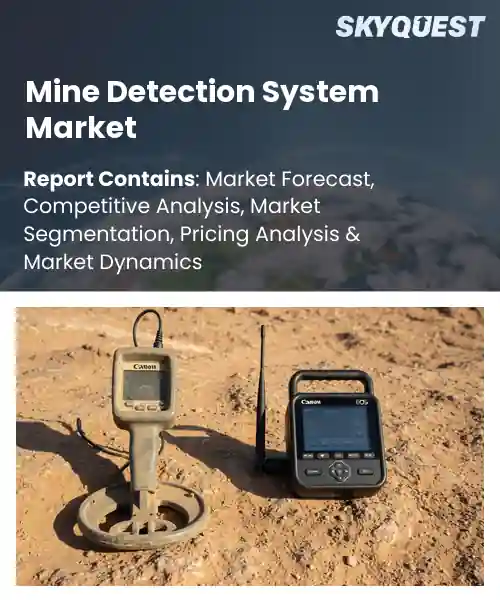
Mine Detection System Market
Report ID: SQMIG20A2774
Report ID: SQMIG20A2774
[email protected]
USA +1 351-333-4748
Report ID:
SQMIG20A2774 |
Region:
Global |
Published Date: July, 2026
Pages:
157
|Tables:
150
|Figures:
78


Global Mine Detection System Market size was valued at USD 5.8 Billion in 2024 and is poised to grow from USD 6.07 Billion in 2025 to USD 8.78 Billion by 2033, growing at a CAGR of 4.72% during the forecast period (2026-2033).
The global mine detection system market encompasses technologies such as ground‑penetrating radar, acoustic sensors, and unmanned aerial vehicles that locate buried explosives in conflict zones, battlefields, and construction sites. Its importance stems from the need to clear landmines that threaten civilians and inhibit economic development. Historically, the market emerged after the Cold War when de‑mining missions intensified in Southeast Asia and the Balkans, prompting governments to fund research into detectors.
Over the past decade, advances in aperture radar and analytics have accelerated product adoption, illustrated by the United Nations’ procurement of large rover systems for clearance international operations in Angola. Building on the momentum described earlier, regulatory pressure and donor funding constitute a pivotal driver of market expansion. As more nations ratify the Ottawa Treaty and allocate reconstruction budgets, demand for faster clearance solutions intensifies, prompting manufacturers to invest in sensor fusion that reduces false‑alarm rates. This capability lowers operational expenses, encouraging firms to embed de‑mining modules into routine site surveys, as seen in Vietnam’s infrastructure program where detection equipment cut clearance time by 30 percent. Consequently, vendors that can demonstrate interoperable platforms and guarantees attract governmental contracts and partnerships, unlocking new regional significant revenue streams across Asia, Africa, and Latin America.
How is AI and IoT integration driving advancements in the mine detection system market?
AI and IoT integration is reshaping mine detection systems by linking sensors, drones and analytics platforms into a continuous intelligence loop. Edge devices capture ground vibrations, magnetic signatures and visual cues, while AI models filter noise and predict threat patterns in real time. This connectivity enables remote monitoring, rapid response and predictive maintenance, reducing the need for manual sweeps in hazardous zones. Operators can now deploy autonomous vehicles that adjust routes based on live risk assessments, improving safety for personnel and accelerating clearance timelines. The market is responding with a surge of smart hardware and cloud services that promise higher reliability and lower operational costs.
In June 2023, a leading defense contractor unveiled an AI and IoT enabled mine detection platform that fuses sensor data with cloud analytics, allowing operators to identify threats from a central command center. The rollout shortens decision cycles and boosts clearance efficiency across contested environments.
Market snapshot - (2026-2033)
Global Market Size
USD 5.8 Billion
Largest Segment
Vehicle-Mounted Systems
Fastest Growth
Robotic & Unmanned Systems
Growth Rate
4.72% CAGR
To get more insights on this market click here to Request a Free Sample Report
Global mine detection system market is segmented by platform, technology, mine type, application, end user and region. Based on platform, the market is segmented into Vehicle-Mounted Systems, Handheld Systems, Robotic & Unmanned Systems and Others. Based on technology, the market is segmented into Ground Penetrating Radar (GPR), Metal Detection, Sonar-Based Detection, Laser-Based Detection (LiDAR & Optical Systems), Infrared & Thermal Imaging and Multi-Sensor Fusion Systems. Based on mine type, the market is segmented into Land Mine Detection Systems and Naval Mine Detection Systems. Based on application, the market is segmented into Military & Defense, Humanitarian Demining, Border Security, Critical Infrastructure Protection and Commercial & Industrial. Based on end user, the market is segmented into Defense Forces, Government & Homeland Security Agencies, Humanitarian & Non-Governmental Organizations (NGOs) and Commercial Organizations. Based on region, the market is segmented into North America, Europe, Asia Pacific, Latin America and Middle East & Africa.
Vehicle mounted systems segment dominates with large mine detection system market share because they integrate detection hardware directly onto operational platforms, providing continuous coverage during missions and leveraging existing power and data infrastructures. This integration reduces deployment time and operational costs, while enhancing survivability through real‑time threat identification. Their proven reliability in diverse terrains and compatibility with armored and mine‑clearance vehicles further solidifies their central role in advancing overall market traction for both defense and humanitarian operators.
As per mine detection system market outlook, handheld systems segment emerges as the most rapidly expanding segment in the mine detection system market. Their portability and ease of deployment enable rapid response in de‑mining and humanitarian operations, prompting increased procurement and innovation cycles. This agility fuels new market entrants and broadens application scenarios, accelerating overall growth.
As per mine detection system market forecast, ground penetrating radar segment dominates because it penetrates various soil compositions to locate buried metallic and non‑metallic threats with high resolution, offering a reliable core technology for both land and naval applications. Its ability to operate under diverse environmental conditions reduces false alarms, while continuous algorithmic improvements enhance depth perception and target discrimination, establishing it as the foundational solution driving market adoption across defense and humanitarian projects global safety goals.
Conversely, multi sensor fusion systems segment is witnessing the strongest growth momentum in the market. Combining radar, metal detection, and imaging yields superior detection accuracy and resilience, attracting investment from defense contractors and NGOs seeking solutions. This convergence accelerates diversification and expands market reach into operational theaters.
To get detailed segments analysis, Request a Free Sample Report
North America shows a mature defense infrastructure coupled with extensive research ecosystems that continuously innovate sensor technologies and autonomous platforms. Strong collaboration between governmental agencies, academic institutions, and industry leaders accelerates product development and integration. Robust funding mechanisms support advanced testing facilities, fostering reliability and performance standards that set global benchmarks. Additionally, the region benefits from a well‑established supply chain that enables rapid scaling of production and deployment. Strategic emphasis on safety and humanitarian missions further drives demand across governmental and commercial sectors, reinforcing the market leadership of North America.
As per mine detection system market regional outlook, United States benefits from a deep pool of engineering talent and a culture of rapid prototyping that shortens development cycles. Integrated support from federal programs encourages joint ventures and technology transfer, while a broad network of specialized manufacturers ensures availability of high‑precision sensors. Continuous investment in export‑ready solutions expands the country’s influence in international demining efforts, reinforcing its position as a market pioneer.
As per mine detection system market regional forecast, Canada leverages strong governmental commitment to safety and environmental stewardship, promoting adoption of cutting‑edge detection solutions. Collaboration between research institutes and defense firms fuels innovation in low‑temperature operational capabilities suited to the country’s diverse terrains. Emphasis on domestic production reduces reliance on external sources, while strategic partnerships with allied nations enhance technology exchange and market reach.
Europe’s expansion is propelled by heightened regulatory focus on civilian safety and cross‑border security, compelling governments to prioritize advanced demining technologies. Collaborative research programs across the continent catalyze the development of high‑resolution sensing and AI‑driven analytics, positioning Europe as an innovation hub. Strong industrial clusters and a tradition of precision engineering support the creation of reliable, export‑oriented solutions. Moreover, coordinated procurement frameworks and joint funding mechanisms enable economies of scale, while growing humanitarian commitments reinforce market momentum throughout the region.
As per mine detection system industry analysis, Germany is anchored by world‑renowned precision engineering and a dense network of specialized suppliers. Integration of sophisticated data processing capabilities with robust hardware yields solutions prized for reliability. Governmental backing for defense and civil safety initiatives stimulates continuous R&D, while strong export channels disseminate German technology across global demining projects, reinforcing its dominant market stance.
United Kingdom benefits from a vibrant defense ecosystem and close ties between academia and industry that accelerate innovation. Focus on adaptable, autonomous platforms meets diverse operational demands, while strategic defense partnerships promote rapid fielding of new solutions. Emphasis on export‑ready technologies extends the United Kingdom’s influence in international humanitarian demining missions, supporting its reputation as a fast‑growing market.
France draws strength from a tradition of cutting‑edge research and strong governmental incentives for safety technologies. Emerging startups combine AI and sensor fusion to create versatile detection systems tailored for varied terrains. Collaborative frameworks with European partners enhance knowledge sharing, positioning France as a rising contributor to the broader continental market expansion.
Asia Pacific advances its position through concerted investment in indigenous development and a growing emphasis on regional security cooperation. Nations are establishing dedicated testing grounds that accommodate diverse environmental conditions, fostering solutions suited to both maritime and land‑based challenges. Strong manufacturing capabilities enable cost‑effective production, while partnerships with global technology providers accelerate technology transfer. Increasing participation in international humanitarian initiatives also showcases the region’s commitment to safe demining practices, enhancing its reputation and market influence.
Japan leverages advanced robotics expertise and a culture of meticulous engineering to produce highly reliable detection equipment. Governmental programs support collaborative research between universities and defense firms, driving continuous refinement of sensor accuracy. Emphasis on compact, energy‑efficient designs aligns with Japan’s extensive maritime focus, positioning the market as a key player in regional safety initiatives.
South Korea benefits from rapid technology adoption cycles and a strong emphasis on electronic miniaturization. Close ties between defense agencies and leading electronics manufacturers foster swift integration of sophisticated processing units into detection platforms. Strategic focus on export readiness and participation in multinational training exercises underscores South Korea’s growing role in the Asia Pacific demining landscape.
To know more about the market opportunities by region and country, click here to
Buy The Complete Report
Increasing Humanitarian Demining Initiatives
Advancements in Sensor Technologies
High Cost of Advanced Systems
Regulatory and Export Control Hurdles
Request Free Customization of this report to help us to meet your business objectives.
The competitive landscape of the global mine detection system industry is shaped by intensified rivalry as firms pursue strategic partnerships, joint ventures, and targeted acquisitions to secure technology leadership and market share. Collaborative agreements enable rapid integration of advanced sonar capabilities, while M&A activity accelerates portfolio diversification and geographic expansion, driving heightened competition and innovation across the sector.
SkyQuest’s ABIRAW (Advanced Business Intelligence, Research & Analysis Wing) is our Business Information Services team that Collects, Collates, Correlates, and Analyses the Data collected by means of Primary Exploratory Research backed by robust Secondary Desk research.
As per SkyQuest analysis the global mine detection system market growth is being propelled primarily by increasing humanitarian demining initiatives, which are unlocking public funding and driving procurement of faster, more reliable clearance tools. A second strong catalyst is the rapid progress in sensor technologies, especially AI‑driven multi‑sensor fusion that lowers false alarms and shortens operation time. The market is however tempered by the high cost of advanced systems, which can deter budget‑constrained defense forces and NGOs. North America remains the dominant region due to its mature defence ecosystem and robust R&D base, while vehicle‑mounted systems hold the largest share, offering integrated, continuous coverage for both military and humanitarian missions. The global mine detection system market trend driven by increasing defense modernization programs, rising security concerns, and the need for advanced technologies to detect and neutralize landmines and explosive threats.
| Report Metric | Details |
|---|---|
| Market size value in 2024 | USD 5.8 Billion |
| Market size value in 2033 | USD 1.65 Billion |
| Growth Rate | 4.72% |
| Base year | 2024 |
| Forecast period | (2026-2033) |
| Forecast Unit (Value) | USD Billion |
| Segments covered |
|
| Regions covered | North America (US, Canada), Europe (Germany, France, United Kingdom, Italy, Spain, Rest of Europe), Asia Pacific (China, India, Japan, Rest of Asia-Pacific), Latin America (Brazil, Rest of Latin America), Middle East & Africa (South Africa, GCC Countries, Rest of MEA) |
| Companies covered |
|
| Customization scope | Free report customization with purchase. Customization includes:-
|
To get a free trial access to our platform which is a one stop solution for all your data requirements for quicker decision making. This platform allows you to compare markets, competitors who are prominent in the market, and mega trends that are influencing the dynamics in the market. Also, get access to detailed SkyQuest exclusive matrix.
Table Of Content
Executive Summary
Market overview
Parent Market Analysis
Market overview
Market size
KEY MARKET INSIGHTS
COVID IMPACT
MARKET DYNAMICS & OUTLOOK
Market Size by Region
KEY COMPANY PROFILES
Methodology
For the Mine Detection System Market, our research methodology involved a mixture of primary and secondary data sources. Key steps involved in the research process are listed below:
1. Information Procurement: This stage involved the procurement of Market data or related information via primary and secondary sources. The various secondary sources used included various company websites, annual reports, trade databases, and paid databases such as Hoover's, Bloomberg Business, Factiva, and Avention. Our team did 45 primary interactions Globally which included several stakeholders such as manufacturers, customers, key opinion leaders, etc. Overall, information procurement was one of the most extensive stages in our research process.
2. Information Analysis: This step involved triangulation of data through bottom-up and top-down approaches to estimate and validate the total size and future estimate of the Mine Detection System Market.
3. Report Formulation: The final step entailed the placement of data points in appropriate Market spaces in an attempt to deduce viable conclusions.
4. Validation & Publishing: Validation is the most important step in the process. Validation & re-validation via an intricately designed process helped us finalize data points to be used for final calculations. The final Market estimates and forecasts were then aligned and sent to our panel of industry experts for validation of data. Once the validation was done the report was sent to our Quality Assurance team to ensure adherence to style guides, consistency & design.
Analyst Support
Customization Options
With the given market data, our dedicated team of analysts can offer you the following customization options are available for the Mine Detection System Market:
Product Analysis: Product matrix, which offers a detailed comparison of the product portfolio of companies.
Regional Analysis: Further analysis of the Mine Detection System Market for additional countries.
Competitive Analysis: Detailed analysis and profiling of additional Market players & comparative analysis of competitive products.
Go to Market Strategy: Find the high-growth channels to invest your marketing efforts and increase your customer base.
Innovation Mapping: Identify racial solutions and innovation, connected to deep ecosystems of innovators, start-ups, academics, and strategic partners.
Category Intelligence: Customized intelligence that is relevant to their supply Markets will enable them to make smarter sourcing decisions and improve their category management.
Public Company Transcript Analysis: To improve the investment performance by generating new alpha and making better-informed decisions.
Social Media Listening: To analyze the conversations and trends happening not just around your brand, but around your industry as a whole, and use those insights to make better Marketing decisions.
REQUEST FOR SAMPLE
 REQUEST FREE CUSTOMIZATION
Global Mine Detection System Market size was valued at USD 5.8 Billion in 2024 and is poised to grow from USD 6.07 Billion in 2025 to USD 1.65 Billion by 2033, growing at a CAGR of 4.72% during the forecast period (2026-2033).
The competitive landscape of the global Mine Detection System market is shaped by intensified rivalry as firms pursue strategic partnerships, joint ventures, and targeted acquisitions to secure technology leadership and market share. Collaborative agreements enable rapid integration of advanced sonar capabilities, while M&A activity accelerates portfolio diversification and geographic expansion, driving heightened competition and innovation across the sector. 'Rheinmetall AG', 'Northrop Grumman Corporation', 'L3Harris Technologies Inc', 'Raytheon Technologies Corporation', 'Thales Group', 'Saab AB', 'Elbit Systems Ltd', 'Leonardo S.p.A.', 'BAE Systems plc', 'General Dynamics Corporation', 'Hensoldt AG', 'Cobham Limited', 'Chemring Group PLC', 'Vallon GmbH', 'Schiebel Corporate', 'Guartel Technologies Ltd', 'Minelab Electronics Pty Ltd', 'Ceia SpA', 'Dynasafe', 'DCD Protected Mobility'
International agencies and non‑governmental organizations are prioritizing the clearance of landmines to protect civilian populations, prompting governments to allocate funds toward advanced detection technologies. This surge in humanitarian focus drives demand for reliable mine detection systems, encouraging manufacturers to innovate and expand product portfolios. As safety standards become stricter, procurement processes favor solutions that demonstrate higher detection accuracy and operational efficiency, thereby reinforcing market growth through sustained investment and broader adoption across affected regions. Stakeholders also emphasize training programs that ensure effective system integration and field performance.
Ai‑Driven Sensor Fusion: The integration of artificial intelligence with multi‑modal detection arrays is reshaping mine detection capabilities. Real‑time data from ground‑penetrating radar, acoustic, and electromagnetic sensors are processed by deep‑learning algorithms that continuously improve target discrimination. This reduces false alarms and accelerates clearance operations, allowing operators to focus on high‑risk zones. As AI models become more robust with field‑collected datasets, manufacturers are positioning these intelligent platforms as the next standard for safety‑critical demining missions worldwide across diverse terrains, conflict zones worldwide and civilian
Why does North America Dominate the Global Mine Detection System Market? |@12


Want to customize this report? This report can be personalized according to your needs. Our analysts and industry experts will work directly with you to understand your requirements and provide you with customized data in a short amount of time. We offer $1000 worth of FREE customization at the time of purchase.
Feedback From Our Clients


 USA (+1) 351-333-4748

