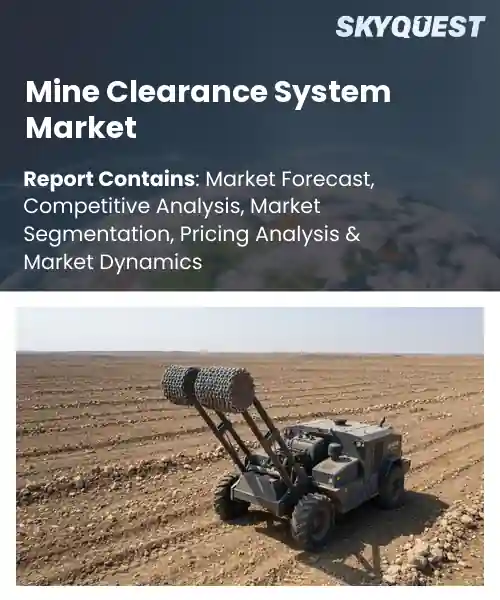
Mine Clearance System Market
Report ID: SQMIG20A2662
Report ID: SQMIG20A2662
[email protected]
USA +1 351-333-4748
Report ID:
SQMIG20A2662 |
Region:
Global |
Published Date: June, 2026
Pages:
157
|Tables:
117
|Figures:
77


Global Mine Clearance System Market size was valued at USD 1.82 Billion in 2024 and is poised to grow from USD 1.94 Billion in 2025 to USD 3.22 Billion by 2033, growing at a CAGR of 6.52% during the forecast period (2026-2033).
The global mine clearance systems market includes the technology and services which can detect, disarm and clear landmines and unexploded ammunition. The importance of this market can be attributed to the need to revitalize agriculture, infrastructure, and resettlement areas along with alleviating the economic pressure on countries affected by mines. Safe Pro Group stated the successful incorporation of their Artificial Intelligence-based landmine detection software into unmanned aircrafts chosen for the U.S. Army Short Range Reconnaissance program. Safe Pro Group's computer vision technology allows unmanned aircraft to detect explosives and dangerous objects from images taken from the sky.
The progress made in the field of robotics can be considered drivers that contribute to the expansion of the market of mine clearance systems, due to the reduction of danger for people, as well as an increase in the rate of clearing, thus leading to the attraction of financing from governments. For example, countries such as Colombia use the Danish-made Mine-Clearance Robot Mk-2, and it allowed a 30 % increase in the amount of the territory cleared each month as opposed to human teams. This has generated contracts worth more than $200 million in South America and Africa, which leads to investments in navigation, sensors, and remote-control systems.
How is AI-driven Automation Improving Safety and Efficiency in the Global Mine Clearance System Market?
The use of AI in automation is transforming mine clearing through the application of sensors on robots and unmanned systems. The use of sensors to identify the environment in real-time and machine learning algorithms in identifying dangerous areas helps operators work from a distance. There is a reduced risk of explosions, and the need for certification of cleared areas is reduced. The new development makes it possible to operate in extreme environments, hence increasing efficiency and making the cost of demining projects less expensive. Governments and humanitarian organizations are looking for quick and safer solutions; hence, the market is providing intelligent solutions that will help in achieving these objectives.
Market snapshot - (2026-2033)
Global Market Size
USD 1.82 Billion
Largest Segment
Mechanical Demining (Vehicles)
Fastest Growth
Robotic Demining Systems
Growth Rate
6.52% CAGR
To get more insights on this market click here to Request a Free Sample Report
Global mine clearance system market is segmented by system type, technology, application, end-user and region. Based on system type, the market is segmented into Manual Demining Equipment, Mechanical Demining (Vehicles), Robotic Demining Systems and EOD (Explosive Ordnance Disposal). Based on technology, the market is segmented into Metal Detectors, Ground Penetrating Radar (GPR) and Infrared/Thermal Imaging. Based on application, the market is segmented into Land Mine Clearance and Underwater Mine Clearance. Based on end-user, the market is segmented into Military, Humanitarian Organizations and Government Agencies. Based on region, the market is segmented into North America, Europe, Asia Pacific, Latin America and Middle East & Africa.
Mechanical Demining Vehicles holds the largest market share due to the combination of high efficiency and reliability that enables processing large volumes of contaminated land. The durable nature of this equipment is adapted to various terrains, while the use of regular detectors provides stability in performance. Such reliability increases trust among the buyers and investors, thereby providing an impulse for further purchases. Moreover, there is a well-developed system of maintenance that prolongs the service of such vehicles and supports their leading position.
Robotic Demining Systems have the fastest growth rate because autonomous systems allow remote control, which prevents personnel from working in dangerous conditions. The developments in sensor technologies and AI navigation make it possible to use robots in a variety of terrains, which brings additional investments into the market of these products.
The Metal Detector segment is dominant since the metal detector offers a proven and economical method for detecting metallic parts of conventional explosives, ensuring reliable detection in different soil types. The ease with which operators can be trained ensures ready incorporation of the technology into existing clearance kits, making them popular in both military and humanitarian efforts.
The Ground Penetrating Radar segment proves to be the fastest growing due to the fact that it is capable of detecting nonmetal threats and buried objects with very high resolution, thereby extending its applicability to areas beyond metal ordnance.
To get detailed segments analysis, Request a Free Sample Report
Asia Pacific dominates the global Mine Clearance System market owing to sophisticated manufacturing, governmental dedication towards de-mining, and historical contamination by wars. The region invests a lot of money into research and development, resulting in new robotic and sensors technology that helps to increase efficiency and safety. Cooperation between defense companies and civilians results in the quick implementation of clearance systems on different terrains. The close location to dangerous regions and a good reputation of being the exporter of such equipment strengthen the dominating position of the Asia Pacific region. Defense ministries in Europe set budgets for upgrading mine-clearance fleet with the help of AI-powered analytics that will enhance target detection. Partnerships between the public and private sectors ensure knowledge transfer and result in rapid development of mine-clearance solutions. Environmental factors influence the development of the products and lead to the adoption of sustainable power source and recycling components.
Market of Mine Clearance System in Japan enjoys the advantage of a well-established defense industry as well as high innovation levels. The local producers use advanced sensors and autonomous navigation in order to cope with the difficulties of working on difficult terrain, while there are government programs that encourage collaboration between the local producers and the universities. The export efforts focus on areas where mine clearing is highly needed due to the reputation of the Japanese equipment.
Mine Clearance System Market in South Korea is powered by the active electronics industry and military partnerships with an emphasis on automation technologies. There is an increased interest in the development of small and nimble systems with analytics. The government promotes joint ventures with friendly countries for boosting exports. Training and certification programs play an important role in the creation of a reliable logistics chain.
The European Mine Clearance System Market is driven by a combination of strict regulation, funding from humanitarian mine clearance programs, and availability of engineers skilled in their trade. International regulations are key priorities for countries in the region, which fuels the need for efficient and eco-friendly mine clearance equipment. Research centers focused on autonomous robotics and mine detection systems work together in Germany, the UK, and France to speed up the development process. User‑focused safety concerns contribute to building trust among users of mine clearance equipment, while exports benefit from the image of high-quality products associated with Europe. These trends create favorable conditions for the fast growth of the market. The defense departments in European countries invest in modernization of their mine clearance fleets using artificial intelligence technologies to better detect targets. Public-private collaboration facilitates the knowledge transfer process, thus making innovations rapidly adopted in real world conditions. Another factor shaping the product development process is environmental awareness.
The market for Mine Clearance Systems in Germany revolves around engineering and defense procurements that emphasize the importance of automation and safety features. The strength of German companies lies in their ability to design modular robots having highly sensitive detectors for use in de-mining operations, whether in military or civilian purposes. The research institutions work together with the companies to expedite technology transfer, and certifications help maintain reliability.
Market for Mine Clearance Systems in the United Kingdom is currently showing fast-paced growth owing to robust governmental funding of innovative mine clearance technologies, along with an active start-up culture. British firms are developing mine clearance solutions that utilize lightweight drones equipped with AI-based threat recognition systems coupled with data communication systems. Joint efforts between universities, laboratories, and defense contractors aid quick validation and testing of prototypes. Export efforts from the UK benefit from its innovative image, making inroads into war-torn areas.
France’s Mine Clearance System Market is supported by extensive government financing, in addition to an industrious ecosystem that thrives on modularity and environmental consciousness. French firms produce customizable mine clearance equipment, which features low noise engine operation and environmentally-friendly material use, in accordance with tough ecological requirements. Collaboration with NATO member countries and NGOs contributes to the sharing of knowledge and participation in multinational missions. This strategy helps to secure its dominant standing in the European de-mining industry.
North America is consolidating its position in the Mine Clearance System market owing to a combination of cutting-edge research potential, substantial defence spending, and an active policy in the area of humanitarian demining. The USA is a leader in the development of new technologies that employ artificial intelligence, self-navigating systems, and high-resolution scanning, while its large number of contractors helps ensure fast commercialization. Canada uses its environmentally friendly standards and experience in the development of equipment for rugged terrain to develop versatile low-environmental impact clearance systems suitable both for domestic use and export. Collaborative efforts between countries help with the exchange of technology and joint field training exercises. Public-private partnership initiatives and export policies pursued by governments also help to broaden the market.
The Market for Mine Clearance Systems in the US drives forward due to defense research and development that focuses on autonomy, sensors, and real-time analysis. Companies in collaboration with educational establishments work together to develop prototypes to quickly deliver them into the field. Procurement of the government is focused on systems that can work in different environments, such as deserts or urban areas, which contributes to the goals of national security. The export policy focuses on regions with a higher need for clearing, using the experience of the USA in mass production.
Canada Mine Clearance System Market can benefit from having a good environmental regulatory regime and the ability to work in difficult terrains. Canadian firms manufacture eco-friendly machines that integrate detection technology and environmentally sustainable energy sources to be able to operate even in bad weather conditions. Cooperation between governmental institutions and companies helps to continuously improve and adapt to changing circumstances both for de-mining purposes in Canada and for providing help in other countries.
To know more about the market opportunities by region and country, click here to
Buy The Complete Report
Increasing Defense Spending
Most governments worldwide have started spending a bigger share of their military budget on humanitarian demining projects as they understand the significance of removing mines from conflict areas. This drives the need for sophisticated mine removal technology, and manufacturers are encouraged to increase their production capacity. As organizations implement standard practices, the procurement cycle becomes regular, resulting in steady investment in modern technology and services. The result is that the market sees a constant flow of new orders that drive growth.
Advancements in Detection Technology
Advances in sensor technology and data analysis are revolutionizing the process of identifying explosive devices buried underground in an increasingly accurate and efficient manner. Such advances make it possible for the operator to survey difficult terrain with less exposure danger to people. By combining automatic devices with live images, solution providers create tools which reduce project delivery times and costs. This competitive advantage results in increased client satisfaction, thus encouraging wider use among governmental and non-governmental organizations looking for effective mine clearing services.
Regulatory Compliance Challenges
Mine clearance contractors have to face an intricate maze of national and international rules and regulations that deal with the handling of explosives, environment, and worker safety issues. The differences between those requirements from one country to another could be quite significant, leading to a considerable administrative load, delays in project implementation and increased operational expenses, thus deterring many entities from undertaking any new ventures. Therefore, prospective buyers will find it harder to make a purchase decision or choose a different option.
Limited Skilled Personnel Availability
Mine clearance is contingent upon the existence of well-trained technicians who can analyze data from sensors, manage dangerous explosives, and take care of complicated equipment. Yet, there is a shortage of such specialists in the global labor force due to the particularity of their job as well as the aging of the experienced workforce. The process of training takes a lot of time and money, which becomes a problem for companies that want to expand their businesses. This limits their plans for implementation and increases costs of labor, forcing firms to postpone orders.
Request Free Customization of this report to help us to meet your business objectives.
The competitive environment consists of just a few big names in the defense industry, who, along with growing their portfolio of mine clearance equipment through mergers and partnerships, are making investments in autonomous mine detection and robotic technologies to meet increasing demands of humanitarian demining. Recent partnerships between large system integrators and smaller robotics companies have resulted in faster commercialization of artificial intelligence-based mine clearance systems.
AI-driven Detection Integration: The field is increasingly adopting innovative technologies such as artificial intelligence and machine learning algorithms to mine detection systems that integrate real-time data from sensors, drones, and ground penetrating radars. The intelligent systems have been shown to increase accuracy in identifying targets, minimize false alarms, and fasten clearance operations. Using intelligent pattern recognition and prediction models makes the distribution of available resources more efficient and safer for the mine clearance team operating on varied terrains.
Sustainable Demining Practices Adoption: An increase in consciousness regarding the environment as well as corporate social responsibility is causing stakeholders to emphasize more on environmentally friendly clearance techniques like biodegradable neutralizers, low impact excavators and renewable energy-driven detectors. Companies have been making use of lifecycle assessments to make sure that there is minimal soil disturbance, water pollution, and carbon footprint. Such an approach creates room for partnerships with NGOs, communities, and even green technology firms.
SkyQuest’s ABIRAW (Advanced Business Intelligence, Research & Analysis Wing) is our Business Information Services team that Collects, Collates, Correlates, and Analyses the Data collected by means of Primary Exploratory Research backed by robust Secondary Desk research.
As per SkyQuest analysis, the market is primarily fueled by an increase in defense expenditure, which goes into humanitarian de-mining activities, and fast incorporation of AI-based detection and navigation technology acts as a secondary, significant driving factor, enhancing the safety aspect and increasing efficiency. The global market is led by the mechanical demining vehicle market owing to the high capacity and reliable performance of these vehicles. Asia-Pacific holds the largest share in the market, backed by established manufacturing capabilities and contamination caused due to past military actions in the region. Nonetheless, strict compliance issues may hamper project completion and increase expenses, acting as a primary restraint for the market.
| Report Metric | Details |
|---|---|
| Market size value in 2024 | USD 1.82 Billion |
| Market size value in 2033 | USD 3.22 Billion |
| Growth Rate | 6.52% |
| Base year | 2024 |
| Forecast period | (2026-2033) |
| Forecast Unit (Value) | USD Billion |
| Segments covered |
|
| Regions covered | North America (US, Canada), Europe (Germany, France, United Kingdom, Italy, Spain, Rest of Europe), Asia Pacific (China, India, Japan, Rest of Asia-Pacific), Latin America (Brazil, Rest of Latin America), Middle East & Africa (South Africa, GCC Countries, Rest of MEA) |
| Companies covered |
|
| Customization scope | Free report customization with purchase. Customization includes:-
|
To get a free trial access to our platform which is a one stop solution for all your data requirements for quicker decision making. This platform allows you to compare markets, competitors who are prominent in the market, and mega trends that are influencing the dynamics in the market. Also, get access to detailed SkyQuest exclusive matrix.
Table Of Content
Executive Summary
Market overview
Parent Market Analysis
Market overview
Market size
KEY MARKET INSIGHTS
COVID IMPACT
MARKET DYNAMICS & OUTLOOK
Market Size by Region
KEY COMPANY PROFILES
Methodology
For the Mine Clearance System Market, our research methodology involved a mixture of primary and secondary data sources. Key steps involved in the research process are listed below:
1. Information Procurement: This stage involved the procurement of Market data or related information via primary and secondary sources. The various secondary sources used included various company websites, annual reports, trade databases, and paid databases such as Hoover's, Bloomberg Business, Factiva, and Avention. Our team did 45 primary interactions Globally which included several stakeholders such as manufacturers, customers, key opinion leaders, etc. Overall, information procurement was one of the most extensive stages in our research process.
2. Information Analysis: This step involved triangulation of data through bottom-up and top-down approaches to estimate and validate the total size and future estimate of the Mine Clearance System Market.
3. Report Formulation: The final step entailed the placement of data points in appropriate Market spaces in an attempt to deduce viable conclusions.
4. Validation & Publishing: Validation is the most important step in the process. Validation & re-validation via an intricately designed process helped us finalize data points to be used for final calculations. The final Market estimates and forecasts were then aligned and sent to our panel of industry experts for validation of data. Once the validation was done the report was sent to our Quality Assurance team to ensure adherence to style guides, consistency & design.
Analyst Support
Customization Options
With the given market data, our dedicated team of analysts can offer you the following customization options are available for the Mine Clearance System Market:
Product Analysis: Product matrix, which offers a detailed comparison of the product portfolio of companies.
Regional Analysis: Further analysis of the Mine Clearance System Market for additional countries.
Competitive Analysis: Detailed analysis and profiling of additional Market players & comparative analysis of competitive products.
Go to Market Strategy: Find the high-growth channels to invest your marketing efforts and increase your customer base.
Innovation Mapping: Identify racial solutions and innovation, connected to deep ecosystems of innovators, start-ups, academics, and strategic partners.
Category Intelligence: Customized intelligence that is relevant to their supply Markets will enable them to make smarter sourcing decisions and improve their category management.
Public Company Transcript Analysis: To improve the investment performance by generating new alpha and making better-informed decisions.
Social Media Listening: To analyze the conversations and trends happening not just around your brand, but around your industry as a whole, and use those insights to make better Marketing decisions.
REQUEST FOR SAMPLE
 REQUEST FREE CUSTOMIZATION
Global Mine Clearance System Market size was valued at USD 1.82 Billion in 2024 and is poised to grow from USD 1.94 Billion in 2025 to USD 3.22 Billion by 2033, growing at a CAGR of 6.52% during the forecast period (2026-2033).
The competitive landscape is shaped by a handful of established defense contractors expanding their mine clearance portfolios through strategic acquisitions and joint ventures, while also investing in autonomous detection technologies and robotics to meet rising humanitarian de‑mining demands. Recent collaborations between major system integrators and specialized robotics firms have accelerated the rollout of AI‑driven clearance solutions, intensifying rivalry over government contracts and international aid funding. 'Rheinmetall AG', 'BAE Systems', 'L3Harris Technologies', 'Chemring Group', 'Northrop Grumman', 'General Dynamics', 'Leonardo SpA', 'Textron Systems', 'iRobot (Amazon)', 'QinetiQ Group', 'Humanitas International', 'HALO Trust', 'Norwegian People's Aid', 'Geneva International Centre for Humanitarian Demining', 'MINES Advisory Group', 'CEIA SpA', 'Vallum AS', 'Minelab (Codan)', 'SELEX Galileo (Leonardo)', 'Pearson Engineering'
Governments worldwide are allocating larger portions of their defense budgets toward humanitarian de‑mining initiatives, recognizing the strategic importance of clearing former conflict zones. This prioritization fuels demand for comprehensive mine clearance systems, encouraging manufacturers to expand production capabilities. As agencies adopt standardized protocols, procurement cycles become more predictable, prompting sustained investment in advanced equipment and support services. Consequently, the market experiences a consistent influx of new contracts that reinforce growth momentum across multiple regions and facilitate long‑term economic recovery in affected communities.
Ai-Driven Detection Integration: The industry is rapidly incorporating advanced artificial intelligence and machine‑learning algorithms into mine detection systems, enabling real‑time data fusion from sensors, drones, and ground‑penetrating radar. These smart platforms enhance target identification accuracy, reduce false positives, and accelerate clearance cycles. By automating pattern recognition and predictive mapping, operators can allocate resources more efficiently, improve safety for demining teams, and adapt to diverse terrains. This technological shift is redefining operational protocols and creating new partnerships between defense contractors, tech startups, and humanitarian agencies.
Why does Asia Pacific Dominate the Global Mine Clearance System Market? |@12


Want to customize this report? This report can be personalized according to your needs. Our analysts and industry experts will work directly with you to understand your requirements and provide you with customized data in a short amount of time. We offer $1000 worth of FREE customization at the time of purchase.
Feedback From Our Clients


 USA (+1) 351-333-4748

