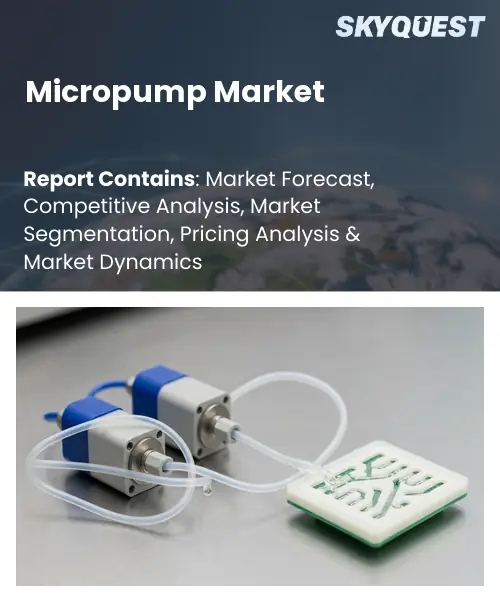
Micropump Market
Report ID: SQMIG35A3788
Report ID: SQMIG35A3788
[email protected]
USA +1 351-333-4748
Report ID:
SQMIG35A3788 |
Region:
Global |
Published Date: June, 2026
Pages:
157
|Tables:
117
|Figures:
72


Global Micropump Market size was valued at USD 1282.5 Million in 2024 and is poised to grow from USD 1408.44 Million in 2025 to USD 2985.4 Million by 2033, growing at a CAGR of 9.82% during the forecast period (2026-2033).
Micropump market centers on miniature fluid-moving devices used in medical, analytical, and industrial systems, and its primary driver is the rising demand for precise, low-volume fluid handling in healthcare diagnostics and drug delivery. This market matters because micropumps enable point-of-care testing, insulin pumps, and lab-on-a-chip platforms that reduce sample sizes and speed results, and its development tracks semiconductor and MEMS advances since the 1990s. Early diaphragm and peristaltic designs evolved into piezoelectric and electroosmotic variants as manufacturing scaled, and companies such as TDK and Bartels pioneered integration into portable devices, demonstrating commercial viability. Regulatory alignment and sensor synergy accelerated uptake.
The chief enabling factor in the global micropump market is technological integration with IoT-enabled medical platforms, which drives revenue by enabling remote monitoring and closed-loop therapies. As devices become networked, developers embed micropumps into wearable insulin systems and implantable drug-delivery modules that automatically adjust dosing, reducing hospital visits and improving outcomes. This connectivity prompts demand for standardized interfaces and battery-efficient actuation, so suppliers invest in low-power piezo and electrostatic designs. The consequence is broader adoption across home healthcare and environmental sensing, creating opportunities for subscription services and aftermarket components and cloud platform partnerships.
How is AI improving performance and reliability in the micropump market?
AI is improving performance and reliability in the micropump market by bringing adaptive control, real time sensor fusion, predictive maintenance and virtual testing into pump systems. These features reduce variability in delicate assays and cut downtime while making devices easier to integrate into automated labs and point of care equipment. Vendors are combining embedded control with analytics so pumps can self tune and compensate for changing resistance and fluid properties. For example Fluigent provides a self learning direct flow control algorithm that removes manual calibration and boosts stability in multi channel setups and industry reports show wider AI and IoT adoption across micro pump platforms.
Fluigent June 2026, Fluigent highlighted its DFC self learning flow control and the Omi automated platform which use adaptive algorithms to stabilize flow and reduce calibration needs. This development strengthens reliability and enables scalable automation which supports faster product development and broader adoption of smart micropump systems.
Market snapshot - (2026-2033)
Global Market Size
USD 1282.5 Million
Largest Segment
Mechanical Micropumps
Fastest Growth
Non-Mechanical Micropumps
Growth Rate
9.82% CAGR
To get more insights on this market click here to Request a Free Sample Report
Global micropump market is segmented by type, material, application, end-use and region. Based on type, the market is segmented into Mechanical Micropumps and Non-Mechanical Micropumps. Based on material, the market is segmented into Silicon, Polymers and Glass. Based on application, the market is segmented into Drug Delivery, Microfluidics, Lab-on-Chip and Cooling Systems. Based on end-use, the market is segmented into Medical, Industrial and Consumer Electronics. Based on region, the market is segmented into North America, Europe, Asia Pacific, Latin America and Middle East & Africa.
Mechanical Micropumps segment dominates because established actuation mechanisms provide robust volumetric control, making them the default choice for precision dosing and industrial fluid handling. Mature manufacturing processes and compatibility with existing microelectromechanical systems enable reliable reproducibility and integration with sensors and control electronics. This familiarity reduces development risk and accelerates adoption among medical and industrial customers, driving procurement choices toward proven mechanical architectures and supporting a large installed base.
However, Non-Mechanical Micropumps are emerging as the most rapidly expanding area because innovations in electrokinetic and valveless designs deliver low-power, silent, wear-free operation. Their fit with miniaturized lab-on-chip and implantable drug delivery uses and suitability for disposable manufacturing are spurring new product development and unlocking novel application opportunities across medical and microfluidic fields.
Silicon segment dominates because well-established microfabrication techniques deliver unmatched dimensional precision and repeatability, enabling complex channel geometries and integrated actuation at micro scales. High material stability and seamless integration with electronic control and sensing layers make silicon the preferred choice for demanding lab-on-chip and high-performance diagnostic applications. This fabrication ecosystem and proven regulatory acceptance reduce development barriers for manufacturers, reinforcing silicon's leadership in high-end micropump systems.
Meanwhile, Polymers are the most rapidly expanding material category as soft lithography and additive manufacturing enable low-cost rapid prototyping and scalable disposable designs. Their tunable biocompatibility and flexibility support wearable and implantable drug delivery and point-of-care diagnostics, driving adoption by emergent manufacturers and unlocking diverse micropump form factors.
To get detailed segments analysis, Request a Free Sample Report
North America commands leadership in the global micropump market through a combination of concentrated technological innovation, a mature medical device ecosystem, and deep industrial manufacturing capabilities that accelerate product development and commercialization. The region benefits from strong collaboration among research institutions, specialized micropump manufacturers, and clinical end users, which drives early adoption of precision fluidic solutions for drug delivery, diagnostics, and analytical instrumentation. Clear regulatory pathways and established quality standards support rigorous validation and market access, while abundant investment and strategic partnerships enable rapid prototyping, pilot production, and scale-up. Comprehensive supplier networks, global OEM relationships, and well developed distribution and service infrastructures ensure reliable aftermarket support and facilitate cross sector integration into healthcare, laboratory, and industrial applications. Intensive intellectual property activity and specialized testing facilities further consolidate competitive advantages across the value chain, reinforcing long term innovation cycles.
Micropump Market in the United States is anchored by a dense cluster of device developers, specialized component suppliers, and advanced testing facilities, fostering rapid design iteration and regulatory engagement. Strong relationships with large medical OEMs and clinical research centers promote integration of micropumps into therapeutic and diagnostic platforms. Emphasis on quality management and aftermarket support enhances adoption by end users, while flexible manufacturing capabilities enable tailored solutions for fluidic applications.
Micropump Market in Canada leverages collaboration between universities and niche manufacturers to advance precision pumping solutions for healthcare and laboratory applications. Emphasis on high quality engineering, customization, and regulatory alignment encourages translation of prototypes into clinically validated devices. Strong service networks and partnerships with regional suppliers facilitate localized production and maintenance. Focus on innovation in materials and low power operation positions offerings to meet diverse end user and industry needs.
Asia Pacific is experiencing rapid expansion in the micropump market driven by converging strengths in precision electronics manufacturing, dense component ecosystems, and strong demand from medical and consumer electronics sectors. Regional suppliers benefit from experience in miniaturized actuator production and flexible assembly processes that support high volume manufacturing and cost efficient design iterations. Increasing collaboration between domestic design houses and global OEMs accelerates technology transfer and localization of advanced fluidic solutions. Growing emphasis on compact, battery efficient and connected medical devices, combined with expanding diagnostic and research infrastructure, fosters diverse end market adoption. Policy support for industrial upgrading and strategic focus on semiconductors and sensors further strengthens capabilities for integrating micropumps into smart systems across healthcare and industrial applications. Regional talent pools and adaptive supply chains support faster commercialization and tailored solutions for local clinical and industrial needs.
Micropump Market in Japan draws on deep expertise in precision engineering, microfabrication, and high reliability manufacturing, enabling development of compact, low noise pumping solutions for medical and analytical platforms. Close integration with sensor and control system suppliers supports sophisticated mechatronic assemblies. Strong emphasis on product quality, certification alignment, and established OEM partnerships fosters adoption in clinical and laboratory settings. Focus on incremental innovation and customization meets demanding end user specifications.
Micropump Market in South Korea benefits from tight integration with advanced electronics and component supply chains, supporting rapid development of miniaturized high performance pumping modules. Skilled manufacturing and agile prototyping enable alignment with consumer electronics and medical device requirements. Collaboration between tech driven startups and manufacturers accelerates commercialization. Emphasis on scalable production, system level integration, and connectivity positions solutions for smart medical devices, point of care diagnostics and laboratory equipment.
Europe is strengthening its position in the micropump market through a combination of deep engineering heritage, strong clinical research networks, and coordinated industry collaboration that facilitates higher value offerings. Regional suppliers emphasize robust quality processes, regulatory harmonization, and interoperable designs that ease adoption by pan regional OEMs and healthcare providers. Investment in microfluidics, system integration and sustainable manufacturing practices supports durable product portfolios. Cross border partnerships, shared testing infrastructure, and targeted specialization in niche segments allow European firms to compete on reliability, customization, and end to end solution delivery. Emerging collaborative models between established manufacturers and innovative startups accelerate commercialization of complex fluidic systems for diagnostics, therapeutic delivery, and analytical instrumentation. Strong emphasis on standards compliance and clinical validation further enhances credibility in global procurement channels, while regional centers of excellence nurture specialized skills for advanced manufacturing.
Micropump Market in Germany benefits from a legacy of precision manufacturing, strong industrial automation capabilities, and collaboration between engineering firms and medical device manufacturers. Emphasis on rigorous quality systems and component traceability supports deployment in safety critical applications. German suppliers focus on robust, durable designs that integrate with process control and automation platforms. Partnerships with clinical research institutions and testing centers help validate solutions for demanding laboratory and industrial environments.
Micropump Market in the United Kingdom is supported by vibrant life sciences clusters, strong translational research, and a dynamic medtech startup community that drives novel fluidic applications. Close links between universities, clinical centers, and contract manufacturers enable effective validation and scale up of innovative designs. Emphasis on user centric design, regulatory expertise, and service oriented commercial models facilitates adoption within diagnostics, drug delivery systems, and laboratory automation across domestic markets.
Micropump Market in France benefits from strong ties between biotechnology research, clinical networks, and engineering firms that drive microfluidic innovation. French manufacturers emphasize customization, precision assembly, and integration with analytical instrumentation for diagnostics and laboratory workflows. Collaboration with public research institutes and cluster initiatives helps bridge early stage development to commercial readiness. Focus on quality, clinical validation, and cross disciplinary partnerships positions offerings for domestic healthcare systems and international markets.
To know more about the market opportunities by region and country, click here to
Buy The Complete Report
Rising Demand In Medical Devices
Growing Adoption In Industrial Automation
Complex Regulatory Approval Pathways
Material Compatibility and Longevity Concerns
Request Free Customization of this report to help us to meet your business objectives.
Competition in the global micropump market is intensifying as consolidation and deep tech spin offs reshape supplier capabilities. M&A and strategic partnerships, for example CEME Group's acquisition of Micropump in 2023, accelerate portfolio breadth and regional reach. Simultaneously, novel principles such as ARTIC's magnetic artificial cilia and piezoelectric MEMS cooling entrants are driving product differentiation and OEM collaborations.
Top Player’s Company Profile
Recent Developments
SkyQuest’s ABIRAW (Advanced Business Intelligence, Research & Analysis Wing) is our Business Information Services team that Collects, Collates, Correlates, and Analyses the Data collected by means of Primary Exploratory Research backed by robust Secondary Desk research. As per SkyQuest analysis, the global micropump market is being propelled primarily by rising demand in medical devices, which require compact, precise fluid handling for drug delivery and diagnostics. A second driver is growing IoT and smart integration enabling remote monitoring, predictive maintenance, closed-loop therapies and aftermarket services. A key restraint remains complex regulatory approval pathways that lengthen development and increase costs. North America currently dominates the market thanks to its mature medical device ecosystem, robust supplier networks and strong commercialization channels, while mechanical micropumps remain the dominant segment because of their established volumetric control, manufacturing maturity and reliability for precision dosing.
| Report Metric | Details |
|---|---|
| Market size value in 2024 | USD 1282.5 Million |
| Market size value in 2033 | USD 2985.4 Million |
| Growth Rate | 9.82% |
| Base year | 2024 |
| Forecast period | (2026-2033) |
| Forecast Unit (Value) | USD Million |
| Segments covered |
|
| Regions covered | North America (US, Canada), Europe (Germany, France, United Kingdom, Italy, Spain, Rest of Europe), Asia Pacific (China, India, Japan, Rest of Asia-Pacific), Latin America (Brazil, Rest of Latin America), Middle East & Africa (South Africa, GCC Countries, Rest of MEA) |
| Companies covered |
|
| Customization scope | Free report customization with purchase. Customization includes:-
|
To get a free trial access to our platform which is a one stop solution for all your data requirements for quicker decision making. This platform allows you to compare markets, competitors who are prominent in the market, and mega trends that are influencing the dynamics in the market. Also, get access to detailed SkyQuest exclusive matrix.
Table Of Content
Executive Summary
Market overview
Parent Market Analysis
Market overview
Market size
KEY MARKET INSIGHTS
COVID IMPACT
MARKET DYNAMICS & OUTLOOK
Market Size by Region
KEY COMPANY PROFILES
Methodology
For the Micropump Market, our research methodology involved a mixture of primary and secondary data sources. Key steps involved in the research process are listed below:
1. Information Procurement: This stage involved the procurement of Market data or related information via primary and secondary sources. The various secondary sources used included various company websites, annual reports, trade databases, and paid databases such as Hoover's, Bloomberg Business, Factiva, and Avention. Our team did 45 primary interactions Globally which included several stakeholders such as manufacturers, customers, key opinion leaders, etc. Overall, information procurement was one of the most extensive stages in our research process.
2. Information Analysis: This step involved triangulation of data through bottom-up and top-down approaches to estimate and validate the total size and future estimate of the Micropump Market.
3. Report Formulation: The final step entailed the placement of data points in appropriate Market spaces in an attempt to deduce viable conclusions.
4. Validation & Publishing: Validation is the most important step in the process. Validation & re-validation via an intricately designed process helped us finalize data points to be used for final calculations. The final Market estimates and forecasts were then aligned and sent to our panel of industry experts for validation of data. Once the validation was done the report was sent to our Quality Assurance team to ensure adherence to style guides, consistency & design.
Analyst Support
Customization Options
With the given market data, our dedicated team of analysts can offer you the following customization options are available for the Micropump Market:
Product Analysis: Product matrix, which offers a detailed comparison of the product portfolio of companies.
Regional Analysis: Further analysis of the Micropump Market for additional countries.
Competitive Analysis: Detailed analysis and profiling of additional Market players & comparative analysis of competitive products.
Go to Market Strategy: Find the high-growth channels to invest your marketing efforts and increase your customer base.
Innovation Mapping: Identify racial solutions and innovation, connected to deep ecosystems of innovators, start-ups, academics, and strategic partners.
Category Intelligence: Customized intelligence that is relevant to their supply Markets will enable them to make smarter sourcing decisions and improve their category management.
Public Company Transcript Analysis: To improve the investment performance by generating new alpha and making better-informed decisions.
Social Media Listening: To analyze the conversations and trends happening not just around your brand, but around your industry as a whole, and use those insights to make better Marketing decisions.
REQUEST FOR SAMPLE
 REQUEST FREE CUSTOMIZATION
Global Micropump Market size was valued at USD 1282.5 Million in 2024 and is poised to grow from USD 1408.44 Million in 2025 to USD 2985.4 Million by 2033, growing at a CAGR of 9.82% during the forecast period (2026-2033).
Competition in the global micropump market is intensifying as consolidation and deep tech spin offs reshape supplier capabilities. M&A and strategic partnerships, for example CEME Group's acquisition of Micropump in 2023, accelerate portfolio breadth and regional reach. Simultaneously, novel principles such as ARTIC's magnetic artificial cilia and piezoelectric MEMS cooling entrants are driving product differentiation and OEM collaborations. 'Bartels Mikrotechnik', 'Servoflo Corporation', 'TOPS Industry & Technology', 'The Lee Company', 'Parker Hannifin (Fluidics)', 'Takasago Fluidic Systems', 'thinXXS Microtechnology', 'Microfluidic Systems', 'Randolph Computer Corp.', 'Chemyx Inc.', 'Elveflow', 'Dolomite Microfluidics (Blacktrace)', 'Smith Medical (ICU Medical)', 'Debiotech SA', 'Fraunhofer EMFT'
Microfluidic and implantable medical device demand drives adoption of micropumps by requiring compact, precise fluid handling solutions that enable accurate dosing and portability. As device designers prioritize miniaturization, micropumps provide reliable pressure and flow control within small footprints and integrate with electronic control systems, facilitating compact therapeutic and diagnostic devices. Collaboration between component suppliers and medical manufacturers improves manufacturability and regulatory readiness, reducing development friction and encouraging incorporation of micropump technologies across a wider range of products, thereby supporting sustained market expansion.
Iot And Smart Integration: Demand for micropumps that communicate with edge devices and cloud platforms is rising, enabling feedback control, remote monitoring, and predictive maintenance. Manufacturers are collaborating with software and system integrators to offer modular interfaces, standardized protocols, and secure connectivity. This trend supports additional services, subscription models, and faster time to market through interoperable ecosystems. Emphasis on low energy consumption, miniaturized electronics, and firmware upgradability positions micropumps as critical components in broader smart systems across medical, industrial, and consumer applications and collaborations.
Why does North America Dominate the Global Micropump Market? |@12


Want to customize this report? This report can be personalized according to your needs. Our analysts and industry experts will work directly with you to understand your requirements and provide you with customized data in a short amount of time. We offer $1000 worth of FREE customization at the time of purchase.
Feedback From Our Clients


 USA (+1) 351-333-4748

