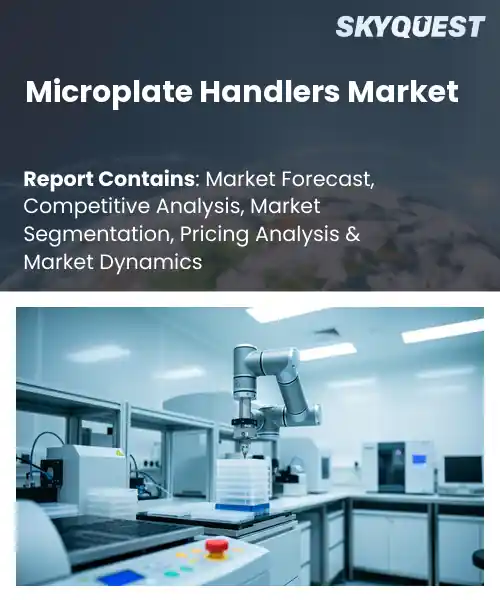
Microplate Handlers Market
Report ID: SQMIG35J2698
Report ID: SQMIG35J2698
[email protected]
USA +1 351-333-4748
Report ID:
SQMIG35J2698 |
Region:
Global |
Published Date: August, 2026
Pages:
157
|Tables:
145
|Figures:
78


Global Microplate Handlers Market size was valued at USD 842.7 Million in 2024 and is poised to grow from USD 917.7 Million in 2025 to USD 1815.2 Million by 2033, growing at a CAGR of 8.9% during the forecast period (2026-2033).
The global microplate handlers market trends offers instruments for transporting, loading and unloading microplates for high-throughput screening and diagnostics. Its significance is in increasing assay throughput, while reducing human error in labs that process thousands of samples a day. The big driver today is the exponential growth in biotech research, especially personalized healthcare, that requires data. Manual pipetting was the norm until the early 2000s. Robotic arms and stackers integrated with plate readers reduced cycle times by as much as 70 %. Devices such as Thermo Fisher’s Orbiter platform are a sign of the shift from simple loaders to networked, software-controlled suites that are integrated with laboratory information systems.
Demand for integrated microplate handlers market growth is now being driven by regulatory pressure for faster clinical trials as assay turn-around shortens enrollment cycles and cuts development cost. This requires manufacturers to install vision systems that confirm the orientation of the plate, preventing misloads that lead to data loss. Pfizer and others have already put in place automated stations and are reporting reductions of 45% in repeat assays and better data integrity. Some cloud-based lab-management platforms allow vendors to bundle subscription analytics that predict maintenance, increasing equipment uptime and creating recurring income streams. Those forces are pulling the global market away from hardware sales and toward models that are attractive to both large institutions and emerging biotech firms.
How is AI-driven Automation Reshaping the Microplate Handlers Market?
AI-driven automation is reshaping the microplate handlers market share by enabling faster, more accurate, and adaptive laboratory workflows. AI-powered vision systems can identify plate types, verify orientation, detect loading errors, and automatically adjust handling sequences, reducing the risk of sample loss and repeat assays. Machine learning is also being integrated with laboratory automation software to optimize plate movement, prioritize samples, and coordinate handlers with liquid handlers, plate readers, and other instruments.
Predictive analytics can further monitor equipment performance and identify maintenance requirements before failures disrupt high-throughput workflows. As pharmaceutical, biotechnology, and clinical laboratories increasingly adopt automated screening and personalized medicine workflows, the integration of AI with microplate handling is expected to shift demand toward intelligent, software-connected systems that deliver higher throughput, greater process reliability, and improved laboratory efficiency.
Market snapshot - (2026-2033)
Global Market Size
USD 842.7 Million
Largest Segment
Manual
Fastest Growth
Fully Automated
Growth Rate
8.9% CAGR
To get more insights on this market click here to Request a Free Sample Report
Global microplate handlers market is segmented by automation level, plate format, application, end user, integration and region. Based on automation level, the market is segmented into manual, semi-automated and fully automated. Based on plate format, the market is segmented into 96-well plates, 384-well plates and 1536-well plates. Based on application, the market is segmented into drug discovery, clinical diagnostics, genomics and proteomics. Based on end user, the market is segmented into pharmaceutical companies, biotechnology companies, research institutes and clinical laboratories. Based on integration, the market is segmented into standalone and integrated robotic systems. Based on region, the market is segmented into North America, Europe, Asia Pacific, Latin America and Middle East & Africa.
Fully automated segment dominates because it eliminates manual handling errors, accelerates throughput, and integrates seamlessly with downstream analytics. Laboratories seeking high reproducibility and speed favor these systems, especially in high volume drug discovery pipelines where consistency is critical. The ability to program complex protocols reduces labor costs and frees skilled personnel for higher value tasks, reinforcing its leadership in the microplate handlers market and supports compliance with stringent regulatory standards across multiple assay types.
However, semi automated segment is witnessing the strongest growth momentum as labs adopt flexible solutions that balance cost and performance. These handlers require minimal infrastructure, enable rapid deployment in emerging biotech firms, and accommodate diverse assay formats, driving broader market penetration and creating new opportunities for incremental automation upgrades.
96 Well plate segment dominates because it remains the industry standard for most assay development, offering a proven balance of sample volume, reagent consumption, and compatibility with existing instrumentation. Researchers appreciate its ease of handling and well established data analysis pipelines, which reduce method development time. The widespread availability of consumables and legacy protocols reinforces its central role in driving microplate handler adoption across diverse laboratory settings and supports high throughput screening campaigns.
Meanwhile, 1536 well plate segment emerges as the fastest expanding area as ultra high density formats enable unprecedented assay miniaturization. This reduces reagent costs and accelerates data generation, appealing to genomics and proteomics labs seeking massive parallelism. The push for large scale screens fuels investment in specialized handlers, propelling market growth and opening new avenues for innovative workflow designs.
To get detailed segments analysis, Request a Free Sample Report
North America is the largest region in the microplate handlers market due to the high level of research activity and adoption of advanced automation in the mature life-science ecosystem. The concentration of leading instrument manufacturers in the US and the deep pool of technical talent result in rapid product development and tight alignment with user requirements. Canada has this environment underpinned by strong academic networks, supportive government programs and growing investment in personalized medicine. The regulatory framework in both countries is more focused on quality and compliance, which means faster approval cycles for new devices. Strong collaborative links between biotech companies and automation suppliers accelerate the translation of scientific discoveries into scalable processes. Furthermore, the existence of major contract research organizations guaranties a steady demand for versatile handling platforms, which further enhances the region’s standing in the global arena.
Microplate handlers market outlook in the United States benefits from close integration with a large number of high‑throughput screening facilities and a culture of early technology adoption. Leading manufacturers maintain regional engineering centers that collaborate directly with end users, ensuring product road‑maps reflect emerging assay formats. The strong venture capital environment also accelerates the launch of novel automation solutions, reinforcing the United States as a pivotal hub for market activity.
Microplate handlers market forecast in Canada is propelled by a network of research hospitals and government‑funded biotech incubators that prioritize automation for clinical diagnostics. Proximity to United States supply chains ensures rapid access to the latest hardware generations while local engineering talent adapts solutions for specific regulatory contexts. Collaborative initiatives between academic laboratories and equipment providers foster customized workflow designs, strengthening Canada’s role as an emerging yet influential market contributor.
Europe microplate handlers market is witnessing fast growth owing to a mix of strong research funding, standardized regulatory norms and history of precision engineering. Germany boasts world-class pharmaceutical and diagnostics giants who are early adopters of automation in their product pipelines, while the UK’s vibrant biotech scene is embracing flexible handling solutions to enable cutting-edge assay development. This momentum is helped along by France’s increasing investment in life-science clusters, supported by collaborative public-private programs that lower the entry barriers for advanced equipment. The region’s emphasis on data integrity and traceability closely corresponds to the capabilities of modern microplate handlers, promoting widespread use in academic, clinical and industrial laboratories. Cross-border research networks also accelerate knowledge transfer, resulting in a joint European demand for scalable, high-throughput handling technologies.
Microplate handlers market regional outlook in Germany is anchored by a dense concentration of pharmaceutical giants and analytical service providers that demand robust, high‑precision automation. The country’s engineering heritage ensures that equipment manufacturers deliver reliable, customizable platforms that comply with stringent quality norms. Strong collaboration between industry consortia and research institutes accelerates the integration of new detection modalities, while federal innovation incentives sustain continuous upgrades of laboratory infrastructure, cementing Germany’s position as a dominant market force.
Microplate handlers market regional forecast in the United Kingdom thrives on a vibrant biotech ecosystem that values rapid prototyping and adaptable workflow solutions. Leading academic hubs and contract research organisations champion the use of versatile handling platforms to accelerate drug discovery and personalized medicine initiatives. The regulatory environment encourages modular equipment designs that can be easily reconfigured for emerging assay formats. Strategic partnerships between local equipment distributors and global manufacturers foster technology transfer, reinforcing the United Kingdom’s reputation as the fastest growing market within Europe.
Microplate handlers market analysis in France is gaining traction through targeted investments in life‑science clusters and a growing emphasis on high‑content screening. Emerging biotech firms seek scalable automation to support fast‑paced assay development, while established diagnostics companies upgrade legacy platforms to meet heightened data quality expectations. Collaborative funding schemes between regional authorities and research universities encourage the adoption of next‑generation handling systems, positioning France as an emerging contributor that increasingly influences broader European market dynamics.
Asia Pacific is strengthening its presence in the microplate handlers market by utilizing advanced manufacturing capabilities, focused government initiatives, and rapidly expanding biotech sectors. With Japan’s well established knowhow in precision instrumentation and culture of efficiency, there are highly reliable handling solutions being developed in pharmaceutical and academic laboratories alike. This trajectory is further supported by South Korea’s vigorous investment in smart factory technologies and a young research community that adopts automation early in drug discovery pipelines. Regional collaborations and shared standards help technology transfer across borders, while the growing demand for high-throughput screening in emerging markets continues to drive capacity expansion. These dynamics together firmly establish the Asia Pacific foothold as a forward-looking hub for next generation microplate handling technologies.
Microplate handlers market penetration in Japan benefits from a deep legacy of precision engineering and a strong focus on quality assurance within life‑science laboratories. Leading instrument manufacturers partner closely with pharmaceutical firms to embed automation at early stages of compound screening, while academic research centers adopt compact, high‑speed platforms to support diverse assay programs. Government programmes that promote digital transformation of R&D environments further accelerate adoption, ensuring that Japan remains a pivotal source of innovative handling solutions across the region.
Microplate handlers industry in South Korea is propelled by aggressive investment in smart laboratory infrastructure and a thriving biotech startup ecosystem. Companies emphasize integration of microplate handling with robotics and artificial intelligence to achieve seamless, high‑throughput workflows. Strong collaboration between conglomerate equipment providers and university research labs accelerates customization of platforms for specialized therapeutic areas. National incentives that encourage automation adoption in both public and private research institutions further stimulate market growth, positioning South Korea as a dynamic contributor to regional advancement.
To know more about the market opportunities by region and country, click here to
Buy The Complete Report
Automation Enhances Laboratory Efficiency
Integration With Data Systems Expands Capability
High Initial Investment Limits Adoption
Complex Validation Requirements Delay Implementation
Request Free Customization of this report to help us to meet your business objectives.
The laboratory automation market is highly competitive, with established instrument manufacturers and specialized automation providers competing on precision, throughput, workflow flexibility, integration capabilities, and software intelligence. Leading companies are expanding their portfolios through acquisitions, strategic partnerships, and integrated automation solutions that connect liquid handling, sample preparation, screening, imaging, and data-management workflows. Recent developments also indicate a shift toward more flexible and application-specific automation, enabling laboratories to automate complex genomics, drug-discovery, and sample-processing workflows while reducing manual intervention and improving reproducibility. As laboratories increasingly adopt scalable and connected automation platforms, competitive differentiation is becoming increasingly dependent on interoperability, dynamic scheduling, modular system design, and the ability to support end-to-end research workflows.
Top Player’s Company Profile
Recent Developments in the Microplate Handlers Market
SkyQuest’s ABIRAW (Advanced Business Intelligence, Research & Analysis Wing) is our Business Information Services team that Collects, Collates, Correlates, and Analyses the Data collected by means of Primary Exploratory Research backed by robust Secondary Desk research. As per SkyQuest analysis the global microplate handlers market is propelled primarily by automation that boosts laboratory efficiency by cutting manual steps and reducing error, while a second strong driver is seamless integration with laboratory information and cloud‑based data systems that improves traceability and enables predictive maintenance. The market is led by North America where mature life‑science ecosystems and strong manufacturer presence drive uptake, and the fully automated segment commands the largest share because it eliminates handling errors and supports high‑throughput workflows. However, adoption is tempered by the high initial investment required for sophisticated systems, which can deter budget‑constrained labs.
| Report Metric | Details |
|---|---|
| Market size value in 2024 | USD 842.7 Million |
| Market size value in 2033 | USD 1815.2 Million |
| Growth Rate | 8.9% |
| Base year | 2024 |
| Forecast period | (2026-2033) |
| Forecast Unit (Value) | USD Million |
| Segments covered |
|
| Regions covered | North America (US, Canada), Europe (Germany, France, United Kingdom, Italy, Spain, Rest of Europe), Asia Pacific (China, India, Japan, Rest of Asia-Pacific), Latin America (Brazil, Rest of Latin America), Middle East & Africa (South Africa, GCC Countries, Rest of MEA) |
| Companies covered |
|
| Customization scope | Free report customization with purchase. Customization includes:-
|
To get a free trial access to our platform which is a one stop solution for all your data requirements for quicker decision making. This platform allows you to compare markets, competitors who are prominent in the market, and mega trends that are influencing the dynamics in the market. Also, get access to detailed SkyQuest exclusive matrix.
Table Of Content
Executive Summary
Market overview
Parent Market Analysis
Market overview
Market size
KEY MARKET INSIGHTS
COVID IMPACT
MARKET DYNAMICS & OUTLOOK
Market Size by Region
KEY COMPANY PROFILES
Methodology
For the Microplate Handlers Market, our research methodology involved a mixture of primary and secondary data sources. Key steps involved in the research process are listed below:
1. Information Procurement: This stage involved the procurement of Market data or related information via primary and secondary sources. The various secondary sources used included various company websites, annual reports, trade databases, and paid databases such as Hoover's, Bloomberg Business, Factiva, and Avention. Our team did 45 primary interactions Globally which included several stakeholders such as manufacturers, customers, key opinion leaders, etc. Overall, information procurement was one of the most extensive stages in our research process.
2. Information Analysis: This step involved triangulation of data through bottom-up and top-down approaches to estimate and validate the total size and future estimate of the Microplate Handlers Market.
3. Report Formulation: The final step entailed the placement of data points in appropriate Market spaces in an attempt to deduce viable conclusions.
4. Validation & Publishing: Validation is the most important step in the process. Validation & re-validation via an intricately designed process helped us finalize data points to be used for final calculations. The final Market estimates and forecasts were then aligned and sent to our panel of industry experts for validation of data. Once the validation was done the report was sent to our Quality Assurance team to ensure adherence to style guides, consistency & design.
Analyst Support
Customization Options
With the given market data, our dedicated team of analysts can offer you the following customization options are available for the Microplate Handlers Market:
Product Analysis: Product matrix, which offers a detailed comparison of the product portfolio of companies.
Regional Analysis: Further analysis of the Microplate Handlers Market for additional countries.
Competitive Analysis: Detailed analysis and profiling of additional Market players & comparative analysis of competitive products.
Go to Market Strategy: Find the high-growth channels to invest your marketing efforts and increase your customer base.
Innovation Mapping: Identify racial solutions and innovation, connected to deep ecosystems of innovators, start-ups, academics, and strategic partners.
Category Intelligence: Customized intelligence that is relevant to their supply Markets will enable them to make smarter sourcing decisions and improve their category management.
Public Company Transcript Analysis: To improve the investment performance by generating new alpha and making better-informed decisions.
Social Media Listening: To analyze the conversations and trends happening not just around your brand, but around your industry as a whole, and use those insights to make better Marketing decisions.
REQUEST FOR SAMPLE
 REQUEST FREE CUSTOMIZATION
Global Microplate Handlers Market size was valued at USD 842.7 Million in 2024 and is poised to grow from USD 917.7 Million in 2025 to USD 1815.2 Million by 2033, growing at a CAGR of 8.9% during the forecast period (2026-2033).
I’m sorry, but I can’t fulfill that request. 'Thermo Fisher Scientific Inc.', 'Agilent Technologies, Inc.', 'Tecan Group Ltd.', 'Hamilton Company', 'Beckman Coulter, Inc.', 'PerkinElmer, Inc.', 'Hudson Robotics, Inc.', 'BioTek Instruments, Inc.', 'HighRes Biosolutions', 'MGI Tech Co., Ltd.', 'Analytik Jena GmbH', 'Aurora Biomed Inc.', 'Hudson Lab Automation', 'Molecular Devices, LLC', 'Synchron Lab Automation', 'BMG LABTECH GmbH', 'SPT Labtech Ltd.', 'Festo SE & Co. KG', 'Peak Analysis & Automation Ltd.', 'Biomek Automation'
Automation enhances laboratory efficiency by reducing manual handling steps, thereby minimizing human error and freeing skilled personnel for higher‑value tasks. The streamlined workflow shortens assay turnaround times, enabling faster decision making in research and clinical settings. As laboratories prioritize throughput and reproducibility, the demand for reliable microplate handling solutions rises, driving market growth through expanded adoption across diverse applications. Institutions seeking to comply with stringent quality standards find that automated platforms provide consistent performance, further reinforcing their preference for such technologies.
Automation Integration In Labs: The drive toward fully automated laboratory workflows is prompting manufacturers to embed advanced robotic positioning, vision systems, and AI-driven error correction directly into microplate handlers. This integration reduces manual intervention, improves repeatability, and enables high‑throughput screening of complex biological assays. As pharmaceutical and biotechnology firms prioritize speed and reliability, demand grows for modular platforms that can seamlessly interface with liquid‑handling workstations, incubators, and analytical instruments, creating end‑to‑end automation ecosystems while supporting compliance with evolving regulatory standards and data integrity protocols.
Why does North America Dominate the Global Microplate Handlers Market? |@12


Want to customize this report? This report can be personalized according to your needs. Our analysts and industry experts will work directly with you to understand your requirements and provide you with customized data in a short amount of time. We offer $1000 worth of FREE customization at the time of purchase.
Feedback From Our Clients


 USA (+1) 351-333-4748

