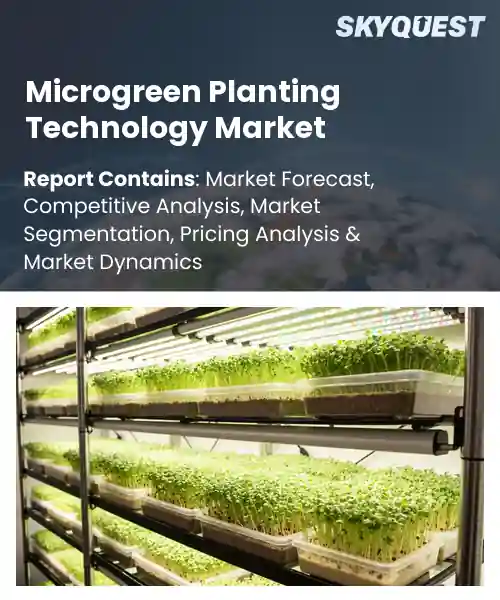
Microgreen Planting Technology Market
Report ID: SQMIG20H2135
Report ID: SQMIG20H2135
[email protected]
USA +1 351-333-4748
Report ID:
SQMIG20H2135 |
Region:
Global |
Published Date: August, 2026
Pages:
157
|Tables:
120
|Figures:
77


Global Microgreen Planting Technology Market size was valued at USD 356.00 Million in 2024 and is poised to grow from USD 398.36 Million in 2025 to USD 979.32 Million by 2033, growing at a CAGR of 11.9% during the forecast period (2026-2033).
The primary engine of the microgreen planting technology market growth is the surge in consumer demand for nutrient‑dense, locally sourced foods. This market comprises hardware such as LED grow lights, modular trays, and cabinets, together with software that monitors moisture, temperature, and growth cycles. As urban populations grow and grocery supply chains lengthen, growers seek systems that can deliver greens within days, a need that has turned microgreens from a niche garnish into a staple salad component. Early hobby kits in the 2010s gave way to AI‑driven farms employed by Whole Foods, illustrating an evolution from home experimentation to commercial scalability.
The convergence of IoT sensors with AI analytics is a decisive factor accelerating the microgreen planting technology market share. Continuous monitoring of temperature, light and nutrient levels allows platforms to auto‑adjust LED spectra and irrigation, cutting waste and shortening harvest cycles. This precision reduces labor expenses while delivering consistent quality, prompting retailers to install on‑site microgreen stations for fresh‑produce displays. A Singapore skyscraper farm now delivers daily trays to office kitchens, and a U.S. meal‑kit service bundles IoT‑linked kits that guarantee a three‑day shelf life, examples that show how data‑driven significant efficiency rapidly opens new distribution channels and fuels market growth.
How is AI and IoT Driving Efficiency in the Microgreen Planting Technology Market?
AI and IoT are transforming microgreen production by turning farms into data‑rich environments. Sensors track temperature, humidity, light intensity and nutrient levels in real time, allowing growers to fine‑tune conditions for each crop cycle. Machine‑learning models analyze this data to predict optimal harvest windows and automatically adjust irrigation or LED spectra, reducing waste and energy use. Edge devices enable localized decision making, while cloud platforms aggregate insights across multiple sites, creating benchmarks that help new growers adopt best practices quickly. The result is faster growth cycles, higher yields per square foot and more consistent flavor and nutritional profiles, making microgreens a more viable option for restaurants and retailers seeking locally sourced produce.
AeroFarms announced a new AI‑driven microgreen module in June 2024, integrating predictive analytics with IoT‑controlled climate systems, which streamlines planting schedules and cuts manual labor, accelerating microgreen planting technology market trends adoption.
Market snapshot - (2026-2033)
Global Market Size
USD 356.0 Million
Largest Segment
Hydroponics
Fastest Growth
Vertical Farming Systems
Growth Rate
11.9% CAGR
To get more insights on this market click here to Request a Free Sample Report
Global microgreen planting technology market is segmented by technology, component, application, end user and region. Based on technology, the market is segmented into hydroponics, aeroponics, soil-based cultivation and vertical farming systems. Based on component, the market is segmented into hardware, software and services. Based on application, the market is segmented into commercial farming, indoor farming, research & education and home cultivation. Based on end user, the market is segmented into commercial growers, retail growers, research institutions and households. Based on region, the market is segmented into North America, Europe, Asia Pacific, Latin America and Middle East & Africa.
Hydroponics segment dominates because it eliminates soil constraints, enabling precise nutrient delivery and consistent yields essential for microgreen cultivation. The water based system supports rapid growth cycles, reduces disease pressure, and integrates easily with controlled environment farms. Its adaptability to various scales, from boutique growers to large commercial operations—creates a reliable foundation that attracts investment and drives widespread adoption across the market, while also facilitating data driven optimization and resource efficiency that further strengthens its market position.
However, aeroponics segment emerges as the fastest growing because its mist based delivery dramatically accelerates root oxygenation, shortening growth cycles and boosting biomass yields. The technology’s minimal water usage and compatibility with modular towers attract innovative startups seeking high density production. This momentum fuels new business models and expands the overall market opportunity for microgreen growers.
Software segment dominates because it provides real time monitoring, predictive analytics, and automated control that streamline microgreen cultivation. Integrated platforms synchronize lighting, irrigation, and climate parameters, reducing manual intervention and error rates. This digital backbone enhances traceability, supports compliance, and enables growers to fine tune recipes, fostering higher productivity and profitability that cement its leadership in the market. By delivering scalable cloud services, it also lowers entry barriers for emerging growers and accelerates ecosystem adoption.
Meanwhile, services segment is witnessing the strongest growth as growers seek expertise in system design, installation, and ongoing optimization. Professional consulting and maintenance reduce downtime, ensure best practice nutrient regimes, and accelerate time to market for new varieties. This demand fuels a service centric business model that expands market reach and creates recurring revenue streams for technology providers.
To get detailed segments analysis, Request a Free Sample Report
The North America microgreen planting technology market is one of the leading markets globally, due to the presence of an advanced research ecosystem, extensive infrastructure for commercial cultivation, and high consumer demand for fresh, nutrient-rich produce. The region boasts a mature venture ecosystem that accelerates the development of precision lighting, automated seeding and climate control systems. Strong distribution networks and a culture that embraces sustainability and local sourcing further support market depth. Additionally, supportive regulatory environments help stimulate innovation as large retailers offer microgreen options in their product lines, creating a cycle of continued adoption and ongoing improvements. When you combine academic insight, private capital and consumer awareness, it creates a landscape for technology providers to scale solutions fast, which is why North America is leading the way in efficiency and product quality in the microgreen industry.
Microgreen planting technology market outlook in the United States thrives on a dense network of agritech incubators, university research programs and a consumer base eager for farm‑to‑table experiences. Pioneering firms leverage sophisticated sensor platforms and data analytics to optimize growth cycles, while large‑scale distributors integrate microgreens into mainstream grocery aisles. This synergy between innovation hubs and retail channels reinforces a dynamic ecosystem that continuously refines production efficiency and product variety.
Microgreen planting technology market forecast in Canada benefits from a strong emphasis on sustainable agriculture and supportive governmental programs that encourage indoor farming ventures. Collaborative research between provincial universities and technology providers yields advances in energy‑efficient lighting and water‑recycling systems. Retail partners increasingly feature locally grown microgreens, reinforcing consumer confidence in domestic production. This focus on environmental stewardship and innovative partnerships positions Canada as a progressive contributor within the North American landscape.
Europe’s microgreen planting technology market is expanding rapidly due to a combination of strict sustainability standards, changing culinary trends, and a concentrated presence of research organizations dedicated to controlled-environment agriculture. Policy frameworks that incentivize resource efficiency drive growers toward precision lighting, hydroponic systems, and closed-loop water management, aligning production with circular economy objectives. Gourmet chefs and health-conscious consumers demand high quality, locally sourced microgreens, so retailers are carving out shelf space for premium products. Collaborations between tech firms, agricultural universities and food-service companies accelerate innovation cycles, promoting solutions that balance productivity with responsibility for the environment. This ecosystem of supportive policy, market demand and collaborative R&D cements Europe’s position as a leading hub for advanced microgreen growing technologies.
Microgreen planting technology market regional forecast in Germany is characterized by a robust research infrastructure and a strong tradition of precision engineering. Partnerships between equipment manufacturers and agricultural institutes drive the development of highly efficient LED modules and automated seeding platforms. Consumers value locally produced, nutrient‑dense greens, prompting supermarkets to highlight German‑grown microgreens. The emphasis on energy‑saving technologies and adherence to strict environmental standards reinforces Germany’s role as a dominant force in European microgreen cultivation.
Microgreen planting technology market regional outlook in the United Kingdom is experiencing the fastest growth across Europe, propelled by a vibrant urban farming culture and high consumer interest in plant‑based nutrition. Innovation hubs in London and Manchester accelerate adoption of modular growth chambers and AI‑driven climate control, while food‑service chains incorporate microgreens into menu offerings. Government incentives for indoor agriculture and a strong focus on sustainability further catalyze market expansion, positioning the United Kingdom as a dynamic leader in microgreen technology adoption.
Microgreen planting technology market analysis in France is emerging as consumers seek fresh, locally cultivated superfoods and chefs experiment with new flavor profiles. Collaborative projects between horticultural schools and start‑up manufacturers focus on developing compact, energy‑efficient growth units suitable for small‑scale urban farms. Retailers are beginning to allocate dedicated sections for French‑grown microgreens, reinforcing consumer confidence in domestic production. This nascent yet promising environment positions France as an upcoming contributor to Europe’s overall microgreen technology landscape.
Rapid urbanization, cultural emphasis on health foods and significant government support for indoor agriculture are bolstering Asia Pacific’s position in the microgreen planting technology market. Smart farming solutions with IoT connectivity, adaptive lighting and water-recycling mechanisms are being adopted by countries in the region with substantial spending, allowing for high-density production in small areas. “Fresh, nutrient-dense ingredients are being driven by consumer trends and food manufacturers are responding to this trend by adding microgreens into value-added products. Technology companies team up with agricultural universities to speed up the development of low-energy growing systems, while export-oriented growers extend the reach of their markets beyond domestic borders. It’s a combination of technological innovation, policy incentives and changing consumer tastes that has helped the region emerge as a major player in the global microgreen technology space.
Microgreen planting technology market penetration in Japan blends sophisticated automation with a deep respect for quality and horticultural tradition. Advanced robotics and sensor‑driven climate management enable precise control of growth parameters, while compact vertical farms cater to dense urban environments. Consumers prioritize safety and nutritional value, encouraging retailers to source domestically produced microgreens. Partnerships between electronics manufacturers and agricultural research institutes foster continuous improvements in energy‑efficient lighting, positioning Japan as a forward‑looking contributor to the regional microgreen technology ecosystem.
Microgreen planting technology industry in South Korea is driven by a tech‑savvy population and strong governmental incentives for smart agriculture. Start‑ups focus on AI‑based optimization platforms that synchronize lighting, temperature and nutrient delivery, creating highly productive indoor farms. Urban consumers demand fresh, health‑enhancing greens, prompting supermarkets to feature locally grown microgreens prominently. Collaboration between engineering universities and commercial growers accelerates the deployment of low‑power LED systems, reinforcing South Korea’s role as an innovative hub within the Asia Pacific microgreen sector.
To know more about the market opportunities by region and country, click here to
Buy The Complete Report
Increasing Consumer Demand for Fresh Produce
Advancements in Hydroponic Growing Systems
High Initial Capital Investment Costs
Limited Technical Expertise Among Farmers
Request Free Customization of this report to help us to meet your business objectives.
The global microgreens market is characterized by competition among controlled-environment agriculture companies, vertical-farming operators, indoor-growing technology providers, and specialized microgreen producers. Companies are differentiating through automated cultivation, LED lighting, environmental controls, hydroponic and aeroponic systems, data-driven crop management, and efficient use of water and energy. Strategic partnerships with retailers, foodservice operators, and technology providers are also important as producers seek to shorten supply chains, improve crop consistency, and expand local production. However, high energy costs, capital requirements, and operational challenges in indoor farming continue to influence competitive positioning.
Top Player’s Company Profile
Recent Developments
SkyQuest’s ABIRAW (Advanced Business Intelligence, Research & Analysis Wing) is our Business Information Services team that Collects, Collates, Correlates, and Analyses the Data collected by means of Primary Exploratory Research backed by robust Secondary Desk research. As per SkyQuest analysis the global microgreen planting technology market is being propelled primarily by rising consumer demand for fresh, nutrient‑dense produce, while the rapid advancement of hydroponic and AI‑enabled growing systems provides a second strong push for adoption. High upfront capital costs remain a notable restraint, limiting entry for smaller growers. North America continues to dominate the market thanks to its mature research ecosystem, venture capital support and strong retail demand. Within the technology split, hydroponics leads the pack, offering precise nutrient delivery and scalability that fuels the overall growth trajectory. These dynamics are encouraging both established agritech firms and new entrants to invest in integrated hardware‑software solutions that improve yield consistency and lower operating expenses.
| Report Metric | Details |
|---|---|
| Market size value in 2024 | USD 356.0 Million |
| Market size value in 2033 | USD 979.32 Million |
| Growth Rate | 11.9% |
| Base year | 2024 |
| Forecast period | (2026-2033) |
| Forecast Unit (Value) | USD Million |
| Segments covered |
|
| Regions covered | North America (US, Canada), Europe (Germany, France, United Kingdom, Italy, Spain, Rest of Europe), Asia Pacific (China, India, Japan, Rest of Asia-Pacific), Latin America (Brazil, Rest of Latin America), Middle East & Africa (South Africa, GCC Countries, Rest of MEA) |
| Companies covered |
|
| Customization scope | Free report customization with purchase. Customization includes:-
|
To get a free trial access to our platform which is a one stop solution for all your data requirements for quicker decision making. This platform allows you to compare markets, competitors who are prominent in the market, and mega trends that are influencing the dynamics in the market. Also, get access to detailed SkyQuest exclusive matrix.
Table Of Content
Executive Summary
Market overview
Parent Market Analysis
Market overview
Market size
KEY MARKET INSIGHTS
COVID IMPACT
MARKET DYNAMICS & OUTLOOK
Market Size by Region
KEY COMPANY PROFILES
Methodology
For the Microgreen Planting Technology Market, our research methodology involved a mixture of primary and secondary data sources. Key steps involved in the research process are listed below:
1. Information Procurement: This stage involved the procurement of Market data or related information via primary and secondary sources. The various secondary sources used included various company websites, annual reports, trade databases, and paid databases such as Hoover's, Bloomberg Business, Factiva, and Avention. Our team did 45 primary interactions Globally which included several stakeholders such as manufacturers, customers, key opinion leaders, etc. Overall, information procurement was one of the most extensive stages in our research process.
2. Information Analysis: This step involved triangulation of data through bottom-up and top-down approaches to estimate and validate the total size and future estimate of the Microgreen Planting Technology Market.
3. Report Formulation: The final step entailed the placement of data points in appropriate Market spaces in an attempt to deduce viable conclusions.
4. Validation & Publishing: Validation is the most important step in the process. Validation & re-validation via an intricately designed process helped us finalize data points to be used for final calculations. The final Market estimates and forecasts were then aligned and sent to our panel of industry experts for validation of data. Once the validation was done the report was sent to our Quality Assurance team to ensure adherence to style guides, consistency & design.
Analyst Support
Customization Options
With the given market data, our dedicated team of analysts can offer you the following customization options are available for the Microgreen Planting Technology Market:
Product Analysis: Product matrix, which offers a detailed comparison of the product portfolio of companies.
Regional Analysis: Further analysis of the Microgreen Planting Technology Market for additional countries.
Competitive Analysis: Detailed analysis and profiling of additional Market players & comparative analysis of competitive products.
Go to Market Strategy: Find the high-growth channels to invest your marketing efforts and increase your customer base.
Innovation Mapping: Identify racial solutions and innovation, connected to deep ecosystems of innovators, start-ups, academics, and strategic partners.
Category Intelligence: Customized intelligence that is relevant to their supply Markets will enable them to make smarter sourcing decisions and improve their category management.
Public Company Transcript Analysis: To improve the investment performance by generating new alpha and making better-informed decisions.
Social Media Listening: To analyze the conversations and trends happening not just around your brand, but around your industry as a whole, and use those insights to make better Marketing decisions.
REQUEST FOR SAMPLE
 REQUEST FREE CUSTOMIZATION
Global Microgreen Planting Technology Market size was valued at USD 356.0 Million in 2024 and is poised to grow from USD 398.36 Million in 2025 to USD 979.32 Million by 2033, growing at a CAGR of 11.9% during the forecast period (2026-2033).
The competitive landscape is shaped by intense rivalry among technology‑driven growers, with market drivers such as rapid product‑cycle acceleration and strategic consolidation. Leading firms are pursuing M&A to acquire proprietary LED patents, forming partnerships with retail chains for in‑store microgreen kiosks, and investing in AI‑based climate control to differentiate yield quality and reduce energy consumption. 'Gotham Greens Holdings, LLC', 'BrightFarms, Inc.', 'Bowery Farming Inc.', 'Plenty Unlimited Inc.', 'AeroFarms, Inc.', 'Farmbox Greens LLC', 'GoodLeaf Farms Inc.', 'Living Earth Farm', 'Fresh Origins LLC', 'Teshuva Agricultural Projects Ltd.', 'Urban Crop Solutions NV', 'Signify N.V.', 'Heliospectra AB', 'Valoya Oy', 'Certhon Group', 'Netafim Ltd.', 'Green Automation Group A/S', 'Priva Holding B.V.', 'Growy B.V.', 'Spread Co., Ltd.'
The rising consumer interest in health‑focused diets drives greater acceptance of microgreens, encouraging restaurants and retailers to incorporate them into menu offerings and product lines. This cultural shift motivates growers to adopt advanced planting technologies, accelerating market expansion as supply chains adapt to meet the desire for locally sourced, nutrient‑dense greens that enhance meal appeal and perceived wellbeing. Moreover, the visual appeal of vibrant sprouts attracts younger demographics, prompting social media promotion that further amplifies consumer curiosity and willingness to experiment with microgreen dishes across home and commercial settings.
Sustainable Urban Integration: Cities are increasingly adopting vertical farms and microgreen modules within residential and commercial buildings to meet rising demand for fresh, locally sourced produce. This shift reduces transportation emissions, shortens supply chains, and leverages unused indoor space. Consequently, technology providers are tailoring compact lighting, hydroponic trays, and IoT monitoring solutions for small‑scale operators, creating new revenue streams. The convergence of real‑estate development and food tech accelerates market adoption, positioning microgreen systems as a cornerstone of sustainable urban living for future generations.
Why does North America Dominate the Global Microgreen Planting Technology Market? |@12


Want to customize this report? This report can be personalized according to your needs. Our analysts and industry experts will work directly with you to understand your requirements and provide you with customized data in a short amount of time. We offer $1000 worth of FREE customization at the time of purchase.
Feedback From Our Clients


 USA (+1) 351-333-4748

