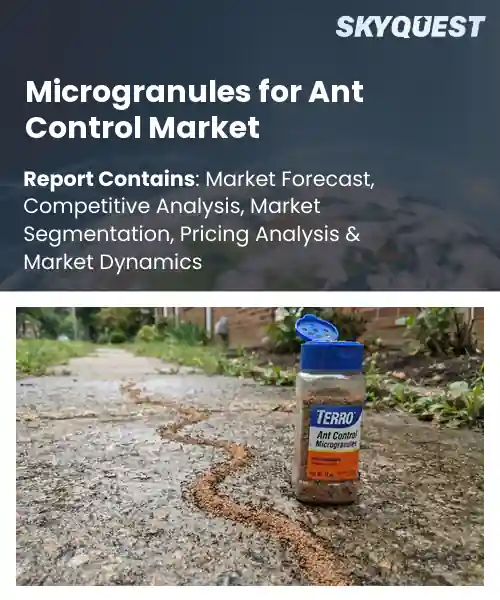
Microgranules for Ant Control Market
Report ID: SQMIG15C2248
Report ID: SQMIG15C2248
[email protected]
USA +1 351-333-4748
Report ID:
SQMIG15C2248 |
Region:
Global |
Published Date: September, 2026
Pages:
157
|Tables:
121
|Figures:
77


Global Microgranules For Ant Control Market size was valued at USD 195.0 Million in 2024 and is poised to grow from USD 203.77 Million in 2025 to USD 289.79 Million by 2033, growing at a CAGR of 4.5% during the forecast period (2026-2033).
Microgranules for ant control are particles that release insecticide, enabling active ingredient to travel through ant tunnels and be consumed by colony. Main driver of the market is rapid urban expansion, which increases indoor ant infestations that jeopardize food safety and cause property damage, leading consumers to prefer low‑toxicity, long‑lasting products. The sector shifted from broad‑spectrum sprays in the 1990s to granular baits in the 2000s, and mid‑2010s introduction of microgranule technology accelerated adoption. Brands such as Bayer’s Advion and BASF’s AntShield show how regulations on volatile organics have redirected formulation choices toward microgranular solutions, paving the way for growth.A key factor propelling the microgranules market is tightening pesticide safety regulations, which compel manufacturers to develop products that meet consumer health concerns and standards. Agencies such as EPA limit permissible pyrethroid levels, prompting investment in microencapsulation that traps active molecules in a biodegradable matrix, reducing off‑target drift while preserving efficacy. This shift creates opportunities in institutional settings schools, hospitals, food‑processing plants where strict compliance drives procurement of microgranular baits that can be placed and monitored remotely. Consequently, firms that combine regulatory expertise with scalable production are poised to capture expanding contracts, while users benefit from safer, longer‑lasting, significantly effective ant management.
How is AI-enhanced microgranules reshaping the ant control market?
AI enhanced microgranules are tiny pesticide particles that embed machine learning driven release profiles. They sense temperature and humidity to time the delivery of ant toxicants, reducing waste and non target exposure. The market now sees faster knock down of colonies and longer residual protection. Traditional dusts and liquid baits require frequent reapplication, while these smart granules adapt to nest activity patterns. Manufacturers are integrating field data from sensors to refine attractant blends, making products more reliable across urban and agricultural settings. The result is a shift toward precision pest management that aligns with sustainability goalsBASF June 2023, introduced an AI enhanced microgranule ant bait that uses real time nest monitoring to adjust dosage and extend field life. The launch has accelerated adoption by growers and city pest services, demonstrating how data driven granules boost control efficiency and lower application frequency
Market snapshot - (2026-2033)
Global Market Size
USD 195.0 Million
Largest Segment
Insecticides
Fastest Growth
Botanical & Bio-Based Agents
Growth Rate
4.5% CAGR
To get more insights on this market click here to Request a Free Sample Report
Global microgranules for ant control market is segmented by active ingredient, application, distribution channel, end user and region. Based on active ingredient, the market is segmented into Insecticides, Insect Growth Regulators, Botanical & Bio-Based Agents and Other Active Ingredients. Based on application, the market is segmented into Residential, Commercial, Agricultural and Industrial. Based on distribution channel, the market is segmented into Retail Stores, Specialty Pest Control Stores, Online Retail and Professional Pest Control Services. Based on end user, the market is segmented into Households, Commercial Establishments, Agricultural Producers and Pest Control Operators. Based on region, the market is segmented into North America, Europe, Asia Pacific, Latin America and Middle East & Africa.
Insecticides segment dominates because they provide rapid knock down of ant colonies, meeting the primary demand for immediate pest relief. Their well established efficacy builds confidence among users, encouraging repeat purchases. Formulators can incorporate them into microgranules with consistent release profiles, ensuring lasting protection. This reliability, combined with broad acceptance across residential and commercial settings, fuels sustained preference for insecticide based microgranules in ant control solutions across diverse applications and industries globally increasingly adopted.
Meanwhile, Botanical & Bio-Based Agents segment emerges as the most rapidly expanding area in the microgranules for ant control market. Growing consumer preference for greener products drives innovation in plant derived actives, enabling effective ant suppression with reduced toxicity. Regulatory support for low impact pest control fuels formulation research, creating fresh opportunities and widening appeal among eco conscious users.
Retail Stores segment dominates because they provide immediate physical access to microgranules, allowing consumers to inspect packaging and receive instore advice. Their entrenched presence in neighborhoods creates habitual purchasing patterns, especially for quick ant remediation needs. Visibility on shelves reinforces brand recognition broadly, while promotional displays stimulate impulse buying. This tactile experience combined with established logistics makes retail outlets the primary acquisition channel for most end users for many today.
Meanwhile, Online Retail segment is witnessing the strongest growth momentum in the microgranules for ant control market. Expanding ecommerce platforms simplify ordering, offering home delivery that meets modern convenience expectations. Advanced data analytics enable personalized product recommendations, driving higher conversion rates. Digital marketing amplifies reach to tech savvy consumers, while subscription models encourage repeat usage, collectively accelerating market penetration and opening new revenue streams.
To get detailed segments analysis, Request a Free Sample Report
North America leverages a mature regulatory framework that encourages the development of environmentally responsible pest‑management products, creating a fertile ground for microgranule innovation. A well‑established network of specialized distributors and a deep‑rooted culture of preventive home care amplify market reach. Research institutions and leading manufacturers collaborate closely, accelerating formulation improvements and ensuring alignment with consumer expectations for safety and efficacy. High consumer awareness of indoor pest threats drives consistent demand, while the region’s logistics infrastructure supports rapid product availability across diverse retail channels. These combined advantages reinforce North America’s leadership position and sustain its competitive edge in the global arena.
Microgranules for Ant Control Market in the United States benefit from extensive research collaborations that translate cutting‑edge scientific insights into commercially viable solutions. Leading manufacturers prioritize product safety and performance, fostering strong confidence among homeowners and professional applicators. A broad spectrum of retail outlets, from large chains to niche specialty stores, ensures widespread accessibility. Consumer education programs and robust extension services further reinforce adoption, while a proactive regulatory environment sustains continuous product refinement.
Microgranules for Ant Control Market in Canada is shaped by a climate that accentuates seasonal pest activity, prompting proactive control measures. The market enjoys support from government initiatives that emphasize integrated pest management and reduced reliance on broad‑spectrum chemicals. Local manufacturers focus on formulation precision, aligning with stringent health and environmental standards. Distribution channels integrate both urban and rural networks, allowing timely product delivery. Consumer preference for low‑impact solutions drives steady demand, reinforcing the country’s role within the broader North American landscape.
Europe’s expansion is propelled by stringent environmental directives that favor low‑impact pest‑control technologies, positioning microgranules as a preferred alternative. Collaborative research across the continent nurtures innovation, yielding formulations that meet rigorous safety criteria while delivering effective ant mitigation. Consumer consciousness regarding indoor health and ecological footprint fuels demand for products that blend efficacy with sustainability. Well‑developed logistical frameworks and a dense retail network accelerate market penetration, while policy incentives encourage adoption in residential and commercial settings. These dynamics collectively accelerate the market’s rapid growth across European territories.
Microgranules for Ant Control Market in Germany thrives on a strong tradition of scientific excellence and industrial precision. Leading chemical firms invest heavily in formulation research, ensuring products meet exacting performance and environmental standards. The market benefits from a comprehensive distribution system that spans large‑scale retailers and specialized horticultural outlets. Consumer trust is reinforced by transparent labeling and rigorous testing protocols, driving consistent product uptake throughout residential and professional segments.
Microgranules for Ant Control Market in the United Kingdom experiences swift adoption driven by heightened awareness of indoor pest risks and a cultural shift toward eco‑friendly solutions. Innovative startups and established firms alike focus on delivering user‑friendly application formats that align with modern living spaces. Retail presence is strong, with both online platforms and high‑street stores providing easy access. Regulatory guidance emphasizing reduced chemical load supports rapid market diffusion, positioning the United Kingdom as a leading growth engine within Europe.
Microgranules for Ant Control Market in France is emerging as consumers increasingly prioritize health‑centric home environments. Collaborative ventures between research institutes and niche manufacturers foster product designs that emphasize biodegradability and low toxicity. Distribution channels integrate pharmacy chains and garden centers, facilitating broad outreach. Educational campaigns highlighting the benefits of targeted microgranule technology reinforce market confidence, encouraging gradual but steady expansion across urban and suburban households.
Asia Pacific is reinforcing its market presence through a convergence of rising urban density, heightened awareness of indoor hygiene, and an openness to modern pest‑management solutions. Regional manufacturers are adopting advanced formulation techniques, often leveraging local expertise to produce cost‑effective yet high‑performance microgranules. Growing retail ecosystems, encompassing e‑commerce platforms and traditional outlets, ensure rapid product diffusion. Governmental encouragement of sustainable pest control aligns with consumer preferences for reduced chemical exposure, fostering a supportive policy environment. Together, these factors enable Asia Pacific to evolve from a developing market to a significant contributor within the global landscape.
Microgranules for Ant Control Market in Japan reflects a meticulous approach to product quality and consumer safety. Companies integrate sophisticated encapsulation technologies that deliver precise ant control while minimizing residual impact. Distribution channels blend high‑tech online marketplaces with established home‑improvement chains, ensuring accessibility for tech‑savvy shoppers. Public awareness campaigns emphasize the importance of proactive ant management in compact living spaces, driving consistent demand for reliable microgranule solutions.
Microgranules for Ant Control Market in South Korea benefits from a dynamic blend of innovative research and rapid consumer adoption. Local firms prioritize rapid development cycles, delivering formulations that address both effectiveness and environmental stewardship. Retail networks, including major department stores and digital platforms, provide extensive market coverage. A cultural emphasis on clean indoor environments motivates homeowners to embrace microgranule technologies, reinforcing the country’s growing influence in the regional market.
To know more about the market opportunities by region and country, click here to
Buy The Complete Report
Increasing Demand for Sustainable Pest Control
Advancements in Controlled Release Technology
Regulatory Scrutiny Over Pesticide Use
High Cost of Advanced Formulations
Request Free Customization of this report to help us to meet your business objectives.
Top Player’s Company Profile
Recent Developments
SkyQuest’s ABIRAW (Advanced Business Intelligence, Research & Analysis Wing) is our Business Information Services team that Collects, Collates, Correlates, and Analyses the Data collected by means of Primary Exploratory Research backed by robust Secondary Desk research. As per SkyQuest analysis the global microgranules for ant control market is being propelled primarily by the rising demand for sustainable pest‑control solutions, which pushes manufacturers toward low‑toxicity, biodegradable formulations. A second important driver is the rapid advancement of controlled‑release technologies that extend residual activity and lower re‑application frequencies, further boosting user confidence. The market’s growth is tempered by stringent regulatory scrutiny over pesticide ingredients, which adds compliance costs and can slow new product launches. North America remains the dominant region thanks to mature regulations, extensive distribution networks and high consumer awareness. Within the product mix, the insecticides segment leads the market due to its proven rapid knock‑down performance and broad acceptance across residential and commercial applications.
| Report Metric | Details |
|---|---|
| Market size value in 2024 | USD 195.0 Million |
| Market size value in 2033 | USD 289.79 Million |
| Growth Rate | 4.5% |
| Base year | 2024 |
| Forecast period | (2026-2033) |
| Forecast Unit (Value) | USD Million |
| Segments covered |
|
| Regions covered | North America (US, Canada), Europe (Germany, France, United Kingdom, Italy, Spain, Rest of Europe), Asia Pacific (China, India, Japan, Rest of Asia-Pacific), Latin America (Brazil, Rest of Latin America), Middle East & Africa (South Africa, GCC Countries, Rest of MEA) |
| Companies covered |
|
| Customization scope | Free report customization with purchase. Customization includes:-
|
To get a free trial access to our platform which is a one stop solution for all your data requirements for quicker decision making. This platform allows you to compare markets, competitors who are prominent in the market, and mega trends that are influencing the dynamics in the market. Also, get access to detailed SkyQuest exclusive matrix.
Table Of Content
Executive Summary
Market overview
Parent Market Analysis
Market overview
Market size
KEY MARKET INSIGHTS
COVID IMPACT
MARKET DYNAMICS & OUTLOOK
Market Size by Region
KEY COMPANY PROFILES
Methodology
For the Microgranules for Ant Control Market, our research methodology involved a mixture of primary and secondary data sources. Key steps involved in the research process are listed below:
1. Information Procurement: This stage involved the procurement of Market data or related information via primary and secondary sources. The various secondary sources used included various company websites, annual reports, trade databases, and paid databases such as Hoover's, Bloomberg Business, Factiva, and Avention. Our team did 45 primary interactions Globally which included several stakeholders such as manufacturers, customers, key opinion leaders, etc. Overall, information procurement was one of the most extensive stages in our research process.
2. Information Analysis: This step involved triangulation of data through bottom-up and top-down approaches to estimate and validate the total size and future estimate of the Microgranules for Ant Control Market.
3. Report Formulation: The final step entailed the placement of data points in appropriate Market spaces in an attempt to deduce viable conclusions.
4. Validation & Publishing: Validation is the most important step in the process. Validation & re-validation via an intricately designed process helped us finalize data points to be used for final calculations. The final Market estimates and forecasts were then aligned and sent to our panel of industry experts for validation of data. Once the validation was done the report was sent to our Quality Assurance team to ensure adherence to style guides, consistency & design.
Analyst Support
Customization Options
With the given market data, our dedicated team of analysts can offer you the following customization options are available for the Microgranules for Ant Control Market:
Product Analysis: Product matrix, which offers a detailed comparison of the product portfolio of companies.
Regional Analysis: Further analysis of the Microgranules for Ant Control Market for additional countries.
Competitive Analysis: Detailed analysis and profiling of additional Market players & comparative analysis of competitive products.
Go to Market Strategy: Find the high-growth channels to invest your marketing efforts and increase your customer base.
Innovation Mapping: Identify racial solutions and innovation, connected to deep ecosystems of innovators, start-ups, academics, and strategic partners.
Category Intelligence: Customized intelligence that is relevant to their supply Markets will enable them to make smarter sourcing decisions and improve their category management.
Public Company Transcript Analysis: To improve the investment performance by generating new alpha and making better-informed decisions.
Social Media Listening: To analyze the conversations and trends happening not just around your brand, but around your industry as a whole, and use those insights to make better Marketing decisions.
REQUEST FOR SAMPLE
 REQUEST FREE CUSTOMIZATION


Want to customize this report? This report can be personalized according to your needs. Our analysts and industry experts will work directly with you to understand your requirements and provide you with customized data in a short amount of time. We offer $1000 worth of FREE customization at the time of purchase.
Feedback From Our Clients


 USA (+1) 351-333-4748

