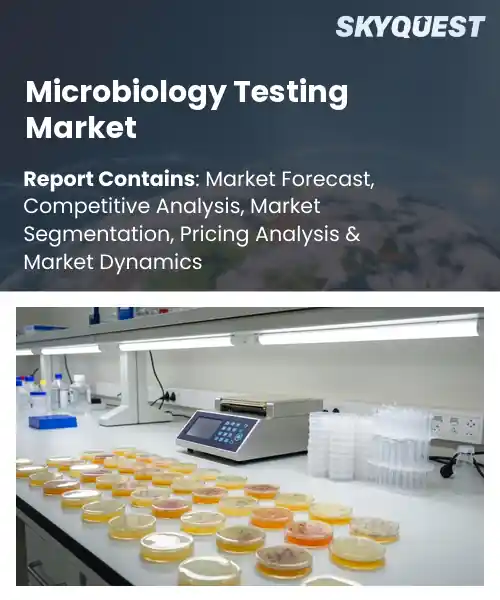
Microbiology Testing Market
Report ID: SQMIG35H2409
Report ID: SQMIG35H2409
[email protected]
USA +1 351-333-4748
Report ID:
SQMIG35H2409 |
Region:
Global |
Published Date: February, 2026
Pages:
157
|Tables:
154
|Figures:
78


Global Microbiology Testing Market size was valued at USD 5.63 Billion in 2024 and is poised to grow from USD 6.14 Billion in 2025 to USD 12.32 Billion by 2033, growing at a CAGR of 9.09% during the forecast period (2026-2033).
The global microbiology testing sector includes all the diagnostic methods which use different platforms and automated systems to identify microorganisms in healthcare and food safety and pharmaceutical quality control operations. The market holds high importance because of health needs and increasing infectious disease outbreaks and regulatory requirements which link diagnostic test accuracy to patient results and product safety.
Moreover, the global microbiology testing market growth started to shift from manual culturing and microscopy techniques toward rapid molecular diagnostic methods and next-generation sequencing because laboratories needed quicker test results and better sensitivity which was demonstrated through the widespread use of PCR for detecting pathogens and conducting genomic surveillance during the recent pandemic. The market has become more complicated through this advancement, which has led to greater investment in integrating instruments.
In addition, the technological shift has led to increased demand for rapid high-throughput and multiplexed assays because hospitals and public health labs need these tests to help them implement PCR panels and automated susceptibility testing systems which will help them achieve faster treatment while maintaining stewardship. The pharmaceutical and food manufacturing industries need to implement environmental monitoring systems which use rapid microbial detection because regulatory standards for cleanrooms and biologics quality control require them to establish cleanroom environments. The integrated diagnostics system together with cloud data analytics and point-of-care testing devices creates a system which transforms fast test results into cost savings and public health results.
How is AI Improving Diagnostic Speed and Accuracy in the Microbiology Testing Market?
The field of AI drives microbiology diagnostic progress through its capacity to perform automatic image analysis and pattern detection and to merge data from different systems. The system uses autonomous equipment to read test plates and it employs algorithms to forecast antimicrobial resistance while AI technology helps researchers understand genetic testing outcomes. Vendors develop instruments by integrating software and workflow automation technology, which decreases the need for manual operations and enhances operational uniformity. The changes make it faster for laboratories to achieve usable results while they assist antimicrobial stewardship programs and enable labs to handle increased testing amounts without compromising their operational standards. The medical field uses AI systems to evaluate negative test results from cultures and the technology processes urine samples through automatic pre-analytical functions and the system uses AI to enhance pathogen identification that delivers results for clinical decision-making.
Market snapshot - 2026-2033
Global Market Size
USD 6.3 Billion
Largest Segment
Culture Testing
Fastest Growth
Molecular Testing
Growth Rate
9.3% CAGR
To get more insights on this market click here to Request a Free Sample Report
The microbiology testing market is categorized across multiple dimensions, including test type, product, technology, application, end user, and region. By test type, the market comprises culture testing, molecular testing, immunological testing, biochemical testing, and antibiotic susceptibility testing. By product, it is divided into instruments & equipment, reagents & consumables, and software & services. By technology, the market includes culture-based testing, molecular diagnostics, mass spectrometry, rapid or automated methods, and biosensors & nano-based assays. By application, microbiology testing is used in clinical diagnostics, environmental testing, food & beverage testing, pharmaceutical testing, and industrial quality control. By end user, the market serves hospitals, diagnostic laboratories, pharmaceutical & biotechnology companies, food & beverage companies, academic & research institutes, environmental testing laboratories, and cosmetics & personal-care laboratories. Geographically, the market is segmented into North America, Europe, Asia Pacific, Latin America, and the Middle East & Africa.
According to the global microbiology testing market analysis, the culture testing segment dominated the market which serves as the best method to detect bacterial and fungal infections while confirming disease status for treatment decisions. Hospitals use blood, urine, and sputum cultures to test patients for pneumonia and sepsis, and urinary tract infections. Intensive care units continue to perform routine blood cultures to identify bloodstream infections and guide antibiotic treatment. The tests achieve worldwide clinical testing reliability which leads to regulatory body approval in all international clinical testing locations.
However, the high sensitivity and short turnaround time of molecular testing will drive its fastest expansion. The use of PCR-based respiratory panels and TB diagnosis, and hospital infection screening havebecome increasingly common. Molecular tests are now used in laboratories to monitor disease outbreaks and provide immediate test results. Emergency rooms benefit from faster discovery because it enables medical staff to make treatment decisions and handle patient isolation procedures.
As per the global microbiology testing market forecast, the testing process in microbiology needs multiple culture media, assay kits, stains, and cartridges for every single sample tested which resulted in reagents and consumables becoming the primary expense category. Instruments generate repeat revenue, but these items create ongoing income streams. The diagnostic labs which process hundreds of patient samples daily must continuously acquire test kits and culture plates. The global hospital and reference laboratory operations rely primarily on consumable items for their main revenue generation.
Whereas the software & services category is anticipated to have the highest microbiology testing market share during their transition to digital lab management and automated result interpretation. AI-assisted reporting and remote instrument monitoring and hospital information system integration have become essential requirements in current operations. Labs are allocating funds to data analytics platforms and microbiology workflow tools because of the increased need for automated labs and stricter documentation requirements.
To get detailed segments analysis, Request a Free Sample Report
As per the microbiology testing market regional forecast, the combination of existing healthcare systems and dedicated diagnostic laboratory networks and ongoing funding for testing advancements enables North America to maintain its dominance over other regions. The existing regulatory framework enables clinical testing of new assays to proceed through testing and validation processes. Academic research centers and biotechnology companies and established diagnostics firms work together to bring new products to market through licensing agreements. The clinical testing environment in critical markets supports microbiological testing by establishing reimbursement systems and payer approval processes.
United States Microbiology Testing Market
The United States microbiology testing industry expands through its vast clinical laboratory network and centralized reference centers which foster the use of both high-throughput and point-of-care diagnostic systems. The demand for clinical services arises from hospital systems and research institutions and the diagnostics market which drives the implementation of new molecular and culture technologies. The system provides clinicians with access to different healthcare settings which use both established procurement processes and commercialization methods according to the healthcare needs of their system.
Canada Microbiology Testing Market
The microbiology testing market in Canada exists through multiple provincial laboratories which work together with different academic and agency networks to create common standards on quality control. The laboratory system acquired new automation technologies through both modernized laboratory operations and its partnerships with diagnostic equipment manufacturers. Public health departments require both standard culture methods and cutting-edge molecular diagnostic testing methods which lead to permanent demand for these testing methods throughout the nation.
The regulatory environment and the clinical research infrastructure and the public health framework which prioritizes surveillance systems and antimicrobial treatment control lead to swift growth across European nations. The laboratory system acquired new automation technologies through both modernized laboratory operations and its partnerships with diagnostic equipment manufacturers. Innovative assays are validated and introduced to the market through active participation in multinational clinical studies and a vibrant medtech ecosystem and collaborative consortia. The coordinated testing processes and developed laboratory systems and point-of-care testing technologies lead to better operational results and increased public access to essential medical services. The combination of payer involvement and key market quality standard requirements establishes Europe as an active market which supports existing organizations and new product development in the microbiology testing industry.
Germany Microbiology Testing Market
The microbiology testing sector in Germany relies on university hospitals and reference laboratories and diagnostics manufacturers to carry out their work. The research institutes work together with the commercial sector to accelerate the development of molecular tests and their automated processing. Clinical laboratories adopt new technologies because their practices follow standardized procedures while their organizations coordinate surveillance, and their offices receive accreditation. The market environment favors established suppliers and partnership models that scale laboratory services and innovative testing solutions across varied care settings.
United Kingdom Microbiology Testing Market
The microbiology testing market in United Kingdom is witnessing accelerated adoption driven by integrated national health systems and targeted innovation programs that support rapid evaluation and deployment of novel diagnostics. Collaborative networks among hospitals, academic centers, and innovators facilitate multicenter validation of molecular platforms and rapid tests. The clinical adoption process becomes simpler through antimicrobial stewardship decentralized testing and automated point-of-care testing in both hospitals and community laboratories.
France Microbiology Testing Market
The microbiology testing market in France develops through public health initiatives which strengthen diagnostic markets and laboratories while their dedicated funding enables new diagnostic technology development. A growing ecosystem of biotech startups, research centers, and laboratories supports validation of specialized assays and molecular applications. The development of regional laboratory systems through regional laboratories and collaborative programs leads to the implementation of automated testing systems and fast diagnostic methods. Research institutions and clinical testing organizations work together in this environment to transform their research capabilities into real-world testing methods.
Asia Pacific boosts its strategic position through dedicated investments which enhance diagnostic capabilities and support domestic medtech enterprise development together with public health programs that specifically improve laboratory facilities and emergency response abilities. Enhanced technical skills together with strong manufacturing capabilities enable local production of instruments and reagents which decreases the need for imports while providing customized solutions for local requirements. The government, together with industry partners, establishes regulatory methods and testing projects which enable fast assessment of new molecular diagnostic tests and quick testing methods. Healthcare providers can now access point-of-care devices and automated systems which research networks use to conduct cross-border studies while their clinical research networks expand. Regional laboratory performance improves through investments in workforce training programs and data connectivity initiatives together with quality system upgrades which enhance interoperability between laboratories.
Japan Microbiology Testing Market
The Japanese microbiology testing sector utilizes its modern laboratory facilities together with its domestic diagnostic market and its dedicated resources which help create and implement advanced molecular testing methods and automated laboratory systems. The research hospital and industry partner and regulatory body collaboration process enables clinical testing of new medical technologies to proceed to wide scale implementation. National testing facilities now have better access to advanced testing methods which emerge through quality management systems and laboratory accreditation procedures and digital diagnostic tool implementation across national healthcare facilities.
South Korea Microbiology Testing Market
The microbiology testing market in South Korea benefits from a strong biotechnology sector, cohesive public health laboratory networks, and rapid uptake of advanced diagnostic technologies. Clinical practice oftranslation accelerates through collaboration between research institutions and hospitals and manufacturers. The government funds laboratory modernization projects together with regulatory shortcut programs which help laboratories validate their operations while conducting effective testing procedures. The manufacturing operation at this facility enables the production of all necessary testing materials which will meet healthcare demands throughout the country and across international borders.
To know more about the market opportunities by region and country, click here to
Buy The Complete Report
Growing Adoption of Rapid Diagnostics
Rising Demand from Pharmaceutical Research
High Cost Of Advanced Instruments
Regulatory Complexity and Compliance
Request Free Customization of this report to help us to meet your business objectives.
The microbiology testing market has become more competitive because customers now demand culture-free tests which provide results within minutes. The testing market has become more competitive,which compels existing companies to establish new partnerships and develop fresh testing platforms through their M&A activities. Thermo Fisher acquired Mesa Biotech to expand its point of care molecular testing capabilities through this acquisition. bioMérieux acquired Neoprospecta to enhance its capabilities in genomic research and data analysis. Spore.Bio and the Pasteur Institute partnership will help both organizations complete their validation and deployment processes at a faster pace.
Digital Diagnostics Integration
Decentralized Testing Growth
SkyQuest’s ABIRAW (Advanced Business Intelligence, Research & Analysis Wing) is our Business Information Services team that Collects, Collates, Correlates, and Analyses the Data collected by means ofPrimary Exploratory Research backed by robust Secondary Desk research.
As per SkyQuest analysis, the global microbiology testing market grows due to two factors which include rising rapid diagnostic system adoption and increasing pharmaceutical research requirements which drive molecular platform and high-throughput workflow adoption. Molecular diagnostics remain in the dominating segment, while North America leads regional adoption due to mature infrastructure, centralized laboratories, and supportive reimbursement. The high cost of advanced instruments prevents smaller laboratories from using them, which results in slow industry-wide adoption. Digital integration, automation,and AI-enabled interpretation enable operational efficiency improvements for vendors and labs while reducing testing time. These digital solutions create practical pathways for vendors and labs to scale testing capacity and improve clinical and industrial decision making.
| Report Metric | Details |
|---|---|
| Market size value in 2024 | USD 5.63 Billion |
| Market size value in 2033 | USD 12.32 Billion |
| Growth Rate | 9.09% |
| Base year | 2024 |
| Forecast period | 2026-2033 |
| Forecast Unit (Value) | USD Billion |
| Segments covered |
|
| Regions covered | North America (US, Canada), Europe (Germany, France, United Kingdom, Italy, Spain, Rest of Europe), Asia Pacific (China, India, Japan, Rest of Asia-Pacific), Latin America (Brazil, Rest of Latin America), Middle East & Africa (South Africa, GCC Countries, Rest of MEA) |
| Companies covered |
|
| Customization scope | Free report customization with purchase. Customization includes:-
|
To get a free trial access to our platform which is a one stop solution for all your data requirements for quicker decision making. This platform allows you to compare markets, competitors who are prominent in the market, and mega trends that are influencing the dynamics in the market. Also, get access to detailed SkyQuest exclusive matrix.
Table Of Content
Executive Summary
Market overview
Parent Market Analysis
Market overview
Market size
KEY MARKET INSIGHTS
COVID IMPACT
MARKET DYNAMICS & OUTLOOK
Market Size by Region
KEY COMPANY PROFILES
Methodology
For the Microbiology Testing Market, our research methodology involved a mixture of primary and secondary data sources. Key steps involved in the research process are listed below:
1. Information Procurement: This stage involved the procurement of Market data or related information via primary and secondary sources. The various secondary sources used included various company websites, annual reports, trade databases, and paid databases such as Hoover's, Bloomberg Business, Factiva, and Avention. Our team did 45 primary interactions Globally which included several stakeholders such as manufacturers, customers, key opinion leaders, etc. Overall, information procurement was one of the most extensive stages in our research process.
2. Information Analysis: This step involved triangulation of data through bottom-up and top-down approaches to estimate and validate the total size and future estimate of the Microbiology Testing Market.
3. Report Formulation: The final step entailed the placement of data points in appropriate Market spaces in an attempt to deduce viable conclusions.
4. Validation & Publishing: Validation is the most important step in the process. Validation & re-validation via an intricately designed process helped us finalize data points to be used for final calculations. The final Market estimates and forecasts were then aligned and sent to our panel of industry experts for validation of data. Once the validation was done the report was sent to our Quality Assurance team to ensure adherence to style guides, consistency & design.
Analyst Support
Customization Options
With the given market data, our dedicated team of analysts can offer you the following customization options are available for the Microbiology Testing Market:
Product Analysis: Product matrix, which offers a detailed comparison of the product portfolio of companies.
Regional Analysis: Further analysis of the Microbiology Testing Market for additional countries.
Competitive Analysis: Detailed analysis and profiling of additional Market players & comparative analysis of competitive products.
Go to Market Strategy: Find the high-growth channels to invest your marketing efforts and increase your customer base.
Innovation Mapping: Identify racial solutions and innovation, connected to deep ecosystems of innovators, start-ups, academics, and strategic partners.
Category Intelligence: Customized intelligence that is relevant to their supply Markets will enable them to make smarter sourcing decisions and improve their category management.
Public Company Transcript Analysis: To improve the investment performance by generating new alpha and making better-informed decisions.
Social Media Listening: To analyze the conversations and trends happening not just around your brand, but around your industry as a whole, and use those insights to make better Marketing decisions.
REQUEST FOR SAMPLE
 REQUEST FREE CUSTOMIZATION
Global Microbiology Testing Market size was valued at USD 6.3 Billion in 2024 and is poised to grow from USD 6.89 Billion in 2025 to USD 14.03 Billion by 2033, growing at a CAGR of 9.3% during the forecast period (2026-2033).
Thermo Fisher Scientific, Merck KGaA, Becton Dickinson and Company, bioMerieux, Abbott Laboratories, Danaher Corporation, Roche Diagnostics, Agilent Technologies, Qiagen N.V., Hologic Inc., Lonza Group AG, Siemens Healthineers AG, Luminex Corporation, PerkinElmer, Inc., Genomatix Software GmbH, Charles River Laboratories, Sartorius AG, Greiner Bio-One International GmbH, Bio-Rad Laboratories, Inc., MilliporeSigma
The key driver of the Microbiology Testing Market is the growing demand for rapid and accurate diagnostic testing. Increasing prevalence of infectious diseases, stringent food safety regulations, rising pharmaceutical R&D, and the need for advanced pathogen detection solutions are fueling market growth globally.
Key trends in the Microbiology Testing Market include the adoption of automated and high-throughput testing systems, rising use of molecular and rapid diagnostic technologies, increasing demand for food and pharmaceutical safety testing, and the integration of digital and AI-based microbiology solutions.
North America held the largest share in the Microbiology Testing Market, driven by advanced healthcare infrastructure, strong pharmaceutical and food safety regulations, high adoption of rapid diagnostic technologies, growing R&D investments, and rising prevalence of infectious diseases, supporting market growth across clinical and industrial sectors.


Want to customize this report? This report can be personalized according to your needs. Our analysts and industry experts will work directly with you to understand your requirements and provide you with customized data in a short amount of time. We offer $1000 worth of FREE customization at the time of purchase.
Feedback From Our Clients


 USA (+1) 351-333-4748

