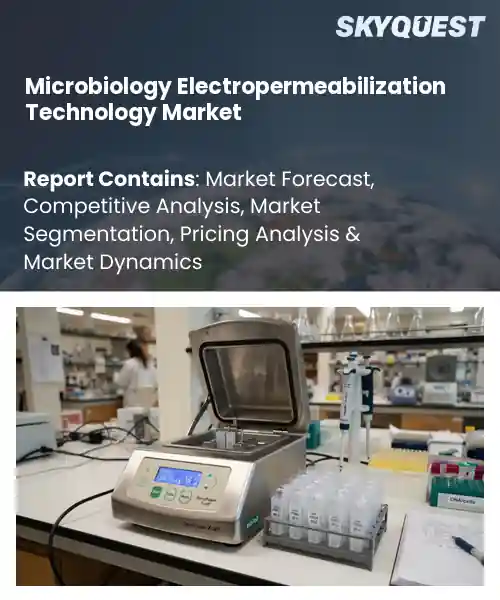
Microbiology Electropermeabilization Technology Market
Report ID: SQMIG35J2845
Report ID: SQMIG35J2845
[email protected]
USA +1 351-333-4748
Report ID:
SQMIG35J2845 |
Region:
Global |
Published Date: October, 2026
Pages:
157
|Tables:
122
|Figures:
77


Global Microbiology Electropermeabilization Technology Market size was valued at USD 290.0 Million in 2024 and is poised to grow from USD 311.46 Million in 2025 to USD 551.37 Million by 2033, growing at a CAGR of 7.4% during the forecast period (2026-2033).
The microbiology electropermeabilization technology market revolves around devices that apply electrical pulses to microbial cells, destabilizing their membranes to facilitate gene delivery, vaccine production, or sterilization. Its importance stems from the ability to increase transformation efficiency while reducing chemical toxicants, a need amplified by the surge in synthetic biology and personalized medicine. Historically, the market emerged in the early 2000s when academic laboratories validated electroporation for plasmid uptake in bacteria; commercial kits followed, and by 2015 firms such as Bio‑Rad and Lonza introduced automated platforms. This evolution shows how rising demand for scalable cell manipulation has expanded the market’s scope. The dominant growth factor now propelling the microbiology electropermeabilization market is the escalating requirement for pathogen detection in food safety and clinical diagnostics. As outbreaks such as the 2022 Listeria incident heightened consumer scrutiny, manufacturers turned to electropermeabilization‑based extraction kits that deliver nucleic acids within minutes, enabling PCR testing. This capability reduces turnaround time, cuts laboratory labor, and improves traceability, which in turn drives demand for integrated hardware and consumable bundles. Consequently, firms are investing in devices that combine electroporation with microfluidic sample handling, creating significant opportunities for expansion into point‑of‑care settings and emerging markets where laboratory infrastructure remains limited.
How is AI-driven automation impacting the microbiology electropermeabilization technology market?
AI driven automation is reshaping the microbiology electropermeabilization market by linking precise pulse control with real time data analytics. Machines now adjust voltage and timing based on live feedback, which improves cell viability and transformation efficiency. The integration of machine learning models streamlines protocol optimization, reducing trial and error cycles. Laboratories benefit from higher throughput and reproducible results, while manufacturers can scale production without proportional labor increases. This convergence also lowers contamination risk as fewer manual interventions are required. As a result, research institutions and biotech firms are adopting automated electroporation platforms to accelerate discovery and streamline therapeutic development. Integrated sensors flag deviations instantly, enabling tighter quality control.July 2023, MaxCyte introduced an AI enabled automated electroporation platform that couples adaptive pulse algorithms with robotic sample handling. The system shortens setup time and boosts reproducibility, demonstrating how AI driven automation can accelerate microbiology workflows and support broader market growth. It also provides real time analytics that guide protocol adjustments, reducing experimental cycles and facilitating faster product development.
Market snapshot - (2026-2033)
Global Market Size
USD 290.0 Million
Largest Segment
Electropermeabilization-Based Delivery Systems
Fastest Growth
Electropermeabilization-Based Delivery Systems
Growth Rate
7.4% CAGR
To get more insights on this market click here to Request a Free Sample Report
Global microbiology electropermeabilization technology market is segmented by technology type, application, microorganism, end user and region. Based on technology type, the market is segmented into Electroporation, Electrotransformation, Electropermeabilization-Based Delivery Systems and Other Electropermeabilization Technologies. Based on application, the market is segmented into Microbial Transformation, Gene Delivery, Protein & Metabolite Production, Antimicrobial Research and Microbial Research. Based on microorganism, the market is segmented into Bacteria, Yeast, Fungi and Other Microorganisms. Based on end user, the market is segmented into Pharmaceutical & Biotechnology Companies, Academic & Research Institutions, Food & Industrial Biotechnology Companies and Diagnostic & Healthcare Laboratories. Based on region, the market is segmented into North America, Europe, Asia Pacific, Latin America and Middle East & Africa.
Electroporation segment dominates because it provides the most direct and controllable method for temporary membrane permeabilization, enabling high efficiency introduction of nucleic acids and proteins across diverse microbial cell walls. Its longstanding industrial adoption, extensive validation in both research and production settings, and compatibility with scalable batch and continuous processes create a reliable foundation that anchors the market. Continuous improvements in pulse generators and electrode designs further reinforce its leadership position.
However, Electrotransformation segment is witnessing the strongest growth momentum because emerging genome editing platforms demand precise scar free DNA insertion in a wider variety of microorganisms. Advances in plasmid free protocols and integration with automated workflow systems are expanding its appeal, accelerating market expansion and creating opportunities for specialty biotech firms.
Protein & Metabolite Production segment dominates because electropermeabilization enables rapid intracellular delivery of pathway enzymes and regulatory RNAs, directly enhancing microbial biosynthetic yields. The technology’s ability to transiently open membranes without compromising cell viability aligns with commercial biomanufacturing goals, reducing downstream processing steps and accelerating time to market. Strong collaborations between biotech firms and equipment providers reinforce its centrality, making it the cornerstone of value creation in the market.
Meanwhile, Antimicrobial Research segment emerges as the key high growth area because rising demand for new antibiotics drives electropermeabilization use in testing membrane targeting compounds and engineering resistant strains. Innovative assay platforms and increased funding for antimicrobial discovery amplify its momentum, positioning it to broaden market reach and generate fresh investment streams across the sector.
To get detailed segments analysis, Request a Free Sample Report
North America leads the Microbiology Electropermeabilization Technology market through a combination of mature research ecosystems, substantial investment in biotechnological innovation, and a regulatory framework that encourages rapid product translation. The United States hosts a concentration of leading academic institutions and biotech hubs that foster collaborative development, while Canada provides complementary strengths in advanced manufacturing and government‑supported programs. Strong demand from pharmaceutical and food safety sectors, coupled with widespread adoption of precision microbial processing, reinforces market depth. In addition, the region benefits from an integrated supply chain and a culture of early technology adoption that together sustain its dominant position. The presence of venture capital networks that prioritize bio‑engineered solutions further accelerates commercialization, while cross‑border collaborations between research parks and industry laboratories enable continuous refinement of electropermeabilization protocols. This ecosystem creates a feedback loop that drives both incremental improvements and breakthrough applications, solidifying North America’s leadership in the global arena.
Microbiology Electropermeabilization Technology Market in the United States is propelled by a dense network of research universities and leading biotech firms that emphasize translational science. Robust funding mechanisms and a supportive intellectual property environment encourage startups to explore novel microbial manipulation methods. Industry partnerships with pharmaceutical and agricultural companies accelerate the validation of electropermeabilization processes, while extensive clinical and pilot‑scale facilities provide pathways for rapid scalability and market entry successful.
Microbiology Electropermeabilization Technology Market in Canada benefits from strong governmental support for biotech innovation and a collaborative research culture that links universities with industry consortia. Emphasis on sustainable food processing and precision medicine drives interest in electropermeabilization applications for pathogen control and cell therapy development. Strategic investments in pilot plants and regulatory expertise facilitate efficient product qualification, positioning Canada as a key significant contributor to the broader North American ecosystem.
Europe experiences rapid expansion of the Microbiology Electropermeabilization Technology market driven by a strong emphasis on sustainable manufacturing, stringent food safety standards, and collaborative research initiatives across the continent. Germany anchors the region with world‑class instrumentation manufacturers and deep expertise in process engineering, while the United Kingdom accelerates adoption through vibrant biotech start‑up ecosystems and supportive policy incentives. France contributes emerging capabilities in academic research and niche applications in dairy and wine industries. Cross‑border funding programs and harmonized regulatory frameworks facilitate technology transfer, enabling seamless scaling from laboratory to industrial settings. The collective focus on green chemistry and precision microbiology fuels demand for electropermeabilization solutions that enhance product quality while reducing environmental impact, cementing Europe’s position as a dynamic growth hub.
Microbiology Electropermeabilization Technology Market in Germany is anchored by a legacy of precision engineering and a dense network of equipment manufacturers dedicated to microbial processing. Close collaboration between federal research institutes and firms accelerates method optimization for pharmaceutical and food sectors. Emphasis on energy‑efficient processes aligns with national sustainability goals, encouraging adoption of electropermeabilization as a low‑impact alternative. Robust training programs and industry standards ensure consistent implementation across production facilities.
Microbiology Electropermeabilization Technology Market in the United Kingdom is propelled by a vibrant start‑up culture supported by government innovation grants and academic spin‑outs. The focus on precision health and food safety drives rapid prototyping of electropermeabilization devices for clinical diagnostics and contamination control. Collaborative clusters linking universities, biotech incubators, and manufacturing hubs accelerate knowledge transfer, while transparent regulatory pathways enable swift market entry for novel applications in the sector across Europe.
Microbiology Electropermeabilization Technology Market in France is emerging through focused academic research and niche industry partnerships, particularly within the dairy and wine sectors. Laboratory expertise in microbial cell wall manipulation translates into pilot projects that seek to enhance product quality and reduce processing times. Governmental funding for green technologies encourages the integration of electropermeabilization into existing production lines, while collaborative platforms facilitate exchange of best practices among French innovators today.
Asia Pacific is strengthening its position in the Microbiology Electropermeabilization Technology market by leveraging rapid industrialization, expanding biotech ecosystems, and increasing focus on food security and personalized medicine. Japan leads with sophisticated electronics manufacturing and deep expertise in precision instrumentation, enabling advanced electropermeabilization platforms for both research and commercial use. South Korea complements this trajectory with aggressive investment in digital health and a culture of rapid product iteration, fostering adoption in pharmaceutical processing and high‑value food applications. Regional trade agreements and collaborative research consortia promote technology sharing across borders, while governmental initiatives prioritize low‑energy, high‑efficiency microbial processes. Together these dynamics create a fertile environment for scaling innovative electropermeabilization solutions to meet growing domestic and export demand.
Microbiology Electropermeabilization Technology Market in Japan benefits from world‑class precision engineering and a strong tradition of integrating electronics with life sciences. Collaboration between leading research universities and established instrument manufacturers yields highly reliable devices tailored for clinical diagnostics and high‑throughput food testing. Government incentives for sustainable manufacturing encourage the broad nationwide adoption of low‑energy electropermeabilization methods, while extensive pilot facilities provide a pathway from laboratory validation to commercial scale deployment.
Microbiology Electropermeabilization Technology Market in South Korea is driven by aggressive investment in digital health and a culture that fast‑tracks prototype to market. Partnerships between biotech start‑ups and major electronics conglomerates enable miniaturized electropermeabilization units suitable for on‑site pharmaceutical processing and high‑value food preservation. National strategies emphasizing low‑carbon manufacturing reinforce the shift toward energy‑efficient microbial techniques, while incubators and venture funding streamline commercialization pathways for emerging Korean innovators with global impact.
To know more about the market opportunities by region and country, click here to
Buy The Complete Report
Increasing Demand for Precision Therapies
Advances In Electroporation Device Design
High Capital Investment Requirements
Regulatory Uncertainty Across Regions
Request Free Customization of this report to help us to meet your business objectives.
Insufficient data to generate the requested competitive landscape with verified startups.
Top Player’s Company Profile
Recent Developments
SkyQuest’s ABIRAW (Advanced Business Intelligence, Research & Analysis Wing) is our Business Information Services team that Collects, Collates, Correlates, and Analyses the Data collected by means of Primary Exploratory Research backed by robust Secondary Desk research. As per SkyQuest analysis, the market is being propelled primarily by the rising demand for precision therapies that require accurate intracellular delivery, while advances in electroporation device design provide a second strong boost by simplifying workflows and improving reproducibility. The greatest restraint comes from the high capital investment needed to acquire advanced platforms, which slows adoption in cost‑sensitive labs. North America remains the dominant region thanks to its mature biotech ecosystem and supportive funding, and the electroporation technology segment continues to lead the market because of its proven efficiency and scalability across bacterial, yeast and fungal applications in both research and industrial settings.
| Report Metric | Details |
|---|---|
| Market size value in 2024 | USD 290.0 Million |
| Market size value in 2033 | USD 551.37 Million |
| Growth Rate | 7.4% |
| Base year | 2024 |
| Forecast period | (2026-2033) |
| Forecast Unit (Value) | USD Million |
| Segments covered |
|
| Regions covered | North America (US, Canada), Europe (Germany, France, United Kingdom, Italy, Spain, Rest of Europe), Asia Pacific (China, India, Japan, Rest of Asia-Pacific), Latin America (Brazil, Rest of Latin America), Middle East & Africa (South Africa, GCC Countries, Rest of MEA) |
| Companies covered |
|
| Customization scope | Free report customization with purchase. Customization includes:-
|
To get a free trial access to our platform which is a one stop solution for all your data requirements for quicker decision making. This platform allows you to compare markets, competitors who are prominent in the market, and mega trends that are influencing the dynamics in the market. Also, get access to detailed SkyQuest exclusive matrix.
Table Of Content
Executive Summary
Market overview
Parent Market Analysis
Market overview
Market size
KEY MARKET INSIGHTS
COVID IMPACT
MARKET DYNAMICS & OUTLOOK
Market Size by Region
KEY COMPANY PROFILES
Methodology
For the Microbiology Electropermeabilization Technology Market, our research methodology involved a mixture of primary and secondary data sources. Key steps involved in the research process are listed below:
1. Information Procurement: This stage involved the procurement of Market data or related information via primary and secondary sources. The various secondary sources used included various company websites, annual reports, trade databases, and paid databases such as Hoover's, Bloomberg Business, Factiva, and Avention. Our team did 45 primary interactions Globally which included several stakeholders such as manufacturers, customers, key opinion leaders, etc. Overall, information procurement was one of the most extensive stages in our research process.
2. Information Analysis: This step involved triangulation of data through bottom-up and top-down approaches to estimate and validate the total size and future estimate of the Microbiology Electropermeabilization Technology Market.
3. Report Formulation: The final step entailed the placement of data points in appropriate Market spaces in an attempt to deduce viable conclusions.
4. Validation & Publishing: Validation is the most important step in the process. Validation & re-validation via an intricately designed process helped us finalize data points to be used for final calculations. The final Market estimates and forecasts were then aligned and sent to our panel of industry experts for validation of data. Once the validation was done the report was sent to our Quality Assurance team to ensure adherence to style guides, consistency & design.
Analyst Support
Customization Options
With the given market data, our dedicated team of analysts can offer you the following customization options are available for the Microbiology Electropermeabilization Technology Market:
Product Analysis: Product matrix, which offers a detailed comparison of the product portfolio of companies.
Regional Analysis: Further analysis of the Microbiology Electropermeabilization Technology Market for additional countries.
Competitive Analysis: Detailed analysis and profiling of additional Market players & comparative analysis of competitive products.
Go to Market Strategy: Find the high-growth channels to invest your marketing efforts and increase your customer base.
Innovation Mapping: Identify racial solutions and innovation, connected to deep ecosystems of innovators, start-ups, academics, and strategic partners.
Category Intelligence: Customized intelligence that is relevant to their supply Markets will enable them to make smarter sourcing decisions and improve their category management.
Public Company Transcript Analysis: To improve the investment performance by generating new alpha and making better-informed decisions.
Social Media Listening: To analyze the conversations and trends happening not just around your brand, but around your industry as a whole, and use those insights to make better Marketing decisions.
REQUEST FOR SAMPLE
 REQUEST FREE CUSTOMIZATION


Want to customize this report? This report can be personalized according to your needs. Our analysts and industry experts will work directly with you to understand your requirements and provide you with customized data in a short amount of time. We offer $1000 worth of FREE customization at the time of purchase.
Feedback From Our Clients


 USA (+1) 351-333-4748

