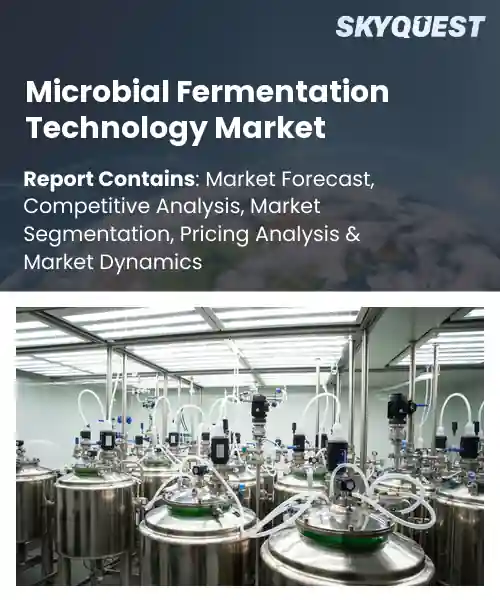
Microbial Fermentation Technology Market
Report ID: SQMIG35J2498
Report ID: SQMIG35J2498
[email protected]
USA +1 351-333-4748
Report ID:
SQMIG35J2498 |
Region:
Global |
Published Date: June, 2026
Pages:
157
|Tables:
71
|Figures:
75


Global Microbial Fermentation Technology Market size was valued at USD 36.18 Billion in 2024 and is poised to grow from USD 39.26 Billion in 2025 to USD 75.39 Billion by 2033, growing at a CAGR of 8.5% during the forecast period (2026-2033).
Microbial fermentation technology market centers on industrial and laboratory platforms that harness microorganisms to produce chemicals, enzymes, pharmaceuticals and food, and its primary driver is the increasing demand for sustainable bio based products. This market matters because fermentation enables scalable, cost effective production with lower emissions compared with petrochemical synthesis, and it evolved from traditional food fermentation into advanced bioprocessing through innovations such as recombinant DNA, high cell density cultivation, and continuous bioreactors. For example, enzyme replacements in detergents and biosynthetic insulin demonstrate economic and public health impacts, while regulatory acceptance and investment have accelerated commercialization globally in emerging economies.
Building on commercialization momentum, a key factor is process optimization and digital biomanufacturing that cut production costs and compress time to market, catalyzing adoption across sectors. Automated monitoring with AI strain selection and single use modular systems boost yields and reduce capital needs, prompting firms to invest in novel biochemicals, microbial protein for food and cell culture media alternatives. For example, a poultry feed producer that switched to fermentation derived methionine reduced emissions and input volatility, while a contract development organization used high throughput screening to move an enzyme pipeline to market within months, driving broader investment and job creation.
How is AI-enabled automation enhancing productivity in the microbial fermentation technology market?
AI enabled automation is improving productivity in the microbial fermentation technology market by combining automated strain design with closed loop process control and continuous analytics. Key elements are rapid generation and screening of candidate microbes, real time monitoring of bioreactors, and predictive models that guide scale up. The current state shows companies shifting from manual optimization to automated workflows that shorten development cycles and improve reproducibility. In the market context this reduces time to commercial production and lowers operational variability. Examples include autonomous laboratories and digital twin approaches that let teams test process changes virtually before running them at scale.
Amyris March 10, 2026, announced a new automated production line at its Barra Bonita precision fermentation plant, which leverages advanced control systems and automation to increase process precision and flexibility. This development demonstrates how AI enabled automation supports growth by improving throughput, easing scale up, and enabling more reliable production of specialty molecules.
Market snapshot - (2026-2033)
Global Market Size
USD 36.18 Billion
Largest Segment
Antibiotics
Fastest Growth
Biosimilars
Growth Rate
8.5% CAGR
To get more insights on this market click here to Request a Free Sample Report
Global microbial fermentation technology market is segmented by segment insights, application and region. Based on segment insights, the market is segmented into Antibiotics, Probiotics Supplements, Monoclonal Antibodies, Recombinant Proteins, Biosimilars, Vaccines, Enzymes, Small Molecules and Others. Based on application, the market is segmented into Medical, Industrial, Alcohol Beverages, Food and Feed Products and Others. Based on region, the market is segmented into North America, Europe, Asia Pacific, Latin America and Middle East & Africa.
Monoclonal antibodies segment dominates because sustained therapeutic demand and payer acceptance have driven heavy investment in fermentation platforms tailored to antibody production. Process intensification, advanced expression constructs and robust downstream purification create consistent yields and product quality required for clinical and commercial supply, encouraging biomanufacturers to prioritize fermentation capacity dedicated to antibodies. This focus cascades into ecosystem maturity, with specialized contract manufacturing, analytical toolsets and regulatory familiarity reinforcing leadership.
However, vaccines are the most rapidly expanding area, driven by platform antigen production, modular fermentation processes and accelerated regulatory pathways for pandemic preparedness. Growing demand for recombinant antigens, conjugate components and adjuvant manufacture is prompting expansion of fermentation capacity and innovation in expression hosts, catalyzing new commercial opportunities and supply chain resilience.
Enzymes segment dominates because their dual role as end products and process catalysts creates pervasive demand across industrial and medical applications. Advances in strain engineering and tailored fermentation workflows have reduced production complexity and improved stability, enabling diverse formulation and incorporation into downstream processes. This utility drives sustained investment in specialized fermentation equipment, optimized media and high throughput screening, reinforcing enzyme focused process innovation and commercial scale up priorities across the market.
On the other hand, probiotics supplements are witnessing the strongest growth momentum due to expanding consumer demand for gut health and improved fermentation methods that enable strain stability and affordable scale up. Better encapsulation and clearer regulatory pathways for live products are unlocking new retail and clinical applications, accelerating manufacturing investments and market opportunities.
To get detailed segments analysis, Request a Free Sample Report
North America dominates due to a convergence of deep research capability, established industrial fermentation infrastructure and a supportive innovation ecosystem that accelerates commercialization. Strong linkage between universities, dedicated research centers and industrial partners fosters rapid translation of process technologies and strain development into marketable products. Robust regulatory frameworks and well defined quality systems reduce barriers to scale up, while experienced contract manufacturing and analytical service providers enable efficient scale transitions. Access to a skilled talent pool, venture and corporate investment appetite and integrated supply chains underpin sustained competitive advantage. Supportive public policy, collaborative consortia and international partnerships further amplify regional capacity and foster knowledge exchange across the innovation lifecycle.
Microbial Fermentation Technology Market in United States is characterized by a mature research infrastructure, extensive industrial fermentation capacity and strong collaboration between academic institutions and private industry. Investment focus on process optimization, bioprocess scale up and advanced analytics supports product diversification across pharmaceuticals, food ingredients and industrial biochemicals. Regulatory clarity and established supply chains enable rapid commercialization of innovations, while strategic partnerships drive continuous improvement and advantage across the landscape.
Microbial Fermentation Technology Market in Canada benefits from a collaborative research ecosystem, adaptable manufacturing facilities and a focus on sustainable bioprocesses and greenfeedstock integration. Industry emphasis on innovation hubs and pilot platforms supports translation of academic discoveries into commercial offerings across biotherapeutics, specialty enzymes and functional ingredients. Policy frameworks that encourage public private partnerships and clusters foster knowledge exchange, talent retention and entrepreneurial activity that strengthens national capability and resilience.
Europe is experiencing rapid expansion driven by an intricate network of research institutes, specialized bioprocess manufacturers and a policy environment that encourages sustainable bioeconomy solutions. Strong emphasis on collaborative funding mechanisms and public private initiatives supports cross border projects that accelerate technology adoption and market entry. The region benefits from a dense ecosystem of small and medium sized innovators, service providers and niche equipment suppliers that lower barriers for scale up and customization. Regulatory alignment across markets and demand for cleaner, circular production methods create pull for microbial fermentation applications in specialty chemicals, food ingredients and biopharmaceuticals. Investment in training and pilot facilities enhances practical skills and reduces risk in commercialization pathways.
Microbial Fermentation Technology Market Germany combines a strong industrial engineering tradition with advanced bioprocess development and manufacturing capacity. Concentrations of specialized equipment makers, contract manufacturers and applied research centers support scale up. Demand from established pharmaceutical and specialty chemical sectors drives high standards for process control and quality. Clustered networks and vocational training systems supply experienced operators and talent, reinforcing Germany role as dominant hub for fermentation and industrial innovation.
Microbial Fermentation Technology Market United Kingdom features a dynamic startup scene, strong translational research and growing investment in fermentation platforms. Collaborations between universities, incubators and industry accelerate development of novel strains and process technologies. Demand from clinical manufacturing and alternative protein sectors diversifies application pipelines. Policy support and industry consortia facilitate scale up and market access, positioning United Kingdom as a rapidly expanding node within the regional fermentation landscape today.
Microbial Fermentation Technology Market France is emerging through focus on competitive clusters, targeted public support and growing private research. Specialized academic centers, agile biotechnology startups and expanding pilot facilities enable validation of novel processes. Industry emphasis on sustainable feedstocks and specialty ingredient markets opens commercialization pathways. Regional collaboration and policy incentives encourage incubation of nascent technologies, strengthening capacity and raising France position within the European fermentation ecosystem and market resilience.
Asia Pacific is strengthening its position through concentrated investment in advanced biomanufacturing, integration of automation and analytical precision and targeted government programs that support biotech scale up. Countries in the region leverage strong manufacturing ecosystems, engineering expertise and growing translational research to localize fermentation technologies and reduce time to market. Partnerships with global firms and regional research centers enable transfer of process knowledge and adaptation to regional feedstocks and market needs. Emphasis on capacity building, pilot facilities and workforce development is creating an increasingly capable ecosystem that supports both domestic demand and export oriented opportunities in pharmaceuticals, food and industrial bioproducts. Investment in precision fermentation platforms, sensor driven process control and modular facility design is elevating manufacturing flexibility. Regulatory modernization and quality harmonization efforts are easing cross border commercialization, while growing networks of incubators and supplier ecosystems support local scale up and specialized application development.
Microbial Fermentation Technology Market Japan leverages precision engineering, strong automation capability and rigorous quality management to support high value fermentation processes. Corporate research centers and established pharma and chemical firms collaborate with universities to refine strains and downstream operations. Focus on robust validation, strict controls and scalable manufacturing platforms supports production of complex biologics and specialty enzymes. Partnerships with equipment suppliers and incremental innovation sustain continuous enhancement of fermentation competence.
Microbial Fermentation Technology Market South Korea benefits from advanced manufacturing automation, strong process engineering skills and coordinated government support for biotechnology commercialization. Active startup communities and established industrial players collaborate on strain development, process intensification and modular manufacturing solutions. Focused efforts on probiotics, enzymes and specialty biochemicals create clear application pathways. Integration of digital monitoring, supplier networks and scale up practices enhances competitiveness and supports expanding domestic and international engagement.
To know more about the market opportunities by region and country, click here to
Buy The Complete Report
Advancements In Bioprocessing Equipment
Rising Demand For Biopharmaceuticals
High Regulatory Complexity
Limited Availability Of Critical Inputs
Request Free Customization of this report to help us to meet your business objectives.
Competition in global microbial fermentation is driven by scale, IP and strategic partnerships as incumbents and deep tech startups race to secure production capacity and proprietary strains. Recent consolidation and platform deals exemplify this: Remilk announced a large Denmark production site to scale dairy proteins, while Ginkgo Bioworks uses structured partnerships and asset acquisitions to extend application specific capabilities. Mergers, partnerships and facility expansion sharpen competitive pressure.
Top Player’s Company Profile
Recent Developments
SkyQuest’s ABIRAW (Advanced Business Intelligence, Research & Analysis Wing) is our Business Information Services team that Collects, Collates, Correlates, and Analyses the Data collected by means of Primary Exploratory Research backed by robust Secondary Desk research. As per SkyQuest analysis, the global microbial fermentation technology market is poised for robust growth as a key driver is rising demand for biopharmaceuticals driven by therapeutic and vaccine needs, and a second driver is process optimization and AI enabled automation that shortens development cycles and increases yields. However, a major restraint is high regulatory complexity which raises compliance costs and extends time to market for new processes and products. North America dominates the market thanks to deep research capacity, established manufacturing infrastructure and supportive investment, while the monoclonal antibodies segment remains the dominant application area due to sustained therapeutic demand and established fermentation platforms.
| Report Metric | Details |
|---|---|
| Market size value in 2024 | USD 36.18 Billion |
| Market size value in 2033 | USD 75.39 Billion |
| Growth Rate | 8.5% |
| Base year | 2024 |
| Forecast period | (2026-2033) |
| Forecast Unit (Value) | USD Billion |
| Segments covered |
|
| Regions covered | North America (US, Canada), Europe (Germany, France, United Kingdom, Italy, Spain, Rest of Europe), Asia Pacific (China, India, Japan, Rest of Asia-Pacific), Latin America (Brazil, Rest of Latin America), Middle East & Africa (South Africa, GCC Countries, Rest of MEA) |
| Companies covered |
|
| Customization scope | Free report customization with purchase. Customization includes:-
|
To get a free trial access to our platform which is a one stop solution for all your data requirements for quicker decision making. This platform allows you to compare markets, competitors who are prominent in the market, and mega trends that are influencing the dynamics in the market. Also, get access to detailed SkyQuest exclusive matrix.
Table Of Content
Executive Summary
Market overview
Parent Market Analysis
Market overview
Market size
KEY MARKET INSIGHTS
COVID IMPACT
MARKET DYNAMICS & OUTLOOK
Market Size by Region
KEY COMPANY PROFILES
Methodology
For the Microbial Fermentation Technology Market, our research methodology involved a mixture of primary and secondary data sources. Key steps involved in the research process are listed below:
1. Information Procurement: This stage involved the procurement of Market data or related information via primary and secondary sources. The various secondary sources used included various company websites, annual reports, trade databases, and paid databases such as Hoover's, Bloomberg Business, Factiva, and Avention. Our team did 45 primary interactions Globally which included several stakeholders such as manufacturers, customers, key opinion leaders, etc. Overall, information procurement was one of the most extensive stages in our research process.
2. Information Analysis: This step involved triangulation of data through bottom-up and top-down approaches to estimate and validate the total size and future estimate of the Microbial Fermentation Technology Market.
3. Report Formulation: The final step entailed the placement of data points in appropriate Market spaces in an attempt to deduce viable conclusions.
4. Validation & Publishing: Validation is the most important step in the process. Validation & re-validation via an intricately designed process helped us finalize data points to be used for final calculations. The final Market estimates and forecasts were then aligned and sent to our panel of industry experts for validation of data. Once the validation was done the report was sent to our Quality Assurance team to ensure adherence to style guides, consistency & design.
Analyst Support
Customization Options
With the given market data, our dedicated team of analysts can offer you the following customization options are available for the Microbial Fermentation Technology Market:
Product Analysis: Product matrix, which offers a detailed comparison of the product portfolio of companies.
Regional Analysis: Further analysis of the Microbial Fermentation Technology Market for additional countries.
Competitive Analysis: Detailed analysis and profiling of additional Market players & comparative analysis of competitive products.
Go to Market Strategy: Find the high-growth channels to invest your marketing efforts and increase your customer base.
Innovation Mapping: Identify racial solutions and innovation, connected to deep ecosystems of innovators, start-ups, academics, and strategic partners.
Category Intelligence: Customized intelligence that is relevant to their supply Markets will enable them to make smarter sourcing decisions and improve their category management.
Public Company Transcript Analysis: To improve the investment performance by generating new alpha and making better-informed decisions.
Social Media Listening: To analyze the conversations and trends happening not just around your brand, but around your industry as a whole, and use those insights to make better Marketing decisions.
REQUEST FOR SAMPLE
 REQUEST FREE CUSTOMIZATION
Global Microbial Fermentation Technology Market size was valued at USD 36.18 Billion in 2024 and is poised to grow from USD 39.26 Billion in 2025 to USD 75.39 Billion by 2033, growing at a CAGR of 8.5% during the forecast period (2026-2033).
Competition in global microbial fermentation is driven by scale, IP and strategic partnerships as incumbents and deep tech startups race to secure production capacity and proprietary strains. Recent consolidation and platform deals exemplify this: Remilk announced a large Denmark production site to scale dairy proteins, while Ginkgo Bioworks uses structured partnerships and asset acquisitions to extend application specific capabilities. Mergers, partnerships and facility expansion sharpen competitive pressure. 'AGC Biologics', 'Fujifilm Diosynth', 'Biocatalysts', 'Abolis Biotechnologies', 'Bio-CAT Microbials', 'Bio-Technical Resources', 'Bluestem Biosciences', 'EKF Diagnostics', 'Microbial Discovery Group', 'Osprey Biotechnics', 'Wisconsin BioProducts', 'Novozymes', 'Chr. Hansen', 'Lonza', 'Amyris', 'Ginkgo Bioworks', 'Danone', 'Nestlé', 'Kerry Group', 'ADM'
Advancements in bioprocessing equipment, including more reliable single-use systems, integrated sensors, and improved agitation and mixing technologies, enhance control over fermentation parameters and reduce contamination risk. Better process control enables consistent product quality and easier scale-up from laboratory to commercial production, lowering operational complexity and enabling manufacturers to adopt microbial fermentation more readily. Improved equipment also supports higher throughput and flexible batch scheduling, which in turn encourages investment and deployment across pharmaceuticals, food ingredients, and industrial enzymes, supporting market expansion.
Process Intensification And Scale Up: Industry investment in intensified and continuous fermentation workflows is accelerating adoption of modular, single use and integrated downstream approaches that compress timelines and improve resource efficiency. Firms prioritize scalable platform technologies to enable rapid commercialization of biologics and specialty chemicals, while reducing capital and operational footprints. This trend supports collaboration between equipment vendors and end users to validate robust scale up strategies, enhancing consistency, flexibility and predictable performance across varied production volumes and diverse product portfolios.
Why does North America Dominate the Global Microbial Fermentation Technology Market? |@12


Want to customize this report? This report can be personalized according to your needs. Our analysts and industry experts will work directly with you to understand your requirements and provide you with customized data in a short amount of time. We offer $1000 worth of FREE customization at the time of purchase.
Feedback From Our Clients


 USA (+1) 351-333-4748

