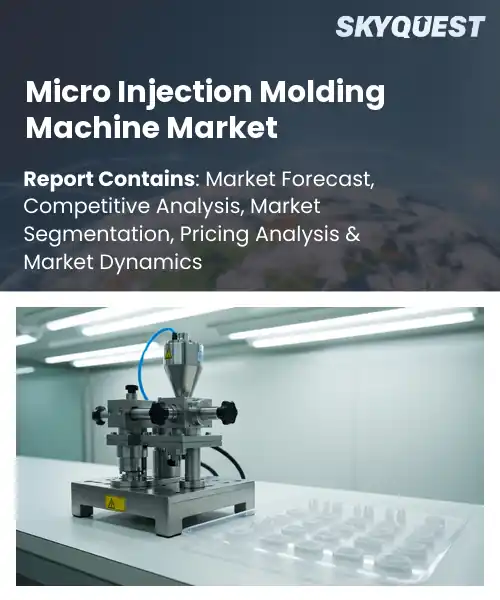
Micro Injection Molding Machine Market
Report ID: SQMIG20I3075
Report ID: SQMIG20I3075
[email protected]
USA +1 351-333-4748
Report ID:
SQMIG20I3075 |
Region:
Global |
Published Date: June, 2026
Pages:
157
|Tables:
122
|Figures:
77


Global Micro Injection Molding Machine Market size was valued at USD 1.39 Billion in 2024 and is poised to grow from USD 1.53 Billion in 2025 to USD 3.36 Billion by 2033, growing at a CAGR of 10.3% during the forecast period (2026-2033).
The chief factor influencing the micro injection molding machine market growth is the increasing requirement for minuscule, accurate polymer components in both the medical and electronics industries, resulting in a need for manufacturers of machines that can provide repeatable microliter shot sizes and submillimeter geometries. The micro injection molding industry is supplying manufacturers with specialized equipment and experts to create complicated, miniature pieces that can not be developed through standard molding, thereby producing parts including but not limited to, insulin pens, hearing aid housings and smartphone optical modules. This industry has transitioned over time from modifying macro presses to designing and creating micro systems with micro tooling, hot runner integration and precise metering.
Innovations of the industry are being further developed through the regulatory requirements in medical devices and the need for functional miniaturization in consumer electronics, creating challenges for suppliers to offer devices with tighter process controls and documentation. In order to produce implantable medical devices and diagnostic cartridges, manufacturers are heavily investing into precision metering, mold temperature control and visual inspection to reduce scrap rates and have traceable products, creating further options for machine manufacturers to supply turnkey lines. As a result, medical technology hubs in regions are producing localized micro molding capabilities, creating shorter lead times and increasing the rate of adoption of new technologies on a worldwide basis for multi material and microfluidic applications, including single use test cartridge and drug delivery.
How is AI Improving Precision and Throughput in the Micro Injection Molding Machine Market?
In micro injection molding machine market trends, there is a need to maintain extremely precise control over the dimensions of the part, as well as accurately measure the amount of material that is being injected into the mould and repeat cycles consistently. AI improves this precision through real-time monitoring of the manufacturing process, and by providing model-based process control systems, allowing for the conversion of all sensor data into adaptive or "smart" set points. OEMs today are utilizing AI along with fully electric machines and in-line process inspection, which is directly impacting the ability for manufacturers to reduce manufacturing waste and improve machinery setup times. The most obvious examples of this synergy include replacing the manual tuning process (initialization) with AI guided initialization as well as improving the predictability and scalability of the manufacturing process through early detection of defects using AI vision systems to detect micro deviations.
In September of 2022, ENGEL launched their inject AI and standalone autonomous molding cell utilizing machine learning to adjust the process parameters automatically and perform in-line quality inspection, thereby reducing setup and waste, while increasing the number of parts produced per hour through longer periods of unmanned operation and shorter periods to stabilize the process, thus supporting manufacturers with the increased use of micro injection molding in the medical and electronics sectors.
Market snapshot - (2026-2033)
Global Market Size
USD 1.39 Billion
Largest Segment
Electric Micro Injection Molding Machines
Fastest Growth
Electric Micro Injection Molding Machines
Growth Rate
10.3% CAGR
To get more insights on this market click here to Request a Free Sample Report
Global micro injection molding machine market is segmented by machine type, clamping force, material, application and region. Based on machine type, the market is segmented into electric micro injection molding machines, hydraulic micro injection molding machines, hybrid micro injection molding machines and others. Based on clamping force, the market is segmented into 0-10 tons, 10-30 tons, above 30 tons and others. Based on material, the market is segmented into thermoplastics, thermosets, liquid silicone rubber and others. Based on application, the market is segmented into medical & healthcare, automotive, electronics & telecom, optics and others. Based on region, the market is segmented into North America, Europe, Asia Pacific, Latin America and Middle East & Africa.
The electric segment has a very large market share (over 70% of the total) due to their innovative and consistent production capabilities. The technology allows the use of fully-electric product designs which lead to improved repeatability and positional accuracy at the scale of micrometers required for manufacturing advanced precision micro-components. The elimination of hydraulic variation, together with the use of servo-driven metering, decreases processing variability and reduces contamination risks, enabling companies to achieve strictest possible levels of quality assurance. These benefits coupled with minimal maintenance and ease of automation integration promote the ongoing growth within the precision healthcare and precision electronics market segments.
Similarly, hybrid electric injection molding machines are positioned for rapid growth because they provide companies the ability to manufacture complex multi-material micro-based products while also allowing for significant force output control. Advances in combined electric and hydraulic-press drive technology and increased demand across different industries for flexible processing have resulted in wide-scale machine enhancements and new opportunities for these types of machines to be used in various precision markets.
The liquid silicone rubber category is in the lead due to of its unique properties which provide excellent elastomer performance on a small diameter micro scale. This includes a wide range of temperatures, compatibility with the human body (biocompatible) and fine surface finishing of small detail features. All of these combined make Liquid Silicone Rubber ideal for use in medical devices, seals and soft-touch components and therefore create a higher demand for specialized equipment designed to accurately dispense the rubber or cure the rubber.
In contrast, thermoplastics have the highest growth rate due to advancements in engineering/resin grade thermoplastic resins and micro-grade thermoplastic formulations being utilized for electronics and precision consumer products. However, the increased use of new melt flow grades, increased focus on recyclability and decreased cost of thermoplastic materials leads to the continued growth of thermoplastics in micro injection molding, with both suppliers and end-user demanding the development of new machine technology that accommodates this growth in high-volume micro-manufacturing.
To get detailed segments analysis, Request a Free Sample Report
Asia Pacific dominates the global micro injection molding machine market because of a dense concentration of precision component manufacturers, well established electronics and medical device ecosystems, and an extensive multi tiered supply chain that supports both high volume production and highly specialized micro components. Regional machine builders emphasize purpose built equipment, integrated automation, advanced process controls and locally available service networks that shorten qualification cycles. Close collaboration among OEMs, tooling specialists and research institutions accelerates application specific innovation, while adaptable production practices and competitive manufacturing economics encourage ongoing investment in tooling, materials expertise and workforce skill development, sustaining leadership in miniaturized, high tolerance part production across diverse end use sectors. Comprehensive aftermarket support, strong customization capabilities and clustered supplier networks further reinforce resilience and responsiveness to evolving technical requirements, keeping the region at the forefront of micro molding capability development.
Micro injection molding machine market share in Japan is anchored in precision engineering and deep manufacturing expertise. Established component makers and specialized machine builders collaborate closely with medical device and electronics manufacturers to deliver high tolerance parts. Strong emphasis on incremental innovation, rigorous quality culture, and integrated supply ecosystems supports complex micro molding requirements while enabling reliable aftersales service and continuous tool and process refinement excellence.
Micro injection molding machine market forecast in South Korea benefits from strong electronics manufacturing and rapid adoption of automation. Domestic machine makers work with semiconductor and electronics suppliers to meet miniaturization and cycle time demands. Emphasis on flexible production lines, skilled process engineering, and collaborative development with component designers fosters tailored micro molding solutions. Local service networks and research and development investments sustain adaptation to novel materials and tighter functional integration.
The micro injection molding machine industry in Europe is quickly growing because of the high level of engineering expertise within Europe, the number of specialized machine tool makers located there, as well as, the amount of research done on how to use injection molding machines. In addition to these factors, the increasing amount of quality and regulatory requirements for medical, automotive, and aerospace applications is creating an increased demand for injection molding machines that can provide very tight tolerances and processes that are traceable. To respond to the needs for producing components that meet these stringent requirements and ensure continuity of a uniform process for producing parts, many manufacturers are adding automated systems, advanced process control methods, and the development of more specialized tooling capabilities into their manufacturing process. Then, with the help of engineering hubs that allow for clustering of activities for supply chains and providing customized solutions, there are also significant increases in local manufacturing capabilities and high-value added components, which are being used as a basis for promoting the greater use of specially designed micro molding equipment across Europe.
Micro injection molding machine market outlook in Germany is characterized by engineering led machine design, close integration between OEMs and tooling specialists, and a strong focus on durability and precision. Established industrial clusters enable rapid prototyping of complex micro parts for automotive and medical sectors. Emphasis on process validation, machine robustness and systematic aftermarket support underpins supplier credibility and fosters long term partnerships that prioritize reproducible quality and continuous improvement excellence.
Micro injection molding machine market analysis in United Kingdom is marked by growing specialization in medical diagnostics and precision optics, supported by collaborative research and niche machine suppliers. Increasing adoption of automation and tailored tooling solutions helps manufacturers meet rigorous regulatory requirements. Emphasis on flexible contract manufacturing, close customer support and partnerships with innovation centres encourages adoption of compact, high precision platforms that address bespoke component challenges within localized supply networks.
Micro injection molding machine market penetartion in France is defined by dynamic adoption across medical, microelectronics and precision components, driven by strong design capabilities and supportive industrial policy. Local machine suppliers tailor solutions for small batch high complexity applications, collaborating with specialized tooling houses to optimize process windows. A focus on material science, testing capabilities and manufacturing models enables rapid customization and strengthens linkages between design, prototyping and micro molding production.
The micro injection molding industry analysis in North America is being enhanced by a mix of technological modernization, strategic reshoring of important manufacturing, and improved partnerships between OEMs, machine manufacturers and material suppliers. There is a focus on advanced automation, quality aftermarket service support and local technical service to enable a quick reaction to the need for strict quality and traceability in medical and electronic applications. Investments in application engineering, process validation and strategic alliances with design houses permit quick customisation of micro moulding platforms. A strong emphasis on supplier reliability, training and integration of monitoring solutions increases the use of micro component production for high value manufacturers that require secure, compliant and scalable manufacturing capabilities. A growing emphasis on digitalisation and data-driven process control and partnerships between universities and industry continue to develop the pipeline for qualified process engineers. The expansion of service and parts locations and local availability of spare parts reduces downtime for manufacturers and helps facilitate the wider acceptance of advanced micro moulding solutions.
Micro injection molding machine market regional outlook in United States is driven by strong demand from medical device, semiconductor and advanced electronics manufacturers seeking rapid development cycles and stringent quality assurance. Domestic machine builders emphasize integrated automation, comprehensive service offerings and close collaboration with design firms to enable application specific configurations. Investments in process validation and skilled application engineering strengthen value proposition for manufacturers focused on complex micro assemblies and supply arrangements.
Micro injection molding machine market regional forecast in Canada is supported by a growing ecosystem of precision manufacturing service providers and close ties to electronics and medical supply chains. Machine suppliers emphasize flexible platforms and strong technical support to accommodate small batch production. Collaboration between industry and research centres enhances material know how and process capability development, while localized service footprints help reduce downtime and improve production continuity for specialized micro components.
To know more about the market opportunities by region and country, click here to
Buy The Complete Report
Growing Demand From Medical Device Manufacturers
Advancements In Precision Mold Technology
High Capital Investment Requirements
Complex Material Processing Challenges
Request Free Customization of this report to help us to meet your business objectives.
Competition in the global micro injection molding machine market is shaped by consolidation, targeted partnerships, and technology-led differentiation. Strategic M&A deals such as Haitian’s acquisition of Niigata broaden supplier portfolios and geographic reach. Machine builders are forming technology partnerships and co-developing micro scale solutions, for example Wittmann Battenfeld’s collaboration with NanoVoxel to couple two photon polymerization and Micropower micro molding systems.
Top Player’s Company Profile
Recent Developments in the Micro Injection Molding Machine Market
SkyQuest’s ABIRAW (Advanced Business Intelligence, Research & Analysis Wing) is our Business Information Services team that Collects, Collates, Correlates, and Analyses the Data collected by means of Primary Exploratory Research backed by robust Secondary Desk research. As per SkyQuest analysis, one key driver is accelerating demand for miniaturized, high-tolerance polymer components in medical and electronics, while one restraint is the high capital investment required for machines, molds and validation. The dominating region is Asia Pacific given its dense precision manufacturing clusters, and the dominating segment is electric micro injection molding machines due to superior repeatability and control. A second driver is advances in precision mold technology and AI-enabled process control that improve throughput and reduce scrap. Together these dynamics support growth yet emphasize the need for financing solutions and skills development to broaden adoption globally and strengthen supply chains.
| Report Metric | Details |
|---|---|
| Market size value in 2024 | USD 1.39 Billion |
| Market size value in 2033 | USD 3.36 Billion |
| Growth Rate | 10.3% |
| Base year | 2024 |
| Forecast period | (2026-2033) |
| Forecast Unit (Value) | USD Billion |
| Segments covered |
|
| Regions covered | North America (US, Canada), Europe (Germany, France, United Kingdom, Italy, Spain, Rest of Europe), Asia Pacific (China, India, Japan, Rest of Asia-Pacific), Latin America (Brazil, Rest of Latin America), Middle East & Africa (South Africa, GCC Countries, Rest of MEA) |
| Companies covered |
|
| Customization scope | Free report customization with purchase. Customization includes:-
|
To get a free trial access to our platform which is a one stop solution for all your data requirements for quicker decision making. This platform allows you to compare markets, competitors who are prominent in the market, and mega trends that are influencing the dynamics in the market. Also, get access to detailed SkyQuest exclusive matrix.
Table Of Content
Executive Summary
Market overview
Parent Market Analysis
Market overview
Market size
KEY MARKET INSIGHTS
COVID IMPACT
MARKET DYNAMICS & OUTLOOK
Market Size by Region
KEY COMPANY PROFILES
Methodology
For the Micro Injection Molding Machine Market, our research methodology involved a mixture of primary and secondary data sources. Key steps involved in the research process are listed below:
1. Information Procurement: This stage involved the procurement of Market data or related information via primary and secondary sources. The various secondary sources used included various company websites, annual reports, trade databases, and paid databases such as Hoover's, Bloomberg Business, Factiva, and Avention. Our team did 45 primary interactions Globally which included several stakeholders such as manufacturers, customers, key opinion leaders, etc. Overall, information procurement was one of the most extensive stages in our research process.
2. Information Analysis: This step involved triangulation of data through bottom-up and top-down approaches to estimate and validate the total size and future estimate of the Micro Injection Molding Machine Market.
3. Report Formulation: The final step entailed the placement of data points in appropriate Market spaces in an attempt to deduce viable conclusions.
4. Validation & Publishing: Validation is the most important step in the process. Validation & re-validation via an intricately designed process helped us finalize data points to be used for final calculations. The final Market estimates and forecasts were then aligned and sent to our panel of industry experts for validation of data. Once the validation was done the report was sent to our Quality Assurance team to ensure adherence to style guides, consistency & design.
Analyst Support
Customization Options
With the given market data, our dedicated team of analysts can offer you the following customization options are available for the Micro Injection Molding Machine Market:
Product Analysis: Product matrix, which offers a detailed comparison of the product portfolio of companies.
Regional Analysis: Further analysis of the Micro Injection Molding Machine Market for additional countries.
Competitive Analysis: Detailed analysis and profiling of additional Market players & comparative analysis of competitive products.
Go to Market Strategy: Find the high-growth channels to invest your marketing efforts and increase your customer base.
Innovation Mapping: Identify racial solutions and innovation, connected to deep ecosystems of innovators, start-ups, academics, and strategic partners.
Category Intelligence: Customized intelligence that is relevant to their supply Markets will enable them to make smarter sourcing decisions and improve their category management.
Public Company Transcript Analysis: To improve the investment performance by generating new alpha and making better-informed decisions.
Social Media Listening: To analyze the conversations and trends happening not just around your brand, but around your industry as a whole, and use those insights to make better Marketing decisions.
REQUEST FOR SAMPLE
 REQUEST FREE CUSTOMIZATION
Global Micro Injection Molding Machine Market size was valued at USD 1.39 Billion in 2024 and is poised to grow from USD 1.53 Billion in 2025 to USD 3.36 Billion by 2033, growing at a CAGR of 10.3% during the forecast period (2026-2033).
Competition in the global micro injection molding machine market is shaped by consolidation, targeted partnerships, and technology-led differentiation. Strategic M&A deals such as Haitian’s acquisition of Niigata broaden supplier portfolios and geographic reach. Machine builders are forming technology partnerships and co-developing micro scale solutions, for example Wittmann Battenfeld’s collaboration with NanoVoxel to couple two photon polymerization and Micropower micro molding systems. 'Arburg', 'Engel', 'Fanuc', 'Sumitomo (SHI) Demag', 'Wittmann Battenfeld', 'Milacron', 'Boy Machines', 'Haitian International', 'Husky Injection Molding Systems', 'KraussMaffei', 'Babyplast', 'Desma', 'Nissei Plastic Industrial', 'Sodick', 'Toyo Machinery & Metal', 'Yizumi Precision Machinery', 'Negri Bossi', 'Chen Hsong Holdings', 'Tederic Machinery', 'Guangdong Kinto'
The increasing need for miniaturized and high-precision components in medical device manufacturing drives adoption of micro injection molding machines because these systems enable consistent production of tiny, complex parts with tight tolerances and reliable repeatability. Manufacturers prioritize equipment that reduces manual finishing and improves throughput for critical applications such as diagnostic disposables, implants, and drug delivery components. The availability of machines tailored to small-part molding supports design innovation and supply chain localization, encouraging investment in specialized production equipment that aligns with quality and regulatory expectations in healthcare sectors.
Miniaturization Driving Adoption: Demand for smaller, more complex components in medical devices, electronics, and wearable technologies is accelerating adoption of micro injection molding. OEMs and converters are prioritizing machines capable of high precision, repeatability, and fine-feature replication, encouraging suppliers to offer specialized tooling, process development services, and integrated quality controls. This trend fosters cross-industry collaboration on design-for-manufacturability, drives customization of equipment for niche applications, and elevates service offerings around process validation and part traceability to ensure consistent production of miniature parts.
Why does Asia Pacific Dominate the Global Micro Injection Molding Machine Market? |@12


Want to customize this report? This report can be personalized according to your needs. Our analysts and industry experts will work directly with you to understand your requirements and provide you with customized data in a short amount of time. We offer $1000 worth of FREE customization at the time of purchase.
Feedback From Our Clients


 USA (+1) 351-333-4748

