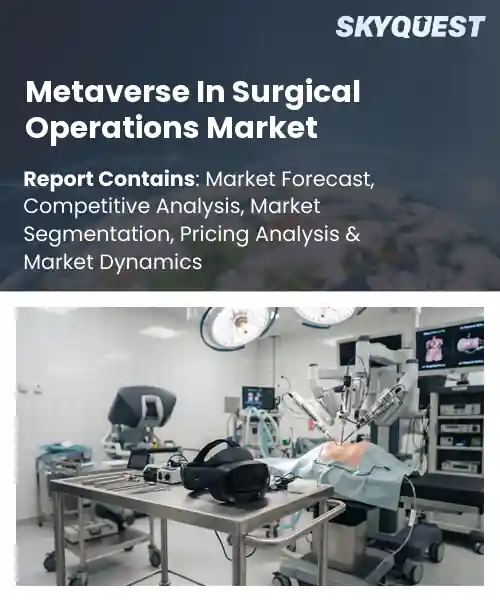
Metaverse In Surgical Operations Market
Report ID: SQMIG35G2567
Report ID: SQMIG35G2567
[email protected]
USA +1 351-333-4748
Report ID:
SQMIG35G2567 |
Region:
Global |
Published Date: August, 2026
Pages:
157
|Tables:
119
|Figures:
77


Global Metaverse In Surgical Operations Market size was valued at USD 2.14 Billion in 2024 and is poised to grow from USD 2.65 Billion in 2025 to USD 14.41 Billion by 2033, growing at a CAGR of 23.6% during the forecast period (2026-2033).
The Metaverse in Surgical Operations market blends environments with clinical data to enable surgeons to plan, rehearse, and execute procedures virtually. Its primary driver is the demand for precision and risk reduction in complex surgeries, a need amplified by aging populations and the rise of minimally invasive techniques. Early pilots such as Stanford’s Virtual Reality Surgical Simulator in 2018 showed how three‑dimensional anatomical reconstruction can shorten learning curves, while hospitals in Singapore adopted displays to overlay imaging during cardiac interventions. Over the past six years the sector has moved from experimental labs to workflows, establishing a foundation for wider adoption.
The key growth engine for the Global Metaverse in Surgical Operations market is the fusion of real‑time analytics with augmented visualizations, turning sensor streams into guidance for the operating team. When a surgeon sees a holographic overlay that reflects live vitals, decision latency falls, complications decline, and hospital stays shorten, creating cost savings that encourage adoption. Medtronic’s partnership with Unity embeds AI‑driven vessel mapping into head‑mounted displays, allowing vascular surgeons to navigate anatomy without fluoroscopy. This functionality fuels remote mentorship services, so an expert in Boston can virtually support a procedure in Nairobi, expanding market reach while alleviating shortages worldwide.
How is AI-powered Metaverse combined with IoT improving surgical operation outcomes?
AI powered Metaverse platforms are merging immersive virtual environments with live data streams from IoT devices to reshape surgical practice. The key aspects include three dimensional anatomical reconstruction, sensor fed physiological monitoring, and predictive analytics that guide instrument handling. Today surgeons can wear head mounted displays that overlay patient specific models while IoT wearables transmit heart rate, blood pressure and tissue oxygenation directly to the virtual scene. This integration reduces latency between observation and action, improves precision, and supports collaborative decision making across distant teams. The market is expanding as hospitals adopt these tools to enhance training, reduce complications and streamline workflow.
In June 2024, a leading medical technology firm announced a new AI driven metaverse platform that links surgical imaging with IoT sensors, enhancing real time decision making and supporting market growth through improved efficiency.
Market snapshot - (2026-2033)
Global Market Size
USD 2.14 Billion
Largest Segment
Hardware
Fastest Growth
Software
Growth Rate
23.6% CAGR
To get more insights on this market click here to Request a Free Sample Report
Global metaverse in surgical operations market is segmented by component, technology, application, end user and region. Based on component, the market is segmented into Software, Hardware and Services. Based on technology, the market is segmented into Virtual Reality (VR), Augmented Reality (AR), Mixed Reality (MR) and Digital Twin. Based on application, the market is segmented into Surgical Planning, Intraoperative Navigation, Surgical Training and Remote Surgical Collaboration. Based on end user, the market is segmented into Hospitals, Academic Medical Centers and Ambulatory Surgical Centers. Based on region, the market is segmented into North America, Europe, Asia Pacific, Latin America and Middle East & Africa.
Virtual reality segment dominates because it creates fully immersive 3D environments that replicate patient anatomy, enabling surgeons to rehearse procedures with tactile fidelity. This deep immersion builds confidence and reduces cognitive load, which directly translates to higher precision during live operations. The technology’s ability to integrate real‑time imaging and haptic feedback drives its central role, making it the cornerstone for metaverse‑based surgical platforms seeking to improve outcomes and workflow efficiency.
However, augmented reality segment is witnessing the strongest growth momentum because it overlays contextual data onto the surgeon’s view without fully immersing them, preserving sterility and line‑of‑sight. Its lightweight headsets and integration with existing OR equipment accelerate adoption, unlocking use cases that expand the metaverse’s clinical reach and spur market expansion.
Software segment leads because it provides the essential platforms that knit together imaging data, AI analytics, and real‑time communication required for metaverse surgical environments. Robust APIs and cloud‑native architectures enable seamless scaling and secure data exchange, allowing clinicians to visualize and manipulate virtual patients collaboratively. This foundational capability fuels confidence among adopters and sustains continuous innovation, anchoring the market’s core value proposition and driving widespread deployment across operative settings.
Meanwhile, services segment is emerging as the key high‑growth area because managed support, training, and subscription models lower entry barriers for institutions hesitant to invest heavily in infrastructure. Clinical updates and outcome monitoring enhance user confidence, prompting rapid uptake and creating revenue streams that accelerate market expansion and foster long‑term ecosystem sustainability.
To get detailed segments analysis, Request a Free Sample Report
North America leads because of a confluence of advanced clinical infrastructure, deep pockets of venture capital, and a culture of rapid technology adoption. World‑class academic medical centers partner closely with leading technology firms, creating ecosystems that accelerate prototype development and real‑world validation. Regulatory agencies provide clear pathways that encourage innovation while maintaining patient safety, and reimbursements structures are evolving to support digital therapeutics. A highly skilled surgical workforce embraces immersive training tools that enhance precision and confidence. The region also benefits from extensive data networks that feed AI‑driven simulations, ensuring that metaverse platforms remain at the cutting edge of surgical education and procedural planning.
Metaverse In Surgical Operations Market in the United States thrives on a robust synergy between top‑tier research hospitals and leading software developers, fostering continuous iteration of immersive tools. Strong intellectual property protection encourages investment in novel platforms, while a proactive regulatory environment facilitates timely clinical integration. The large, diverse patient population provides rich data for refining simulation fidelity, and health systems increasingly allocate resources toward digital transformation initiatives that embed metaverse solutions into operative workflows.
Metaverse In Surgical Operations Market in Canada benefits from a collaborative health ecosystem that blends universal coverage with forward‑thinking technology adoption. Government health agencies actively fund pilot projects that explore immersive training for remote and underserved communities. Partnerships between academic institutions and tech incubators nurture a pipeline of homegrown solutions, while a regulatory framework emphasizes safety and data privacy, building confidence among clinicians and patients alike. This supportive landscape accelerates the translation of metaverse tools from research labs to operating rooms.
Europe’s expansion is propelled by strong governmental commitment to digital health strategies and a dense network of innovative medical technology clusters. Collaborative research programs across borders foster shared standards and interoperability, allowing metaverse platforms to scale efficiently throughout the continent. Leading hospitals in key markets adopt immersive training to address surgical workforce shortages, while regulatory harmonization eases market entry for new solutions. The presence of world‑renowned engineering talent and a culture of precision medicine further refines simulation accuracy, positioning Europe as a hub where cutting‑edge virtual environments enhance surgical outcomes and education.
Metaverse In Surgical Operations Market in Germany is anchored by a powerful alliance of engineering excellence and clinical expertise. Prominent research hospitals integrate immersive platforms into resident curricula, enhancing procedural confidence. Federal funding programs prioritize digital transformation in health, encouraging startups to develop localized solutions that align with stringent quality standards. The country’s strong export orientation also drives German firms to shape global metaverse frameworks, reinforcing a leadership role in surgical simulation.
Metaverse In Surgical Operations Market in the United Kingdom experiences swift uptake due to proactive national health initiatives that champion digital education. Leading academic medical centers pilot immersive operating room simulations to reduce training bottlenecks, while collaborations with fintech and AI companies accelerate platform sophistication. A flexible regulatory approach encourages rapid testing and deployment, enabling clinicians to adopt metaverse tools that improve patient safety and procedural efficiency across the health system.
Metaverse In Surgical Operations Market in France emerges as an innovative frontier through strong public‑private partnerships that blend artistic design with technical rigor. French hospitals explore immersive environments to enhance multidisciplinary surgical planning, supported by government incentives for digital health research. The nation’s emphasis on patient‑centered care drives the creation of realistic, culturally sensitive simulations that resonate with clinicians and trainees alike, fostering gradual but steady market maturation.
Asia Pacific advances its position by leveraging rapid digital infrastructure growth and a burgeoning appetite for cutting‑edge medical training. Nations invest heavily in high‑speed connectivity and cloud ecosystems that underpin seamless metaverse experiences. Regional academic hospitals adopt immersive platforms to bridge geographic gaps, enabling remote mentorship and skill transfer across vast populations. Strong manufacturing capabilities allow local production of compatible hardware, reducing cost barriers and encouraging broader adoption. Collaborative agreements between technology giants and healthcare providers accelerate knowledge exchange, positioning the region as a dynamic arena for innovative surgical simulation.
Metaverse In Surgical Operations Market in Japan thrives on a tradition of precision engineering combined with a forward‑looking health policy. Leading surgical centers integrate high‑fidelity virtual environments to refine techniques before patient contact, reducing intra‑operative risk. Government initiatives support the development of interoperable standards, fostering cooperation among domestic startups and established medical device firms. The cultural emphasis on continuous improvement drives clinicians to embrace immersive training as a cornerstone of surgical excellence.
Metaverse In Surgical Operations Market in South Korea is propelled by a tech‑savvy medical community that rapidly adopts innovative tools. Strong collaboration between leading hospitals and semiconductor manufacturers yields ultra‑responsive hardware that enhances real‑time simulation. National health strategies prioritize digital education, encouraging widespread implementation of metaverse platforms for resident training and surgical rehearsal. This synergy between cutting‑edge technology and clinical ambition accelerates the nation’s influence within the global market.
To know more about the market opportunities by region and country, click here to
Buy The Complete Report
Enhanced Surgical Training Using VR
Real‑Time Collaboration Leveraging Immersive Platforms
High Implementation Costs and Infrastructure
Regulatory Uncertainty and Data Privacy
Request Free Customization of this report to help us to meet your business objectives.
The metaverse surgical market is intensifying as firms leverage XR, AI and digital‑twin capabilities to secure clinical advantage. Uncovr’s recent $7 million seed round fuels its AI video‑analysis platform, while Andromeda Surgical’s $15 million Series A backs a mixed‑reality navigation system linked to a major device maker. These tech‑innovation investments and strategic partnerships are driving rapid adoption and heightening competition.
Top Player’s Company Profile
SkyQuest’s ABIRAW (Advanced Business Intelligence, Research & Analysis Wing) is our Business Information Services team that Collects, Collates, Correlates, and Analyses the Data collected by means of Primary Exploratory Research backed by robust Secondary Desk research.
As per SkyQuest analysis, the global metaverse in surgical operations market is propelled mainly by enhanced surgical training using virtual reality, which lets surgeons rehearse complex procedures in a risk‑free setting and speeds skill acquisition. A second driver is real‑time collaboration through immersive platforms that connect dispersed teams in a shared virtual operating room, reducing delays and improving decision making. High implementation costs and the need for robust infrastructure act as a major restraint, limiting uptake in budget‑constrained hospitals. North America remains the dominant region due to advanced clinical infrastructure and strong venture capital, while the virtual reality segment leads the market by offering fully immersive 3D environments that drive adoption.
| Report Metric | Details |
|---|---|
| Market size value in 2024 | USD 2.14 Billion |
| Market size value in 2033 | USD 14.41 Billion |
| Growth Rate | 23.6% |
| Base year | 2024 |
| Forecast period | (2026-2033) |
| Forecast Unit (Value) | USD Billion |
| Segments covered |
|
| Regions covered | North America (US, Canada), Europe (Germany, France, United Kingdom, Italy, Spain, Rest of Europe), Asia Pacific (China, India, Japan, Rest of Asia-Pacific), Latin America (Brazil, Rest of Latin America), Middle East & Africa (South Africa, GCC Countries, Rest of MEA) |
| Companies covered |
|
| Customization scope | Free report customization with purchase. Customization includes:-
|
To get a free trial access to our platform which is a one stop solution for all your data requirements for quicker decision making. This platform allows you to compare markets, competitors who are prominent in the market, and mega trends that are influencing the dynamics in the market. Also, get access to detailed SkyQuest exclusive matrix.
Table Of Content
Executive Summary
Market overview
Parent Market Analysis
Market overview
Market size
KEY MARKET INSIGHTS
COVID IMPACT
MARKET DYNAMICS & OUTLOOK
Market Size by Region
KEY COMPANY PROFILES
Methodology
For the Metaverse In Surgical Operations Market, our research methodology involved a mixture of primary and secondary data sources. Key steps involved in the research process are listed below:
1. Information Procurement: This stage involved the procurement of Market data or related information via primary and secondary sources. The various secondary sources used included various company websites, annual reports, trade databases, and paid databases such as Hoover's, Bloomberg Business, Factiva, and Avention. Our team did 45 primary interactions Globally which included several stakeholders such as manufacturers, customers, key opinion leaders, etc. Overall, information procurement was one of the most extensive stages in our research process.
2. Information Analysis: This step involved triangulation of data through bottom-up and top-down approaches to estimate and validate the total size and future estimate of the Metaverse In Surgical Operations Market.
3. Report Formulation: The final step entailed the placement of data points in appropriate Market spaces in an attempt to deduce viable conclusions.
4. Validation & Publishing: Validation is the most important step in the process. Validation & re-validation via an intricately designed process helped us finalize data points to be used for final calculations. The final Market estimates and forecasts were then aligned and sent to our panel of industry experts for validation of data. Once the validation was done the report was sent to our Quality Assurance team to ensure adherence to style guides, consistency & design.
Analyst Support
Customization Options
With the given market data, our dedicated team of analysts can offer you the following customization options are available for the Metaverse In Surgical Operations Market:
Product Analysis: Product matrix, which offers a detailed comparison of the product portfolio of companies.
Regional Analysis: Further analysis of the Metaverse In Surgical Operations Market for additional countries.
Competitive Analysis: Detailed analysis and profiling of additional Market players & comparative analysis of competitive products.
Go to Market Strategy: Find the high-growth channels to invest your marketing efforts and increase your customer base.
Innovation Mapping: Identify racial solutions and innovation, connected to deep ecosystems of innovators, start-ups, academics, and strategic partners.
Category Intelligence: Customized intelligence that is relevant to their supply Markets will enable them to make smarter sourcing decisions and improve their category management.
Public Company Transcript Analysis: To improve the investment performance by generating new alpha and making better-informed decisions.
Social Media Listening: To analyze the conversations and trends happening not just around your brand, but around your industry as a whole, and use those insights to make better Marketing decisions.
REQUEST FOR SAMPLE
 REQUEST FREE CUSTOMIZATION
Global Metaverse In Surgical Operations Market size was valued at USD 2.14 Billion in 2024 and is poised to grow from USD 2.65 Billion in 2025 to USD 14.41 Billion by 2033, growing at a CAGR of 23.6% during the forecast period (2026-2033).
The metaverse surgical market is intensifying as firms leverage XR, AI and digital‑twin capabilities to secure clinical advantage. Uncovr’s recent $7 million seed round fuels its AI video‑analysis platform, while Andromeda Surgical’s $15 million Series A backs a mixed‑reality navigation system linked to a major device maker. These tech‑innovation investments and strategic partnerships are driving rapid adoption and heightening competition. 'Medtronic plc', 'Johnson & Johnson', 'Stryker Corporation', 'Siemens Healthineers AG', 'Intuitive Surgical, Inc.', 'Zimmer Biomet Holdings, Inc.', 'GE HealthCare Technologies Inc.', 'Koninklijke Philips N.V.', 'Microsoft Corporation', 'Meta Platforms, Inc.', 'NVIDIA Corporation', 'Surgical Theater, Inc.', 'FundamentalVR Ltd.', 'Osso VR, Inc.', 'VirtaMed AG', 'CAE Inc.', 'Touch Surgery', 'ImmersiveTouch, Inc.', 'Brainlab AG', 'EchoPixel, Inc.'
The integration of immersive virtual reality environments enables surgeons to rehearse complex procedures in a risk‑free setting, fostering skill acquisition and confidence before entering the operating theater. By replicating anatomical nuances and tactile feedback, trainees can iteratively refine techniques, reducing learning curves and enhancing procedural precision. This capability accelerates adoption of metaverse solutions across teaching hospitals, as institutions recognize the value of accelerated competency development and patient safety improvements, thereby driving market expansion. The experience supports interdisciplinary teamwork, allowing surgeons, anesthesiologists, and nurses to synchronize actions within a digital space.
Immersive Training Integration: Surgeons are increasingly adopting immersive virtual environments to rehearse complex procedures before entering the operating room. These platforms replicate tactile feedback, anatomical variability, and real-time decision pathways, allowing clinicians to refine techniques and reduce intraoperative uncertainty. Hospitals partner with technology firms to embed these simulations within credentialing programs, fostering a culture of continuous skill enhancement. The resulting confidence boost translates into smoother case flow, lower complication rates, and heightened patient trust in cutting‑edge surgical care and improved long‑term outcomes globally.
Why does North America Dominate the Global Metaverse In Surgical Operations Market? |@12


Want to customize this report? This report can be personalized according to your needs. Our analysts and industry experts will work directly with you to understand your requirements and provide you with customized data in a short amount of time. We offer $1000 worth of FREE customization at the time of purchase.
Feedback From Our Clients


 USA (+1) 351-333-4748

