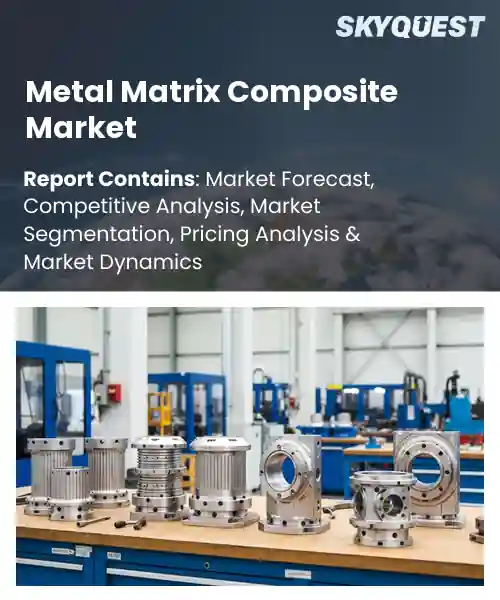
Metal Matrix Composite Market
Report ID: SQMIG15F2326
Report ID: SQMIG15F2326
[email protected]
USA +1 351-333-4748
Report ID:
SQMIG15F2326 |
Region:
Global |
Published Date: May, 2026
Pages:
157
|Tables:
184
|Figures:
79


Global Metal Matrix Composite Market size was valued at USD 825.0 Million in 2024 and is poised to grow from USD 889.35 Million in 2025 to USD 1621.9 Million by 2033, growing at a CAGR of 7.8% during the forecast period (2026-2033).
The combination of metal matrix composites consists of a metal (e.g. aluminum, magnesium or titanium) that acts as the binder and the ceramic material that serves as the reinforcement. These materials provide mechanical properties (e.g., stiffness, tensile/compressive strength and wear resistance) that are far superior to traditional metals. The attributes of the composite materials are important because they will allow manufacturers to produce lighter, longer-lasting and more stable components for aircraft, automobiles and cooling (electronics). This will assist manufacturers in meeting more stringent fuel economy and improved thermal management criteria.
Due to the development and maturity of manufacturing processes such as powder metallurgy, stir-casting and additive manufacturing, we have seen a shift from research and development of lab-produced components to manufacturing of industrial-grade parts using metal matrix composites. Many automobile manufacturers have tested metal matrix composite brake rotors and heat sink components, made with aluminum silicon carbide as the reinforcement, in order to minimize the weight of time-consuming braking systems and maximize their ability to dissipate heat.
Significant growth in demand for metal matrix composites has occurred as a result of restrictive energy efficiency regulations (e.g., Corporate Average Fuel Economy (CAFE), Euro, GHG emissions) that require Original Equipment Manufacturers (OEMs) to reduce vehicle and aircraft weight;, thus increasing metal matrix composite demand; automotive electrification will continue to require excellent thermal management of batteries and power electronics; providing new applications for aluminum silicon carbide and aluminum graphite metal matrix composites as lightweight heat spreaders will create new growth and investment opportunities for the production of these composites, reducing the total cost per part. Parallel advances in additive manufacturing and scalable casting reduce manufacturing waste and enable complex, integrated parts that lower assembly steps and maintenance, so suppliers capture broader applications across defense, industrial and electronics sectors globally.
How is AI Enhancing Manufacturing Efficiency In The Metal Matrix Composite Market?
Through advanced process capability and integration of intelligent tools, including AI-based adaptive design and real-time process control, the manufacturing of metal matrix composites will experience significant efficiency improvements through accelerated matrix designs, improved production consistency and reproducibility with varied microstructures. AI-driven design toolsets can accurately predict microstructure and performance, and utilize sensor-based monitoring and digital twin models to optimize thermal and tool paths during manufacturing. As a result, actual examples of AI-assisted, machine learning-based processes are rapidly becoming the norm, whereby defects are detected and process parameters are adaptively adjusted in real time, thus enabling reduced scrap and accelerated development cycles, are prevalent throughout many industries.
In addition to AI-driven innovations, growing industrial demand from the aerospace and transportation sectors is driving increased value and utilization of these technologies. Further, current examples of these types of tools used for additive manufacturing and materials informatics are creating more consistency and scalability when producing these types of products. Cymat Corporation, in March of 2026, announced their intent to acquire Rio Tinto Alcan's metal matrix composite division and leverage that acquisition to invest in and develop their own AI-based process control and inline sensing technology. By doing so, Cymat will be able to scale their production capability, accelerate part qualification for their customers and produce more yield and quality, thus enhancing their overall market position.
Market snapshot - (2026-2033)
Global Market Size
USD 825.0 Million
Largest Segment
Aluminum Matrix Composites
Fastest Growth
Magnesium Matrix Composites
Growth Rate
7.8% CAGR
To get more insights on this market click here to Request a Free Sample Report
Global metal matrix composite market is segmented by matrix material, reinforcement material, production process, application, end user industry, form and region. Based on matrix material, the market is segmented into Aluminum Matrix Composites, Magnesium Matrix Composites, Titanium Matrix Composites, Copper Matrix Composites and Others. Based on reinforcement material, the market is segmented into Silicon Carbide, Alumina, Carbon Fiber, Boron Fiber and Others. Based on production process, the market is segmented into Powder Metallurgy, Liquid Metal Infiltration, Stir Casting, Squeeze Casting and Others. Based on application, the market is segmented into Automotive Components, Aerospace & Defense, Electronics & Thermal Management, Industrial Machinery, Energy & Power and Others. Based on end user industry, the market is segmented into Automotive, Aerospace & Defense, Electrical & Electronics, Industrial, Energy and Others. Based on form, the market is segmented into Sheets & Panels, Rods & Bars, Particulates and Others. Based on region, the market is segmented into North America, Europe, Asia Pacific, Latin America and Middle East & Africa.
The Aluminum Matrix Composites (Al-MC) segment will continue to dominate the metal matrix composite market mainly because of their low-density, high strength to weight ratio and low-cost processing methods. They are, therefore, the default choice for use in a wide variety of applications within the metal matrix composite marketplace. Furthermore, established manufacturing processes are compatible withifying processes, providing weight reduction, thermal properties, and formability that meet the demands of automotive and thermal management applications, which builds confidence in procurement and facilitates integration into complex assemblies.
Conversely, the Titanium Matrix Composite (Ti-MC) segment has been experiencing the fastest growth due to superior properties of Ti-MC's high-temperature strength and corrosion resistance relative to aerospace and energy applications. Advancements in powder metallurgy and bonding techniques have reduced production barriers for Ti-MCs, creating opportunities for ti-matrix composites to be used in applications that justify their higher cost, and providing premium quality application opportunities due to their extreme specific strength and thermal stability characteristics.
Because of its unique properties, Silicon Carbide is the preferred material for the production of high-performance Metal Matrix Composites (MMCs). The combination of its exceptional hardness, thermal stability, and wear resistance, along with its compatibility with multiple metal matrices and a well-established track record in terms of lifecycle performance, is driving the adoption of Silicon Carbide in high-performance friction systems, cutting tools, and thermal management components. Well-established supply chains and extensive knowledge of processing techniques are reducing technical friction and facilitating widespread industrial implementation of these types of materials. The performance profile of Silicon Carbide also reduces the time required by industrial purchasers to certify and qualify products manufactured using these materials.
In addition to Silicon Carbide, Carbon Fiber is rapidly emerging as an even faster-growing source of material reinforcement. The combination of its unmatched specific strength with its low weight is triggering increased demand for Carbon Fibers in aerospace, electric vehicle, and high-end industrial applications. Furthermore, improved Bonding between Carbon Fibers and metals, combined with new Hybrid Composite designs, are allowing manufacturers to explore new performance ranges for their structures, leading to lighter and stiffer structures and creating new and profitable corridors of application.
To get detailed segments analysis, Request a Free Sample Report
The Asia-Pacific region is leading in this area primarily because of the combination of large-scale manufacturing, concentrated demand throughout multiple types of supply chains (i.e., automotive and aerospace), and the ongoing investment in advanced material research development. Industrial clusters allow for a high degree of collaboration between materials scientists, part manufacturers, and end-users, allowing for rapid prototyping and commercialization of new products. An ample supply of alloy feedstock and capabilities to process various form of composites will support many different composite formulations and demonstration projects. Collaboration among the top companies and research institutions in multiple countries will enhance the sharing of knowledge and the development of applications; also, the tiered supplier model allows for rapid growth from very niche applications to an even larger production scale. Furthermore, the high growth industrial segments, the strategic focus on lighter weight and better performance of metal matrix composites, will drive their usage, and the beneficial manufacturing infrastructure, will shorten the time to produce innovative metal matrix composite solutions. In addition to this, a strong policy framework and targeted incentives will be implemented by some of the more significant markets to promote additional investment within the industry and to provide innovative metal matrix composite solutions.
Japan has an established metal matrix composite market due to its highly integrated nature of advanced materials research with precision manufacturing. It is characterised by strong institutional research capabilities and collaborative relationships between major automotive and electronics manufacturers to develop application-specific composite solutions. A focus on quality, reliability, and miniaturisation has led to their application in high-performance components. Domestic suppliers are primarily focused on refining production processes and creating accreditation systems to facilitate their adoption across various sectors and to aid in collaborative development of standards internationally.
South Korea's metal matrix composite market has developed due to a well-established base of investment into advanced manufacturing, coupled with the close working relationship between R&D institutions and the heavy industrial sector. Investment into targeted programs that improve performance in transportation and energy sectors is being used to support a more streamlined supply network across suppliers for new processing techniques and methods. Together with collaborative pilot programmes and feedback loops between manufacturers and developers of metal matrix composite materials allow manufacturers to support iterative enhancements that facilitate broader adoption of metal matrix composite materials in high value manufactured goods supply chains.
The rapid growth taking place in North America is being fueled primarily by a close alignment of the end-user demand for lightweight, high-performance materials with an innovation ecosystem that is supporting the needs of the aerospace and automotive industries through significant collaboration between manufacturers and technology-centric startups. A strong pull from these two industries is generated by the need for materials to provide improved performance (durability) and reduced mass, while researchers are collaborating with established companies to bring their research advancements into the marketplace. In addition, strategic procurement policies, including supplier qualification processes, are encouraging the adoption of these materials by providing funds for demonstration projects and validating supply chains. Additionally, advanced manufacturing capabilities, such as precision processing and testing infrastructure, have been developed to scale up production of complex composite components. Various collaborations across industry sectors; regional material clusters; and emphasis on standards/certification pathways, are helping accelerate the market adoption and maturity of these materials in many different industrial applications. Growth of the emphasis on lifecycle performance/repairability and environmental issues is driving an increase in use among sectors looking for efficiencies and long-term operational benefit.
In the U.S., Metal Matrix Composite Market benefits from cooperative relationships between defence, aerospace and automotive OEMs as well as material developer companies. Achieving high levels of performance and meeting all the required certifications for the validation and production processes can only be accomplished through mature private investment and research consortia that promote innovation to production. The proliferation of concentrated manufacturing hubs and specialized suppliers allows for broader application diversity due to advanced processing capabilities, thereby strengthening the commercialisation effort of metal matrix composite components across multiple industrial sectors.
In Canada, the Metal Matrix Composite market is influenced by the collaboration of participating industry partners, research institutions, private manufacturers, and government agencies to create a cohesive and meaningful development pathway for composite materials. This collaboration is driven by a focus on improving material performance in high-traffic transportation and energy sectors, whereby creating durable composite materials is critical to achieving successful long-term applications. Development of innovation networks, augmented by specialized laboratories allows researchers and manufacturers to take previously tested prototype components and create commercially-usable parts through the validation process. The development of various supply chain solutions enables the parties to maintain redundancy in the supply chain, supporting the resilience of the market. The concentration of development on cross-border partnerships coupled with niche industrial applications allows for continued expansion of Metal Matrix Composites across Canada’s manufacturing ecosystem.
Europe is strengthening its position through coordinated efforts that blend industrial expertise, targeted research programs, and a strong focus on manufacturing quality and standardization. Regional clusters concentrate specialized suppliers, pilot production facilities, and testing centers that enable rigorous qualification of composite materials for demanding applications. Collaboration between OEMs and materials laboratories emphasizes validation, recyclability, and life cycle performance, aligning product development with regulatory and sustainability priorities. Investment in automation and precision processing reduces barriers to consistent production, while cross border partnerships and harmonized certification pathways improve market access and stimulate application uptake across transportation, energy, and industrial equipment sectors. Support mechanisms for SMEs and technology transfer initiatives foster commercialization of niche innovations, while an emphasis on supply chain resilience and circularity encourages material reuse and end of life strategies that enhance industry credibility and long term adoption.
Metal Matrix Composite Market in Germany leverages deep engineering expertise and integration with precision manufacturing sectors. Emphasis on rigorous testing and reproducibility supports reliable component qualification for automotive and industrial machinery applications. Collaborative research hubs and pilot production centers enable scale up of processing methods, while specialized suppliers develop tailored material systems. A culture of innovation and supplier networks facilitates incorporation of metal matrix composite solutions into industrial production environments.
Metal Matrix Composite Market in United Kingdom draws on a strong research base and collaboration between universities and advanced manufacturers. Emphasis on materials engineering and rigorous testing supports adoption in aerospace and high performance transport applications. Pilot facilities and focused production sites enable demonstration of component performance, while industry consortia drive standards and certification efforts, smoothing transition from prototype validation to broader supply chain uptake of metal matrix composite technologies.
Metal Matrix Composite Market in France is supported by strong materials science expertise and collaboration with aerospace and energy companies seeking performance gains. National research networks and industrial laboratories focus on process development, component testing, and qualification pathways. Emphasis on sustainable production and recyclability aligns material development with regulatory priorities. Small and medium enterprises work with OEMs to pilot applications, enabling transfer from experimental to certified components within supply chains.
To know more about the market opportunities by region and country, click here to
Buy The Complete Report
High Performance Requirements In Industries
Designers across aerospace, automotive and industrial equipment are forced to look for ways to create lightweight, high strength components. Metal matrix composites (MMCs) provide a solution that offers both material and operational benefits. By enabling the creation of more efficient components, longer working life and less maintenance, MMCs allow manufacturers and designers to achieve strict operational requirements and regulations. Support for the use of MMCs is driven by a combination of alignment of performance criteria with the capabilities of materials, support for investment into future development and stimulation of usage of MMCs in applications where conventional metals do not meet multiple functional performance criteria.
Demand For Lightweight Components
Complex Manufacturing Processes
The complex processes that create metal matrix composites make the potential to use them more restrictive among the marketplace as a whole. The need for specialised equipment, strict process controls and highly skilled personnel must be met in order to achieve consistent distribution of reinforcements throughout the composite and the same properties for each composite that is manufactured. These required operational characteristics extend development timelines and add complexity to process scale up time for new applications. This creates a barrier to entities in some industries from looking at MMCs for common products, creates conservative purchasing activity regarding MMC's and results in established materials being prioritised, therefore restricting the introduction of MMC's into lower margin or higher volume markets that require reliable, repeatable processes for production.
Limited Standardization Across Applications
Request Free Customization of this report to help us to meet your business objectives.
Competition in the global metal matrix composite market centers on securing proprietary processing and thermal management IP, vertical supply chains, and defense contracts; incumbents pursue M&A to add refractory and powder capabilities, exemplified by Plansee Group's Mi-Tech Tungsten acquisition in 2022. Startups compete via university partnerships and pilot programs, for example CMMC's collaboration with TU Chemnitz and CPS Technologies' SBIR funded product development and first articles shipped.
SkyQuest’s ABIRAW (Advanced Business Intelligence, Research & Analysis Wing) is our Business Information Services team that Collects, Collates, Correlates, and Analyses the Data collected by means of Primary Exploratory Research backed by robust Secondary Desk research.
As per SkyQuest analysis, a key driver is regulatory pressure to improve energy efficiency, which pushes OEMs toward lightweight, high performance materials, and a second driver is rising demand from electrification and thermal management for batteries and power electronics. A key restraint remains the complex manufacturing processes required to ensure uniform reinforcement distribution and repeatable properties, which complicates scale up and qualification. Asia Pacific currently dominates the market thanks to manufacturing scale, R&D clusters and concentrated automotive and aerospace demand, while Aluminum Matrix Composites are the dominating segment due to low density, cost effectiveness and established processing routes that support broad industrial uptake.
| Report Metric | Details |
|---|---|
| Market size value in 2024 | USD 825.0 Million |
| Market size value in 2033 | USD 1621.9 Million |
| Growth Rate | 7.8% |
| Base year | 2024 |
| Forecast period | (2026-2033) |
| Forecast Unit (Value) | USD Million |
| Segments covered |
|
| Regions covered | North America (US, Canada), Europe (Germany, France, United Kingdom, Italy, Spain, Rest of Europe), Asia Pacific (China, India, Japan, Rest of Asia-Pacific), Latin America (Brazil, Rest of Latin America), Middle East & Africa (South Africa, GCC Countries, Rest of MEA) |
| Companies covered |
|
| Customization scope | Free report customization with purchase. Customization includes:-
|
To get a free trial access to our platform which is a one stop solution for all your data requirements for quicker decision making. This platform allows you to compare markets, competitors who are prominent in the market, and mega trends that are influencing the dynamics in the market. Also, get access to detailed SkyQuest exclusive matrix.
Table Of Content
Executive Summary
Market overview
Parent Market Analysis
Market overview
Market size
KEY MARKET INSIGHTS
COVID IMPACT
MARKET DYNAMICS & OUTLOOK
Market Size by Region
KEY COMPANY PROFILES
Methodology
For the Metal Matrix Composite Market, our research methodology involved a mixture of primary and secondary data sources. Key steps involved in the research process are listed below:
1. Information Procurement: This stage involved the procurement of Market data or related information via primary and secondary sources. The various secondary sources used included various company websites, annual reports, trade databases, and paid databases such as Hoover's, Bloomberg Business, Factiva, and Avention. Our team did 45 primary interactions Globally which included several stakeholders such as manufacturers, customers, key opinion leaders, etc. Overall, information procurement was one of the most extensive stages in our research process.
2. Information Analysis: This step involved triangulation of data through bottom-up and top-down approaches to estimate and validate the total size and future estimate of the Metal Matrix Composite Market.
3. Report Formulation: The final step entailed the placement of data points in appropriate Market spaces in an attempt to deduce viable conclusions.
4. Validation & Publishing: Validation is the most important step in the process. Validation & re-validation via an intricately designed process helped us finalize data points to be used for final calculations. The final Market estimates and forecasts were then aligned and sent to our panel of industry experts for validation of data. Once the validation was done the report was sent to our Quality Assurance team to ensure adherence to style guides, consistency & design.
Analyst Support
Customization Options
With the given market data, our dedicated team of analysts can offer you the following customization options are available for the Metal Matrix Composite Market:
Product Analysis: Product matrix, which offers a detailed comparison of the product portfolio of companies.
Regional Analysis: Further analysis of the Metal Matrix Composite Market for additional countries.
Competitive Analysis: Detailed analysis and profiling of additional Market players & comparative analysis of competitive products.
Go to Market Strategy: Find the high-growth channels to invest your marketing efforts and increase your customer base.
Innovation Mapping: Identify racial solutions and innovation, connected to deep ecosystems of innovators, start-ups, academics, and strategic partners.
Category Intelligence: Customized intelligence that is relevant to their supply Markets will enable them to make smarter sourcing decisions and improve their category management.
Public Company Transcript Analysis: To improve the investment performance by generating new alpha and making better-informed decisions.
Social Media Listening: To analyze the conversations and trends happening not just around your brand, but around your industry as a whole, and use those insights to make better Marketing decisions.
REQUEST FOR SAMPLE
 REQUEST FREE CUSTOMIZATION
Global Metal Matrix Composite Market size was valued at USD 825.0 Million in 2024 and is poised to grow from USD 889.35 Million in 2025 to USD 1621.9 Million by 2033, growing at a CAGR of 7.8% during the forecast period (2026-2033).
Competition in the global metal matrix composite market centers on securing proprietary processing and thermal management IP, vertical supply chains, and defense contracts; incumbents pursue M&A to add refractory and powder capabilities, exemplified by Plansee Group's Mi-Tech Tungsten acquisition in 2022. Startups compete via university partnerships and pilot programs, for example CMMC's collaboration with TU Chemnitz and CPS Technologies' SBIR funded product development and first articles shipped. '3M', 'Materion Corporation', 'CPS Technologies', 'Plansee Group', 'GKN Aerospace', 'DWA Aluminum Composites', 'Denka Company', 'Hitachi Metals', 'TISICS', 'SGL Carbon', 'Sandvik', 'AMETEK Specialty Metal Products', 'Mitsubishi Materials', 'FMW Composite Systems', 'Alvant', 'Ceratizit', 'Performance Materials Corporation', 'Höganäs', 'ATI', 'Kyocera Corporation'
High performance demands in aerospace, automotive, and industrial equipment compel designers to seek materials that combine lightweight characteristics with superior strength, stiffness, and thermal stability, making metal matrix composites an attractive option. By enabling more efficient component designs, longer service life, and reduced maintenance cycles, MMCs help manufacturers meet stringent operational requirements and regulatory expectations. This alignment between performance needs and material capabilities encourages specification of MMCs, supports investment in development, and stimulates adoption across applications where conventional metals cannot satisfy multiple functional performance targets.
Lightweighting For Fuel Efficiency: Manufacturers across aerospace and automotive sectors increasingly prioritize material solutions that reduce component mass while preserving structural integrity and thermal performance. Metal matrix composites enable design consolidation, extended service life under demanding conditions, and compatibility with advanced manufacturing processes, supporting suppliers and OEMs seeking differentiated performance. Adoption is driven by sustainability priorities and lifecycle considerations, prompting collaboration among material scientists, fabricators, and end users to validate application specific benefits and integrate these composites into next generation vehicle and aircraft platforms.
Why does Asia Pacific Dominate the Global Metal Matrix Composite Market? |@12


Want to customize this report? This report can be personalized according to your needs. Our analysts and industry experts will work directly with you to understand your requirements and provide you with customized data in a short amount of time. We offer $1000 worth of FREE customization at the time of purchase.
Feedback From Our Clients


 USA (+1) 351-333-4748

