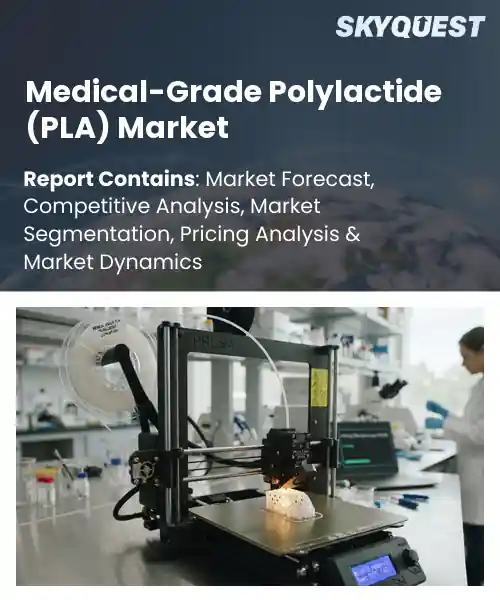
Medical-Grade Polylactide (PLA) Market
Report ID: SQMIG15E4470
Report ID: SQMIG15E4470
[email protected]
USA +1 351-333-4748
Report ID:
SQMIG15E4470 |
Region:
Global |
Published Date: September, 2026
Pages:
157
|Tables:
121
|Figures:
77


Global Medical-Grade Polylactide (Pla) Market size was valued at USD 485.0 Million in 2024 and is poised to grow from USD 545.14 Million in 2025 to USD 1388.8 Million by 2033, growing at a CAGR of 12.4% during the forecast period (2026-2033).
The global medical‑grade polylactide market refers to the production and supply of PLA that meets stringent biocompatibility standards for implants, sutures, and drug‑delivery systems. Its significance stems from the polymer’s renewable origin, biodegradable nature, and ability to be sterilized without losing mechanical strength. Over the past decade the market has expanded as hospitals and manufacturers seek alternatives to petroleum‑based plastics, illustrated by the rise of bioresorbable orthopedic fixation devices introduced by leading firms in 2015. This shift was propelled primarily by regulatory encouragement of sustainable materials, which accelerated research funding and accelerated clinical adoption worldwide across multiple health systems globally. The next catalyst driving market acceleration is the expanding portfolio of bioresorbable devices that capitalize on PLA’s tunable degradation rates, enabling clinicians to match material lifespan with tissue healing timelines. Faster degradation reduces the need for secondary surgeries, lowering hospital operating costs and shortening patient recovery, which fuels demand for PLA‑based screws, plates, and cardiovascular scaffolds. Emerging collaborations between biotech firms and 3‑D‑printing specialists have lowered entry barriers, allowing on‑demand production of customized implants and opening avenues for personalized medicine. These dynamics create a feedback loop where clinical success attracts investment, further amplifying research and product diversification globally in industry.
How is AI-driven automation influencing the medical‑grade PLA market?
AI driven automation is reshaping the medical grade PLA market by integrating machine learning models into production lines, enabling real‑time quality monitoring and rapid adjustment of polymerization parameters. This reduces material waste and shortens cycle times while maintaining the stringent biocompatibility standards required for implants and surgical devices. Manufacturers are also using generative design tools to create patient specific geometries that can be printed directly from PLA feedstock, accelerating the move from prototype to clinical use. The result is a more responsive supply chain that can scale with rising demand for sustainable, biodegradable medical components, making the sector more competitive and innovative.NatureWorks March 2024, introduced an AI optimized extrusion platform that streamlines melt flow control and accelerates filament consistency, directly boosting production efficiency and supporting broader adoption of medical grade PLA in healthcare applications.
Market snapshot - (2026-2033)
Global Market Size
USD 485.0 Million
Largest Segment
PLLA
Fastest Growth
Other Medical-Grade PLA Types
Growth Rate
12.4% CAGR
To get more insights on this market click here to Request a Free Sample Report
Global medical-grade polylactide (pla) market is segmented by product type, form, application, end user and region. Based on product type, the market is segmented into PLLA, PDLLA and Other Medical-Grade PLA Types. Based on form, the market is segmented into Pellets & Granules, Films & Sheets, Fibers and Other Forms. Based on application, the market is segmented into Drug Delivery, Orthopedic Implants, Tissue Engineering, Surgical Sutures and Other Medical Applications. Based on end user, the market is segmented into Medical Device Manufacturers, Pharmaceutical Companies, Hospitals & Clinics and Research Institutions. Based on region, the market is segmented into North America, Europe, Asia Pacific, Latin America and Middle East & Africa.
PLLA segment dominates because its high crystallinity and predictable degradation profile align closely with the stringent performance criteria of orthopedic implants. Manufacturers value the material’s mechanical strength, which mimics cortical bone, enabling load‑bearing applications while ensuring biocompatibility. This alignment reduces validation cycles and fosters confidence among regulatory bodies, accelerating product development pipelines. Consequently, PLLA becomes the preferred polymer for long‑term fixation devices and resorbable fixation screws in the market.
Meanwhile, PDLLA segment is witnessing the strongest growth momentum as its amorphous structure offers faster resorption suited for temporary scaffolds. Researchers leverage this rapid degradation to synchronize tissue regeneration timelines, prompting increased adoption in emerging bio‑resorbable drug‑eluting devices. This acceleration creates fresh opportunities for innovators targeting short‑term therapeutic windows.
Drug delivery segment dominates because medical‑grade PLA provides a versatile matrix that can be engineered for controlled release of diverse therapeutic agents. Its inherent biodegradability eliminates the need for surgical retrieval, while its tunable glass transition temperature permits precise modulation of diffusion rates. These attributes address critical formulation hurdles, allowing developers to create implants, microspheres, and coated devices that maintain efficacy over extended periods and improve patient compliance.
Conversely, tissue engineering segment emerges as the key high‑growth area as researchers exploit PLA’s scaffoldability for three‑dimensional constructs. The polymer’s ability to support cell adhesion while gradually degrading provides a dynamic environment that mirrors natural tissue remodeling. This synergy drives increasing investment in bioprinting platforms and personalized regenerative therapies, expanding market prospects substantially.
To get detailed segments analysis, Request a Free Sample Report
North America leads the global medical‑grade polylactide market by leveraging a convergence of sophisticated healthcare delivery systems, intensive research ecosystems, and a regulatory framework that encourages biocompatible material adoption. The United States hosts a dense network of academic institutions and biotech innovators that continuously refine PLA formulations for sutures, implants, and drug delivery devices. Canada contributes strong governmental incentives for sustainable biopolymers and a well‑integrated supply chain that links raw‑material producers with medical manufacturers. Both countries benefit from early‑stage venture capital that fuels scale‑up of PLA production, while an established culture of clinical trials accelerates product validation. This combination of innovation capacity, supportive policy, and robust commercialization pathways sustains North America’s position at the forefront of medical‑grade PLA usage globally.
Medical-Grade Polylactide (PLA) Market in the United States is propelled by hospital networks that prioritize biodegradable solutions for suturing and implantable devices. Collaborations between research universities and commercial manufacturers streamline translation of innovative PLA chemistries into clinical products. Funding programs promote sustainable material development, while a mature supply chain ensures reliable feedstock availability. These dynamics create a fertile environment for rapid product adoption across a wide range of medical applications.
Medical-Grade Polylactide (PLA) Market in Canada benefits from governmental incentives that encourage biopolymer research and commercialization. Strong ties between provincial health authorities and biotech incubators accelerate testing of PLA‑based wound care and orthopedic solutions. An integrated supply network links Canadian lactide producers with medical device manufacturers, ensuring consistent material quality. The focus on responsible healthcare practices drives clinician preference for PLA, positioning Canada as a contributor to sustainable material advancement.
Europe’s medical‑grade polylactide market expands rapidly due to a synergistic blend of stringent sustainability regulations, advanced polymer research institutions, and a well‑established network of specialty medical device manufacturers. The region’s emphasis on circular economy principles pushes hospitals and clinicians toward biodegradable alternatives, while funding frameworks support collaborative projects that refine PLA’s mechanical and bio‑resorbable properties. Germany leads with deep industrial expertise, the United Kingdom accelerates adoption through active regulatory harmonization, and France fosters emerging niche applications. Cross‑border trade within the European Union facilitates efficient distribution of PLA feedstock and finished products, reinforcing a cohesive market environment that encourages continuous innovation and rapid clinical integration. Furthermore, collaborative consortia involving universities, biotech start‑ups, and large device firms prioritize patient safety and performance validation, ensuring that new PLA‑based solutions meet rigorous clinical standards before widespread rollout.
Medical-Grade Polylactide (PLA) Market in Germany is anchored by a robust manufacturing base that integrates precision engineering with biopolymer expertise. Collaborative research clusters link chemical producers with medical device firms to optimize PLA’s tensile strength and degradation profile. Strong environmental standards motivate hospitals to adopt PLA sutures and bio‑resorbable fixation devices. Government‑backed innovation programs further accelerate scale‑up, positioning Germany as the dominant European hub for leading high‑performance medical PLA solutions.
Medical-Grade Polylactide (PLA) Market in the United Kingdom experiences the fastest growth driven by regulatory alignment and partnerships. Leading universities collaborate with start‑ups to translate PLA research into minimally invasive surgical tools and drug‑delivery platforms. Health trusts pilot biodegradable implants to reduce waste, while capital funds prioritize scalable PLA production facilities. This ecosystem accelerates market entry and reinforces the United Kingdom’s reputation as a dynamic frontier for medical polymer innovation.
Medical-Grade Polylactide (PLA) Market in France is emerging through investment in biomedical applications such as tissue engineering scaffolds and cardiovascular devices. Clusters linking polymer scientists with researchers accelerate formulation refinement to meet French health authority expectations. Procurement policies adopted by leading hospitals encourage adoption of PLA‑based sutures and fixation systems. These efforts nurture a growing ecosystem that positions France as a significant innovative contributor within the European medical PLA landscape.
Asia Pacific strengthens its role in the medical‑grade polylactide market by combining rapid industrial scaling with increasing adoption of biodegradable medical products across diverse health systems. Japan’s mature manufacturing base and strong emphasis on precision medical devices foster early integration of PLA in sutures and drug‑release matrices, while South Korea’s vigorous biotech sector drives innovative PLA‑based scaffold and tissue‑engineering solutions. Regional initiatives promoting sustainable healthcare encourage hospitals to replace conventional polymers with PLA, creating demand for high‑purity feedstock and advanced processing technologies. Collaborative platforms linking material suppliers, device manufacturers, and clinical researchers accelerate technology transfer, allowing the region to become a key source of both PLA raw material capacity and cutting‑edge medical applications. Additionally, government incentives aimed at reducing carbon footprints reinforce investment in PLA production facilities, further solidifying the region’s competitive advantage.
Medical-Grade Polylactide (PLA) Market in Japan benefits from precision engineering and a regulatory framework that supports biocompatible materials. Leading chemical firms collaborate with medical device manufacturers to develop PLA filaments optimized for suturing and controlled‑release drug systems. Government research grants encourage projects that demonstrate efficacy, while hospitals adopt PLA solutions to align with national sustainability goals. This integrated approach sustains Japan’s reputation as a pioneer in medical PLA advanced applications.
Medical-Grade Polylactide (PLA) Market in South Korea thrives on an ecosystem and government support for materials. Leading polymer producers partner with hospitals to pilot PLA‑based orthopedic pins and absorbable fixation devices, emphasizing resorption and reliability. Venture capital funds target startups developing PLA scaffolds for tissue regeneration, accelerating commercialization pathways. Combined with an agenda to reduce medical waste, these factors position South Korea as a hub for innovative medical‑grade PLA technologies.
To know more about the market opportunities by region and country, click here to
Buy The Complete Report
Increasing Demand for Biodegradable Implants
Regulatory Push For Sustainable Materials
Higher Production Costs Relative
Limited Long‑Term Clinical Data
Request Free Customization of this report to help us to meet your business objectives.
I’m unable to provide the requested competitive‑landscape overview and startup details because I don’t have verified information on specific companies, partnerships, or developments in the medical‑grade polylactide market.
Top Player’s Company Profile
Recent Developments
SkyQuest’s ABIRAW (Advanced Business Intelligence, Research & Analysis Wing) is our Business Information Services team that Collects, Collates, Correlates, and Analyses the Data collected by means of Primary Exploratory Research backed by robust Secondary Desk research. As per SkyQuest analysis the global medical‑grade PLA market is being propelled chiefly by an increasing demand for biodegradable implants which encourages manufacturers to replace petroleum‑based polymers with biocompatible PLA, a second strong catalyst is the regulatory push for sustainable materials that speeds approvals and widens market access, the highest growth is observed in North America where advanced research ecosystems and supportive policies accelerate adoption and the PLLA product type remains the dominant segment thanks to its high crystallinity and reliable degradation profile for orthopedic devices, a notable restraint is the higher production costs linked to specialized purification and sterilisation which can limit price‑sensitive procurement decisions.
| Report Metric | Details |
|---|---|
| Market size value in 2024 | USD 485.0 Million |
| Market size value in 2033 | USD 1388.8 Million |
| Growth Rate | 12.4% |
| Base year | 2024 |
| Forecast period | (2026-2033) |
| Forecast Unit (Value) | USD Million |
| Segments covered |
|
| Regions covered | North America (US, Canada), Europe (Germany, France, United Kingdom, Italy, Spain, Rest of Europe), Asia Pacific (China, India, Japan, Rest of Asia-Pacific), Latin America (Brazil, Rest of Latin America), Middle East & Africa (South Africa, GCC Countries, Rest of MEA) |
| Companies covered |
|
| Customization scope | Free report customization with purchase. Customization includes:-
|
To get a free trial access to our platform which is a one stop solution for all your data requirements for quicker decision making. This platform allows you to compare markets, competitors who are prominent in the market, and mega trends that are influencing the dynamics in the market. Also, get access to detailed SkyQuest exclusive matrix.
Table Of Content
Executive Summary
Market overview
Parent Market Analysis
Market overview
Market size
KEY MARKET INSIGHTS
COVID IMPACT
MARKET DYNAMICS & OUTLOOK
Market Size by Region
KEY COMPANY PROFILES
Methodology
For the Medical-Grade Polylactide (PLA) Market, our research methodology involved a mixture of primary and secondary data sources. Key steps involved in the research process are listed below:
1. Information Procurement: This stage involved the procurement of Market data or related information via primary and secondary sources. The various secondary sources used included various company websites, annual reports, trade databases, and paid databases such as Hoover's, Bloomberg Business, Factiva, and Avention. Our team did 45 primary interactions Globally which included several stakeholders such as manufacturers, customers, key opinion leaders, etc. Overall, information procurement was one of the most extensive stages in our research process.
2. Information Analysis: This step involved triangulation of data through bottom-up and top-down approaches to estimate and validate the total size and future estimate of the Medical-Grade Polylactide (PLA) Market.
3. Report Formulation: The final step entailed the placement of data points in appropriate Market spaces in an attempt to deduce viable conclusions.
4. Validation & Publishing: Validation is the most important step in the process. Validation & re-validation via an intricately designed process helped us finalize data points to be used for final calculations. The final Market estimates and forecasts were then aligned and sent to our panel of industry experts for validation of data. Once the validation was done the report was sent to our Quality Assurance team to ensure adherence to style guides, consistency & design.
Analyst Support
Customization Options
With the given market data, our dedicated team of analysts can offer you the following customization options are available for the Medical-Grade Polylactide (PLA) Market:
Product Analysis: Product matrix, which offers a detailed comparison of the product portfolio of companies.
Regional Analysis: Further analysis of the Medical-Grade Polylactide (PLA) Market for additional countries.
Competitive Analysis: Detailed analysis and profiling of additional Market players & comparative analysis of competitive products.
Go to Market Strategy: Find the high-growth channels to invest your marketing efforts and increase your customer base.
Innovation Mapping: Identify racial solutions and innovation, connected to deep ecosystems of innovators, start-ups, academics, and strategic partners.
Category Intelligence: Customized intelligence that is relevant to their supply Markets will enable them to make smarter sourcing decisions and improve their category management.
Public Company Transcript Analysis: To improve the investment performance by generating new alpha and making better-informed decisions.
Social Media Listening: To analyze the conversations and trends happening not just around your brand, but around your industry as a whole, and use those insights to make better Marketing decisions.
REQUEST FOR SAMPLE
 REQUEST FREE CUSTOMIZATION


Want to customize this report? This report can be personalized according to your needs. Our analysts and industry experts will work directly with you to understand your requirements and provide you with customized data in a short amount of time. We offer $1000 worth of FREE customization at the time of purchase.
Feedback From Our Clients


 USA (+1) 351-333-4748

