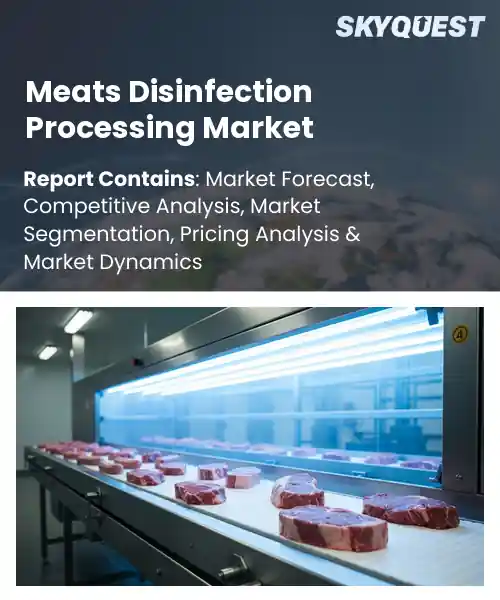
Meats Disinfection Processing Market
Report ID: SQMIG30I2986
Report ID: SQMIG30I2986
[email protected]
USA +1 351-333-4748
Report ID:
SQMIG30I2986 |
Region:
Global |
Published Date: June, 2026
Pages:
157
|Tables:
177
|Figures:
81


Global Meats Disinfection Processing Market size was valued at USD 2.84 Billion in 2024 and is poised to grow from USD 3.03 Billion in 2025 to USD 5.1 Billion by 2033, growing at a CAGR of 6.7% during the forecast period (2026-2033).
The global meats disinfection processing industry encompasses technologies and services that eliminate pathogenic microorganisms from pork, beef, poultry and seafood before they reach consumers. Its importance drives from rising food‑borne illness outbreaks, stricter governmental standards, and consumer demand for safe, high‑quality protein.
The adoption of spray‑chilling systems emerges as a key growth catalyst because they reduce microbial load and extend shelf life, thereby lowering waste for retailers. For example, a large poultry processor integrated ultraviolet‑LED tunnels in 2022, achieving a 30 % drop in Salmonella prevalence and a 12 % increase in product turnover. The cost savings generated by fewer recalls and longer distribution windows encourage investment, which in turn spurs equipment manufacturers to innovate more efficient designs. This feedback loop creates opportunities for service contracts, retrofitting projects, and expansion into emerging markets where food safety infrastructure remains underdeveloped.
How is AI-driven automation improving safety and efficiency in the meat disinfection processing market?
AI‑driven automation is reshaping meat disinfection by integrating vision systems, predictive modelling, and adaptive robotics. Smart cameras detect surface contaminants in real time, allowing robotic spray arms to target only affected zones and reduce chemical waste. Machine‑learning algorithms analyse temperature, humidity and pathogen load to optimize cycle times, ensuring consistent kill rates while maintaining product quality. The technology also logs every pass, creating immutable records that simplify compliance audits and traceability. By shifting from manual spraying to autonomous, data‑rich processes, processors achieve higher safety standards, lower labor exposure, and steadier throughput, positioning the sector for scalable growth as demand for safe, pathogen‑free meat rises.
Ecolab in April 2025, launched an AI‑controlled disinfection robot that maps carcass surfaces and adjusts sanitizer dosage on the fly, boosting both safety and line efficiency while supporting broader market expansion.
Market snapshot - (2026-2033)
Global Market Size
USD 2.84 Billion
Largest Segment
Fastest Growth
Growth Rate
6.7% CAGR
To get more insights on this market click here to Request a Free Sample Report
Global meats disinfection processing market is segmented by disinfection technology, meat type, processing stage, application, end user, equipment type, and region. Based on disinfection technology, the market is segmented into chemical disinfectants, ultraviolet (UV) disinfection, ozone treatment, cold plasma technology, steam pasteurization, electrolyzed water, and organic acid treatment. Based on meat type, the market is segmented into poultry, beef, pork, seafood, lamb & mutton, and game meat. Based on processing stage, the market is segmented into pre-slaughter sanitation, post-slaughter carcass decontamination, meat cutting & trimming, packaging, and storage & distribution. Based on application, the market is segmented into pathogen control, shelf-life extension, surface decontamination, equipment sanitation, and packaging disinfection. Based on end user, the market is segmented into slaughterhouses, meat processing plants, poultry processing facilities, seafood processing facilities, and food service & retail processors. Based on equipment type, the market is segmented into spray systems, immersion systems, tunnel disinfection systems, UV disinfection units, ozone generators, and automated sanitation systems. Based on region, the market is segmented into North America, Europe, Asia Pacific, Latin America and Middle East & Africa.
Chemical disinfectants segment dominates with large meats disinfection processing market share because they provide broad‑spectrum efficacy, are well‑established in processing lines, and integrate seamlessly with existing cleaning protocols. Their proven ability to inactivate bacteria, viruses, and parasites builds confidence among processors seeking reliable safety assurances. Moreover, the ease of procurement, familiar handling procedures, and compatibility with automated spray systems reinforce their preference, anchoring them as the primary choice in the meats disinfection processing market today, globally and across the industry.
As per meats disinfection processing market outlook, cold plasma technology emerges as the most rapidly expanding area in the meats disinfection processing market. Its non‑thermal nature preserves product quality while delivering superior microbial reduction, attracting processors focused on cuts and convenience items. Research and regulatory encouragement accelerate adoption, positioning it as a catalyst for market diversification and creation.
As per meats disinfection processing market forecast, poultry segment dominates because its high turnover, lower fat content, and susceptibility to surface contamination make it the priority for disinfection processing. Processors handle large volumes and require stringent microbial control to meet safety standards, driving reliance on proven disinfection solutions. Additionally, consumer demand for safe, ready‑to‑cook poultry reinforces continually extensive investment in dedicated decontamination lines, cementing its preeminence in the meats disinfection processing market globally across the industry.
On the other hand, game meat is witnessing the strongest growth momentum in the meats disinfection processing market. Rising consumer interest in proteins and experiences drives processors to adopt decontamination protocols. Niche supply chains and heightened safety scrutiny accelerate investment, positioning game meat as a key high‑growth avenue for market expansion.
To get detailed segments analysis, Request a Free Sample Report
Asia Pacific dominance is driven by high consumer demand for premium protein, extensive integrated supply chains, and advanced food safety regulations. Producers in Japan and South Korea invest heavily in cutting‑edge disinfection technologies, emphasizing microbial control and traceability. The region benefits from strong research institutions collaborating with equipment manufacturers to develop scalable solutions tailored to varied processing scales. Robust cold‑chain infrastructure and export‑oriented meat industries push firms to adopt stringent disinfection protocols to meet both domestic expectations and international standards. Additionally, cultural emphasis on hygiene and government incentives for modernising facilities encourage continual upgrades, reinforcing the region’s leadership in the global arena. Supply chain transparency is further enhanced by digital monitoring platforms that integrate disinfection data with quality management systems. Consumer awareness of foodborne risks fuels continuous demand for validated sanitisation practices across retail and food service channels.
As per meats disinfection processing market regional outlook, Japan benefits from rigorous governmental food safety guidelines that mandate advanced microbial control. Industry leaders collaborate closely with technology providers to implement automated sanitisation lines, emphasizing precision and consistency. The strong presence of research universities drives continual innovation, resulting in tailored solutions for both large‑scale processors and artisanal producers. Consumer expectations for pristine product quality further reinforce widespread adoption of state‑of‑the‑art disinfection practices throughout industry.
As per meats disinfection processing market regional forecast, South Korea is propelled by regulatory frameworks that require stringent hygiene protocols across all processing stages. Leading firms invest in high‑efficiency ultraviolet and plasma systems to achieve rapid microbial reduction without compromising product integrity. Collaboration between conglomerates and academic institutions accelerates development of customized disinfection solutions for diverse meat cuts. Growing consumer confidence in safe meat products drives expansion of advanced sanitisation adoption globally today.
North America experiences rapid expansion of market as food safety concerns and stringent regulatory oversight intensify. Producers across the United States and Canada prioritize state‑of‑the‑art sanitisation to meet rigorous inspection standards and to protect brand reputation. High investment in automation and data‑driven monitoring enables real‑time pathogen control, aligning with retailer requirements for transparent traceability. Growing consumer awareness of zoonotic risks fuels demand for visibly safe meat products, encouraging processors to adopt validated disinfection protocols. Collaborative research initiatives between industry groups and academic laboratories accelerate innovation in non‑thermal and chemical‑free technologies, further strengthening market momentum. Supply chain resilience is enhanced by integrating disinfection steps within centralized processing hubs, reducing contamination risk during distribution. Additionally, sustainability goals drive adoption of energy‑efficient disinfection methods that minimize water use while maintaining microbial efficacy.
As per meats disinfection processing industry analysis, United States is shaped by federal food codes that compel processors to implement layered sanitisation strategies. Major meat packers leverage robotic cleaning systems combined with real‑time microbial sensors to ensure consistent compliance across large facilities. Partnerships with technology startups foster rapid deployment of innovative plasma and ozone treatments. Consumer demand for traceable, pathogen‑free products reinforces continual investment in rigorous disinfection protocols throughout the supply chain.
Canada reflects a strong emphasis on collaborative standards between government agencies and industry groups. Processors adopt integrated cleaning lines that combine thermal and non‑thermal disinfection to meet provincial inspection requirements and consumer safety expectations. Research institutions in provinces provide expertise in natural antimicrobial applications, supporting the shift toward reduced chemical protocols. Focus on traceable sanitation records aligns with retailer demands for hygiene throughout the distribution network.
Europe is strengthening its position in market through a combination of rigorous food safety legislation, high consumer expectations for clean label products, and a collaborative ecosystem that drives innovation. The region’s emphasis on sustainability encourages the adoption of energy‑efficient and water‑saving disinfection methods, while strong research funding supports the development of alternative non‑chemical treatments. Cross‑border trade within the European Union creates a unified standard environment, prompting processors to implement harmonized sanitation protocols that meet the most demanding market requirements. Partnerships between multinational equipment manufacturers and local research institutes accelerate the rollout of advanced ultraviolet, high‑pressure, and pulsed light technologies, reinforcing Europe’s reputation as a leader in safe and responsible meat processing. Consumer advocacy groups actively monitor compliance, driving transparency and improvement in sanitation practices across the supply chain. Additionally, the integration of digital verification tools enables real‑time tracking of disinfection cycles, further enhancing confidence in product safety.
Germany benefits from stringent EU directives that require multi‑stage pathogen control throughout meat production. German processors invest heavily in automated cleaning tunnels equipped with real‑time microbial detection to ensure sanitation. Collaboration with technical universities drives research into low‑temperature plasma and enzymatic treatments, aligning with the country’s sustainability objectives. Retail partners demand documented hygiene certifications, prompting widespread implementation of traceable disinfection records across the supply chain.
United Kingdom is driven by food safety frameworks that mandate periodic verification of sanitation efficacy. British meat processors adopt modular disinfection units that combine ultraviolet and ozone technologies to address diverse processing lines. Academic partnerships foster the exploration of bio‑derived antimicrobials, supporting the shift toward reduced chemical reliance. Consumer preference for responsibly processed meat reinforces the adoption of transparent cleaning protocols and third‑party certification schemes.
France reflects a regulatory emphasis on hygienic processing environments supported by food authority guidelines. French processors implement integrated disinfection lines featuring high‑intensity light and controlled humidity stages to minimize microbial growth. Collaboration with research institutes accelerates the validation of natural essential‑oil based sanitizers, aligning with consumer demand for clean‑label products. The focus on documented sanitation audits satisfies both export market requirements and domestic retailer standards.
To know more about the market opportunities by region and country, click here to
Buy The Complete Report
Increasing Consumer Safety Awareness
Adoption Of Advanced Disinfection Technologies
High Capital Investment Requirements
Stringent Regulatory Compliance Challenges
Request Free Customization of this report to help us to meet your business objectives.
Intense competition in the global meats disinfection processing industry is driven by the need to meet stricter safety standards while reducing operational costs. Players are accelerating technology adoption through sizable funding rounds, as seen with New Age Meats’ $2.7 million seed financing and Next Gen Foods’ $100 million Series A, which fund advanced sanitation equipment and integration of novel disinfection protocols into processing lines.
SkyQuest’s ABIRAW (Advanced Business Intelligence, Research & Analysis Wing) is our Business Information Services team that Collects, Collates, Correlates, and Analyses the Data collected by means of Primary Exploratory Research backed by robust Secondary Desk research.
As per SkyQuest analysis, the global meats disinfection processing market growth propelled first by increasing consumer safety awareness that pushes processors to adopt rigorous sanitation steps, and second by the rapid uptake of advanced disinfection technologies such as ultraviolet, plasma and high‑pressure treatments which improve microbial kill rates while preserving product quality. The largest global meats disinfection processing market share remains with chemical disinfection, reflecting its proven broad‑spectrum efficacy and easy integration into existing lines. Asia Pacific dominates the landscape due to strong demand, stringent regulations and robust supply‑chain investment, although high capital investment requirements continue to restrain adoption among smaller producers. The global meat disinfection processing market trend driven by increasing concerns over food safety, rising incidences of foodborne illnesses, and stringent regulatory standards for meat hygiene across processing facilities.
| Report Metric | Details |
|---|---|
| Market size value in 2024 | USD 2.84 Billion |
| Market size value in 2033 | USD 5.1 Billion |
| Growth Rate | 6.7% |
| Base year | 2024 |
| Forecast period | (2026-2033) |
| Forecast Unit (Value) | USD Billion |
| Segments covered |
|
| Regions covered | North America (US, Canada), Europe (Germany, France, United Kingdom, Italy, Spain, Rest of Europe), Asia Pacific (China, India, Japan, Rest of Asia-Pacific), Latin America (Brazil, Rest of Latin America), Middle East & Africa (South Africa, GCC Countries, Rest of MEA) |
| Companies covered |
|
| Customization scope | Free report customization with purchase. Customization includes:-
|
To get a free trial access to our platform which is a one stop solution for all your data requirements for quicker decision making. This platform allows you to compare markets, competitors who are prominent in the market, and mega trends that are influencing the dynamics in the market. Also, get access to detailed SkyQuest exclusive matrix.
Table Of Content
Executive Summary
Market overview
Parent Market Analysis
Market overview
Market size
KEY MARKET INSIGHTS
COVID IMPACT
MARKET DYNAMICS & OUTLOOK
Market Size by Region
KEY COMPANY PROFILES
Methodology
For the Meats Disinfection Processing Market, our research methodology involved a mixture of primary and secondary data sources. Key steps involved in the research process are listed below:
1. Information Procurement: This stage involved the procurement of Market data or related information via primary and secondary sources. The various secondary sources used included various company websites, annual reports, trade databases, and paid databases such as Hoover's, Bloomberg Business, Factiva, and Avention. Our team did 45 primary interactions Globally which included several stakeholders such as manufacturers, customers, key opinion leaders, etc. Overall, information procurement was one of the most extensive stages in our research process.
2. Information Analysis: This step involved triangulation of data through bottom-up and top-down approaches to estimate and validate the total size and future estimate of the Meats Disinfection Processing Market.
3. Report Formulation: The final step entailed the placement of data points in appropriate Market spaces in an attempt to deduce viable conclusions.
4. Validation & Publishing: Validation is the most important step in the process. Validation & re-validation via an intricately designed process helped us finalize data points to be used for final calculations. The final Market estimates and forecasts were then aligned and sent to our panel of industry experts for validation of data. Once the validation was done the report was sent to our Quality Assurance team to ensure adherence to style guides, consistency & design.
Analyst Support
Customization Options
With the given market data, our dedicated team of analysts can offer you the following customization options are available for the Meats Disinfection Processing Market:
Product Analysis: Product matrix, which offers a detailed comparison of the product portfolio of companies.
Regional Analysis: Further analysis of the Meats Disinfection Processing Market for additional countries.
Competitive Analysis: Detailed analysis and profiling of additional Market players & comparative analysis of competitive products.
Go to Market Strategy: Find the high-growth channels to invest your marketing efforts and increase your customer base.
Innovation Mapping: Identify racial solutions and innovation, connected to deep ecosystems of innovators, start-ups, academics, and strategic partners.
Category Intelligence: Customized intelligence that is relevant to their supply Markets will enable them to make smarter sourcing decisions and improve their category management.
Public Company Transcript Analysis: To improve the investment performance by generating new alpha and making better-informed decisions.
Social Media Listening: To analyze the conversations and trends happening not just around your brand, but around your industry as a whole, and use those insights to make better Marketing decisions.
REQUEST FOR SAMPLE
 REQUEST FREE CUSTOMIZATION
Global Meats Disinfection Processing Market size was valued at USD 2.84 Billion in 2024 and is poised to grow from USD 3.03 Billion in 2025 to USD 5.1 Billion by 2033, growing at a CAGR of 6.7% during the forecast period (2026-2033).
Intense competition in theglobal meats disinfection processing market is driven by the need to meet stricter safety standards while reducing operational costs. Players are accelerating technology adoption through sizable funding rounds, as seen with New Age Meats’ $2.7 million seed financing and Next Gen Foods’ $100 million Series A, which fund advanced sanitation equipment and integration of novel disinfection protocols into processing lines. 'New Age Meats: Established in 2020, their main objective is to develop scalable cell‑based meat products that reduce reliance on traditional livestock. Recent development: the company secured a $2.7 million seed round led by ff Venture Capital, which will fund pilot‑scale bioreactor construction, regulatory testing, and partnership negotiations with meat‑processing equipment manufacturers to integrate disinfection protocols for cultured meat production. The funding also supports expansion of its pilot facility in California and the launch of a prototype chicken fillet slated for 2024, positioning the startup to address sanitation standards in emerging cell‑based meat supply chains.', 'Next Gen Foods: Established in 2022, their main objective is to create plant‑based meat alternatives that mimic animal texture and flavor while offering lower environmental impact. Recent development: the company announced a $100 million Series A round, the largest Series A ever for a food‑tech firm, enabling scale‑up of its soy‑based chicken product line, entry into new retail channels across North America, and investment in advanced sanitation technologies to ensure product safety during processing.', 'Marel hf.', 'JBT Marel Corporation', 'GEA Group AG', 'Meyn Food Processing Technology B.V.', 'Bettcher Industries, Inc.', 'Baader Global SE', 'Prime Equipment Group, Inc.', 'Frontmatec Group ApS', 'CTB, Inc.', 'John Bean Technologies Corporation', 'STERIS plc', 'Ecolab Inc.', 'Neogen Corporation', 'Birko Corporation', 'CID LINES NV', 'Kersia Group', 'Evonik Industries AG', 'Lanxess AG', 'Diversey Holdings, Ltd.', 'Hydro Systems Company'
Increasing consumer safety awareness drives demand for rigorous disinfection processes across meat supply chains, as retailers and end‑users seek assurance that products are free from pathogens. This heightened focus spurs investment in validated treatment methods and encourages processors to integrate systematic sanitation steps, thereby expanding market size and fostering the adoption of specialized equipment. As awareness spreads, expectations for traceable safety protocols rise, reinforcing the need for reliable disinfection solutions throughout processing facilities and supporting continuous improvement initiatives across operations.
Advanced Non-Thermal Technologies: Processors are increasingly adopting non‑thermal disinfection methods such as high‑pressure processing, pulsed light, and cold plasma to mitigate microbial risk while preserving the sensory and nutritional attributes of meat. These technologies avoid heat‑induced texture changes, reduce energy consumption, and align with consumer expectations for minimally processed products. Industry stakeholders view the flexibility of non‑thermal solutions as a catalyst for expanding product portfolios and entering premium market segments where quality retention is paramount and delivering consistent safety assurance worldwide across supply.
Why does Asia Pacific Dominate the Global Meats Disinfection Processing Market? |@12


Want to customize this report? This report can be personalized according to your needs. Our analysts and industry experts will work directly with you to understand your requirements and provide you with customized data in a short amount of time. We offer $1000 worth of FREE customization at the time of purchase.
Feedback From Our Clients


 USA (+1) 351-333-4748

