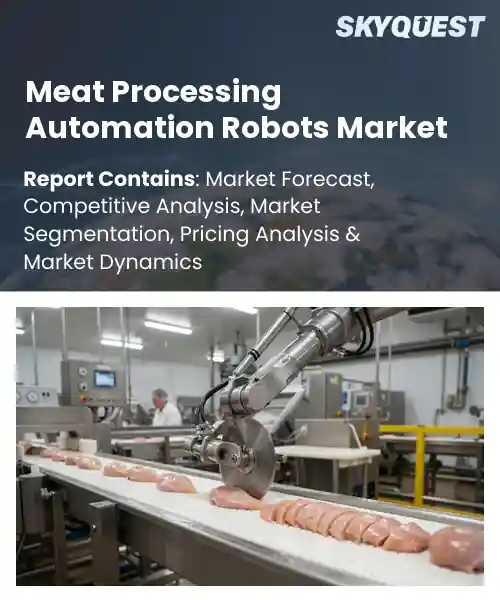
Meat Processing Automation Robots Market
Report ID: SQMIG20I3680
Report ID: SQMIG20I3680
[email protected]
USA +1 351-333-4748
Report ID:
SQMIG20I3680 |
Region:
Global |
Published Date: August, 2026
Pages:
157
|Tables:
122
|Figures:
77


Global Meat Processing Automation Robots Market size was valued at USD 3.38 Billion in 2024 and is poised to grow from USD 3.79 Billion in 2025 to USD 9.45 Billion by 2033, growing at a CAGR of 12.1% during the forecast period (2026-2033).
The global meat‑processing automation robot market encompasses robotic systems that perform tasks such as cutting, deboning, sorting, and packaging within slaughterhouses and processing plants. Its importance stems from the need to increase throughput while meeting stringent food‑safety standards and labor‑shortage pressures. Historically, the sector relied on manual labor, but the introduction of the first industrial meat‑cutting robot by Marel in 2005 sparked a shift toward mechanization. Since then, adoption accelerated as producers integrated vision‑guided cutters and collaborative arms to reduce waste, improve yield consistency, and comply with traceability regulations. This evolution establishes automation as a cornerstone of meat supply chains.Building on this shift, the main growth driver is the demand for uniform quality alongside rising labor costs, which pushes producers toward intelligent robotic lines. Real‑time sensory feedback lets robots fine‑tune cutting angles to animal variation, cutting trim loss and raising margins a result shown by Tyson Foods’ AI‑driven deboning units that reduced waste by 12 percent. Advances in collaborative‑robot safety lower entry barriers, enabling mid‑size plants to automate premium cuts. Consequently, market expansion stems from both equipment sales and subscription‑based predictive‑maintenance services that convert increased uptime into clear ROI. Investors are funding faster AI integration that further improves yield predictability significantly.
How is AI-driven automation reshaping the meat processing robotics market?
AI driven automation is redefining the meat processing robotics market by embedding intelligent vision, real time data analytics and adaptive control into every stage of production. Modern plants now use robots that can identify muscle structure, adjust cutting angles on the fly and predict equipment wear before failures occur. This shift reduces labor intensity, cuts waste and raises product consistency, making facilities more competitive. The technology also enhances workplace safety as machines take over hazardous tasks. As a result manufacturers are expanding their robotic fleets and investing in AI platforms that learn from each batch, accelerating overall industry transformation.In June 2025 a leading meat processor introduced an AI guided robotic slicer, improving cut precision and throughput while lowering waste. This innovation demonstrates how AI automation can boost efficiency and supports continued expansion of the meat processing robotics market. By enabling real time quality monitoring and reducing manual handling it further enhances plant productivity.
Market snapshot - (2026-2033)
Global Market Size
USD 3.38 Billion
Largest Segment
Articulated Robots
Fastest Growth
Collaborative Robots
Growth Rate
12.1% CAGR
To get more insights on this market click here to Request a Free Sample Report
Global meat processing automation robots market is segmented by robot type, function, meat type, end user and region. Based on robot type, the market is segmented into Articulated Robots, Delta Robots, SCARA Robots, Cartesian Robots and Collaborative Robots. Based on function, the market is segmented into Cutting & Deboning, Pick & Place, Packaging & Palletizing, Inspection & Quality Control and Other Processing Operations. Based on meat type, the market is segmented into Beef, Pork, Poultry, Seafood and Other Meat. Based on end user, the market is segmented into Meat Processing Plants and Food Processing Companies. Based on region, the market is segmented into North America, Europe, Asia Pacific, Latin America and Middle East & Africa.
Articulated Robots segment dominates because its versatile kinematic architecture enables complex movements required for trimming, deboning, and intricate cutting tasks across varied meat cuts. The ability to handle heavy payloads and operate in confined spaces aligns with the high throughput demands of large processing lines. This adaptability reduces change over time and supports multifunction stations, driving widespread adoption among processors seeking productivity and precision. Moreover, the robust design tolerates the harsh sanitation environments typical in meat facilities.
However, Collaborative Robots segment is witnessing the strongest growth momentum because they enable flexible cell configurations and easy integration with existing lines, reducing capital investment and allowing rapid retooling for seasonal product variations. Their safety features facilitate human robot cooperation, expanding adoption in smaller plants and specialty processing, thus accelerating market expansion.
Cutting & Deboning segment dominates because these operations constitute the core value adding steps in meat processing, directly influencing product yield and safety. Automated robots perform precise cuts and bone removal with consistent force, minimizing waste and contamination risk. Their ability to operate continuously under strict hygiene standards meets the high volume requirements of processors, making them indispensable for achieving efficiency and product consistency.
Meanwhile, Inspection & Quality Control segment is emerging as the key high growth area because advanced vision systems and AI enable defect detection and compliance monitoring. These capabilities reduce manual inspection labor and enhance traceability, aligning with stricter food safety regulations. The expanding adoption of smart sensors drives broader implementation across processing lines, creating new opportunities for market expansion.
To get detailed segments analysis, Request a Free Sample Report
Asia Pacific leads the market through a convergence of advanced engineering capabilities, high technology adoption, and strategic emphasis on productivity within the meat sector. The region benefits from a mature robotics ecosystem that accelerates innovation in handling, cutting, and packaging applications. Competitive labor dynamics encourage manufacturers to seek automated solutions that ensure consistent quality and compliance with stringent food safety standards. Strong governmental incentives for industrial automation and robust supply chains further lower entry barriers for technology providers. Collaborative partnerships between equipment makers and local meat processors create tailored solutions that address specific cultural and regulatory nuances, reinforcing the region’s position as a hub for cutting‑edge meat processing automation.
Japan Meat Processing Automation Robots Market
Meat Processing Automation Robots Market in Japan is shaped by a long history of precision engineering and a culture of continuous improvement. Manufacturers prioritize integration of flexible robotic cells that can adapt to diverse product lines, supporting small‑to‑medium processors seeking efficiency gains. Close collaboration between robotics firms and food safety authorities ensures compliance with rigorous hygiene protocols, while a focus on workforce skill development sustains high adoption rates across the sector.
South Korea Meat Processing Automation Robots Market
Meat Processing Automation Robots Market in South Korea is driven by rapid digital transformation and strong government backing for smart factory initiatives. The industry leverages expertise in sensor technologies and artificial intelligence to enhance real‑time monitoring and quality control. Emphasis on reducing reliance on manual labor aligns with broader economic goals, prompting meat processors to invest in collaborative robots that improve throughput while maintaining stringent safety standards.
North America experiences rapid expansion due to heightened consumer expectations for consistent product quality, coupled with a strategic shift toward resilient supply chains. Food processors are adopting advanced robotics to mitigate labor shortages and to standardize operations across large, multi‑site facilities. Investment in research collaborations between technology providers and academic institutions fuels innovation in vision‑guided cutting and packaging solutions. Regulatory frameworks emphasizing traceability and hygiene encourage adoption of automated systems that can seamlessly integrate data capture. Market participants benefit from a supportive financing environment and a culture of early technology adoption that accelerates deployment of sophisticated meat processing robots.
United States Meat Processing Automation Robots Market
Meat Processing Automation Robots Market in United States reflects a strong focus on scalability and integration with enterprise resource planning systems. Leading processors prioritize modular robotic solutions that can be rapidly reconfigured to address evolving product portfolios. Emphasis on data analytics and predictive maintenance drives deeper adoption of connected robot platforms, enhancing operational visibility. Collaborative efforts between industry consortia and technology firms accelerate the development of standards that streamline implementation across diverse processing environments.
Canada Meat Processing Automation Robots Market
Meat Processing Automation Robots Market in Canada benefits from a commitment to innovation and a regulatory climate that emphasizes food safety and sustainability. Processors adopt automation to improve line efficiency while reducing workplace injuries in cold‑chain environments. Partnerships with local technology incubators foster customized robotic applications that address the unique challenges of integrating high‑quality meat products into export‑focused supply chains. A skilled engineering workforce supports ongoing adaptation and optimization of automated systems.
Europe strengthens its position by leveraging a deep engineering heritage and a coordinated approach to sustainability within the food sector. The region emphasizes the development of energy‑efficient robotic systems that align with broader environmental goals, encouraging processors to adopt solutions that reduce waste and improve resource utilization. Cross‑border research programs and standardization initiatives facilitate harmonized technology adoption across multiple markets. Strong consumer demand for transparency and traceability pushes meat processors toward integrated automation that supports real‑time monitoring. Collaborative ecosystems among equipment manufacturers, academic institutions, and policy bodies ensure continuous innovation and market readiness.
Germany Meat Processing Automation Robots Market
Meat Processing Automation Robots Market in Germany is characterized by precision engineering and a focus on high‑speed, high‑accuracy robotic solutions. The industry invests heavily in modular automation that can be seamlessly integrated into existing processing lines, supporting both traditional and niche meat products. Strong emphasis on Industry 4.0 standards enables advanced data connectivity, fostering proactive quality management and operational excellence.
United Kingdom Meat Processing Automation Robots Market
Meat Processing Automation Robots Market in United Kingdom reflects a strategic shift toward flexible automation that can respond to changing consumer preferences and regulatory requirements. Processors prioritize collaborative robots that enhance worker safety while delivering consistent cutting and packaging performance. Partnerships with research institutions drive the adoption of AI‑enabled vision systems that improve defect detection and product uniformity.
France Meat Processing Automation Robots Market
Meat Processing Automation Robots Market in France is driven by a commitment to artisanal quality combined with modern efficiency. Operators seek robotic solutions that preserve product integrity while accelerating throughput, especially in value‑added processing segments. Government incentives for technological modernization support investment in intelligent robotic cells that integrate seamlessly with traceability platforms, reinforcing France’s reputation for high‑standards meat production.
To know more about the market opportunities by region and country, click here to
Buy The Complete Report
Rising Demand For Processed Meat
Advancements In Robotics Technology
High Initial Capital Investment
Complex Integration With Legacy Systems
Request Free Customization of this report to help us to meet your business objectives.
The competitive landscape is shaped by intense rivalry among robotics integrators and meat processors leveraging AI-driven cutting, deboning, and sorting solutions; recent M&A activity includes large equipment manufacturers acquiring niche AI firms to broaden their automation portfolios, while strategic partnerships between meat processors and technology startups accelerate deployment of vision‑guided robotic lines, reinforcing market differentiation through proprietary software and modular hardware platforms.
Top Player’s Company Profile
Recent Developments
SkyQuest’s ABIRAW (Advanced Business Intelligence, Research & Analysis Wing) is our Business Information Services team that Collects, Collates, Correlates, and Analyses the Data collected by means of Primary Exploratory Research backed by robust Secondary Desk research. As per SkyQuest analysis the global meat processing automation robots market is being propelled primarily by the rising demand for processed meat, which pushes producers to adopt robots that can cut, debone and package at speeds unattainable by manual labor. A second strong driver is the rapid advancement of robotics technology, especially AI‑driven vision and collaborative designs that improve flexibility and safety. The market is led by Asia Pacific, where a mature robotics ecosystem and supportive policies accelerate adoption. Articulated robots dominate the segment landscape because their versatile kinematics handle complex trimming and deboning tasks efficiently. However, high initial capital investment remains a notable restraint, slowing uptake among smaller processors.
| Report Metric | Details |
|---|---|
| Market size value in 2024 | USD 3.38 Billion |
| Market size value in 2033 | USD 9.45 Billion |
| Growth Rate | 12.1% |
| Base year | 2024 |
| Forecast period | (2026-2033) |
| Forecast Unit (Value) | USD Billion |
| Segments covered |
|
| Regions covered | North America (US, Canada), Europe (Germany, France, United Kingdom, Italy, Spain, Rest of Europe), Asia Pacific (China, India, Japan, Rest of Asia-Pacific), Latin America (Brazil, Rest of Latin America), Middle East & Africa (South Africa, GCC Countries, Rest of MEA) |
| Companies covered |
|
| Customization scope | Free report customization with purchase. Customization includes:-
|
To get a free trial access to our platform which is a one stop solution for all your data requirements for quicker decision making. This platform allows you to compare markets, competitors who are prominent in the market, and mega trends that are influencing the dynamics in the market. Also, get access to detailed SkyQuest exclusive matrix.
Table Of Content
Executive Summary
Market overview
Parent Market Analysis
Market overview
Market size
KEY MARKET INSIGHTS
COVID IMPACT
MARKET DYNAMICS & OUTLOOK
Market Size by Region
KEY COMPANY PROFILES
Methodology
For the Meat Processing Automation Robots Market, our research methodology involved a mixture of primary and secondary data sources. Key steps involved in the research process are listed below:
1. Information Procurement: This stage involved the procurement of Market data or related information via primary and secondary sources. The various secondary sources used included various company websites, annual reports, trade databases, and paid databases such as Hoover's, Bloomberg Business, Factiva, and Avention. Our team did 45 primary interactions Globally which included several stakeholders such as manufacturers, customers, key opinion leaders, etc. Overall, information procurement was one of the most extensive stages in our research process.
2. Information Analysis: This step involved triangulation of data through bottom-up and top-down approaches to estimate and validate the total size and future estimate of the Meat Processing Automation Robots Market.
3. Report Formulation: The final step entailed the placement of data points in appropriate Market spaces in an attempt to deduce viable conclusions.
4. Validation & Publishing: Validation is the most important step in the process. Validation & re-validation via an intricately designed process helped us finalize data points to be used for final calculations. The final Market estimates and forecasts were then aligned and sent to our panel of industry experts for validation of data. Once the validation was done the report was sent to our Quality Assurance team to ensure adherence to style guides, consistency & design.
Analyst Support
Customization Options
With the given market data, our dedicated team of analysts can offer you the following customization options are available for the Meat Processing Automation Robots Market:
Product Analysis: Product matrix, which offers a detailed comparison of the product portfolio of companies.
Regional Analysis: Further analysis of the Meat Processing Automation Robots Market for additional countries.
Competitive Analysis: Detailed analysis and profiling of additional Market players & comparative analysis of competitive products.
Go to Market Strategy: Find the high-growth channels to invest your marketing efforts and increase your customer base.
Innovation Mapping: Identify racial solutions and innovation, connected to deep ecosystems of innovators, start-ups, academics, and strategic partners.
Category Intelligence: Customized intelligence that is relevant to their supply Markets will enable them to make smarter sourcing decisions and improve their category management.
Public Company Transcript Analysis: To improve the investment performance by generating new alpha and making better-informed decisions.
Social Media Listening: To analyze the conversations and trends happening not just around your brand, but around your industry as a whole, and use those insights to make better Marketing decisions.
REQUEST FOR SAMPLE
 REQUEST FREE CUSTOMIZATION


Want to customize this report? This report can be personalized according to your needs. Our analysts and industry experts will work directly with you to understand your requirements and provide you with customized data in a short amount of time. We offer $1000 worth of FREE customization at the time of purchase.
Feedback From Our Clients


 USA (+1) 351-333-4748

