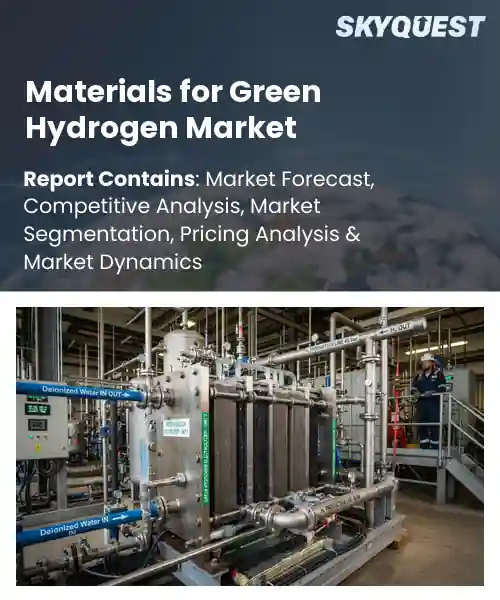
Materials for Green Hydrogen Market
Report ID: SQMIG15E4447
Report ID: SQMIG15E4447
[email protected]
USA +1 351-333-4748
Report ID:
SQMIG15E4447 |
Region:
Global |
Published Date: September, 2026
Pages:
157
|Tables:
125
|Figures:
77


Global Materials For Green Hydrogen Market size was valued at USD 1.19 Billion in 2024 and is poised to grow from USD 1.7 Billion in 2025 to USD 30.14 Billion by 2033, growing at a CAGR of 43.2% during the forecast period (2026-2033).
Decarbonization mandates have become the primary driver of the global materials for green hydrogen market, compelling governments and corporations to replace fossil‑based processes with electro‑lysis powered by renewable electricity. The market includes specialty alloys, platinum‑group catalysts, polymer electrolyte membranes, and water‑treatment components that enable hydrogen production. Its significance lies in delivering a carbon‑free fuel that can decarbonize sectors such as steel, chemicals, and long‑haul transport. Since the early 2000s, research on durable electrolyzer stacks progressed from laboratory prototypes to commercial units, and the past decade has witnessed plants in Germany, Japan, and Saudi Arabia, illustrating cost reductions and supply‑chain maturation. The surge in demand for high‑performance electrolyzer components now drives the global materials market, because capacity expansions generate larger orders for durable alloys and efficient catalysts. Investment in green‑hydrogen hubs such as Australia’s Asian Renewable Energy Hub and Europe’s HyDeal Ambition creates a feedback loop: economies of scale lower material costs, which in turn speed project financing and deployment. Adoption of nickel‑based stainless steel for PEM electrolyzers reduces degradation, extending plant life and attracting utility‑scale buyers. As a result, suppliers scale production, pursue low‑platinum alternatives, and form partnerships with OEMs, unlocking new revenue streams and reinforcing market significant future growth.
How is AI-driven material optimization impacting the green hydrogen market?
AI-driven material optimization is reshaping the green hydrogen landscape by accelerating catalyst discovery, improving membrane durability, and lowering production costs. Machine learning models sift through vast chemical spaces to pinpoint alloy compositions that boost electro‑lysis efficiency while resisting corrosion. This approach shortens development cycles compared with traditional trial‑and‑error methods, allowing firms to respond quickly to rising demand for clean energy. Early adopters report more stable electrolyzer performance under variable renewable inputs, making hydrogen generation more reliable. By integrating predictive analytics with advanced manufacturing, the sector is moving toward scalable, cost‑effective solutions that align with global decarbonisation goals.A recent development in March 2024 saw a leading materials company announce an AI‑guided catalyst that enhances electrolyzer lifespan, demonstrating how data‑driven design can directly support market growth and operational efficiency.
Market snapshot - (2026-2033)
Global Market Size
USD 1.19 Billion
Largest Segment
Bipolar Plate Materials
Fastest Growth
Storage Materials
Growth Rate
43.2% CAGR
To get more insights on this market click here to Request a Free Sample Report
Global materials for green hydrogen market is segmented by material type, hydrogen production technology, application, end-use industry and region. Based on material type, the market is segmented into Catalyst Materials, Membrane Materials, Electrode Materials, Bipolar Plate Materials, Storage Materials and Other Materials. Based on hydrogen production technology, the market is segmented into Alkaline Electrolysis, Proton Exchange Membrane Electrolysis, Solid Oxide Electrolysis and Anion Exchange Membrane Electrolysis. Based on application, the market is segmented into Hydrogen Production, Hydrogen Storage, Hydrogen Transportation & Distribution and Fuel Cell Applications. Based on end-use industry, the market is segmented into Energy & Power, Chemicals, Refining, Steel & Metals, Transportation and Other Industries. Based on region, the market is segmented into North America, Europe, Asia Pacific, Latin America and Middle East & Africa.
Catalyst materials segment dominates because they directly determine the efficiency and durability of PEM electrolysis cells, enabling higher conversion rates and lower energy consumption. Their ability to accelerate the oxygen evolution and hydrogen evolution reactions reduces overpotential, making the process more cost‑effective. Continuous improvements in catalyst composition and nanostructuring drive adoption across large‑scale production facilities, cementing their central position in the market for industrial deployment and supporting sustainable energy transition.
Meanwhile, membrane materials are witnessing the strongest growth momentum because emerging high‑conductivity, chemically stable polymers are enabling longer cell lifetimes and lower stack resistance. Innovations in thin‑film fabrication and durability under high pressure are expanding their use in next‑generation electrolyzers, unlocking new capacity and supporting market expansion across multiple applications today.
Bipolar plate materials segment leads because they provide essential electrical conductivity and structural integrity in high‑temperature solid oxide electrolyzers, enabling efficient current distribution and gas sealing. Their resistance to thermal cycling and corrosion ensures reliable operation, reducing maintenance downtime. Advanced ceramic‑metal composites and coated steels enhance performance, making them pivotal for scaling up solid oxide technology in industrial‑scale projects and facilitating longer service life across diverse energy systems globally for future.
On the other hand, storage materials are emerging as the key high‑growth area because breakthroughs in metal‑hydride and liquid organic hydrogen carriers are expanding safe storage options. Policy incentives and the need for grid balancing drive investment, accelerating deployment of storage solutions that complement production and distribution, thereby broadening market opportunities.
To get detailed segments analysis, Request a Free Sample Report
Asia Pacific leads the global materials for green hydrogen market due to a confluence of strategic policy ambition, mature industrial supply chains, and strong investment in advanced electrolyzer and catalyst technologies. The region benefits from a robust manufacturing base that can produce high‑purity metals and alloys essential for electrolyzer components at scale. Close collaboration between research institutions and leading equipment manufacturers accelerates technology transfer and cost reduction. Government frameworks emphasize decarbonisation pathways that integrate hydrogen into energy mixes, creating a stable demand environment. Additionally, the region’s focus on export‑oriented production supports the diffusion of materials expertise worldwide, reinforcing its dominant position. The presence of world‑class semiconductor and petrochemical sectors supplies critical precursor chemicals and processes that are readily adaptable to hydrogen material production. Collaborative clusters that integrate academia, startups, and legacy firms foster rapid prototyping and scale‑up, ensuring that new material innovations move swiftly from lab to plant.
Japan Materials for Green Hydrogen Market
Materials for Green Hydrogen Market in Japan are driven by a long‑standing emphasis on precision engineering and high‑grade alloy development. Close ties between major steel producers and hydrogen equipment manufacturers enable the tailoring of membranes and catalyst supports to meet stringent performance criteria. Government initiatives encourage domestic supply chain resilience, prompting investments in next‑generation metal processing and recycling capabilities that enhance material sustainability and reduce reliance on imports.
South Korea Materials for Green Hydrogen Market
Materials for Green Hydrogen Market in South Korea benefit from a strong base in advanced materials research and a rapidly expanding renewable energy sector. Collaborative programs between national laboratories and leading industrial conglomerates accelerate the development of corrosion‑resistant alloys and efficient catalyst substrates. Policy frameworks prioritize local production of critical components, fostering a supportive ecosystem that combines government funding, private venture activity, and export‑orientated manufacturing strength.
Europe experiences rapid expansion of the materials for green hydrogen market as a result of cohesive regulatory frameworks, deep industrial expertise, and a strategic focus on energy independence. Strong tradition in chemical processing and steel manufacturing supplies a solid foundation for producing high‑quality electrolyzer components. Collaborative initiatives across borders unite research institutes, venture capital, and established manufacturers, fostering innovation in catalyst design and membrane durability. Policy incentives emphasize domestic supply chain development, encouraging the scaling of green hydrogen projects that demand advanced materials. The region’s commitment to decarbonising transport, industry, and power sectors creates sustained demand, while environmental standards drive the adoption of recyclable and low‑impact material solutions, positioning Europe as a leader in sustainable hydrogen technology.
Germany Materials for Green Hydrogen Market
Germany Materials for Green Hydrogen Market are anchored by a robust engineering sector and a comprehensive network of specialty steel producers. Close cooperation between automotive manufacturers and hydrogen technology firms drives the customization of high‑performance alloys and durable membrane materials. National research programs focus on enhancing catalyst efficiency and reducing material degradation, supporting large‑scale deployment of electrolyzers. Investment in circular economy practices promotes recycling of critical metals, reinforcing supply security and aligning with stringent environmental policies.
United Kingdom Materials for Green Hydrogen Market
United Kingdom Materials for Green Hydrogen Market benefit from an aggressive clean‑energy agenda and a thriving innovation ecosystem. Partnerships between academic centres, start‑ups, and legacy energy companies accelerate the development of novel catalyst formulations and lightweight composite structures. Government support structures prioritize domestic manufacturing of key components, reducing reliance on external sources. The emphasis on offshore hydrogen production and integration with existing gas infrastructure stimulates demand for advanced materials that can withstand marine conditions and variable operating pressures.
France Materials for Green Hydrogen Market
France Materials for Green Hydrogen Market are emerging through a blend of strong nuclear expertise and growing renewable energy investments. Collaborative clusters link national research laboratories with emerging manufacturers to advance membrane technologies and alloy processing techniques. Policy frameworks encourage the establishment of pilot projects that test new material solutions in industrial hydrogen applications. Focus on sustainability drives the pursuit of recyclable and low‑carbon material pathways, positioning France as an up‑and‑coming contributor to the European hydrogen ecosystem.
North America strengthens its position in the materials for green hydrogen market by leveraging extensive industrial capacity, a dynamic innovation landscape, and strong private‑sector investment. The region’s large‑scale steel and alloy producers are adapting facilities to meet the specific requirements of electrolyzer manufacturers, emphasizing durability and performance. Close collaboration between leading research universities and commercial firms accelerates breakthroughs in catalyst materials and membrane technologies. Federal policies encourage domestic supply chain development, fostering partnerships that integrate raw material sourcing, component fabrication, and system integration. A focus on scaling up clean‑energy projects across diverse geographic zones creates consistent demand for advanced, adaptable material solutions, positioning the region as a pivotal hub for hydrogen technology advancement.
United States Materials for Green Hydrogen Market
United States Materials for Green Hydrogen Market benefit from a deep pool of scientific talent and a highly competitive manufacturing environment. Partnerships between national laboratories, private research entities, and major equipment manufacturers drive rapid iteration of catalyst designs and high‑strength alloy production. Government initiatives support the establishment of domestic material supply chains, reducing reliance on imports and promoting economic resilience. Emphasis on large‑scale renewable integration spurs the need for scalable, cost‑effective material solutions that can be deployed across varied project sizes. The private capital ecosystem further fuels commercialization of innovative material technologies, reinforcing the United States role in the global hydrogen landscape.
Canada Materials for Green Hydrogen Market
Canada Materials for Green Hydrogen Market draw on abundant natural resources and a strong tradition in metal processing and clean‑energy research. Collaborative programs between provincial governments, universities, and industry leaders focus on developing corrosion‑resistant alloys and efficient catalyst supports suited for cold‑climate operation. Incentives aimed at domestic production encourage the establishment of specialized manufacturing hubs, enhancing supply chain security. The integration of hydrogen solutions into existing energy infrastructure, particularly in remote and resource‑intensive regions, drives demand for reliable, high‑performance materials. Commitment to environmental stewardship guides the pursuit of recyclable and low‑impact material pathways, strengthening Canada’s contribution to the North American hydrogen ecosystem.
To know more about the market opportunities by region and country, click here to
Buy The Complete Report
Policy Support Accelerating Adoption
Cost Reductions Enabling Scale
Infrastructure Gaps Limiting Deployment
Material Supply Chain Uncertainties
Request Free Customization of this report to help us to meet your business objectives.
Top Player’s Company Profile
Recent Developments
SkyQuest’s ABIRAW (Advanced Business Intelligence, Research & Analysis Wing) is our Business Information Services team that Collects, Collates, Correlates, and Analyses the Data collected by means of Primary Exploratory Research backed by robust Secondary Desk research. As per SkyQuest analysis, the global materials for green hydrogen market is propelled primarily by strong policy support that subsidizes projects and accelerates development of high‑performance catalysts, membranes and storage components; a second key driver is the rapid cost reduction achieved through economies of scale and improved manufacturing, which makes large‑scale deployments financially viable. The catalyst materials segment remains the dominant force because it directly governs electrolyzer efficiency and durability, especially in PEM systems. Asia Pacific leads the market thanks to its extensive manufacturing base, ambitious decarbonisation policies and integrated supply chains. However, the growth pace is tempered by infrastructure gaps in hydrogen transport and storage, which limit broader adoption until networks expand.
| Report Metric | Details |
|---|---|
| Market size value in 2024 | USD 1.19 Billion |
| Market size value in 2033 | USD 30.14 Billion |
| Growth Rate | 43.2% |
| Base year | 2024 |
| Forecast period | (2026-2033) |
| Forecast Unit (Value) | USD Billion |
| Segments covered |
|
| Regions covered | North America (US, Canada), Europe (Germany, France, United Kingdom, Italy, Spain, Rest of Europe), Asia Pacific (China, India, Japan, Rest of Asia-Pacific), Latin America (Brazil, Rest of Latin America), Middle East & Africa (South Africa, GCC Countries, Rest of MEA) |
| Companies covered |
|
| Customization scope | Free report customization with purchase. Customization includes:-
|
To get a free trial access to our platform which is a one stop solution for all your data requirements for quicker decision making. This platform allows you to compare markets, competitors who are prominent in the market, and mega trends that are influencing the dynamics in the market. Also, get access to detailed SkyQuest exclusive matrix.
Table Of Content
Executive Summary
Market overview
Parent Market Analysis
Market overview
Market size
KEY MARKET INSIGHTS
COVID IMPACT
MARKET DYNAMICS & OUTLOOK
Market Size by Region
KEY COMPANY PROFILES
Methodology
For the Materials for Green Hydrogen Market, our research methodology involved a mixture of primary and secondary data sources. Key steps involved in the research process are listed below:
1. Information Procurement: This stage involved the procurement of Market data or related information via primary and secondary sources. The various secondary sources used included various company websites, annual reports, trade databases, and paid databases such as Hoover's, Bloomberg Business, Factiva, and Avention. Our team did 45 primary interactions Globally which included several stakeholders such as manufacturers, customers, key opinion leaders, etc. Overall, information procurement was one of the most extensive stages in our research process.
2. Information Analysis: This step involved triangulation of data through bottom-up and top-down approaches to estimate and validate the total size and future estimate of the Materials for Green Hydrogen Market.
3. Report Formulation: The final step entailed the placement of data points in appropriate Market spaces in an attempt to deduce viable conclusions.
4. Validation & Publishing: Validation is the most important step in the process. Validation & re-validation via an intricately designed process helped us finalize data points to be used for final calculations. The final Market estimates and forecasts were then aligned and sent to our panel of industry experts for validation of data. Once the validation was done the report was sent to our Quality Assurance team to ensure adherence to style guides, consistency & design.
Analyst Support
Customization Options
With the given market data, our dedicated team of analysts can offer you the following customization options are available for the Materials for Green Hydrogen Market:
Product Analysis: Product matrix, which offers a detailed comparison of the product portfolio of companies.
Regional Analysis: Further analysis of the Materials for Green Hydrogen Market for additional countries.
Competitive Analysis: Detailed analysis and profiling of additional Market players & comparative analysis of competitive products.
Go to Market Strategy: Find the high-growth channels to invest your marketing efforts and increase your customer base.
Innovation Mapping: Identify racial solutions and innovation, connected to deep ecosystems of innovators, start-ups, academics, and strategic partners.
Category Intelligence: Customized intelligence that is relevant to their supply Markets will enable them to make smarter sourcing decisions and improve their category management.
Public Company Transcript Analysis: To improve the investment performance by generating new alpha and making better-informed decisions.
Social Media Listening: To analyze the conversations and trends happening not just around your brand, but around your industry as a whole, and use those insights to make better Marketing decisions.
REQUEST FOR SAMPLE
 REQUEST FREE CUSTOMIZATION


Want to customize this report? This report can be personalized according to your needs. Our analysts and industry experts will work directly with you to understand your requirements and provide you with customized data in a short amount of time. We offer $1000 worth of FREE customization at the time of purchase.
Feedback From Our Clients


 USA (+1) 351-333-4748

