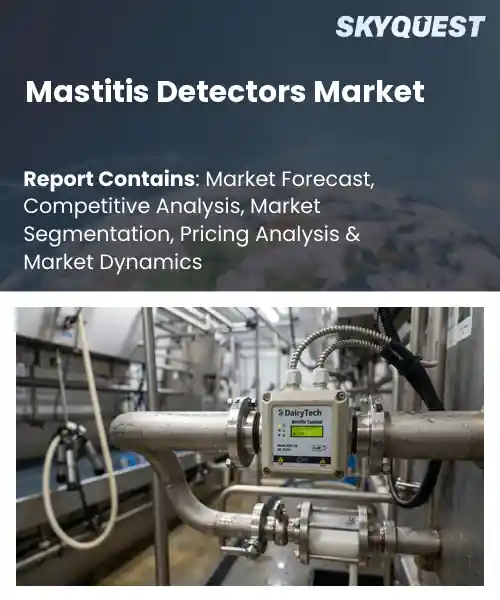
Mastitis Detectors Market
Report ID: SQMIG20H2156
Report ID: SQMIG20H2156
[email protected]
USA +1 351-333-4748
Report ID:
SQMIG20H2156 |
Region:
Global |
Published Date: November, 2026
Pages:
157
|Tables:
120
|Figures:
77


Global Mastitis Detectors Market size was valued at USD 210.0 Million in 2024 and is poised to grow from USD 223.02 Million in 2025 to USD 360.87 Million by 2033, growing at a CAGR of 6.2% during the forecast period (2026-2033).
Adoption of milking systems (AMS) represents the growth catalyst, as these platforms require health monitoring to maintain efficiency. When AMS integrates mastitis detectors, alarms trigger isolation of affected cows, contamination of milk and reducing downtime for cleaning. Dairy operations in the Netherlands and New Zealand have reported a 15 percent decline in antibiotic usage after deploying sensor‑driven alerts, illustrating savings and compliance benefits. Moreover, data analytics derived from detection devices enable modeling, allowing producers to schedule interventions and optimize herd genetics. These outcomes generate attractive investment opportunities for hardware manufacturers and software providers seeking to capitalize on the precision‑dairy ecosystem.
How is AI and IoT integration improving accuracy in the mastitis detectors market?
AI and IoT are reshaping mastitis detection by linking sensor data directly to cloud analytics. Wearable udder sensors capture temperature conductivity and activity while edge processors run machine learning models that differentiate early inflammation from normal variation. The continuous stream of data allows farms to receive instant alerts on smartphones reducing reliance on periodic manual testing. Integration also enables historical trend analysis helping veterinarians fine tune treatment protocols. As farms adopt precision dairy management the combined technology improves diagnostic confidence and lowers false alarms making early intervention more practical for large herds. Farm managers can also compare herd level patterns to benchmark data refining nutrition and milking schedules.CowManager March 2024, introduced an AI enabled platform that merges real time sensor feeds with predictive algorithms to pinpoint mastitis cases before clinical signs appear. This rollout has accelerated adoption of smart monitoring and demonstrated how integrated intelligence can boost accuracy and farm productivity across dozens of dairy operations.
Market snapshot - (2026-2033)
Global Market Size
USD 210.0 Million
Largest Segment
Electrical Conductivity-Based Detectors
Fastest Growth
Biomarker-Based Detectors
Growth Rate
6.2% CAGR
To get more insights on this market click here to Request a Free Sample Report
Global mastitis detectors market is segmented by detection technology, product type, application, end user and region. Based on detection technology, the market is segmented into Electrical Conductivity-Based Detectors, Somatic Cell Count-Based Detectors, Optical & Imaging-Based Detectors, Biomarker-Based Detectors and Other Detection Technologies. Based on product type, the market is segmented into Portable Detectors, On-Farm Automated Detectors and Laboratory Detection Systems. Based on application, the market is segmented into Subclinical Mastitis Detection, Clinical Mastitis Detection and Herd Health Monitoring. Based on end user, the market is segmented into Dairy Farms, Veterinary Clinics, Dairy Processing Companies and Veterinary & Diagnostic Laboratories. Based on region, the market is segmented into North America, Europe, Asia Pacific, Latin America and Middle East & Africa.
Optical & imaging‑based detectors segment dominates because they provide direct visual evidence of udder tissue changes, enabling immediate interpretation without complex calculations. Their ability to capture high‑resolution images of inflammation hotspots builds confidence among farm managers, fostering broader acceptance. This visual clarity reduces diagnostic ambiguity, accelerates treatment decisions, and aligns with precision‑dairy initiatives, driving their leadership in the mastitis detectors market.
Meanwhile, biomarker‑based detectors segment emerges as the most rapidly expanding area. Leveraging advances in molecular biology, these devices identify specific proteins or metabolites linked to infection, offering earlier detection than traditional methods. Growing interest in non‑invasive, highly sensitive tools and continuous research funding fuel their adoption, positioning them to unlock new opportunities for proactive herd health management.
On‑farm automated detectors segment leads because they integrate seamlessly into milking systems, continuously measuring udder parameters with minimal human intervention. This constant data flow enables real‑time alerts, reducing labor costs and enhancing early‑stage intervention. Their scalability across large herds and compatibility with farm management software reinforce their prominence, making them essential for modern dairy operations seeking efficiency and animal welfare improvements.
Conversely, portable detectors segment is witnessing the strongest growth momentum. Their handheld design offers flexibility for quick spot checks in remote or small‑scale settings, appealing to farms lacking full automation. Innovations in battery life and wireless data transmission improve usability, encouraging wider uptake. This agility meets rising demand for on‑demand diagnostics, propelling market expansion and creating fresh pathways for service providers.
To get detailed segments analysis, Request a Free Sample Report
North America leads due to advanced dairy infrastructure, strong research ecosystem, high adoption of precision farming, supportive regulatory environment, presence of major technology providers, and robust funding for agricultural innovation. Integration of sensor technologies in milking systems is widespread, driven by the focus on animal health, milk quality and operational efficiency. Consumers demand premium dairy products, motivating producers to invest in early detection solutions. Collaboration between universities, research institutes and industry accelerates product development. The market benefits from well‑established distribution networks and skilled technical workforce, ensuring rapid deployment and service support. These combined factors create a fertile environment that sustains leadership in the global mastitis detectors market.
Mastitis Detectors Market in United States thrives on extensive dairy operations that prioritize herd health and product quality. The ecosystem features leading sensor manufacturers, advanced milking equipment integrators, and strong farm advisory services. Innovation is bolstered by partnerships between academic research centers and commercial firms, fostering rapid iteration of detection algorithms. Producers adopt these tools to reduce treatment costs, improve animal welfare, and meet stringent quality standards, reinforcing market depth.
Mastitis Detectors Market in Canada benefits from a collaborative agricultural community and government incentives that support technology adoption. Emphasis on sustainable dairy practices drives interest in early disease detection to minimize antibiotic use and environmental impact. Local research institutions contribute to customized sensor solutions suited to regional herd characteristics. Dairy operators integrate detectors into automated milking parlors, enhancing monitoring capabilities and aligning with consumer expectations for high‑quality, responsibly produced milk.
Europe experiences rapid expansion of the mastitis detectors market as dairy producers seek to align with stringent animal welfare regulations and heightened consumer expectations for product safety. The region’s strong emphasis on technological innovation is supported by extensive research networks and funding programs that encourage precision agriculture. Integration of detection systems into automated milking lines is accelerating, driven by the need to optimize labor efficiency and reduce therapeutic interventions. Collaborative initiatives between equipment manufacturers, veterinary experts, and dairy cooperatives facilitate the development of tailored solutions that address diverse herd management practices across the continent. Moreover, growing awareness of the economic benefits of early mastitis identification reinforces investment in advanced monitoring technologies, cementing Europe’s position as a dynamic growth hub.
Germany Mastitis Detectors Market is anchored by a highly organized dairy sector and a tradition of engineering excellence. Domestic manufacturers specialize in robust sensor platforms that integrate seamlessly with sophisticated milking equipment. Research collaborations with technical universities foster continuous refinement of detection algorithms, ensuring high accuracy. Dairy farms adopt these solutions to enhance herd health management, reduce antibiotic reliance, and comply with rigorous quality standards, thereby strengthening market resilience.
United Kingdom Mastitis Detectors Market is distinguished by rapid adoption driven by a proactive regulatory environment and strong focus on animal health. Innovation clusters in agricultural technology accelerate the availability of cutting‑edge detection tools. Dairy producers integrate these systems to improve milk quality, meet export requirements, and support sustainability goals. Close cooperation between veterinary associations and technology providers ensures that solutions are responsive to farm‑level challenges, fueling swift market expansion.
France Mastitis Detectors Market is emerging as dairy producers embrace precision farming to enhance product reputation and meet evolving consumer demands. Collaborative research initiatives between agronomy institutes and sensor developers generate solutions adapted to the diverse herd structures prevalent across the country. Early detection capabilities help minimize treatment costs and support the industry’s commitment to reducing antibiotic usage. Adoption is gradually increasing as awareness of the economic and environmental advantages of mastitis monitoring spreads among French farms.
Asia Pacific is strengthening its position in the mastitis detectors market through a combination of expanding dairy production, heightened focus on animal health, and growing investment in digital farming technologies. Nations in the region are modernizing milking operations, incorporating sensor‑based monitoring to improve herd management and milk safety. Government programs that endorse technology adoption and promote sustainable dairy practices create a conducive environment for market entry. Partnerships between local equipment manufacturers and international technology firms accelerate knowledge transfer and customization of detection solutions to suit varied farm sizes. Consumer preferences for high‑quality dairy products further motivate producers to implement early disease detection, reinforcing the region’s upward trajectory.
Japan Mastitis Detectors Market leverages advanced technological expertise and a strong emphasis on food safety. Precision dairy farms integrate sophisticated sensor arrays into automated milking systems, enabling real‑time monitoring of udder health. Collaborative projects between research institutes and equipment suppliers drive continual improvement of detection accuracy. Farmers adopt these tools to reduce treatment expenses, maintain premium milk standards, and comply with strict regulatory frameworks, thereby fostering a mature market ecosystem.
South Korea Mastitis Detectors Market benefits from rapid digital transformation in agriculture and government support for smart farming initiatives. Emerging dairy operations are increasingly equipped with sensor‑driven monitoring platforms that provide early alerts of mastitis, enhancing animal welfare and product quality. Local tech startups work closely with livestock breeders to tailor solutions for the specific challenges of Korean herd management. This synergy between innovation and practical application accelerates market adoption and positions South Korea as a notable contributor to regional growth.
To know more about the market opportunities by region and country, click here to
Buy The Complete Report
Increasing Adoption of Precision Dairy Farming
Growing Emphasis on Early Disease Detection
High Initial Cost Of Devices
Limited Technical Expertise Among Farmers
Request Free Customization of this report to help us to meet your business objectives.
Top Player’s Company Profile
Recent Developments
SkyQuest’s ABIRAW (Advanced Business Intelligence, Research & Analysis Wing) is our Business Information Services team that Collects, Collates, Correlates, and Analyses the Data collected by means of Primary Exploratory Research backed by robust Secondary Desk research. As per SkyQuest analysis, the mastitis detectors market is being propelled primarily by the increasing adoption of precision dairy farming, which drives demand for real‑time sensor integration with automated milking systems, while a growing emphasis on early disease detection serves as a second catalyst by encouraging producers to invest in non‑invasive monitoring to safeguard milk yield and animal welfare. However, the high upfront cost of these devices remains a notable restraint, especially for smaller farms lacking capital for advanced technology. North America dominates the market, benefitting from advanced infrastructure and strong research support, and the optical and imaging‑based detection segment leads the market due to its clear visual diagnostics and rapid acceptance among growers.
| Report Metric | Details |
|---|---|
| Market size value in 2024 | USD 210.0 Million |
| Market size value in 2033 | USD 360.87 Million |
| Growth Rate | 6.2% |
| Base year | 2024 |
| Forecast period | (2026-2033) |
| Forecast Unit (Value) | USD Million |
| Segments covered |
|
| Regions covered | North America (US, Canada), Europe (Germany, France, United Kingdom, Italy, Spain, Rest of Europe), Asia Pacific (China, India, Japan, Rest of Asia-Pacific), Latin America (Brazil, Rest of Latin America), Middle East & Africa (South Africa, GCC Countries, Rest of MEA) |
| Companies covered |
|
| Customization scope | Free report customization with purchase. Customization includes:-
|
To get a free trial access to our platform which is a one stop solution for all your data requirements for quicker decision making. This platform allows you to compare markets, competitors who are prominent in the market, and mega trends that are influencing the dynamics in the market. Also, get access to detailed SkyQuest exclusive matrix.
Table Of Content
Executive Summary
Market overview
Parent Market Analysis
Market overview
Market size
KEY MARKET INSIGHTS
COVID IMPACT
MARKET DYNAMICS & OUTLOOK
Market Size by Region
KEY COMPANY PROFILES
Methodology
For the Mastitis Detectors Market, our research methodology involved a mixture of primary and secondary data sources. Key steps involved in the research process are listed below:
1. Information Procurement: This stage involved the procurement of Market data or related information via primary and secondary sources. The various secondary sources used included various company websites, annual reports, trade databases, and paid databases such as Hoover's, Bloomberg Business, Factiva, and Avention. Our team did 45 primary interactions Globally which included several stakeholders such as manufacturers, customers, key opinion leaders, etc. Overall, information procurement was one of the most extensive stages in our research process.
2. Information Analysis: This step involved triangulation of data through bottom-up and top-down approaches to estimate and validate the total size and future estimate of the Mastitis Detectors Market.
3. Report Formulation: The final step entailed the placement of data points in appropriate Market spaces in an attempt to deduce viable conclusions.
4. Validation & Publishing: Validation is the most important step in the process. Validation & re-validation via an intricately designed process helped us finalize data points to be used for final calculations. The final Market estimates and forecasts were then aligned and sent to our panel of industry experts for validation of data. Once the validation was done the report was sent to our Quality Assurance team to ensure adherence to style guides, consistency & design.
Analyst Support
Customization Options
With the given market data, our dedicated team of analysts can offer you the following customization options are available for the Mastitis Detectors Market:
Product Analysis: Product matrix, which offers a detailed comparison of the product portfolio of companies.
Regional Analysis: Further analysis of the Mastitis Detectors Market for additional countries.
Competitive Analysis: Detailed analysis and profiling of additional Market players & comparative analysis of competitive products.
Go to Market Strategy: Find the high-growth channels to invest your marketing efforts and increase your customer base.
Innovation Mapping: Identify racial solutions and innovation, connected to deep ecosystems of innovators, start-ups, academics, and strategic partners.
Category Intelligence: Customized intelligence that is relevant to their supply Markets will enable them to make smarter sourcing decisions and improve their category management.
Public Company Transcript Analysis: To improve the investment performance by generating new alpha and making better-informed decisions.
Social Media Listening: To analyze the conversations and trends happening not just around your brand, but around your industry as a whole, and use those insights to make better Marketing decisions.
REQUEST FOR SAMPLE
 REQUEST FREE CUSTOMIZATION


Want to customize this report? This report can be personalized according to your needs. Our analysts and industry experts will work directly with you to understand your requirements and provide you with customized data in a short amount of time. We offer $1000 worth of FREE customization at the time of purchase.
Feedback From Our Clients


 USA (+1) 351-333-4748

