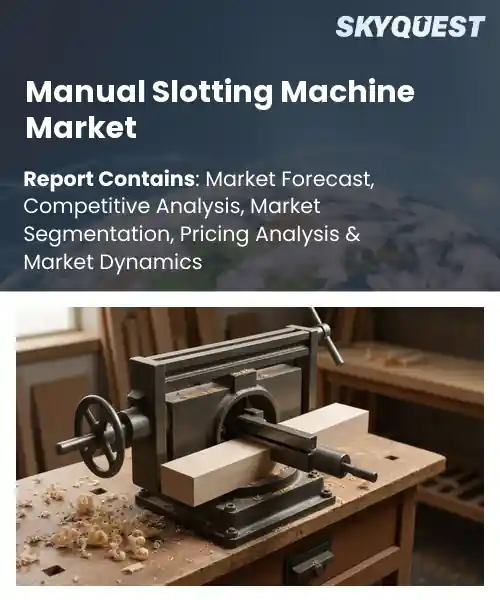
Manual Slotting Machine Market
Report ID: SQMIG20I3388
Report ID: SQMIG20I3388
[email protected]
USA +1 351-333-4748
Report ID:
SQMIG20I3388 |
Region:
Global |
Published Date: July, 2026
Pages:
157
|Tables:
143
|Figures:
78


Global Manual Slotting Machine Market size was valued at USD 268.4 Million in 2024 and is poised to grow from USD 284.24 Million in 2025 to USD 449.62 Million by 2033, growing at a CAGR of 5.9% during the forecast period (2026-2033).
Global manual slotting machines, devices that guide components into precise positions during assembly, have become essential in mixed‑product production environments. The primary driver of this market is the persistent demand for cost‑effective precision where fully automated systems are financially prohibitive. Historically, manufacturers relied on hand‑tool techniques, but the 1990s introduced ergonomic lever‑actuated slotters that reduced cycle time and error rates. For example, a mid‑size automotive supplier adopted a manual slotting unit to align wiring harnesses, cutting labor hours by 30 percent while maintaining tolerances tighter than 0.1 mm. This evolution underscores the technology’s role in bridging manual labor and industrial automation. Building on that evolution, the next key factor shaping the global manual slotting machine market is the surge in small‑batch production driven by Industry 4.0 adoption. As manufacturers integrate twins, they require flexible tooling that can be reconfigured without software programming. Consequently, manual slotters equipped with dies and ergonomic controls have gained traction in electronics firms that produce printed‑circuit boards, enabling a 20 % reduction in changeover time. This flexibility also opens opportunities in medical device assembly, where stringent sterility standards demand quick adjustments. The cause‑effect chain digital flexibility prompting demand for adaptable hardware propels market growth and invites suppliers to innovate ergonomic designs.
How is AI-driven automation influencing the manual slotting machine market?
AI‑driven automation is reshaping the manual slotting machine market by embedding smart sensors and real‑time data analytics into traditionally mechanical equipment. These technologies enable machines to self‑adjust feed rates, detect tool wear, and suggest optimal cutting paths, which reduces operator fatigue and improves product consistency. Operators now receive visual cues and step‑by‑step guidance on touchscreens, turning complex setups into intuitive tasks. The blend of machine learning with legacy hardware also shortens changeover times and lowers scrap rates, making manual slotting more competitive against fully automated alternatives. As factories pursue flexible production, AI tools provide the agility needed to handle varied part geometries without extensive re‑engineering.Recent AI integration in a manual slotting machine released in March 2024 demonstrates how predictive maintenance alerts and adaptive control loops boost uptime and streamline workflow, reinforcing market growth through enhanced efficiency.
Market snapshot - (2026-2033)
Global Market Size
USD 268.4 Million
Largest Segment
Floor-Type Slotting Machines
Fastest Growth
Bench-Type Slotting Machines
Growth Rate
5.9% CAGR
To get more insights on this market click here to Request a Free Sample Report
Global manual slotting machine market is segmented by machine type, capacity, application, end user, drive mechanism and region. Based on machine type, the market is segmented into Bench-Type Slotting Machines and Floor-Type Slotting Machines. Based on capacity, the market is segmented into Light Duty, Medium Duty and Heavy Duty. Based on application, the market is segmented into Keyway Cutting, Internal Gear Machining, Die & Mold Making and Tool Room Operations. Based on end user, the market is segmented into Machine Shops, Automotive and Industrial Manufacturing. Based on drive mechanism, the market is segmented into Mechanical and Hydraulic-Assisted. Based on region, the market is segmented into North America, Europe, Asia Pacific, Latin America and Middle East & Africa.
Bench-Type Slotting Machines segment dominates because it aligns with the spatial constraints of most production floors, delivering compact footprint while maintaining precision. Users favor its flexibility to be positioned on existing workstations, reducing investment in dedicated foundations. The inherent ease of integration accelerates adoption across small to medium enterprises, and its proven reliability builds confidence among operators seeking consistent manual slotting performance throughout various industry applications including tool room operations.
However, Floor-Type Slotting Machines segment emerges as the fastest growing because rising demand for high throughput machining encourages investment in floor mounted units. Manufacturers appreciate the increased rigidity and power capacity that support heavier workloads, prompting broader acceptance in heavy duty environments and spurring product development opportunities for market expansion.
Medium Duty segment dominates because it offers an optimal balance between load capacity and operational cost, fitting the majority of mid size production lines that require reliable performance without extreme power consumption. This tier provides sufficient torque for typical keyway and gear slotting tasks while preserving manageable maintenance schedules, making it the preferred choice for versatile workshop environments seeking consistent productivity across different industry sectors including automotive and industrial manufacturing applications.
Meanwhile, Heavy Duty segment is witnessing the strongest growth because expanding production facilities are upgrading to machines capable of handling larger workpieces and prolonged cycles. The push for resilience and the need for reduced downtime are driving investment in equipment, thereby unlocking new market avenues and reinforcing demand trajectory.
To get detailed segments analysis, Request a Free Sample Report
North America benefits from a highly developed manufacturing ecosystem that prioritizes operational efficiency and workplace safety. The region’s extensive distribution networks and sophisticated warehousing practices create a fertile environment for advanced material handling solutions. Strong investment in research and development fuels continuous innovation, while an experienced workforce readily adopts precision equipment. Regulatory frameworks that emphasize ergonomic standards and productivity further encourage the uptake of manual slotting technology. Combined with the presence of major equipment manufacturers and a culture of continuous improvement, these factors collectively reinforce North America’s leading position in the global market.
Manual Slotting Machine Market in the United States is propelled by large‑scale distribution centers that seek to optimize order fulfillment speed and accuracy. The emphasis on lean inventory practices drives demand for adaptable slotting tools that enhance picker productivity. Collaboration between equipment suppliers and logistics providers accelerates solution adoption, while a strong emphasis on worker safety supports the integration of ergonomically designed machines across diverse warehouse environments.
Manual Slotting Machine Market in Canada is shaped by a focus on resource‑intensive industries that value precise material handling to reduce waste. Growing e‑commerce activity encourages the modernization of fulfillment sites, creating a need for flexible slotting solutions that can be quickly reconfigured. Government incentives for productivity improvements and a well‑trained labor pool further reinforce the country’s commitment to adopting manual slotting technology in both new and retrofitted facilities.
Europe’s expansion is driven by a convergence of sustainability mandates, rising e‑commerce volumes, and a tradition of engineering excellence. The region’s commitment to reducing carbon footprints encourages the use of manual slotting machines that improve space utilization and lower energy consumption. Robust regulatory support for worker safety and ergonomic standards incentivizes the adoption of precision tools across a variety of sectors. Germany’s strong industrial base sets a benchmark for quality, while the United Kingdom’s agile logistics landscape accelerates market penetration. Emerging initiatives in France nurture early adoption, creating a cohesive environment where technology diffusion and operational optimization thrive in tandem.
Manual Slotting Machine Market in Germany is anchored by a mature manufacturing sector that emphasizes precision and reliability. The country’s focus on high‑value goods and complex supply chains drives the need for accurate slotting solutions that enhance order accuracy and throughput. Close collaboration between equipment engineers and logistics experts results in highly customized machines that align with stringent quality standards. This engineering culture, combined with a strong commitment to workplace safety, sustains robust demand for manual slotting technology across diverse industrial settings.
Manual Slotting Machine Market in the United Kingdom experiences rapid adoption due to a vibrant e‑commerce environment and a logistics industry that values speed and flexibility. The emphasis on omni‑channel fulfillment encourages the deployment of adaptable slotting tools that can be quickly reconfigured to meet shifting demand patterns. A proactive regulatory approach towards ergonomic practices further fuels investment in technology that supports worker wellbeing. Partnerships between technology providers and third‑party logistics firms accelerate diffusion of manual slotting solutions throughout the supply chain network.
Manual Slotting Machine Market in France is emerging as businesses seek to modernize warehousing operations amid growing consumer expectations. A focus on improving productivity and reducing manual handling injuries motivates firms to explore ergonomic slotting tools. Collaborative initiatives between industrial clusters and equipment manufacturers facilitate knowledge transfer and pilot projects that showcase the benefits of manual slotting. This progressive mindset, coupled with evolving safety standards, positions France as an emerging adopter within the broader European landscape.
Asia Pacific is advancing its role through a combination of rapid industrialization, technology‑driven manufacturing, and expanding distribution networks. The region’s emphasis on cost‑effective yet high‑precision solutions propels interest in manual slotting machines that enhance warehouse density and reduce labor strain. Investment in smart factory initiatives and automation literacy fuels a receptive market for ergonomic equipment. Japan’s heritage of meticulous engineering and South Korea’s focus on electronics‑driven logistics create complementary strengths that collectively elevate the region’s presence in the global ecosystem.
Manual Slotting Machine Market in Japan benefits from a culture of meticulous quality control and space‑constrained facilities that demand efficient storage solutions. The prevalence of high‑tech manufacturing and precision‑oriented logistics drives the selection of slotting tools that can be fine‑tuned for exacting standards. Collaborative research between equipment makers and industrial users promotes the development of compact, low‑impact machines that align with Japanese emphasis on safety and productivity, reinforcing steady adoption across diverse sectors.
Manual Slotting Machine Market in South Korea is shaped by a dynamic electronics supply chain and a rapidly growing e‑commerce sector that prioritize swift order processing. The pursuit of high throughput and ergonomic work environments encourages investment in adaptable slotting equipment that can be quickly reconfigured for varying product assortments. Strong government support for advanced manufacturing and close ties between technology firms and logistics providers accelerate the integration of manual slotting solutions within modern warehouse infrastructures.
To know more about the market opportunities by region and country, click here to
Buy The Complete Report
Rising Demand For Efficient Packing
Integration With Automation Systems
High Labor Skill Requirements
Limited Technological Advancements
Request Free Customization of this report to help us to meet your business objectives.
The Manual Slotting Machine market is shaped by intense rivalry among established manufacturers such as Maincer, Ajax Machine Tools, Cams Srl and Eastar Machine Tools, each leveraging product upgrades and regional alliances to defend market share. The entry of new players intensifies competition, prompting incumbents to pursue technology‑driven enhancements, joint ventures with distributors, and selective acquisitions to broaden capabilities and geographic reach.
Top Player’s Company Profile
Recent Developments
SkyQuest’s ABIRAW (Advanced Business Intelligence, Research & Analysis Wing) is our Business Information Services team that Collects, Collates, Correlates, and Analyses the Data collected by means of Primary Exploratory Research backed by robust Secondary Desk research. As per SkyQuest analysis the manual slotting machine market is projected to grow strongly, driven primarily by rising demand for efficient packing that lowers labor costs and boosts line productivity, while a second catalyst comes from seamless integration with broader automation systems that allows these machines to complement conveyors and robotics for smoother workflows; however, adoption is tempered by the high labor‑skill requirements needed to operate the equipment consistently. North America emerges as the dominant region thanks to its advanced manufacturing ecosystem and strong safety regulations, and within the product lineup the bench‑type slotting machines lead the segment by offering a compact footprint and reliable precision for most workshop environments.
| Report Metric | Details |
|---|---|
| Market size value in 2024 | USD 268.4 Million |
| Market size value in 2033 | USD 449.62 Million |
| Growth Rate | 5.9% |
| Base year | 2024 |
| Forecast period | (2026-2033) |
| Forecast Unit (Value) | USD Million |
| Segments covered |
|
| Regions covered | North America (US, Canada), Europe (Germany, France, United Kingdom, Italy, Spain, Rest of Europe), Asia Pacific (China, India, Japan, Rest of Asia-Pacific), Latin America (Brazil, Rest of Latin America), Middle East & Africa (South Africa, GCC Countries, Rest of MEA) |
| Companies covered |
|
| Customization scope | Free report customization with purchase. Customization includes:-
|
To get a free trial access to our platform which is a one stop solution for all your data requirements for quicker decision making. This platform allows you to compare markets, competitors who are prominent in the market, and mega trends that are influencing the dynamics in the market. Also, get access to detailed SkyQuest exclusive matrix.
Table Of Content
Executive Summary
Market overview
Parent Market Analysis
Market overview
Market size
KEY MARKET INSIGHTS
COVID IMPACT
MARKET DYNAMICS & OUTLOOK
Market Size by Region
KEY COMPANY PROFILES
Methodology
For the Manual Slotting Machine Market, our research methodology involved a mixture of primary and secondary data sources. Key steps involved in the research process are listed below:
1. Information Procurement: This stage involved the procurement of Market data or related information via primary and secondary sources. The various secondary sources used included various company websites, annual reports, trade databases, and paid databases such as Hoover's, Bloomberg Business, Factiva, and Avention. Our team did 45 primary interactions Globally which included several stakeholders such as manufacturers, customers, key opinion leaders, etc. Overall, information procurement was one of the most extensive stages in our research process.
2. Information Analysis: This step involved triangulation of data through bottom-up and top-down approaches to estimate and validate the total size and future estimate of the Manual Slotting Machine Market.
3. Report Formulation: The final step entailed the placement of data points in appropriate Market spaces in an attempt to deduce viable conclusions.
4. Validation & Publishing: Validation is the most important step in the process. Validation & re-validation via an intricately designed process helped us finalize data points to be used for final calculations. The final Market estimates and forecasts were then aligned and sent to our panel of industry experts for validation of data. Once the validation was done the report was sent to our Quality Assurance team to ensure adherence to style guides, consistency & design.
Analyst Support
Customization Options
With the given market data, our dedicated team of analysts can offer you the following customization options are available for the Manual Slotting Machine Market:
Product Analysis: Product matrix, which offers a detailed comparison of the product portfolio of companies.
Regional Analysis: Further analysis of the Manual Slotting Machine Market for additional countries.
Competitive Analysis: Detailed analysis and profiling of additional Market players & comparative analysis of competitive products.
Go to Market Strategy: Find the high-growth channels to invest your marketing efforts and increase your customer base.
Innovation Mapping: Identify racial solutions and innovation, connected to deep ecosystems of innovators, start-ups, academics, and strategic partners.
Category Intelligence: Customized intelligence that is relevant to their supply Markets will enable them to make smarter sourcing decisions and improve their category management.
Public Company Transcript Analysis: To improve the investment performance by generating new alpha and making better-informed decisions.
Social Media Listening: To analyze the conversations and trends happening not just around your brand, but around your industry as a whole, and use those insights to make better Marketing decisions.
REQUEST FOR SAMPLE
 REQUEST FREE CUSTOMIZATION


Want to customize this report? This report can be personalized according to your needs. Our analysts and industry experts will work directly with you to understand your requirements and provide you with customized data in a short amount of time. We offer $1000 worth of FREE customization at the time of purchase.
Feedback From Our Clients


 USA (+1) 351-333-4748

