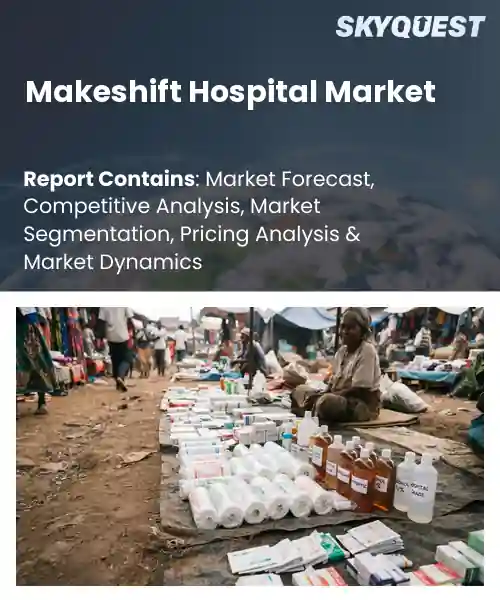
Makeshift Hospital Market
Report ID: SQMIG35E2096
Report ID: SQMIG35E2096
[email protected]
USA +1 351-333-4748
Report ID:
SQMIG35E2096 |
Region:
Global |
Published Date: August, 2026
Pages:
157
|Tables:
91
|Figures:
76


Global Makeshift Hospital Market size was valued at USD 3.76 Billion in 2024 and is poised to grow from USD 4.11 Billion in 2025 to USD 8.38 Billion by 2033, growing at a CAGR of 9.3% during the forecast period (2026-2033).
The makeshift hospital market supplies deployable medical facilities for disaster zones or pandemics that exceed permanent health capacity. Its primary driver is the increasing frequency of large‑scale emergencies that strain hospitals, prompting governments and NGOs to seek solutions. Field hospitals appeared in World War I trenches, but versions expanded after the 2004 Indian Ocean tsunami, where tented clinics treated thousands. The 2014 Ebola outbreak and the 2020 COVID‑19 crisis amplified demand, leading to modular units, container‑based wards, and portable ICU systems that can be assembled in days. This evolution from basic shelters to platforms underscores the market’s growing strategic importance. The dominant growth factor is the convergence of modular construction and digital health integration, turning temporary sites into care centers. As emergencies generate demand, manufacturers accelerate production of pre‑fabricated units equipped with smart monitoring, enabling clinicians to deliver services comparable to permanent hospitals. For example, the Army’s Deployable Hospital deployed 30‑bed modules with IoT‑linked ventilators during the 2022 hurricane season, while Chinese firms supplied container‑based isolation wards for COVID‑19 hotspots, showing scalability and data connectivity. This synergy creates opportunities for renewable power kits, tele‑ICU platforms, and rapid‑assembly logistics, prompting investors to fund joint ventures that expand market reach and resilience.
How is AI enhancing patient triage efficiency in the makeshift hospital market?
AI is reshaping patient triage in makeshift hospitals by automating initial assessments and routing patients to appropriate care zones. Machine‑learning algorithms analyze vital signs, symptom descriptions and limited medical histories to generate risk scores within seconds. This reduces reliance on overburdened clinicians, speeds up decision‑making and frees staff to focus on critical interventions. The technology integrates with portable monitoring devices and electronic health records, creating a seamless workflow that adapts to the fluid environment of temporary facilities. As demand for rapid, scalable care grows, AI‑driven triage becomes a cornerstone for maintaining quality and efficiency in these constrained settings.In July 2026, an AI‑enabled triage system was rolled out in several makeshift hospitals, cutting assessment time and improving patient flow, thereby supporting overall market growth.
Market snapshot - (2026-2033)
Global Market Size
USD 3.76 Billion
Largest Segment
Field Hospitals
Fastest Growth
Mobile Hospitals
Growth Rate
9.3% CAGR
To get more insights on this market click here to Request a Free Sample Report
Global makeshift hospital market is segmented by facility type, component, end user and region. Based on facility type, the market is segmented into Field Hospitals, Modular Hospitals and Mobile Hospitals. Based on component, the market is segmented into Infrastructure, Medical Equipment and Support Services. Based on end user, the market is segmented into Military, Government & Public Health Agencies, Humanitarian Organizations and Healthcare Providers. Based on region, the market is segmented into North America, Europe, Asia Pacific, Latin America and Middle East & Africa.
Modular hospitals segment dominates because they combine rapid deployability with scalable design, allowing stakeholders to expand capacity quickly while maintaining clinical standards. Their prefabricated components integrate seamlessly with existing infrastructure, reducing construction time and logistical complexity. This flexibility meets the unpredictable demand patterns of disaster response, making them the preferred choice for governments and humanitarian groups seeking reliable, repeatable solutions in the makeshift hospital market across varied operational contexts globally.
However, mobile hospitals segment emerges as the fastest growing area as advances in vehicle based isolation units and self contained power systems enable rapid relocation to hard to reach sites. This mobility addresses emerging demand for flexible care delivery during sudden outbreaks, driving partnerships and investment that accelerate market expansion and open service models.
Support services segment leads because it provides the essential logistics, staffing, and maintenance frameworks that keep temporary facilities functional under pressure. Integrated supply chain management ensures timely delivery of consumables, while specialized training programs enhance staff readiness for austere environments. These coordinated services reduce downtime, improve patient flow, and build confidence among end users, making support services the backbone of effective makeshift hospital operations through continuous quality monitoring and rapid issue resolution.
On the other hand, medical equipment segment is witnessing the strongest growth momentum as portable diagnostic devices and modular ICU units become sophisticated and affordable. This technological evolution expands the clinical capabilities of temporary sites, attracting investment and prompting adoption across humanitarian and public health initiatives, thereby propelling market expansion and creating new service opportunities.
To get detailed segments analysis, Request a Free Sample Report
North America benefits from a combination of highly integrated health systems, sophisticated supply chains, and proactive governmental policies that prioritize rapid deployment of temporary care facilities. The region’s extensive experience in emergency management encourages collaboration among hospitals, defense agencies, and private innovators, fostering continuous improvement of modular designs. Strong financial backing from both public and private sectors enables swift procurement and scaling of makeshift solutions. Advanced research institutions contribute to the development of resilient materials and adaptable infrastructure, while a culture of regulatory agility reduces approval timelines. Together these factors create an ecosystem where makeshift hospitals can be designed, manufactured, and operationalized with speed and reliability, cementing North America’s leading position in the global market.
Makeshift Hospital Market United States emphasizes integration with existing hospital networks and a focus on rapid mobilization for large‑scale events. Collaboration between federal emergency agencies and private manufacturers drives innovation in containerized units and prefabricated wards. Emphasis on interoperability ensures seamless connection to electronic health records and supply logistics. Strong funding channels support research on portable power and medical equipment, reinforcing the United States role as a hub for cutting‑edge temporary care solutions.
Makeshift Hospital Market Canada centers on collaborative frameworks that link provincial health authorities with specialized engineering firms. Emphasis on modularity aligns with Canada’s vast and varied geography, enabling rapid deployment to remote communities and disaster‑prone locations. Government incentives encourage the adoption of sustainable materials and energy‑efficient designs. Integration with telemedicine platforms extends clinical reach, while a focus on training ensures that staff can operate temporary facilities effectively, strengthening national resilience.
Europe benefits from coordinated regulatory environments, strong public health funding, and a tradition of cross‑border cooperation that accelerates the diffusion of makeshift hospital solutions. Robust research ecosystems in key nations generate innovative modular designs that address diverse climate and demographic conditions. Policy frameworks that prioritize emergency preparedness incentivize public‑private partnerships, leading to rapid prototyping and deployment. The presence of leading medical device manufacturers facilitates integration of advanced monitoring and treatment technologies within temporary structures. Growing emphasis on sustainability drives the use of recyclable components and green energy sources, reinforcing Europe’s position as a dynamic hub for next‑generation makeshift healthcare infrastructure.
Makeshift Hospital Market Germany reflects a strong engineering heritage combined with a centralized health policy that encourages standardized temporary care units. Collaboration between leading automotive suppliers and medical firms yields high‑precision modular systems. Federal support for disaster readiness promotes regular drills that incorporate makeshift facilities, ensuring operational familiarity. Emphasis on environmental standards drives the adoption of energy‑efficient modules, while integration with digital health platforms enhances patient management during rapid deployments.
Makeshift Hospital Market United Kingdom is characterized by agile policy responses and a vibrant ecosystem of innovative startups focused on rapid‑deployment health solutions. Close ties between the National Health Service and defense agencies enable swift mobilization of prefabricated wards during crises. Emphasis on modular scalability allows facilities to be tailored to urban and rural contexts alike. Investment in digital connectivity ensures that temporary sites can access real‑time clinical data, supporting effective patient care and operational coordination.
Makeshift Hospital Market France is emerging through a blend of public initiative and academic research that prioritizes flexible, quickly assembled medical spaces. Government health programs encourage partnerships with construction firms skilled in modular techniques, fostering the creation of adaptable units. Focus on patient comfort and infection control informs design choices, while integration with national health information systems ensures continuity of care. Growing attention to eco‑friendly materials positions France as a forward‑looking contributor to the makeshift hospital landscape.
Asia Pacific is advancing its makeshift hospital capabilities by leveraging a combination of rapid urbanization, heightened natural disaster exposure, and strong manufacturing capacity. Nations invest heavily in joint exercises that integrate temporary medical facilities with existing emergency response networks, sharpening operational readiness. Proximity to leading component suppliers accelerates the adoption of cutting‑edge modular technologies, while government policies promote the development of resilient, climate‑adapted designs. Collaboration across regional research institutions fosters innovation in portable power, sterilization, and telehealth integration, collectively strengthening the Asia Pacific role as a dynamic and adaptable market participant.
Makeshift Hospital Market Japan emphasizes precision engineering and disaster‑focused design, reflecting the country’s experience with seismic events. Partnerships between leading technology conglomerates and health authorities produce compact, rapidly installable units equipped with advanced life‑support systems. Integration with robust emergency communication networks ensures swift coordination during deployments. Emphasis on modular flexibility allows facilities to be configured for both urban hospitals and remote islands. Commitment to high environmental standards guides the use of recyclable materials and efficient energy solutions.
Makeshift Hospital Market South Korea combines rapid technological adoption with government‑led emergency preparedness programs to accelerate deployment of temporary care facilities. Strong electronics manufacturing base enables incorporation of smart monitoring devices and real‑time data analytics into modular units. Collaborative drills between health ministries and civil defense agencies refine operational protocols. Focus on scalable designs supports swift expansion in densely populated areas and during large‑scale public health events. Investments in renewable energy integration further enhance the sustainability of makeshift hospital deployments.
To know more about the market opportunities by region and country, click here to
Buy The Complete Report
Increasing Demand for Rapid Deployment
Advancements in Portable Medical Technologies
Regulatory Compliance And Approval Processes
Limited Supply Chain Resilience
Request Free Customization of this report to help us to meet your business objectives.
The competitive landscape of the global makeshift hospital market is shaped by rapid capital influx and strategic collaborations, with firms racing to secure funding for modular unit development and to partner with logistics providers for swift deployment in disaster zones; recent high‑profile funding rounds and joint ventures illustrate how players leverage financial strength and supply‑chain alliances to outpace rivals and meet escalating demand for portable medical infrastructure.
Top Player’s Company Profile
Recent Developments
SkyQuest’s ABIRAW (Advanced Business Intelligence, Research & Analysis Wing) is our Business Information Services team that Collects, Collates, Correlates, and Analyses the Data collected by means of Primary Exploratory Research backed by robust Secondary Desk research. As per SkyQuest analysis the global makeshift hospital market is expanding rapidly driven primarily by the rising demand for fast‑deployment facilities amid frequent disasters and pandemics, while a second key accelerator is the surge in portable medical technologies that make field units clinically comparable to permanent hospitals. The market is constrained by stringent regulatory compliance and lengthy approval processes that add cost and delay projects. North America dominates the market thanks to its integrated health systems, strong funding and agile policy environment. Within the segment hierarchy modular hospitals lead, offering interchangeable, quickly assembled units that balance speed and clinical standards, positioning them as the preferred solution for responders worldwide.
| Report Metric | Details |
|---|---|
| Market size value in 2024 | USD 3.76 Billion |
| Market size value in 2033 | USD 8.38 Billion |
| Growth Rate | 9.3% |
| Base year | 2024 |
| Forecast period | (2026-2033) |
| Forecast Unit (Value) | USD Billion |
| Segments covered |
|
| Regions covered | North America (US, Canada), Europe (Germany, France, United Kingdom, Italy, Spain, Rest of Europe), Asia Pacific (China, India, Japan, Rest of Asia-Pacific), Latin America (Brazil, Rest of Latin America), Middle East & Africa (South Africa, GCC Countries, Rest of MEA) |
| Companies covered |
|
| Customization scope | Free report customization with purchase. Customization includes:-
|
To get a free trial access to our platform which is a one stop solution for all your data requirements for quicker decision making. This platform allows you to compare markets, competitors who are prominent in the market, and mega trends that are influencing the dynamics in the market. Also, get access to detailed SkyQuest exclusive matrix.
Table Of Content
Executive Summary
Market overview
Parent Market Analysis
Market overview
Market size
KEY MARKET INSIGHTS
COVID IMPACT
MARKET DYNAMICS & OUTLOOK
Market Size by Region
KEY COMPANY PROFILES
Methodology
For the Makeshift Hospital Market, our research methodology involved a mixture of primary and secondary data sources. Key steps involved in the research process are listed below:
1. Information Procurement: This stage involved the procurement of Market data or related information via primary and secondary sources. The various secondary sources used included various company websites, annual reports, trade databases, and paid databases such as Hoover's, Bloomberg Business, Factiva, and Avention. Our team did 45 primary interactions Globally which included several stakeholders such as manufacturers, customers, key opinion leaders, etc. Overall, information procurement was one of the most extensive stages in our research process.
2. Information Analysis: This step involved triangulation of data through bottom-up and top-down approaches to estimate and validate the total size and future estimate of the Makeshift Hospital Market.
3. Report Formulation: The final step entailed the placement of data points in appropriate Market spaces in an attempt to deduce viable conclusions.
4. Validation & Publishing: Validation is the most important step in the process. Validation & re-validation via an intricately designed process helped us finalize data points to be used for final calculations. The final Market estimates and forecasts were then aligned and sent to our panel of industry experts for validation of data. Once the validation was done the report was sent to our Quality Assurance team to ensure adherence to style guides, consistency & design.
Analyst Support
Customization Options
With the given market data, our dedicated team of analysts can offer you the following customization options are available for the Makeshift Hospital Market:
Product Analysis: Product matrix, which offers a detailed comparison of the product portfolio of companies.
Regional Analysis: Further analysis of the Makeshift Hospital Market for additional countries.
Competitive Analysis: Detailed analysis and profiling of additional Market players & comparative analysis of competitive products.
Go to Market Strategy: Find the high-growth channels to invest your marketing efforts and increase your customer base.
Innovation Mapping: Identify racial solutions and innovation, connected to deep ecosystems of innovators, start-ups, academics, and strategic partners.
Category Intelligence: Customized intelligence that is relevant to their supply Markets will enable them to make smarter sourcing decisions and improve their category management.
Public Company Transcript Analysis: To improve the investment performance by generating new alpha and making better-informed decisions.
Social Media Listening: To analyze the conversations and trends happening not just around your brand, but around your industry as a whole, and use those insights to make better Marketing decisions.
REQUEST FOR SAMPLE
 REQUEST FREE CUSTOMIZATION


Want to customize this report? This report can be personalized according to your needs. Our analysts and industry experts will work directly with you to understand your requirements and provide you with customized data in a short amount of time. We offer $1000 worth of FREE customization at the time of purchase.
Feedback From Our Clients


 USA (+1) 351-333-4748

