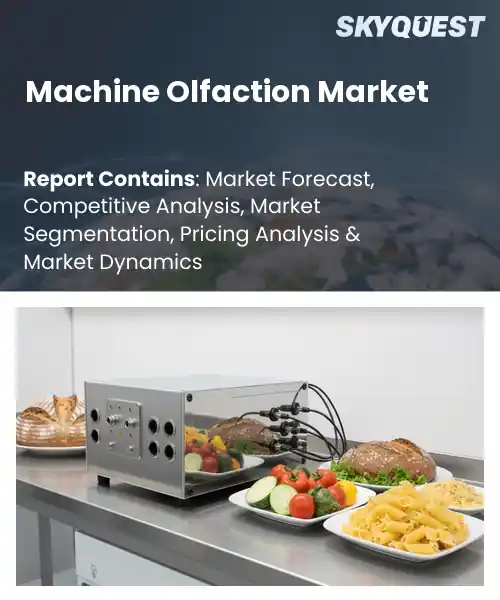
Machine Olfaction Market
Report ID: SQMIG45J2894
Report ID: SQMIG45J2894
[email protected]
USA +1 351-333-4748
Report ID:
SQMIG45J2894 |
Region:
Global |
Published Date: August, 2026
Pages:
157
|Tables:
145
|Figures:
78


Global Machine Olfaction Market size was valued at USD 2.3 Billion in 2024 and is poised to grow from USD 2.66 Billion in 2025 to USD 8.48 Billion by 2033, growing at a CAGR of 15.6% during the forecast period (2026-2033).
The primary driver behind the burgeoning machine‑olfaction market is the escalating need for real‑time detection of volatile compounds in safety‑critical environments. As a result of the growing pressure from pollution regulation agencies on plants, food industries, and healthcare companies, electronic noses equipped with sensor arrays are already employed in everyday operations instead only in laboratory experiments. Initially, the technology was first utilized by the petrochemical industry which employed metal-oxide sensors to identify leaks while nowadays it is widely used for food freshness detection in “smart kitchens”. Hence, it is evident that the technology has evolved from being a rare research tool to an important part of the quality and risk management system.
Building on this foundation, the integration of intelligence with sensor hardware emerges as the pivotal growth factor for the machine‑olfaction market. The algorithms of artificial intelligence change the initial scent symbols into predictive algorithms meaning they can be utilized not only for detecting things. For example, in pharmacology, the combination of smart noses and machine learning classifiers helps find out when the batches must be recalled, while garbage disposal systems apply IoT devices to identify hazardous emissions. Such a cause-effect cycle creates a feedback loop whereby better data generates regulatory incentives leading to investment in scalable olfactory systems.
How are AI and IoT Integration Shaping the Machine Olfaction Market?
AI is transforming the global machine olfaction market because machine-learning algorithms can interpret complex sensor signals and identify odor patterns more accurately and rapidly. As AI learns from expanding odor datasets, electronic noses can classify VOCs, detect anomalies, and distinguish subtle changes that conventional sensing methods may miss, increasing demand for intelligent olfaction systems.
Market snapshot - (2026-2033)
Global Market Size
USD 2.3 Billion
Largest Segment
Sensors
Fastest Growth
Software
Growth Rate
15.6% CAGR
To get more insights on this market click here to Request a Free Sample Report
Global machine olfaction market is segmented by component, technology, application, end user, deployment and region. Based on component, the market is segmented into sensors, software and systems. Based on technology, the market is segmented into electronic nose, gas sensor arrays and AI-based olfaction. Based on application, the market is segmented into food & beverage, healthcare, environmental monitoring and others. Based on end user, the market is segmented into industrial, research institutes, government and others. Based on deployment, the market is segmented into portable and fixed. Based on region, the market is segmented into North America, Europe, Asia Pacific, Latin America and Middle East & Africa.
Sensors segment dominates because they form the core detection element that directly translates volatile compounds into measurable signals, enabling all higher level functionalities. Thanks to their reliability, miniaturization capabilities, and growing range of materials, these devices are commonly used in many sectors of the industry. They cleanly fit in and are inexpensive, making them an important technology, as they allow seamless integration into data analysis systems, thus helping enhance the intelligence of such systems.
However, software segment is witnessing the strongest growth momentum because advanced analytics and cloud connectivity are unlocking new value propositions for users. Developers are delivering modular platforms that enable rapid algorithm deployment, while increasing demand for real time odor classification fuels investment, positioning software as a catalyst for broader market penetration and differentiation.
AI based olfaction technology leads because it applies machine learning to decode intricate odor signatures, eliminating the need for extensive handcrafted calibration. Flexibility enables an expedited launch at multiple locations while improved processes raise efficiency and precision of detection. The process allows acquiring knowledge from current information which helps significantly reduce the time needed to deploy complex solutions which necessitate fine separation of similar substances and provides assistance to cloud solutions that make handling different places much easier.
On the other hand, gas sensor arrays are emerging as the high growth area because advances in microfabrication enable dense multiplexed platforms that capture richer chemical fingerprints. Their ability to provide redundancy and enhanced selectivity attracts new adopters in safety and quality control, propelling broader market expansion and opening novel application pathways.
To get detailed segments analysis, Request a Free Sample Report
North America leads the industry due to an ecosystem that blends deep research expertise with rapid commercial translation. First-rate sensor technologies are elaborated on at colleges and industrial laboratories in America, where economic tools allow quick transition from prototype to final product. Regulatory environment in the USA and Canada helps promote the emergence of new applications in food safety, environmental monitoring and defense industries. Collaboration between suppliers and end-users leads to solutions that meet different operational needs. The presence of big multinational companies in the region’s market is an advantage, as consumers are more open to new technologies in the said region. The venture capital also plays an important role in the financing of early-stage olfactory sensors in the USA, while Canadian tech clusters are notable for close connections between educational institutions and companies.
United States Machine Olfaction Market
Machine olfaction market in the United States benefits from a concentration of research universities and venture‑backed startups that push sensor miniaturization and data analytics. The food processing industry, pharma companies and military sector form a feedback loop to develop technology for actual use. With a highly developed IP protection and fast prototyping, it is possible to launch innovative products into the market in the USA and ensure that it remains a trendsetter.
Canada Machine Olfaction Market
Machine olfaction market in Canada leverages strong governmental support for clean‑technology initiatives, channeling resources toward sensor development for environmental and agricultural applications. The collaborative centers unite national research facilities with local businesses in order to help them cooperate in different areas including chemistry, electronics and data science. The emphasis on sustainability allows using the scent technology for emission and soil control, while the constructive nature of regulations enables starting the trials at an early stage, making Canada the leader in this sphere.
Europe experiences rapid expansion of the machine olfaction market as regulatory emphasis on safety and environmental stewardship aligns with mature industrial sectors. Standardization of product certification used in different countries has contributed to an enhancement in the technological progress of odor-detection platforms. Among the countries which have built strong research networks are Germany, the UK, and France with their contribution towards new sensor chemistry. Wide funding programs enable the commercialization of new products in the sphere of food safety, waste management, and car emissions control. Growing awareness about air quality among consumers has increased demand for solutions related to indoor and outdoor monitoring. Thus, cross-border cooperation allows swift technology transfer.
Germany Machine Olfaction Market
Machine olfaction market in Germany is anchored by a legacy of precision engineering and a robust chemical industry that drives sensor innovation. Joint research initiatives involving private and public sector entities have been established between automobile manufacturers, environmental bodies and research institutions to improve technology that can be applied to test product quality and emissions. The focus on Industry 4.0 integration guarantees that scent sensors are used in smart production lines, and strict environmental regulations create ongoing demand for innovative odor control techniques.
United Kingdom Machine Olfaction Market
Machine olfaction market in the United Kingdom accelerates through vibrant startup ecosystems and strong collaboration between healthcare providers and sensor developers. The focus on early diagnosis of diseases and the safety of food has resulted in investments into portable odor detection devices that integrate nanomaterial sensors with cloud analytics. State innovation grants and a supportive regulatory environment facilitate the deployment of tests in hospitals and supply lines. The combination of these factors makes the United Kingdom a leader in the development of the latest scent-based technologies.
France Machine Olfaction Market
Machine olfaction market in France emerges alongside growing emphasis on sustainable agriculture and perfume industry innovation. In Paris and Lyon collaborative laboratories offer a combination of traditional olfactory knowledge and the latest in sensory technologies in terms of fret-free methods of detection belonging to both areas of study. Funding available to public research projects provides room for developments intended to implement some olfactory sensors in smart agricultural equipment whereas the support of regulatory organizations concerning unharmful emissions monitoring results in new opportunities for industrial implementations.
Asia Pacific strengthens its position in the industry by coupling rapid technology adoption with unique regional demands for food safety, environmental monitoring, and industrial quality control. Smart manufacturing and Internet-of-Things are among the top priorities of government programs all over the region. The combination of Japan’s know-how in microminiaturized electrical engineering with South Korea’s achievements in semiconductor production leads to the emergence of tiny but extremely sensitive and advanced devices. The rise of consumers’ awareness of the quality of the air they breathe at home has led to an increased demand for both household and commercial monitoring solutions, while the growing logistics networks create the need for advanced odor detection technologies allowing for verifications of product freshness. Collaborative research platforms and cross-border venture partnerships facilitate the process of bringing lab inventions to market.
Japan Machine Olfaction Market
Machine olfaction market in Japan benefits from world‑class expertise in micro‑fabrication and a cultural focus on meticulous quality control. The synergy of electronics and food companies enables the creation of ultra-compact sensors that can be placed in packages and production lines. The role of the government in developing smart cities contributes to the introduction of scent-based air quality monitoring systems in cities. The combination of cutting-edge technology in its practical application makes Japan one of the leaders in smelling technology development.
South Korea Machine Olfaction Market
Machine olfaction market in South Korea thrives on cutting‑edge semiconductor capabilities and a strong emphasis on export‑driven technology. The alliances between leading firms in chip technology and biotechnology yield ultra-sensitive odour detectors for use in automotive exhaust systems and electronic devices. National initiatives aimed at Industry 5.0 are facilitating the acceptance of AI-based scent analysis in production monitoring. The convergence of advanced technology hardware with smart software has caused South Korea to emerge as a key agent in the regional olfactory technology ecosystem.
To know more about the market opportunities by region and country, click here to
Buy The Complete Report
Growing Demand For Early Detection
Advancements In Sensor Miniaturization
High Development Costs
Limited Standardized Testing Protocols
Request Free Customization of this report to help us to meet your business objectives.
International competition exists in the global machine olfaction market, among which, important players involve Alpha MOS, AIRSENSE Analytics, Aryballe Technologies, The eNose Company, Sensigent, Odotech and RoboScientific. Although Alpha MOS is engaged in the production of electronic noses and sensory analytics, which are employed in the fields of food, beverage industries, scents and chemicals, Aryballe has managed to win the interest of its customers through applying technologies of silicon-photonic sensors and methods of machine learning for recognizing odors. Meanwhile, AIRSENSE focuses on providing businesses with personalized electronic noses.
Top Player’s Company Profile
Recent Developments in Global Machine Olfaction Market
SkyQuest’s ABIRAW (Advanced Business Intelligence, Research & Analysis Wing) is our Business Information Services team that Collects, Collates, Correlates, and Analyses the Data collected by means of Primary Exploratory Research backed by robust Secondary Desk research.
As per SkyQuest analysis the global machine‑olfaction industry is set to expand rapidly, driven primarily by the growing demand for early detection of contaminants and disease markers across food, healthcare and environmental sectors, while advances in sensor miniaturization provide a second powerful catalyst by enabling portable, low‑power devices and broader IoT integration. The sensors segment remains dominant because it supplies the core detection capability that fuels all downstream software and systems. North America leads the market thanks to its strong research ecosystem, early‑adopter culture and supportive regulations. However, high development costs pose a restraint, slowing entry for smaller innovators and tempering the pace of wider adoption.
| Report Metric | Details |
|---|---|
| Market size value in 2024 | USD 2.3 Billion |
| Market size value in 2033 | USD 8.48 Billion |
| Growth Rate | 15.6% |
| Base year | 2024 |
| Forecast period | (2026-2033) |
| Forecast Unit (Value) | USD Billion |
| Segments covered |
|
| Regions covered | North America (US, Canada), Europe (Germany, France, United Kingdom, Italy, Spain, Rest of Europe), Asia Pacific (China, India, Japan, Rest of Asia-Pacific), Latin America (Brazil, Rest of Latin America), Middle East & Africa (South Africa, GCC Countries, Rest of MEA) |
| Companies covered |
|
| Customization scope | Free report customization with purchase. Customization includes:-
|
To get a free trial access to our platform which is a one stop solution for all your data requirements for quicker decision making. This platform allows you to compare markets, competitors who are prominent in the market, and mega trends that are influencing the dynamics in the market. Also, get access to detailed SkyQuest exclusive matrix.
Table Of Content
Executive Summary
Market overview
Parent Market Analysis
Market overview
Market size
KEY MARKET INSIGHTS
COVID IMPACT
MARKET DYNAMICS & OUTLOOK
Market Size by Region
KEY COMPANY PROFILES
Methodology
For the Machine Olfaction Market, our research methodology involved a mixture of primary and secondary data sources. Key steps involved in the research process are listed below:
1. Information Procurement: This stage involved the procurement of Market data or related information via primary and secondary sources. The various secondary sources used included various company websites, annual reports, trade databases, and paid databases such as Hoover's, Bloomberg Business, Factiva, and Avention. Our team did 45 primary interactions Globally which included several stakeholders such as manufacturers, customers, key opinion leaders, etc. Overall, information procurement was one of the most extensive stages in our research process.
2. Information Analysis: This step involved triangulation of data through bottom-up and top-down approaches to estimate and validate the total size and future estimate of the Machine Olfaction Market.
3. Report Formulation: The final step entailed the placement of data points in appropriate Market spaces in an attempt to deduce viable conclusions.
4. Validation & Publishing: Validation is the most important step in the process. Validation & re-validation via an intricately designed process helped us finalize data points to be used for final calculations. The final Market estimates and forecasts were then aligned and sent to our panel of industry experts for validation of data. Once the validation was done the report was sent to our Quality Assurance team to ensure adherence to style guides, consistency & design.
Analyst Support
Customization Options
With the given market data, our dedicated team of analysts can offer you the following customization options are available for the Machine Olfaction Market:
Product Analysis: Product matrix, which offers a detailed comparison of the product portfolio of companies.
Regional Analysis: Further analysis of the Machine Olfaction Market for additional countries.
Competitive Analysis: Detailed analysis and profiling of additional Market players & comparative analysis of competitive products.
Go to Market Strategy: Find the high-growth channels to invest your marketing efforts and increase your customer base.
Innovation Mapping: Identify racial solutions and innovation, connected to deep ecosystems of innovators, start-ups, academics, and strategic partners.
Category Intelligence: Customized intelligence that is relevant to their supply Markets will enable them to make smarter sourcing decisions and improve their category management.
Public Company Transcript Analysis: To improve the investment performance by generating new alpha and making better-informed decisions.
Social Media Listening: To analyze the conversations and trends happening not just around your brand, but around your industry as a whole, and use those insights to make better Marketing decisions.
REQUEST FOR SAMPLE
 REQUEST FREE CUSTOMIZATION
Global Machine Olfaction Market size was valued at USD 2.3 Billion in 2024 and is poised to grow from USD 2.66 Billion in 2025 to USD 8.48 Billion by 2033, growing at a CAGR of 15.6% during the forecast period (2026-2033).
The machine olfaction market is shaped by intense rivalry as incumbents accelerate product rollouts and forge alliances to lock in key verticals. Aromyx partnered with IBM Watson in 2022 to embed AI‑driven odor classification into its e‑nose platform, while Alpha MOS launched a nanowire sensor array in 2023 that boosts detection speed and sensitivity for food safety and industrial monitoring. 'AIRSENSE Analytics GmbH', 'Aryballe Technologies', 'Alpha MOS', 'Aeroqual Limited', 'Sensigent LLC', 'Electronic Sensor Technology', 'The eNose Company', 'Owlstone Medical Ltd.', 'Odotech Inc.', 'Scentroid', 'ams-OSRAM AG', 'Bosch Sensortec GmbH', 'Figaro Engineering Inc.', 'Sensirion AG', 'Honeywell International Inc.', 'Siemens AG', 'Aromyx Corporation', 'Envirosuite Limited', 'AirTest Technologies Inc.', 'Breathomix B.V.'
The increasing emphasis on early detection of contaminants, spoilage, and disease markers across food safety, healthcare, and environmental monitoring creates a strong need for electronic noses. Companies adopt machine olfaction solutions to sense volatile compounds before visible signs appear, enabling proactive interventions. This proactive capability reduces product losses, enhances consumer confidence, and supports regulatory compliance, thereby encouraging broader adoption of sensor platforms and accelerating market expansion. It also facilitates research into novel applications and fosters partnerships between technology firms and end‑user industries, further embedding olfactory technologies into standard operational workflows.
Ai‑Driven Scent Analytics Expansion: Manufacturers are embedding advanced machine‑learning algorithms into electronic noses, allowing pattern recognition and predictive odor profiling. This shift enables faster product development cycles, more precise quality control, and new service models such as on‑demand fragrance personalization. As AI platforms become more accessible, smaller firms can leverage cloud‑based analytics without extensive hardware investment, widening adoption across food safety, pharmaceuticals, and environmental monitoring. The resulting ecosystem accelerates innovation, reduces time to market, and creates differentiated value propositions for end‑users seeking olfactory insights.
Why does North America Dominate the Global Machine Olfaction Market? |@12


Want to customize this report? This report can be personalized according to your needs. Our analysts and industry experts will work directly with you to understand your requirements and provide you with customized data in a short amount of time. We offer $1000 worth of FREE customization at the time of purchase.
Feedback From Our Clients


 USA (+1) 351-333-4748

