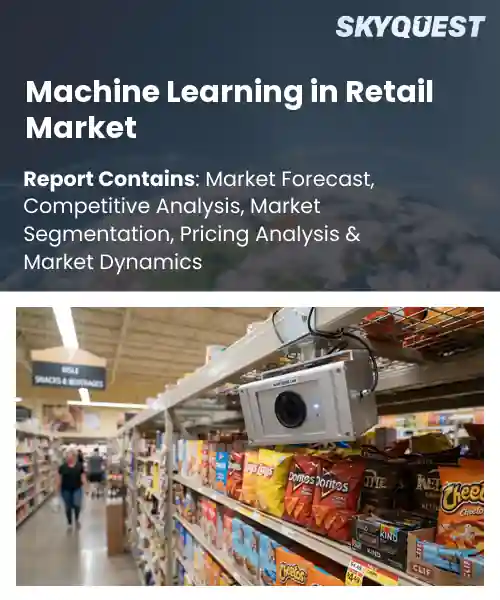
Machine Learning in Retail Market
Report ID: SQMIG45E3331
Report ID: SQMIG45E3331
[email protected]
USA +1 351-333-4748
Report ID:
SQMIG45E3331 |
Region:
Global |
Published Date: September, 2026
Pages:
157
|Tables:
153
|Figures:
78


Global Machine Learning In Retail Market size was valued at USD 11.2 Billion in 2024 and is poised to grow from USD 14.09 Billion in 2025 to USD 88.38 Billion by 2033, growing at a CAGR of 25.8% during the forecast period (2026-2033).
The primary catalyst behind the global machine‑learning in retail market is the relentless pursuit of personalized consumer experiences, a trend amplified by digital transformation of shopping. Retail today encompasses brick‑and‑mortar stores, e‑commerce platforms, and omnichannel ecosystems, each generating data streams on purchasing behavior, inventory levels, and foot traffic. This data richness matters because it enables retailers to predict demand, tailor promotions, and reduce waste, thereby boosting margins. Over the past decade industry shifted from rule‑based analytics to learning models; for instance, a major apparel chain moved from simple basket analysis to neural‑network recommendations that lifted conversion rates by fifteen percent. Building on personalization, the next key factor driving machine‑learning adoption is supply‑chain optimization, which turns inventory management into a predictive engine. When demand forecasts become granular, retailers align replenishment with store traffic, reducing stock‑outs and holding costs; profit margins improve while satisfaction rises. Amazon’s automated fulfillment centers illustrate this effect: algorithms analyze sales velocity and warehouse capacity to reroute products, cutting delivery times by forty percent. Walmart uses sensors to monitor shelf availability, prompting instant restocking that prevents lost sales. These examples show how data‑driven agility unlocks revenue streams, encouraging investment in edge computing and strategic partnerships for future growth.
What impact does AI-powered machine learning have on retail inventory automation?
AI powered machine learning reshapes retail inventory automation by turning raw sales data into predictive insights. Algorithms forecast demand at the SKU level, allowing stores to adjust stock before peaks or lulls appear. Real time analytics connect point of sale signals with supplier lead times, triggering automatic reorder triggers that keep shelves full while trimming excess. The shift toward omnichannel shopping increases the need for synchronized inventory across online and brick and mortar locations, and machine learning provides the glue that aligns these channels. Retailers see fewer stockouts, lower holding costs, and faster response to trend shifts, making the supply chain more agile and customer centric.In June 2024, a leading retailer launched an AI driven inventory platform that automates replenishment, reduces manual errors and speeds shelf restocking. The system links sales forecasts with supplier lead times, enabling real time stock adjustments that keep popular items available and cut waste, reinforcing AI’s role in retail efficiency.
Market snapshot - (2026-2033)
Global Market Size
USD 11.2 Billion
Largest Segment
Predictive Analytics
Fastest Growth
Computer Vision
Growth Rate
25.8% CAGR
To get more insights on this market click here to Request a Free Sample Report
Global machine learning in retail market is segmented by solution type, deployment, application, retail channel, end-use industry and region. Based on solution type, the market is segmented into Predictive Analytics, Recommendation Engines, Demand Forecasting, Computer Vision, Customer Analytics and Others. Based on deployment, the market is segmented into Cloud-Based, On-Premises and Hybrid. Based on application, the market is segmented into Inventory Management, Pricing & Promotion, Customer Personalization, Fraud Detection, Supply Chain Optimization and Others. Based on retail channel, the market is segmented into Online Retail, Offline Retail and Omnichannel Retail. Based on end-use industry, the market is segmented into Grocery & Supermarkets, Fashion & Apparel, Consumer Electronics, Home & Furniture, Specialty Retail and Others. Based on region, the market is segmented into North America, Europe, Asia Pacific, Latin America and Middle East & Africa.
Predictive analytics segment dominates because retailers rely on data‑driven insights to anticipate buying behavior and optimize stock levels. Machine learning models that forecast demand, identify trends, and simulate scenarios provide a strategic edge, enabling faster decision making and cost reduction. The ability to integrate historical sales, seasonal patterns, and external factors creates a compelling value proposition that drives widespread adoption across the retail ecosystem and enhances profitability.
However, recommendation engines segment is witnessing the strongest growth momentum because e‑commerce platforms seek to personalize the shopper journey in real time. Collaborative filtering and deep learning techniques enable product suggestions that increase conversion rates and basket size. Rising consumer expectations and competitive pressure accelerate investment, positioning this capability as a key driver of future market expansion.
Cloud‑based deployment segment leads because retailers value the scalability and rapid provisioning that cloud infrastructures provide. Machine learning workloads can be spun up on demand, reducing capital expense and enabling continuous model updates. Integrated services from major providers simplify data ingestion, processing, and model serving, fostering agility in responding to market fluctuations. This flexibility and cost efficiency attract both large chains and emerging brands, cementing cloud as the preferred environment.
Meanwhile, hybrid deployment segment is emerging as the key area because organizations seek to balance data sovereignty with cloud elasticity. Sensitive customer information can stay on‑premises while using compute for model training, creating an architecture that addresses security concerns and performance demands. This approach fuels adoption among retailers hesitant to fully migrate, unlocking investment streams and expanding the market.
To get detailed segments analysis, Request a Free Sample Report
North America leads the global machine learning in retail market through a combination of deep technology ecosystems, mature retail infrastructure, and strong investment culture. The United States hosts a dense concentration of AI research institutions and venture capital that fuels continuous innovation in predictive analytics, personalization engines, and autonomous logistics. Canada contributes a robust talent pipeline and supportive government policies that encourage collaboration between academia and industry. Together, these factors create a synergistic environment where retailers can rapidly adopt sophisticated algorithms, integrate real‑time data streams, and scale solutions across large, diverse consumer bases, reinforcing the region’s leadership position. Furthermore, the presence of leading cloud service providers enables seamless deployment of scalable models, while robust data privacy frameworks give retailers confidence to experiment with personalized recommendations. The collaborative mindset between technology firms and legacy retailers accelerates time‑to‑value, ensuring that innovations move quickly from pilot to full‑store implementation.
United States Machine Learning in Retail Market
Machine Learning in Retail Market is deeply embedded in United States retail operations, where large omnichannel players harness advanced forecasting and dynamic pricing to enhance shopper experiences. Research hubs in major cities feed continuous improvements in computer vision for checkout‑free stores, while startups specialize in sentiment analysis and supply‑chain optimization. The convergence of high‑speed connectivity, extensive consumer data, and a culture of rapid experimentation drives sustained adoption across grocery, fashion, and specialty sectors.
Canada Machine Learning in Retail Market
Machine Learning in Retail Market is gaining traction in Canada through collaborative ecosystems that link universities, research institutes, and forward‑looking retailers. Emphasis on ethical AI and data stewardship shapes implementations that respect privacy while delivering personalized promotions and inventory balancing. Regional innovation hubs focus on natural language processing for bilingual customer service and on demand‑driven logistics, enabling retailers to respond swiftly to shifting consumer preferences across both urban and remote markets.
Europe’s machine learning in retail market is propelled by a blend of sophisticated consumer expectations, regulatory frameworks that encourage responsible AI, and a dense network of technology clusters spanning several economies. German engineering precision underpins robust analytics platforms, while the United Kingdom’s vibrant fintech heritage fuels innovative payment and loyalty solutions powered by AI. France’s strong emphasis on creative branding integrates visual recognition tools to personalize shopper journeys. Cross‑border data initiatives and collaborative research programs amplify knowledge sharing, allowing retailers to adopt multilingual recommendation engines and seamless omnichannel experiences. The collective focus on sustainability also steers algorithmic optimization toward waste reduction and circular inventory management, further accelerating market momentum across the continent.
Germany Machine Learning in Retail Market
Machine Learning in Retail Market in Germany benefits from a tradition of industrial rigor and a well‑established digital manufacturing base. Leading retailers partner with engineering firms to deploy predictive maintenance for cold‑chain logistics and advanced demand forecasting that aligns closely with supply capabilities. Strong data protection standards foster consumer trust, enabling the rollout of personalized recommendation systems that respect privacy. Academic collaborations in technical hubs drive continuous improvement in computer vision for checkout automation and reinforcement learning for dynamic shelf arrangement.
United Kingdom Machine Learning in Retail Market
Machine Learning in Retail Market in United Kingdom thrives on a dynamic fintech ecosystem that merges payment innovation with real‑time analytics. Retailers exploit AI‑driven price optimization and churn prediction to refine loyalty programs and enhance customer retention. The presence of leading research universities accelerates development of natural language understanding for conversational commerce, while regulatory guidance encourages transparent model governance. This blend of financial technology expertise and retail ambition creates a fertile environment for rapid scaling of AI solutions across both brick‑and‑mortar and online channels.
France Machine Learning in Retail Market
Machine Learning in Retail Market in France is shaped by a strong creative industry that blends fashion sensibility with cutting‑edge AI. Retail brands adopt visual search and style recommendation engines to deliver highly curated experiences that resonate with trend‑aware shoppers. Government incentives support startups focusing on computer vision for virtual fitting rooms and AI‑enhanced inventory turnover. Collaborative clusters in major cities foster multilingual chatbots and sentiment analysis tools, allowing retailers to engage customers across diverse linguistic landscapes while maintaining brand elegance.
Asia Pacific is advancing its role in the machine learning in retail market by leveraging rapid digital adoption, extensive mobile commerce penetration, and strong governmental commitments to AI development. Japan places emphasis on precision engineering that fuels sophisticated sensor integration and robotics for in‑store automation, while South Korea exhibits leadership in high‑speed connectivity that enables seamless real‑time personalization across online and physical touchpoints. Regional collaborations among technology giants, retail consortia, and research institutions accelerate the creation of context‑aware recommendation engines and predictive logistics platforms. A cultural focus on innovation and consumer convenience drives experimentation with augmented reality fitting experiences and AI‑guided inventory replenishment, positioning the region as a hub for next‑generation retail intelligence.
Japan Machine Learning in Retail Market
Machine Learning in Retail Market in Japan merges meticulous engineering with a culture of convenience, leading to advanced in‑store robotics and sensor‑driven analytics. Retailers integrate AI‑powered shelf monitoring that anticipates demand fluctuations and automates restocking, enhancing operational efficiency. Collaboration with automotive and electronics manufacturers accelerates development of autonomous checkout solutions and immersive augmented reality shopping. Strong consumer acceptance of contactless experiences further encourages deployment of predictive pricing models and personalized product recommendations, reinforcing Japan’s reputation as a leader in technically refined retail transformations.
South Korea Machine Learning in Retail Market
Machine Learning in Retail Market in South Korea benefits from world‑class broadband infrastructure and a tech‑savvy consumer base eager for interactive shopping experiences. Retail chains deploy AI chatbots with natural language capabilities that support instant multilingual assistance, while advanced video analytics monitor foot traffic to optimize store layouts. Partnerships with semiconductor firms drive high‑performance edge computing devices that process data locally for ultra‑low latency personalization. Government initiatives promote AI research in retail logistics, fostering sophisticated demand forecasting that reduces waste and aligns supply with fast‑moving consumer trends.
To know more about the market opportunities by region and country, click here to
Buy The Complete Report
Personalized Shopping Experiences
Supply Chain Optimization
Data Privacy Concerns
High Implementation Costs
Request Free Customization of this report to help us to meet your business objectives.
Top Player’s Company Profile
Recent Developments
SkyQuest’s ABIRAW (Advanced Business Intelligence, Research & Analysis Wing) is our Business Information Services team that Collects, Collates, Correlates, and Analyses the Data collected by means of Primary Exploratory Research backed by robust Secondary Desk research. As per SkyQuest analysis, the global machine‑learning in retail market is being propelled primarily by the demand for personalized shopping experiences, where real‑time data enables tailored recommendations and dynamic pricing that lift sales and loyalty. A second major driver is supply‑chain optimization, with predictive models fine‑tuning inventory and logistics to cut stockouts and waste. The predictive‑analytics segment leads the market because retailers rely on accurate demand forecasts to make swift decisions. North America dominates the landscape thanks to its deep tech ecosystem, abundant venture capital and early‑adopter retailers. However, stringent data‑privacy regulations pose a significant restraint, raising compliance costs and limiting the breadth of data available for model training.
| Report Metric | Details |
|---|---|
| Market size value in 2024 | USD 11.2 Billion |
| Market size value in 2033 | USD 88.38 Billion |
| Growth Rate | 25.8% |
| Base year | 2024 |
| Forecast period | (2026-2033) |
| Forecast Unit (Value) | USD Billion |
| Segments covered |
|
| Regions covered | North America (US, Canada), Europe (Germany, France, United Kingdom, Italy, Spain, Rest of Europe), Asia Pacific (China, India, Japan, Rest of Asia-Pacific), Latin America (Brazil, Rest of Latin America), Middle East & Africa (South Africa, GCC Countries, Rest of MEA) |
| Companies covered |
|
| Customization scope | Free report customization with purchase. Customization includes:-
|
To get a free trial access to our platform which is a one stop solution for all your data requirements for quicker decision making. This platform allows you to compare markets, competitors who are prominent in the market, and mega trends that are influencing the dynamics in the market. Also, get access to detailed SkyQuest exclusive matrix.
Table Of Content
Executive Summary
Market overview
Parent Market Analysis
Market overview
Market size
KEY MARKET INSIGHTS
COVID IMPACT
MARKET DYNAMICS & OUTLOOK
Market Size by Region
KEY COMPANY PROFILES
Methodology
For the Machine Learning in Retail Market, our research methodology involved a mixture of primary and secondary data sources. Key steps involved in the research process are listed below:
1. Information Procurement: This stage involved the procurement of Market data or related information via primary and secondary sources. The various secondary sources used included various company websites, annual reports, trade databases, and paid databases such as Hoover's, Bloomberg Business, Factiva, and Avention. Our team did 45 primary interactions Globally which included several stakeholders such as manufacturers, customers, key opinion leaders, etc. Overall, information procurement was one of the most extensive stages in our research process.
2. Information Analysis: This step involved triangulation of data through bottom-up and top-down approaches to estimate and validate the total size and future estimate of the Machine Learning in Retail Market.
3. Report Formulation: The final step entailed the placement of data points in appropriate Market spaces in an attempt to deduce viable conclusions.
4. Validation & Publishing: Validation is the most important step in the process. Validation & re-validation via an intricately designed process helped us finalize data points to be used for final calculations. The final Market estimates and forecasts were then aligned and sent to our panel of industry experts for validation of data. Once the validation was done the report was sent to our Quality Assurance team to ensure adherence to style guides, consistency & design.
Analyst Support
Customization Options
With the given market data, our dedicated team of analysts can offer you the following customization options are available for the Machine Learning in Retail Market:
Product Analysis: Product matrix, which offers a detailed comparison of the product portfolio of companies.
Regional Analysis: Further analysis of the Machine Learning in Retail Market for additional countries.
Competitive Analysis: Detailed analysis and profiling of additional Market players & comparative analysis of competitive products.
Go to Market Strategy: Find the high-growth channels to invest your marketing efforts and increase your customer base.
Innovation Mapping: Identify racial solutions and innovation, connected to deep ecosystems of innovators, start-ups, academics, and strategic partners.
Category Intelligence: Customized intelligence that is relevant to their supply Markets will enable them to make smarter sourcing decisions and improve their category management.
Public Company Transcript Analysis: To improve the investment performance by generating new alpha and making better-informed decisions.
Social Media Listening: To analyze the conversations and trends happening not just around your brand, but around your industry as a whole, and use those insights to make better Marketing decisions.
REQUEST FOR SAMPLE
 REQUEST FREE CUSTOMIZATION


Want to customize this report? This report can be personalized according to your needs. Our analysts and industry experts will work directly with you to understand your requirements and provide you with customized data in a short amount of time. We offer $1000 worth of FREE customization at the time of purchase.
Feedback From Our Clients


 USA (+1) 351-333-4748

