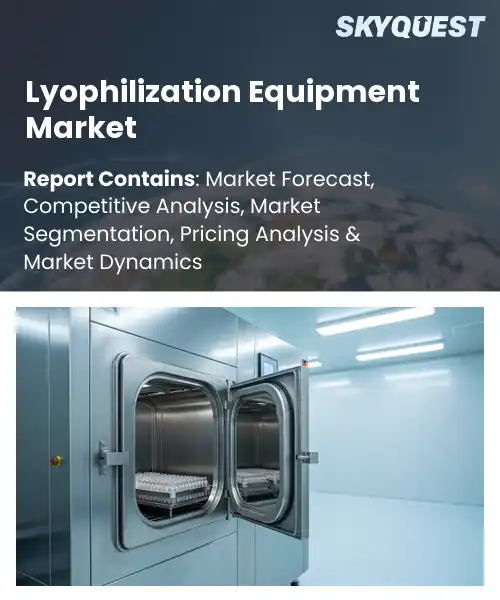
Lyophilization Equipment Market
Report ID: SQMIG35A3457
Report ID: SQMIG35A3457
[email protected]
USA +1 351-333-4748
Report ID:
SQMIG35A3457 |
Region:
Global |
Published Date: May, 2026
Pages:
157
|Tables:
208
|Figures:
80


Global Lyophilization Equipment Market size was valued at USD 6.90 Billion in 2024 and is poised to grow from USD 7.27 Billion in 2025 to USD 11.08 Billion by 2033, growing at a CAGR of 5.4% during the forecast period (2026-2033).
The lyophilization equipment market trends includes all products that are designed to take away moisture from pharmaceutical, biological, diagnostic, and food products in order to provide long-lasting and transportable products, and the need for these products has been increasing because many modern pharmaceuticals and biologicals are being designed to have reliable shelf life and to be able to maintain their potency through the entire cold chain process of distribution. Freeze-drying started as a specialised market for the production of vaccines and antibiotics; however, it developed into a large industrial manufacturing process with the development of mAbs (monoclonal antibodies) and recombinant proteins. The main driver of this market today is the increase in complex bio-pharmaceuticals, such as biologics used in oncology treatments and biopharmaceuticals produced from virus strains used to manufacture vaccines, which are being made more readily available throughout the globe by way of being lyophilised prior to distribution (in order to maintain potency).
Due to the increasingly stringent stability and sterility requirements imposed by manufacturers, companies are investing heavily in advanced lyophilization technologies, generating new opportunities for continuous processing; single-use systems; automated shelf-loading configurations that cut down on cycle times and risk of contamination. As a result of these developments, contract development and manufacturing organizations are growing their service offerings, allowing small biotechnology companies to develop and commercialize both lyophilized vaccines and individualized therapies without incurring large capital expenditures. Additionally, as emerging markets have reduced their reliance on cold-chain systems, this has helped to accelerate wider vaccination campaigns; therefore, vendors of equipment are developing flexible, scalable, modular units along with establishing local service solutions to achieving market share. Furthermore, as regulatory authorities focus on validating processes and generating stability data, the pharmaceutical industry's procurement of validated, high-throughput systems to support their supply chains continues to grow.
How is IoT Enhancing Real-time Monitoring in the Lyophilization Equipment Market?
By combining embedded sensors with cloud analytics, wireless networks and Edge device, customers in the lyophilization equipment market growth now have a real-time monitoring solution that allows for continuous visibility of product temperature, chamber pressure and process dynamics. Key features of this solution include non-invasive soft sensors, wireless vial measurements and process analytical technology that communicate with dashboards and control loops. The current adoption trend for these solutions is rapidly increasing in the pharmaceutical industry and with manufacturers who are using biologics for batch stability and reproducibility. The use of IoT technologies will help to reduce batch risks, expedite troubleshooting activities, and facilitate regulatory compliance / traceability by providing IoT technologies for integrated gas sensing leak detection and closed loop control of cycles based on real-time product data instead of fixed recipe.
Tempris (February 26, 2026) obtained recognition for their innovative system that does not require batteries or wired systems to operate/monitor within an IoT enabled environment through a combination of robot-assisted sensor placement and intelligent control software, providing true real-time product temperature data and automated endpoint detection that reduces cycle time and increases yield, allowing for faster scale-up to production levels.
Market snapshot - (2026-2033)
Global Market Size
USD 6.9 Billion
Largest Segment
Freeze Dryers
Fastest Growth
Monitoring & Control Systems
Growth Rate
5.4% CAGR
To get more insights on this market click here to Request a Free Sample Report
Global lyophilization equipment market is segmented by product type, scale of operation, mode of operation, technology, application, end user, distribution channel and region. Based on product type, the market is segmented into freeze dryers, vacuum systems, condensers & ice condensers, loading & unloading systems, clean-in-place (CIP) & sterilize-in-place (SIP) systems, monitoring & control systems and auxiliary & support equipment. Based on scale of operation, the market is segmented into laboratory scale, pilot scale and industrial/production scale. Based on mode of operation, the market is segmented into batch lyophilization and continuous lyophilization. Based on technology, the market is segmented into conventional lyophilization, automated lyophilization and smart/iot-enabled lyophilization systems. Based on application, the market is segmented into pharmaceuticals, biotechnology, food processing, diagnostics, research & academic applications and cosmetics & nutraceuticals. Based on end user, the market is segmented into pharmaceutical & biopharmaceutical companies, contract manufacturing organizations (CMOs/CDMOs), food processing companies, biotechnology companies, research laboratories & academic institutes, hospitals & diagnostic centers and others. Based on distribution channel, the market is segmented into direct sales, distributors & channel partners and online/equipment procurement platforms. Based on region, the market is segmented into North America, Europe, Asia Pacific, Latin America, and Middle East & Africa.
The freeze dryer segment is the leading part of a company’s overall manufacturing method since it is the processing equipment which provides product stability and is responsible for the overall cycle performance and scalability of products. Consequently, freeze dryers will typically be the most costly investment by companies that manufacture products using freeze drying technology. The freeze dryer holds a central role in the preservation of biologics and sensitive formulations; hence, they are the highest procurement priority in the development of products. Because of their demonstrated reliability, versatility and established validation pathways, freeze dryer adoption risk is significantly diminished, leading buyers of freeze dryers to make advanced freeze dryer purchases with the dual intent of providing quality products and facilitating downstream regulatory approval, thereby driving overall market demand for freeze dryers.
The rapidly growing monitoring and controls system sub-segment is driven by the demand for real-time process analytics, data integrity and automated controls to speed product development and ensure product compliance. The combination of improved automation software integration, innovations in sensors and connectivity is providing numerous new opportunities for predictive maintenance and improved process control in freeze drying applications, in addition to whether customers should retrofit or upgrade existing monitoring and controls systems.
The batch segment is the most prevalent with the lyophilization method because batch processing has the most flexibility in product formats and is positioned with validation methods that are readily used by regulatory and manufacturing groups. Controlled cycle parameters from small to large batch sizes minimize the development risk for complicated formulations and provide an avenue for many users within the pharmaceutical and research communities to adopt this method.
On the other hand, continuous Lyophilization is the fastest-growing subsegment of the market due to the need for increased throughput, shorter cycle times, and consistent product quality. The use of continuous lyophilization methods in producing commercial-scale products is being accelerated by ongoing advancements in the processes of process intensification, inline monitoring, and the regulatory acceptance of continuous methods. There are opportunities for the design of new equipment, integrated services, and optimized lifecycles as manufacturers adopt continuous lyophilization as an option to batch lyophilization.
To get detailed segments analysis, Request a Free Sample Report
North America holds a large advantage due to an interlocking network of established advanced life science ecosystems, extensive industry know-how and a strong innovation pipeline that consistently generates strong demand for freeze drying equipment. There is also a high level of concentration of pharmaceutical and biotechnology companies in close proximity as well as an integrated contract development and manufacturing network that provides the foundation for developing products through engineering expertise. The presence of strong regulatory processes with quality assurance as well as early adoption of automation, process analytics and validated equipment further create an environment conducive to rapid adoption. There is also a well-established aftermarket and service provider network, which helps to support uptime, validation support, and spare parts availability for all types of freeze drying equipment, reducing friction in making the necessary investments. The cooperative relationship between the players across industry and academia, as well as with suppliers, helps to foster continual advancements and customization of complex biologics and specialty therapeutics, which support continuous improvement to maintain market leadership and drive technological diffusion across both clinical and commercial environments.
Lyophilization equipment market regional outlook in United States has seen growth due to numerous pharmaceutical companies and biotech companies, strong contract manufacturing and development networks, and many engineering capabilities; in addition, there exists a strong regulatory framework, as well as access to major research institutions, thus facilitating the uptake of new freeze-drying technology and process analytics; a good aftermarket service and support industry has also allowed companies to experience shorter downtimes on their equipment, and thus accelerate technology diffusion from clinical to commercial production; and finally, by having so much skilled labor and capital available to continue driving innovation pace forward.
Lyophilization equipment market regional forecast in Canada is supported by many life science clusters, collaborative research efforts, and public sector investment in the commercialisation of technology. Local manufacturers focus on developing customised products, designing more energy-efficient equipment, and integrating their equipment into the sterile filling process to ensure a seamless transition between individual and larger scale production processes. Strong collaborations between universities and the private sector are further accelerating workforce development, innovation of processes, and maintenance/validation of equipment. This additional support for the continued use of capital equipment also allows small and medium size businesses to remain in operation.
Europe is experiencing rapid growth due to strong industrial capabilities, highly clustered life sciences hubs and a pro-investment policy environment supporting advanced pharmaceutical manufacturing. The European market offers robust development and manufacturing contract service networks, as well as OEMs that have an emphasis on precision engineering, modularity and energy efficiency. Furthermore, collaborative frameworks established between industry, research and regulatory bodies, allow for more efficient technology transfer and validation processes. Sustainability, quality standards and providing customised solutions for complex biologics all serve to increase demand for flexible and configurable freeze drying systems. Partnerships crossing borders, aftermarket service networks, and an increasing emphasis on digitally controlled processes and validated processes are all contributing towards accelerating the adoption of freeze drying systems within both mature and developing markets across Europe.
Lyophilization equipment market outlook in Germany has been buoyed by an extensive legacy of engineering, a robust network of manufacturing suppliers, and concentration of specialized manufacturers. Manufacturers support precision-improvements, automation improvements and energy-efficient systems to support comprehensive high-quality Pharmaceutical Manufacture. Specialized Research Institutions and well-trained workforce support a process of incremental product evolution and after-market support services to meet customer demand. Manufacturers with strong export markets and collaborative manufacturing networks grow the rate of technology transfer between regional manufacturers.
Lyophilization equipment market forecast in United Kingdom is seeing rapid development; it is supported through an established and experienced clinical research environment (both in terms of funding and capability) as well as increased opportunities for contract manufacturing. The focus of both manufacturers and service providers is primarily on flexibility of equipment configurations, speed of validation support, and developing partnerships with companies that assist in accelerating the adoption of new methods of processing biologics. Policy initiatives and investments in the development of skills support a competitive environment for both domestic manufacturing and contract service exports. Aftermarket capabilities along with consultation services support the scaling up of processes as well as regulatory readiness.
Lyophilization equipment market analysis in France appears to have an emerging level of strength due to identified areas of industrial modernizations that are being pursued as well as through scientific expertise and increased collaborations between public research and the private sector. As such, area OEMs are working to develop modularly designed, sustainability-focused engineered units, as well as connections with aseptic finishing systems for niche category therapeutics. Additionally, many clusters are forming to support area companies in their efforts to develop's and utilize comparative examinations of their freeze drying equipment. Service networks will provide increased uptime and regulatory compliance readiness from using lyophilization service providers.
The Asia Pacific region is investing heavily in the development of biopharmaceutical manufacturing capacity, increasing local demand for specialty pharmaceutical products, and investing in new technologies for manufacturing. There is a synergetic relationship between the contract manufacturing capabilities available at the regional level and the local manufacturers and distributors of equipment who provide cost-effective solutions, compact designs, and automation capabilities that align well with regional production systems. Government entities and industry consortiums are working together to develop the capabilities and technology transfers that will help companies adopt newer advanced process control technologies and analytical capabilities more readily. In addition, cross-border partnerships that involve global Original Equipment Manufacturers (OEMs) and service providers add additional validation capability as well as aftermarket support and supply chain resilience. The emphasis on energy-efficient equipment, digitized monitoring, and workforce development, positions the Asia Pacific region as a growing and important place for the domestic supply of, as well as the regional exporting of, lyophilization technologies.
Lyophilization equipment industry in Japan has benefited from high-quality drug manufacturing technology, precision engineering, and a strong emphasis upon high-quality processes. Local suppliers develop reliable equipment with long service lives and can effectively integrate process analytical technologies into their systems to ensure product integrity. The close working relationships between manufacturers, research institutes, and contract manufacturers make it easy to refine and adopt customised freeze-drying solutions. Energy efficiency design and superior service are also important components of the region's ability to compete globally in the market.
Lyophilization equipment market in South Korea is driven by strong manufacturing capability driven by electronics, quick adoption of process automation, and increased biopharma production. Local OEMs are concentrating on creating equipment with small footprints, innovative control systems, and rapid validation methods that align with lean manufacturing principles. Sharing best practices and developing new capabilities through strong industrial partners provides the support needed to build a platform for digital monitoring and preventive maintenance services and provide improved responsiveness in the supply chain. All of these strengths contribute to an increased level of competitiveness in the larger regional export markets.
To know more about the market opportunities by region and country, click here to
Buy The Complete Report
Rising Demand For Biologics
Advancements In Freeze Drying Technology
High Initial Capital Investment
Complex Regulatory Compliance Requirements
Request Free Customization of this report to help us to meet your business objectives.
The competitive landscape for global lyophilization equipment continues to evolve through technology innovation; retrofitting older equipment with new technology; and creating new partnerships to accelerate the ability to add capacity quickly or get capabilities more quickly through mergers/acquisitions. An example of this was the partnership between LyoWave and Millrock (joint development of microwave retrofittable modules into existing lyophilizers) as well as the recent acquisition of LSNE by PCI Pharma Services, which resulted in a significant increase in lyophilization capacity.
Top Player’s Company Profile
Recent Developments in the Lyophilization Equipment Market
SkyQuest’s ABIRAW (Advanced Business Intelligence, Research & Analysis Wing) is our Business Information Services team that Collects, Collates, Correlates, and Analyses the Data collected by means of Primary Exploratory Research backed by robust Secondary Desk research.
As per SkyQuest analysis, increased demand for biologics is creating a need for manufacturers to increase freeze drying capabilities, while improvements in freeze drying technology including increased automation, short cycle times and consistent end-products have further driven growth of the industry. A hinderance to many smaller companies is the high initial capital investment and lack of ability to invest in manufacturing equipment, leading many to use contract and development manufacturers (CDMO). North America remains the dominant region with a diverse range of companies within the life science ecosystem, robust regulatory environment and well-developed aftermarket support. Freeze dryers are the leading segment due to their direct correlation with product stability and scalability. The overall trend in the market is towards digital solutions, modular designs, and service-based offerings which provide benefits such as speeding up growth opportunities and minimizing chance of loss through operational risk.
| Report Metric | Details |
|---|---|
| Market size value in 2024 | USD 6.9 Billion |
| Market size value in 2033 | USD 11.08 Billion |
| Growth Rate | 5.4% |
| Base year | 2024 |
| Forecast period | (2026-2033) |
| Forecast Unit (Value) | USD Billion |
| Segments covered |
|
| Regions covered | North America (US, Canada), Europe (Germany, France, United Kingdom, Italy, Spain, Rest of Europe), Asia Pacific (China, India, Japan, Rest of Asia-Pacific), Latin America (Brazil, Rest of Latin America), Middle East & Africa (South Africa, GCC Countries, Rest of MEA) |
| Companies covered |
|
| Customization scope | Free report customization with purchase. Customization includes:-
|
To get a free trial access to our platform which is a one stop solution for all your data requirements for quicker decision making. This platform allows you to compare markets, competitors who are prominent in the market, and mega trends that are influencing the dynamics in the market. Also, get access to detailed SkyQuest exclusive matrix.
Table Of Content
Executive Summary
Market overview
Parent Market Analysis
Market overview
Market size
KEY MARKET INSIGHTS
COVID IMPACT
MARKET DYNAMICS & OUTLOOK
Market Size by Region
KEY COMPANY PROFILES
Methodology
For the Lyophilization Equipment Market, our research methodology involved a mixture of primary and secondary data sources. Key steps involved in the research process are listed below:
1. Information Procurement: This stage involved the procurement of Market data or related information via primary and secondary sources. The various secondary sources used included various company websites, annual reports, trade databases, and paid databases such as Hoover's, Bloomberg Business, Factiva, and Avention. Our team did 45 primary interactions Globally which included several stakeholders such as manufacturers, customers, key opinion leaders, etc. Overall, information procurement was one of the most extensive stages in our research process.
2. Information Analysis: This step involved triangulation of data through bottom-up and top-down approaches to estimate and validate the total size and future estimate of the Lyophilization Equipment Market.
3. Report Formulation: The final step entailed the placement of data points in appropriate Market spaces in an attempt to deduce viable conclusions.
4. Validation & Publishing: Validation is the most important step in the process. Validation & re-validation via an intricately designed process helped us finalize data points to be used for final calculations. The final Market estimates and forecasts were then aligned and sent to our panel of industry experts for validation of data. Once the validation was done the report was sent to our Quality Assurance team to ensure adherence to style guides, consistency & design.
Analyst Support
Customization Options
With the given market data, our dedicated team of analysts can offer you the following customization options are available for the Lyophilization Equipment Market:
Product Analysis: Product matrix, which offers a detailed comparison of the product portfolio of companies.
Regional Analysis: Further analysis of the Lyophilization Equipment Market for additional countries.
Competitive Analysis: Detailed analysis and profiling of additional Market players & comparative analysis of competitive products.
Go to Market Strategy: Find the high-growth channels to invest your marketing efforts and increase your customer base.
Innovation Mapping: Identify racial solutions and innovation, connected to deep ecosystems of innovators, start-ups, academics, and strategic partners.
Category Intelligence: Customized intelligence that is relevant to their supply Markets will enable them to make smarter sourcing decisions and improve their category management.
Public Company Transcript Analysis: To improve the investment performance by generating new alpha and making better-informed decisions.
Social Media Listening: To analyze the conversations and trends happening not just around your brand, but around your industry as a whole, and use those insights to make better Marketing decisions.
REQUEST FOR SAMPLE
 REQUEST FREE CUSTOMIZATION
Global Lyophilization Equipment Market size was valued at USD 6.9 Billion in 2024 and is poised to grow from USD 7.27 Billion in 2025 to USD 11.08 Billion by 2033, growing at a CAGR of 5.4% during the forecast period (2026-2033).
Competitive activity in the global lyophilization equipment market is being driven by technology differentiation, retrofit modules and dealmaking that speed capacity or capability gains. Recent examples include LyoWave’s joint development with Millrock to integrate microwave modules into existing dryers and contract manufacturer consolidation such as PCI Pharma Services’ acquisition of LSNE to add lyophilization capacity. These moves respond to demand for faster, higher throughput lyophilization for biologics. 'GEA Group AG', 'SP Industries, Inc.', 'Azbil Telstar, S.L.U.', 'IMA S.p.A.', 'Martin Christ Gefriertrocknungsanlagen GmbH', 'Labconco Corporation', 'Tofflon Science and Technology Group Co., Ltd.', 'Zirbus Technology GmbH', 'Millrock Technology, Inc.', 'Hof Sonderanlagenbau GmbH', 'OPTIMA packaging group GmbH', 'Cuddon Freeze Dry', 'Shanghai Tofflon Science and Technology Co., Ltd.', 'FreeZone Freeze Dryers', 'Lyomac Technology Inc.', 'Frozen in Time Ltd.', 'Buchi Labortechnik AG', 'Kambic d.o.o.', 'VirTis Company, Inc.', 'MechaTech Systems Ltd.'
The expanding pipeline of biologics, vaccines, and advanced therapeutics supports increased adoption of lyophilization equipment because these products frequently require solid-state stabilization to preserve potency, safety, and shelf life. Manufacturers invest in freeze-drying capacity to enable robust formulation development, improve product stability, and facilitate long-distance distribution without cold chain dependence. As a result, demand for specialized, scalable lyophilization systems rises to meet production needs and quality expectations, stimulating equipment suppliers to expand offerings and services to address diverse pharmaceutical drying requirements.
Bioprocessing Integration: Manufacturers are aligning lyophilization equipment with upstream and downstream bioprocess workflows to enhance process continuity, ensure product integrity, and support complex biologics production. Seamless integration with single use systems, modular skids, and closed handling reduces transfer steps and contamination risk, while facilitating technology transfer from development to manufacturing. Vendors emphasize customizable configurations and compact designs to meet batch scale variation, enabling biotech firms to streamline operations, reduce manual interventions, and accelerate time to market for sensitive therapeutic and diagnostic products.
Why does North America Dominate the Global Lyophilization Equipment Market? |@12


Want to customize this report? This report can be personalized according to your needs. Our analysts and industry experts will work directly with you to understand your requirements and provide you with customized data in a short amount of time. We offer $1000 worth of FREE customization at the time of purchase.
Feedback From Our Clients


 USA (+1) 351-333-4748

