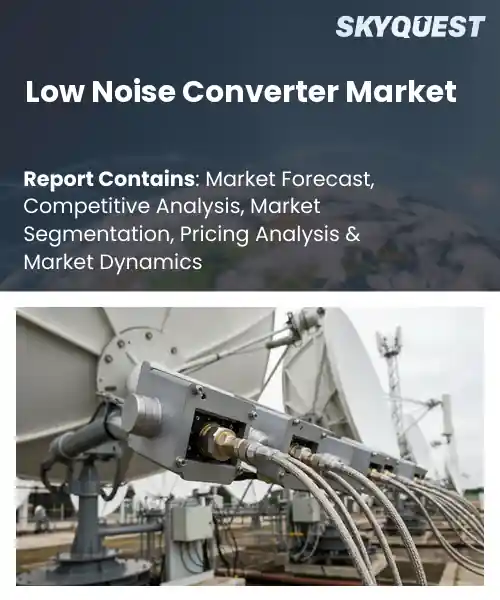
Low Noise Converter Market
Report ID: SQMIG45H2167
Report ID: SQMIG45H2167
[email protected]
USA +1 351-333-4748
Report ID:
SQMIG45H2167 |
Region:
Global |
Published Date: March, 2026
Pages:
157
|Tables:
117
|Figures:
77


Global Low Noise Converter Market size was valued at USD 13.0 Billion in 2024 and is poised to grow from USD 14.14 Billion in 2025 to USD 27.77 Billion by 2033, growing at a CAGR of 8.8% during the forecast period (2026-2033).
Key Takeaways : Market Trends & Insights
The primary driver of the low noise converter market is escalating demand for higher-sensitivity RF front ends in wireless communications, satellite stations and radar systems. Downconverters are used to combine amplifiers and low-noise frequency converters into units that can receive weak signals in order to allow for reliable processing of these signals at lower frequency levels. The market is important because improved signal-to-noise ratios produce higher data throughput, longer link distances and more accurate sensing, which shape telecommunications, earth observation and defense capabilities. Over the decade the market shifted from discrete assemblies toward integrated, software-configurable modules, with vendors supplying compact, broadband LNCs for 5G small cells and CubeSat.
A key factor driving the global low noise converter sector growth is convergence of spectrum scarcity and push toward higher frequency bands, which compels designers to reduce system noise and boost gain to maintain link budgets. As operators migrate to mid-band 5G and explore mmWave backhaul, demand for wideband, tunable LNCs rises because lower noise figures directly translate into extended coverage and reliability, and fewer base stations, reducing capital expenditures. In satellite and Earth observation, improved LNC performance increases sensitivity allowing smaller antennas on CubeSats and higher-resolution imagery, thereby opening commercial opportunities in remote sensing services and IoT connectivity in underserved regions.
How is AI Improving Performance and Reliability in the Low Noise Converter Market?
Low noise converters are judged by how well they preserve weak signals while limiting added noise and drift. Key aspects include noise figure, linearity, thermal stability and fast adaptation to changing signals. Today the market faces tighter demands from satellite links, 5G infrastructure and sensitive sensors. AI improves performance and reliability through intelligent calibration routines that tune gain and filters in real time, learned denoising models embedded in signal chains and AI driven design tools that reduce iterations in layout and testing. These approaches let devices maintain cleaner outputs under interference and extend operational life through predictive maintenance and adaptive compensation.
Market snapshot - 2026-2033
Global Market Size
USD 13.0 Billion
Largest Segment
Ku-Band LNB
Fastest Growth
Ka-Band LNB
Growth Rate
8.8% CAGR
To get more insights on this market click here to Request a Free Sample Report
The low noise converter market is segmented by band frequency, output configuration, technology/noise figure, application and region. Based on band frequency, the market is segmented into C-band LNB, Ku-band LNB and Ka-band LNB. Based on output configuration, the market is segmented into single output, twin/dual output and quad/octo output. Based on technology/noise figure, the market is segmented into standard LNB, ultra-low noise and PLL LNB. Based on application, the market is segmented into direct-to-home (DTH) consumer TV, VSAT & satellite internet and military & professional communications. Based on region, the market is segmented into North America, Europe, Asia Pacific, Latin America and Middle East & Africa.
Based on global low noise converter market growth, Ku band LNB segment dominates because its frequency characteristics balance usable bandwidth with manageable antenna size, enabling widespread deployment across consumer and enterprise use cases. The manufacturer ecosystem and supply chain are both strong and well developed, as a result, there is a lower cost/units and improved reliability, which drives preference for integration by system integrators and end-users. Compatibility with existing platform architectures shortens upgrade cycles, reinforcing demand that supports production scale and fosters ongoing innovation and cost improvements.
However, Ka band LNB is emerging as the fastest growing area because its higher frequency enables substantially greater bandwidth and supports next-generation high-throughput satellite applications, driving demand for compact, high-capacity links. Component integration and antenna advances, together with rising satellite internet and mobility applications, are accelerating product development and creating new commercial opportunities.
Ultra low noise LNB segment dominates because its exceptional noise performance directly improves receiver sensitivity, allowing reliable signal acquisition under weak conditions and extending effective link margins. Relying on this level of performance has led to many deployments where the quality of the received signal greatly matters so it is no surprise that many of the vendors at these deployments focus on creating low-noise architectures for their products. The resulting preference among network designers drives design wins, produces economies of scale, and stimulates continued investment in component refinement and advanced low-noise manufacturing techniques.
However, PLL LNB is experiencing rapid growth as its frequency stability and phase-locked control satisfy stricter requirements of modern digital modulation and precise tracking. The frequency drift and automated network management capabilities of PLL integrated networks have made PLL's attractive for use in professional communications deployments and VSAT networks and have created a demand for focused R&D on PLLs and increased overall adoption of this technology.
To get detailed segments analysis, Request a Free Sample Report
As per the global low noise converter market share, North America leads the global Low Noise Converter market due to a combination of advanced aerospace and defense demand, strong satellite and telecommunications infrastructure, and concentrated design and manufacturing expertise. Low noise performance is very important for sensitive receiver chains. Consequently, OEMs and system integrators within the region work together to build a closer partnership with both component vendors as well as their end user customers. Robust standards, matured supply chains and high-quality testing/qualification resources all work together to aid in speeding up product development and implementation.
In addition, through the use of strategic procurement by major institutions and commercial customers, high-value projects are supported over time. Ongoing investment in research and development, plus frequent industry-academia partnerships, further reinforce the region's ability to translate emerging materials and architectures into deployable products.
Low noise converter market in the United States benefits from deep defense and space engagement, extensive RF design expertise, and a dense network of component manufacturers. System requirements drive specialization in ultra-low noise amplifiers and converter architectures, supported by testing infrastructure. Collaborative programs between industry and national research institutions accelerate maturation of advanced materials and processes. Procurement practices and a competitive supplier base encourage improvement and integration into complex platforms.
Low noise converter market in Canada draws strength from a focused mix of aerospace subcontracting and research centers concentrating on RF and microwave technologies. Quality assurance (QA) and system reliability are the foundations for the selection of suppliers of proven low-noise (L/H) products. In order to support the manufacturers’ niche manufacturing/testing capabilities, manufacturers collaborate with their international counterparts. Government procurement/technology transfer programs create a bridge between the development and commercialization of products. The environment helps establish criteria for converter performance refinement for demanding applications.
Based on global low noise converter market regional forecast, Asia Pacific expansion is driven by dynamic demand across commercial satellite systems, expanding mobile backhaul networks, and advanced radar and sensing deployments in key economies. As a result of increasing usage of high-freq communication, and the trend toward smaller, energy efficient designs, regional suppliers are placing greater importance on good noise performance and system level integration.
In addition to strong electronics manufacturing ecosystems, government-sponsored technology programs allow for faster production scaling and faster adaptation of new semiconductor processes. The cooperation between global OEMs and local engineering groups allows design expertise to pass through to the local area and quickly adapt to local needs. Investing in R&D centers and working with universities will allow for ongoing advances in low noise circuit techniques and materials.
Low noise converter market in Japan benefits from long-standing precision in RF engineering, miniaturized component manufacturing, and integration expertise. Working with specialized test laboratories allows these companies to achieve rigorous qualification for the most demanding types of deployments. A culture of innovation that prioritizes improving and maintaining a stable supply chain also allows domestic companies to continue providing high-quality converter products to international customers.
Low noise converter market in South Korea is driven by strong telecom ecosystems and focused investment in satellite and defense electronics. Compact, efficient, and densely integrated designs are important elements of local suppliers with respect to meeting increasing performance standards. Manufacturers and semiconductor foundries maintain closely knit relationships, allowing for a rapid adoption of new technologies, including improved technology to decrease noise. Manufacturers and system integrators work collaboratively to develop optimized solutions for target applications, thereby strengthening the competitive position of their products in technology markets.
As per global low noise converter market regional outlook, Europe is strengthening its role through coordinated efforts in advanced materials research, standards development, and industrial collaboration across key technology clusters. The growing need for reliable systems in aviation, defence and essential infrastructure has generated a strong desire for high-quality, low-noise converters that meet or exceed the rigorous standards required of any product being sold to those sectors.
Manufacturers within those industries are capitalising on regional engineering expertise and specialised test environments to improve performance metrics of their products while developing modular/scalable architectures suitable for diverse applications. Collaborations between manufacturers spread out over various countries through supply chains allow for easy knowledge transfer and flexibility in producing small quantities of products due to the tremendous amount of knowledge required to develop new technologies.
Low noise converter market in Germany is anchored by precision engineering, a strong industrial base, and close links between research institutes and manufacturers. Reliable product performance in critical systems is supported by a rigorous testing infrastructure. The collaboration between subsystems integrators helps ensure that converters are adapted for the complex nature of platforms and will ultimately help maintain Germany's competitive edge in regional and export markets while being a reliable source of supply.
Low noise converter market in United Kingdom benefits from vibrant defense electronics sector, strong university research programs, and concentration of satellite and telecommunications expertise. Suppliers focus on low noise performance, ruggedization, and certification for deployment in demanding operational environments. Cooperation between prime contractors and specialist component makers accelerates integration into complex platforms. Through a focus on bespoke service solutions and export-oriented development, UK companies are increasingly being seen as the optimal choice of partner for bespoke converter services.
Low noise converter market in France leverages strong aerospace and space sectors supported by laboratories and specialized electronics suppliers. High reliability through effective thermal management and low-phase-noise performance meets the very stringent requirements imposed by mission profiles. Prototyping and qualification are expedited by partnerships with universities and research institutes as well as within the industry. In addition, French companies have developed relationships with export partners to accommodate the adaptations necessary for their solutions to satisfy international system specifications.
To know more about the market opportunities by region and country, click here to
Buy The Complete Report
Rising Need For Signal Integrity
The increasing requirement for signal integrity in modern telecommunications applications and radar systems is leading to more widespread use of low noise converters as they enable enhancement of the signal-to-noise ratio (SNR) by decreasing noise figure thereby preserving very weak signals. As such this allows both for better reception of signals as well as extended detection range of signals. Thus, manufacturers will continue to develop low noise converters with an emphasis on design and materials suitable for use in the electromagnetic environment to assure engineers can continue to utilize components that provide the greatest fidelity in difficult electromagnetic situations.
Expansion Of 5G and Satellite Services
Broadening deployment of 5G networks and the proliferation of satellite constellations increase demand for front-end components that preserve signal clarity, leading system designers to specify low noise converters for base stations and satellite terminals. By minimizing thermal and phase noise contributions, these devices provide support for higher frequencies, wider band operations, and link reliability as indicated by the fact that they allow operators to provide users with a consistent experience and have good uplink sensitivity. Because of their importance to the user experience and the quality of uplink connections, operators' purchasing cycles are increasingly focused on components that provide predictable performance.
Complex Design and Integration Challenges
System architects are faced with a set of complex design requirements and having to integrate such design requirements into multifunctional platforms, so the slowdown of the adoption of low noise converters is driven by the requirement for system architects to reconcile their noise performance with the physical limitations of size, thermal dissipation, and power. Customization needs increase development timelines and necessitate specialized testing and qualification procedures, which raise engineering costs and delay time-to-market. Smaller OEMs may lack resources to undertake such complex integration, reducing supplier diversity and slowing procurement. The resulting preference for proven, integrated solutions can constrain market entry for novel converter designs and limit rapid expansion.
High Component Cost and Supply Constraints
Elevated costs of precision components and fluctuations in supply chains limit procurement of low noise converters by increasing total system expenses and creating uncertainty around delivery schedules. Long lead times will require designers to qualify multiple suppliers and hold larger quantities of finished goods; this ultimately increases the operational burden of both manufacturers and customers. The combination of these two (price and lead time) factors tends to decrease the willingness to make investments in advanced converters while slowing down the rate of market adoption since cost control and supply predictability are seen as more important than performance improvement by the majority of market participants.
Request Free Customization of this report to help us to meet your business objectives.
Competition in the global low noise converter market outlook is driven by consolidation and feature-led differentiation, with players using acquisitions and partnerships to integrate RF front ends with IP and headend solutions. Recent examples include Inverto’s 2023 acquisition of Quadrille Ingénierie and a 2024 partnership to deliver DVB Native IP gateways. Parallel technology bets on cryogenic and quantum-grade low-noise amplifiers target aerospace and advanced sensing customers.
Advanced Semiconductor Integration
Expanding Satellite And 5G Demand
SkyQuest’s ABIRAW (Advanced Business Intelligence, Research & Analysis Wing) is our Business Information Services team that Collects, Collates, Correlates, and Analyses the Data collected by means of Primary Exploratory Research backed by robust Secondary Desk research.
As per SkyQuest analysis, the global low noise converter industry is propelled by rising demand for higher-sensitivity RF front ends in wireless, satellite and radar systems as a key driver, while complex design and integration challenges act as a notable restraint. Ku-band LNBs currently dominate due to balanced bandwidth and manageable antenna size, and North America leads regionally thanks to advanced aerospace, defense and telecom ecosystems. A second driver accelerating growth is spectrum scarcity and migration to higher frequency bands, which raises demand for wideband, tunable LNCs. Overall manufacturers are focusing on integration and AI-enabled calibration to meet performance and deployment needs.
| Report Metric | Details |
|---|---|
| Market size value in 2024 | USD 13.0 Billion |
| Market size value in 2033 | USD 27.77 Billion |
| Growth Rate | 8.8% |
| Base year | 2024 |
| Forecast period | 2026-2033 |
| Forecast Unit (Value) | USD Billion |
| Segments covered |
|
| Regions covered | North America (US, Canada), Europe (Germany, France, United Kingdom, Italy, Spain, Rest of Europe), Asia Pacific (China, India, Japan, Rest of Asia-Pacific), Latin America (Brazil, Rest of Latin America), Middle East & Africa (South Africa, GCC Countries, Rest of MEA) |
| Companies covered |
|
| Customization scope | Free report customization with purchase. Customization includes:-
|
To get a free trial access to our platform which is a one stop solution for all your data requirements for quicker decision making. This platform allows you to compare markets, competitors who are prominent in the market, and mega trends that are influencing the dynamics in the market. Also, get access to detailed SkyQuest exclusive matrix.
Table Of Content
Executive Summary
Market overview
Parent Market Analysis
Market overview
Market size
KEY MARKET INSIGHTS
COVID IMPACT
MARKET DYNAMICS & OUTLOOK
Market Size by Region
KEY COMPANY PROFILES
Methodology
For the Low Noise Converter Market, our research methodology involved a mixture of primary and secondary data sources. Key steps involved in the research process are listed below:
1. Information Procurement: This stage involved the procurement of Market data or related information via primary and secondary sources. The various secondary sources used included various company websites, annual reports, trade databases, and paid databases such as Hoover's, Bloomberg Business, Factiva, and Avention. Our team did 45 primary interactions Globally which included several stakeholders such as manufacturers, customers, key opinion leaders, etc. Overall, information procurement was one of the most extensive stages in our research process.
2. Information Analysis: This step involved triangulation of data through bottom-up and top-down approaches to estimate and validate the total size and future estimate of the Low Noise Converter Market.
3. Report Formulation: The final step entailed the placement of data points in appropriate Market spaces in an attempt to deduce viable conclusions.
4. Validation & Publishing: Validation is the most important step in the process. Validation & re-validation via an intricately designed process helped us finalize data points to be used for final calculations. The final Market estimates and forecasts were then aligned and sent to our panel of industry experts for validation of data. Once the validation was done the report was sent to our Quality Assurance team to ensure adherence to style guides, consistency & design.
Analyst Support
Customization Options
With the given market data, our dedicated team of analysts can offer you the following customization options are available for the Low Noise Converter Market:
Product Analysis: Product matrix, which offers a detailed comparison of the product portfolio of companies.
Regional Analysis: Further analysis of the Low Noise Converter Market for additional countries.
Competitive Analysis: Detailed analysis and profiling of additional Market players & comparative analysis of competitive products.
Go to Market Strategy: Find the high-growth channels to invest your marketing efforts and increase your customer base.
Innovation Mapping: Identify racial solutions and innovation, connected to deep ecosystems of innovators, start-ups, academics, and strategic partners.
Category Intelligence: Customized intelligence that is relevant to their supply Markets will enable them to make smarter sourcing decisions and improve their category management.
Public Company Transcript Analysis: To improve the investment performance by generating new alpha and making better-informed decisions.
Social Media Listening: To analyze the conversations and trends happening not just around your brand, but around your industry as a whole, and use those insights to make better Marketing decisions.
REQUEST FOR SAMPLE
 REQUEST FREE CUSTOMIZATION
Global Low Noise Converter Market size was valued at USD 13.0 Billion in 2024 and is poised to grow from USD 14.14 Billion in 2025 to USD 27.77 Billion by 2033, growing at a CAGR of 8.8% during the forecast period (2026-2033).
Key vendors in the Low Noise Converter Market include major RF, satellite communication, and semiconductor companies such as Norsat International Inc., Orbital Research Ltd., Av-Comm, Actox Corporation, Satcom Resources, Raditek, MaxLinear, Inc., MTI Wireless Edge Ltd., and MultiChoice Group.
The key driver of the Low Noise Converter Market is the growing demand for satellite communication and broadcasting services. Increasing adoption of direct-to-home (DTH) television, expanding broadband connectivity, and rising use of satellite-based communication systems are significantly driving the need for efficient low noise converters.
A key market trend in the Low Noise Converter Market is the increasing miniaturization and integration of high-performance components. There is also a growing focus on enhanced signal quality, energy efficiency, and compatibility with advanced communication technologies such as 5G and satellite-based broadband systems.
Asia-Pacific accounted for the largest share in the Low Noise Converter Market, driven by the rapid expansion of satellite communication services, growing demand for direct-to-home (DTH) broadcasting, and increasing investments in telecommunications infrastructure across countries such as China, India, and Japan.


Want to customize this report? This report can be personalized according to your needs. Our analysts and industry experts will work directly with you to understand your requirements and provide you with customized data in a short amount of time. We offer $1000 worth of FREE customization at the time of purchase.
Feedback From Our Clients


 USA (+1) 351-333-4748

