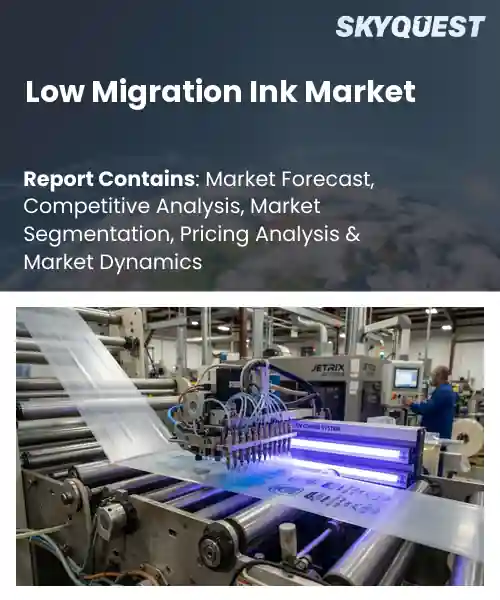
Low Migration Ink Market
Report ID: SQMIG15E4333
Report ID: SQMIG15E4333
[email protected]
USA +1 351-333-4748
Report ID:
SQMIG15E4333 |
Region:
Global |
Published Date: September, 2026
Pages:
157
|Tables:
146
|Figures:
78


Global Low Migration Ink Market size was valued at USD 1.2 Billion in 2024 and is poised to grow from USD 1.28 Billion in 2025 to USD 2.16 Billion by 2033, growing at a CAGR of 6.7% during the forecast period (2026-2033).
Low‑migration ink, a formulation that limits pigment movement during printing, has become essential for graphics and security applications. The market emerged in the 2000s as manufacturers sought to overcome bleed problems that reduced fidelity on porous substrates such as newspaper and packaging board. By engineering polymer binders that lock pigment particles in place, suppliers enabled printers to achieve sharper lines and stability. This capability matters because industries from pharmaceutical labeling to anti‑counterfeit documents rely on prints. In the decade, adoption accelerated in Asia where e‑commerce growth spurred demand for packaging inks, while regulators promoted stricter label‑legibility standards, expanding the market. The growth catalyst lies in rising demand for packaging, which forces converters to adopt low‑migration inks that meet environmental regulations while preserving image quality. Retailers pledging to cut plastic waste require printable biodegradable films that do not leach pigments into food or recyclates; low‑migration formulations provide that barrier, prompting ink suppliers to partner with biopolymer producers. Consequently, companies such as Sun Chemical and Toyo Ink have launched lines that capture market share in food‑grade segment. This shift creates opportunities for players to supply niche inks for pharmaceutical blister packs, where compliance translates into margins and faster time‑to‑market for drug manufacturers.
How is AI-driven automation influencing product performance in the low migration ink market?
AI-driven automation is reshaping product performance in the low migration ink market by enabling precise formulation, rapid testing, and adaptive process control. Key aspects include data rich modeling of pigment migration, real time sensor feedback, and predictive adjustment of drying parameters. The current state sees manufacturers integrating machine learning algorithms into their R&D labs, allowing them to simulate ink behavior on a variety of packaging films before physical trials. This reduces trial and error cycles and enhances consistency across batches. Companies are also using AI to optimize viscosity and surface tension, which directly improves print clarity and barrier properties. The result is a more reliable ink that meets stringent food safety standards while maintaining high visual quality.Sun Chemical June 2023, introduced an AI driven formulation platform that tailors low migration ink recipes to specific substrates, cutting development cycles and boosting consistency, which supports market growth and efficiency. The system uses machine learning to predict pigment interactions and solvent balance, delivering faster time to market and reducing waste.
Market snapshot - (2026-2033)
Global Market Size
USD 1.2 Billion
Largest Segment
Water-Based Inks
Fastest Growth
Electron Beam-Cured Inks
Growth Rate
6.7% CAGR
To get more insights on this market click here to Request a Free Sample Report
Global low migration ink market is segmented by ink type, printing technology, application, substrate, end-use industry and region. Based on ink type, the market is segmented into Water-Based Inks, Solvent-Based Inks, UV-Cured Inks and Electron Beam-Cured Inks. Based on printing technology, the market is segmented into Flexographic Printing, Gravure Printing, Digital Printing and Offset Printing. Based on application, the market is segmented into Food Packaging, Pharmaceutical Packaging and Cosmetic Packaging. Based on substrate, the market is segmented into Plastic Films, Paper & Paperboard and Aluminum Foil. Based on end-use industry, the market is segmented into Food & Beverage, Pharmaceuticals and Cosmetics & Personal Care. Based on region, the market is segmented into North America, Europe, Asia Pacific, Latin America and Middle East & Africa.
Water based inks segment dominates because they inherently exhibit low solvent migration, aligning with stringent food contact regulations and providing excellent substrate adhesion. Their formulation flexibility enables manufacturers to tailor viscosity and drying characteristics, facilitating integration across diverse printing processes while maintaining product safety. This alignment with regulatory compliance and operational ease fuels their leading position in the low migration ink market and supports long term brand trust through consistent performance.
However, electron beam cured inks segment is emerging as the key high growth area in the low migration ink market. Their ability to cure without photoinitiators reduces residual migration risks, while rapid curing speeds meet increasing production demands. These advantages are sparking broader adoption across premium packaging, accelerating market expansion.
Flexographic printing segment leads because it offers continuous roll to roll processing that seamlessly integrates low migration inks with high speed production lines. The technology’s ability to use quick drying formulations minimizes ink bleed, ensuring barrier integrity on flexible pharmaceutical films. Combined with precise ink deposition control, it reduces contamination risk and satisfies stringent health authority requirements, cementing its prominence in the low migration ink arena while supporting sustainable material use.
Meanwhile, digital printing segment is witnessing the strongest growth momentum in the low migration ink market. Its ability to print on demand eliminates waste and enables precise placement of low migration formulations on complex packaging geometries. This flexibility aligns with rising personalized pharmaceutical products, driving market adoption and opening opportunities for innovative ink solutions.
To get detailed segments analysis, Request a Free Sample Report
Asia Pacific combines deep engineering expertise with robust manufacturing ecosystems that favor the development and scaling of low migration ink technologies. The region benefits from strong collaboration between research institutions and leading polymer manufacturers, driving continuous innovation in formulation stability and substrate compatibility. Government incentives encouraging sustainable printing solutions further accelerate adoption across diverse industrial applications. High consumer demand for environmentally responsible packaging fuels market momentum, while efficient supply chain networks ensure rapid product rollout. Together these factors create a fertile environment that positions Asia Pacific as the leading hub for low migration ink advancement and market share.
Low Migration Ink Market in Japan thrives on a culture of precision engineering and long‑standing commitment to quality standards. Collaborative partnerships between academia and major ink producers foster cutting‑edge research on polymer blends that minimize migratory behavior. Strong regulatory frameworks encourage the adoption of safer inks in food packaging, while consumer awareness drives demand for cleaner labeling solutions. Efficient logistics and a highly skilled workforce support rapid commercialization of innovative formulations.
Low Migration Ink Market in South Korea is propelled by a dynamic semiconductor and display industry that demands high‑purity materials. Investment in advanced R&D facilities enables the creation of inks with superior barrier properties and low volatile content. Government programs promoting green manufacturing reinforce the shift toward sustainable ink solutions. The country’s agile manufacturing sector quickly adapts to emerging standards, facilitating broad uptake across electronics, cosmetics, and printed media sectors.
Europe’s rapid expansion is driven by stringent regulatory environments that set high safety thresholds for consumer products, encouraging manufacturers to adopt low migration inks. Strong emphasis on circular economy principles pushes firms to seek inks that reduce contaminant transfer and improve recyclability of printed materials. Collaborative innovation clusters across key economies blend chemical expertise with packaging design, delivering solutions that meet both compliance and performance expectations. Growing consumer consciousness around product safety reinforces market pull, while proactive policy frameworks create a supportive ecosystem for sustained growth and cross‑border trade of low migration ink technologies.
Low Migration Ink Market in Germany benefits from a robust chemical industry renowned for precision and reliability. Close cooperation between leading ink formulators and automotive packaging firms drives the development of high‑performance, low‑migration solutions. Strict environmental legislation encourages the transition toward inks that minimize leaching, while well‑established supply chains support swift market adoption across diverse sectors.
Low Migration Ink Market in the United Kingdom experiences fast growth through active research initiatives and strong intellectual property protection. Academic institutions partner with ink manufacturers to explore novel polymer matrices that enhance barrier performance. Consumer advocacy groups amplify demand for safer printed goods, prompting retailers to favor low migration options. Flexible manufacturing hubs enable rapid scaling of new formulations to meet market needs.
Low Migration Ink Market in France is emerging through a blend of creative design culture and rigorous safety standards. Collaborative projects between fashion packaging houses and specialty chemical firms generate inks that combine aesthetic appeal with low migratory characteristics. Government incentives for sustainable manufacturing bolster investment in green ink technologies, positioning France as a rising contributor to the European market landscape.
North America strengthens its position by leveraging a highly integrated value chain that links raw material sourcing, advanced formulation, and large‑scale printing operations. The region’s focus on innovation is evident in extensive R&D efforts targeting eco‑friendly ink chemistries that meet demanding safety standards for food and medical packaging. Proactive regulatory bodies promote the adoption of low migration solutions, encouraging manufacturers to upgrade legacy processes. Market participants benefit from a skilled workforce and sophisticated logistics that enable efficient distribution of new ink products across both domestic and export markets. This combination of innovation, compliance, and operational excellence fuels a growing foothold for North America in the global low migration ink arena.
Low Migration Ink Market in the United States is driven by a culture of technological entrepreneurship and extensive research funding. Partnerships between leading universities and ink producers accelerate the creation of formulations that reduce contaminant migration. Strong consumer protection agencies enforce rigorous standards, prompting broad implementation across food, pharmaceutical, and consumer goods packaging. A mature distribution network ensures rapid market penetration of novel low migration ink products.
Low Migration Ink Market in Canada benefits from a collaborative ecosystem that merges sustainable policy goals with innovative chemical research. Provincial initiatives supporting green manufacturing encourage the shift toward inks with minimal migratory behavior. Close ties between academic laboratories and niche ink manufacturers foster the development of tailored solutions for specialty packaging sectors. Efficient cross‑border logistics further enhance access to emerging low migration technologies.
To know more about the market opportunities by region and country, click here to
Buy The Complete Report
Sustainability Goals are Elevating Preference
Digital Printing Trends are Boosting Demand
Higher Production Costs are Limiting Adoption
Supply Chain Complexity is Hindering Availability
Request Free Customization of this report to help us to meet your business objectives.
I’m unable to provide the requested information.
Top Player’s Company Profile
Recent Developments
SkyQuest’s ABIRAW (Advanced Business Intelligence, Research & Analysis Wing) is our Business Information Services team that Collects, Collates, Correlates, and Analyses the Data collected by means of Primary Exploratory Research backed by robust Secondary Desk research. As per SkyQuest analysis, the low migration ink market is being propelled primarily by sustainability goals that push manufacturers toward formulations with reduced hazardous emissions, while the rapid expansion of digital printing further fuels demand by requiring inks that ensure precise color reproduction and minimal substrate interaction. Water‑based inks continue to dominate the segment landscape because of their inherent low solvent migration and regulatory compliance, and Asia Pacific remains the leading region thanks to strong engineering expertise, supportive policies and a booming packaging sector. However, higher production costs associated with specialized raw materials and stringent quality controls act as a restraint, tempering broader adoption especially in price‑sensitive markets.
| Report Metric | Details |
|---|---|
| Market size value in 2024 | USD 1.2 Billion |
| Market size value in 2033 | USD 2.16 Billion |
| Growth Rate | 6.7% |
| Base year | 2024 |
| Forecast period | (2026-2033) |
| Forecast Unit (Value) | USD Billion |
| Segments covered |
|
| Regions covered | North America (US, Canada), Europe (Germany, France, United Kingdom, Italy, Spain, Rest of Europe), Asia Pacific (China, India, Japan, Rest of Asia-Pacific), Latin America (Brazil, Rest of Latin America), Middle East & Africa (South Africa, GCC Countries, Rest of MEA) |
| Companies covered |
|
| Customization scope | Free report customization with purchase. Customization includes:-
|
To get a free trial access to our platform which is a one stop solution for all your data requirements for quicker decision making. This platform allows you to compare markets, competitors who are prominent in the market, and mega trends that are influencing the dynamics in the market. Also, get access to detailed SkyQuest exclusive matrix.
Table Of Content
Executive Summary
Market overview
Parent Market Analysis
Market overview
Market size
KEY MARKET INSIGHTS
COVID IMPACT
MARKET DYNAMICS & OUTLOOK
Market Size by Region
KEY COMPANY PROFILES
Methodology
For the Low Migration Ink Market, our research methodology involved a mixture of primary and secondary data sources. Key steps involved in the research process are listed below:
1. Information Procurement: This stage involved the procurement of Market data or related information via primary and secondary sources. The various secondary sources used included various company websites, annual reports, trade databases, and paid databases such as Hoover's, Bloomberg Business, Factiva, and Avention. Our team did 45 primary interactions Globally which included several stakeholders such as manufacturers, customers, key opinion leaders, etc. Overall, information procurement was one of the most extensive stages in our research process.
2. Information Analysis: This step involved triangulation of data through bottom-up and top-down approaches to estimate and validate the total size and future estimate of the Low Migration Ink Market.
3. Report Formulation: The final step entailed the placement of data points in appropriate Market spaces in an attempt to deduce viable conclusions.
4. Validation & Publishing: Validation is the most important step in the process. Validation & re-validation via an intricately designed process helped us finalize data points to be used for final calculations. The final Market estimates and forecasts were then aligned and sent to our panel of industry experts for validation of data. Once the validation was done the report was sent to our Quality Assurance team to ensure adherence to style guides, consistency & design.
Analyst Support
Customization Options
With the given market data, our dedicated team of analysts can offer you the following customization options are available for the Low Migration Ink Market:
Product Analysis: Product matrix, which offers a detailed comparison of the product portfolio of companies.
Regional Analysis: Further analysis of the Low Migration Ink Market for additional countries.
Competitive Analysis: Detailed analysis and profiling of additional Market players & comparative analysis of competitive products.
Go to Market Strategy: Find the high-growth channels to invest your marketing efforts and increase your customer base.
Innovation Mapping: Identify racial solutions and innovation, connected to deep ecosystems of innovators, start-ups, academics, and strategic partners.
Category Intelligence: Customized intelligence that is relevant to their supply Markets will enable them to make smarter sourcing decisions and improve their category management.
Public Company Transcript Analysis: To improve the investment performance by generating new alpha and making better-informed decisions.
Social Media Listening: To analyze the conversations and trends happening not just around your brand, but around your industry as a whole, and use those insights to make better Marketing decisions.
REQUEST FOR SAMPLE
 REQUEST FREE CUSTOMIZATION


Want to customize this report? This report can be personalized according to your needs. Our analysts and industry experts will work directly with you to understand your requirements and provide you with customized data in a short amount of time. We offer $1000 worth of FREE customization at the time of purchase.
Feedback From Our Clients


 USA (+1) 351-333-4748

