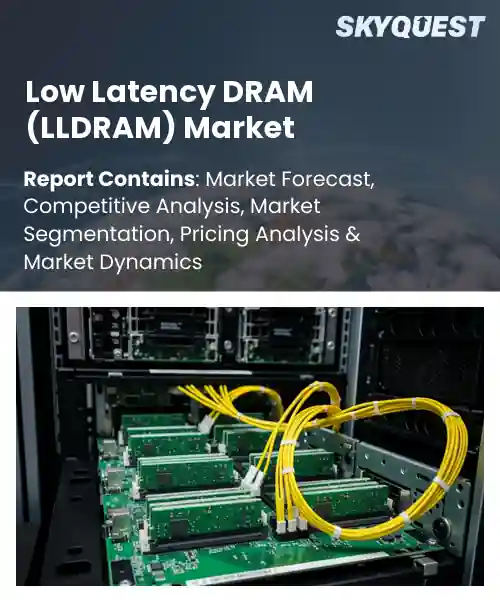
Low Latency DRAM (LLDRAM) Market
Report ID: SQMIG45O2191
Report ID: SQMIG45O2191
[email protected]
USA +1 351-333-4748
Report ID:
SQMIG45O2191 |
Region:
Global |
Published Date: July, 2026
Pages:
157
|Tables:
145
|Figures:
78


Global Low Latency Dram (Lldram) Market size was valued at USD 4.4 Billion in 2024 and is poised to grow from USD 4.9 Billion in 2025 to USD 11.53 Billion by 2033, growing at a CAGR of 11.3% during the forecast period (2026-2033).
The Low Latency DRAM (LLDRAM) market comprises memory modules optimized for sub‑nanosecond access times, targeting high‑performance computing, artificial‑intelligence inference, and financial‑trading platforms. Its relevance stems from the increasing premium placed on real‑time data processing, where every microsecond of delay can translate into revenue loss or missed scientific insight. Historically, the market emerged when server manufacturers paired DDR5 with on‑chip cache controllers to shave response times, and early adopters such as Google’s TPU clusters demonstrated tangible latency reductions.
Over the past five years, supply‑chain investments and fab upgrades have accelerated production, turning a niche component into a strategic commodity for edge‑centric workloads. The dominant growth catalyst for the global LLDRAM market is the surge in AI inferencing at the edge, where reduced latency directly improves model accuracy and user experience. As edge devices migrate from cloud‑dependent designs to autonomous processing, manufacturers integrate LLDRAM to avoid bottlenecks that would otherwise degrade video analytics, autonomous‑vehicle perception, and latency‑sensitive gaming. This shift forces chipset vendors to co‑design memory interfaces, prompting a wave of joint development programs that lower bill‑of‑materials costs while expanding addressable markets. Consequently, data‑center operators now deploy hybrid clusters that pair DDR5 with LLDRAM accelerators, unlocking revenue streams through premium pricing for services.
How is AI-driven automation influencing the growth of the low latency DRAM market?
AI‑driven automation is reshaping the low latency DRAM market by tightening the feedback loop between workload demands and memory supply. As generative models and real‑time inference expand, data‑center operators rely on automated provisioning tools that allocate DRAM in micro‑seconds, ensuring that latency‑critical tasks never stall. Chip designers are using AI‑assisted layout and testing to shave nanoseconds from access paths, while manufacturers respond with faster production cycles that match the rapid scaling of AI clusters. This synergy creates a virtuous cycle: more automation fuels higher performance needs, which in turn drives further investment in ultra‑low latency DRAM solutions.
Samsung announced a new low latency DDR5 module in April 2026, showcasing tighter timing and higher bandwidth that directly supports AI‑driven automation workloads, reinforcing market momentum and efficiency.
Market snapshot - (2026-2033)
Global Market Size
USD 4.4 Billion
Largest Segment
Reduced Latency
Fastest Growth
Pseudo SRAM
Growth Rate
11.3% CAGR
To get more insights on this market click here to Request a Free Sample Report
Global low latency dram (lldram) market is segmented by architecture type, density capacity, interface modality, application, end use industry and region. Based on architecture type, the market is segmented into Reduced Latency, Fast Cycle and Pseudo SRAM. Based on density capacity, the market is segmented into Below 288 Mb, 288 Mb to 576 Mb and Above 576 Mb. Based on interface modality, the market is segmented into CIO Interface and SIO Interface. Based on application, the market is segmented into Packet Buffering, Data Inspection, High Speed Search, Switch Routing and Others. Based on end use industry, the market is segmented into Telecommunications, Cloud Datacenters and Aerospace Defense. Based on region, the market is segmented into North America, Europe, Asia Pacific, Latin America and Middle East & Africa.
Reduced latency segment dominates because it directly targets the core requirement of ultra‑fast data access that defines LLDRAM products. Designers prioritize minimal access times, so architectures that shave off nanoseconds become the default choice for high‑frequency networking and compute workloads. This focus creates strong supplier commitment, extensive IP libraries, and tight integration with timing‑critical silicon, reinforcing its leadership across diverse platforms and emerging edge deployments.
However, Pseudo SRAM segment is witnessing the strongest growth as system architects seek SRAM‑like deterministic latency without the cost of true SRAM. Its hybrid design enables near‑instantaneous reads while maintaining DRAM density, opening new opportunities in packet inspection and high‑speed search functions. This momentum expands the overall LLDRAM addressable market.
CIO interface segment leads because it offers a tightly coupled host‑to‑memory pathway that minimizes protocol overhead and signaling latency. By aligning clock domains and providing deterministic transaction timing, CIO enables real‑time packet buffering and switch routing with predictable performance. This reliability drives adoption in carrier‑grade routers and high‑throughput switches, cementing its position as the preferred connectivity choice for latency‑sensitive LLDRAM deployments across evolving data‑center fabrics and emerging edge compute nodes.
On the other hand, SIO interface segment is expanding rapidly as designers embrace serial high‑speed links to overcome board routing constraints. Its flexible lane aggregation and lower pin count simplify integration with ASICs, unlocking use cases in AI accelerators and hyperscale switches. This applicability fuels market entry and diversifies LLDRAM adoption scenarios.
To get detailed segments analysis, Request a Free Sample Report
The region benefits from a tightly integrated semiconductor ecosystem that combines world‑class foundries, advanced packaging expertise, and vigorous government investment in technology infrastructure. Leading memory manufacturers anchor the supply chain while fostering continuous innovation in process technology and design. High demand from rapidly expanding sectors such as artificial intelligence, high‑performance computing, gaming, and automotive electronics drives relentless pressure for faster, more efficient memory solutions. Collaborative research initiatives and a culture of rapid product rollout further reinforce the region’s ability to set performance benchmarks, positioning Asia Pacific as the primary source of cutting‑edge LLDRAM technologies.
Japan is anchored by strong R&D capabilities within major electronics firms and a robust supply chain that emphasizes precision manufacturing. The country’s focus on automotive electronics and high‑performance computing creates sustained demand for memory solutions that deliver minimal delay. Collaborative efforts between academia and industry accelerate technology transfer, ensuring that Japanese manufacturers remain at the forefront of latency‑optimized DRAM development.
South Korea stems from the presence of globally recognized DRAM producers that consistently push the envelope on process scaling and performance. Aggressive technology roadmaps, coupled with substantial domestic consumption in consumer electronics and data center infrastructure, drive continuous innovation. Export‑oriented strategies and close ties with international chipset designers reinforce South Korea’s role as a pivotal supplier of ultra‑low‑latency memory components.
The continent’s expansion is propelled by a confluence of massive data‑center deployments, the rise of artificial intelligence workloads, and a vibrant ecosystem of technology innovators. Leading cloud service providers and enterprise IT firms prioritize latency‑critical memory to accelerate processing speeds and improve user experiences. Strong venture capital support fuels startups that specialize in high‑performance memory architectures, while academic research centers contribute breakthroughs in device physics. Together, these forces generate robust demand for LLDRAM solutions across sectors ranging from finance to autonomous systems, cementing North America’s position as a fast‑growing market.
United States are driven by the concentration of major cloud providers, semiconductor design houses, and AI research labs that require ultra‑fast memory to sustain computational workloads. The country’s emphasis on high‑performance computing and data‑intensive services fuels continuous adoption of latency‑optimized DRAM. Strong collaboration between industry and research institutions accelerates the translation of emerging memory technologies into commercial products.
Canada is supported by burgeoning AI research clusters, government incentives that encourage technology adoption, and a rising need for high‑speed memory in telecommunications and data‑center operations. The nation’s strategic focus on digital infrastructure and sustainability attracts investment in advanced memory solutions that meet stringent performance criteria while aligning with broader economic objectives.
Europe is enhancing its standing through coordinated policy frameworks that promote semiconductor independence, substantial public‑private partnerships, and a focus on high‑value applications such as automotive safety, aerospace, and scientific computing. Collaborative research networks across the continent drive innovation in low‑latency memory architectures, while industry consortia standardize design practices to accelerate time‑to‑market. Emphasis on energy‑efficient performance and compliance with rigorous regulatory standards positions European manufacturers to capture niche segments that demand reliability and precision.
Germany is closely linked to its world‑renowned automotive sector and advanced industrial automation. The demand for real‑time data processing in vehicle electronics and smart factories drives the adoption of memory solutions that minimize response times. Strong engineering expertise and a dense network of suppliers foster rapid development of latency‑optimized DRAM tailored to high‑precision applications.
United Kingdom benefits from a vibrant fintech ecosystem, cutting‑edge AI research institutions, and expanding data‑center capacity. The need for rapid transaction processing and sophisticated analytics fuels interest in memory that delivers ultra‑low latency. Collaborative initiatives between universities and technology firms accelerate the commercialization of high‑performance DRAM for diverse commercial uses.
France is propelled by strong aerospace and defense programs that require dependable, low‑delay memory for mission‑critical systems. Government support for semiconductor innovation and close ties between research labs and manufacturers foster a conducive environment for advancing latency‑focused DRAM technologies. The emphasis on secure, high‑performance memory aligns with national priorities for technological sovereignty.
To know more about the market opportunities by region and country, click here to
Buy The Complete Report
Increasing Demand for Real‑Time Analytics
Adoption of Edge Computing Frameworks
High Cost of Advanced Memory
Limited Compatibility with Legacy Systems
Request Free Customization of this report to help us to meet your business objectives.
The market is shaped by intense competition among memory leaders leveraging strategic M&A, partnerships, and advanced 3D‑stacked designs to meet AI‑driven demand. SK Hynix, for example, is expanding its custom memory portfolio through collaborations with U.S. customers and recruiting engineers to develop 3D‑stacked DRAM‑on‑logic, while other incumbents accelerate product rollouts to capture latency‑critical workloads.
Recent Developments in the Low Latency DRAM (LLDRAM) Market
SkyQuest’s ABIRAW (Advanced Business Intelligence, Research & Analysis Wing) is our Business Information Services team that Collects, Collates, Correlates, and Analyses the Data collected by means of Primary Exploratory Research backed by robust Secondary Desk research.
As per SkyQuest analysis, the global low latency DRAM (LLDRAM) market growth is being propelled primarily by the rapid expansion of AI‑driven edge computing, which pushes demand for sub‑nanosecond memory to support real‑time inference, while the high cost of advanced memory remains a clear restraint that limits adoption in price‑sensitive segments. The reduced‑latency architecture continues to dominate the segment landscape, delivering the fastest access times that most latency‑critical applications require. Asia Pacific emerges as the dominating region, benefiting from a tightly integrated semiconductor ecosystem and strong governmental support. A second driver is the growing integration of LLDRAM with 3‑D‑stacked architectures, which improves bandwidth and power efficiency across server and accelerator designs.
| Report Metric | Details |
|---|---|
| Market size value in 2024 | USD 4.4 Billion |
| Market size value in 2033 | USD 11.53 Billion |
| Growth Rate | 11.3% |
| Base year | 2024 |
| Forecast period | (2026-2033) |
| Forecast Unit (Value) | USD Billion |
| Segments covered |
|
| Regions covered | North America (US, Canada), Europe (Germany, France, United Kingdom, Italy, Spain, Rest of Europe), Asia Pacific (China, India, Japan, Rest of Asia-Pacific), Latin America (Brazil, Rest of Latin America), Middle East & Africa (South Africa, GCC Countries, Rest of MEA) |
| Companies covered |
|
| Customization scope | Free report customization with purchase. Customization includes:-
|
To get a free trial access to our platform which is a one stop solution for all your data requirements for quicker decision making. This platform allows you to compare markets, competitors who are prominent in the market, and mega trends that are influencing the dynamics in the market. Also, get access to detailed SkyQuest exclusive matrix.
Table Of Content
Executive Summary
Market overview
Parent Market Analysis
Market overview
Market size
KEY MARKET INSIGHTS
COVID IMPACT
MARKET DYNAMICS & OUTLOOK
Market Size by Region
KEY COMPANY PROFILES
Methodology
For the Low Latency DRAM (LLDRAM) Market, our research methodology involved a mixture of primary and secondary data sources. Key steps involved in the research process are listed below:
1. Information Procurement: This stage involved the procurement of Market data or related information via primary and secondary sources. The various secondary sources used included various company websites, annual reports, trade databases, and paid databases such as Hoover's, Bloomberg Business, Factiva, and Avention. Our team did 45 primary interactions Globally which included several stakeholders such as manufacturers, customers, key opinion leaders, etc. Overall, information procurement was one of the most extensive stages in our research process.
2. Information Analysis: This step involved triangulation of data through bottom-up and top-down approaches to estimate and validate the total size and future estimate of the Low Latency DRAM (LLDRAM) Market.
3. Report Formulation: The final step entailed the placement of data points in appropriate Market spaces in an attempt to deduce viable conclusions.
4. Validation & Publishing: Validation is the most important step in the process. Validation & re-validation via an intricately designed process helped us finalize data points to be used for final calculations. The final Market estimates and forecasts were then aligned and sent to our panel of industry experts for validation of data. Once the validation was done the report was sent to our Quality Assurance team to ensure adherence to style guides, consistency & design.
Analyst Support
Customization Options
With the given market data, our dedicated team of analysts can offer you the following customization options are available for the Low Latency DRAM (LLDRAM) Market:
Product Analysis: Product matrix, which offers a detailed comparison of the product portfolio of companies.
Regional Analysis: Further analysis of the Low Latency DRAM (LLDRAM) Market for additional countries.
Competitive Analysis: Detailed analysis and profiling of additional Market players & comparative analysis of competitive products.
Go to Market Strategy: Find the high-growth channels to invest your marketing efforts and increase your customer base.
Innovation Mapping: Identify racial solutions and innovation, connected to deep ecosystems of innovators, start-ups, academics, and strategic partners.
Category Intelligence: Customized intelligence that is relevant to their supply Markets will enable them to make smarter sourcing decisions and improve their category management.
Public Company Transcript Analysis: To improve the investment performance by generating new alpha and making better-informed decisions.
Social Media Listening: To analyze the conversations and trends happening not just around your brand, but around your industry as a whole, and use those insights to make better Marketing decisions.
REQUEST FOR SAMPLE
 REQUEST FREE CUSTOMIZATION
Global Low Latency Dram (Lldram) Market size was valued at USD 4.4 Billion in 2024 and is poised to grow from USD 4.9 Billion in 2025 to USD 11.53 Billion by 2033, growing at a CAGR of 11.3% during the forecast period (2026-2033).
The LLDRAM market is shaped by intense competition among memory leaders leveraging strategic M&A, partnerships, and advanced 3D‑stacked designs to meet AI‑driven demand. SK Hynix, for example, is expanding its custom memory portfolio through collaborations with U.S. customers and recruiting engineers to develop 3D‑stacked DRAM‑on‑logic, while other incumbents accelerate product rollouts to capture latency‑critical workloads. 'GSI Technology Inc', 'Samsung Electronics Co Ltd', 'SK Hynix Inc', 'Micron Technology Inc', 'Nanya Technology Corporation', 'Winbond Electronics Corporation', 'Macronix International Co Ltd', 'Elite Semiconductor Microelectronics Technology Inc', 'Alliance Memory Inc', 'Integrated Silicon Solution Inc', 'ISSI', 'Renesas Electronics Corporation', 'Infineon Technologies AG', 'Cypress Semiconductor Corp', 'Fujitsu Semiconductor Limited', 'Sony Group Corporation', 'Toshiba Corporation', 'Intel Corporation', 'Broadcom Inc', 'Marvell Technology Inc'
Enterprises across finance, telecommunications, and autonomous vehicle sectors require instantaneous processing of massive data streams, prompting a shift toward memory solutions that minimize access delays. Low latency DRAM delivers the speed needed to sustain high‑frequency transactions and rapid decision‑making, thereby enhancing system responsiveness and operational efficiency. As organizations prioritize real‑time insights to maintain competitive advantage, they increasingly adopt LLDRAM architectures, fostering market expansion through heightened demand for performance‑critical applications. This trend also encourages hardware vendors to integrate LLDRAM into next‑generation platforms, reinforcing the technology’s relevance across diverse use cases.
Ai‑Driven Edge Computing Surge: The rapid expansion of artificial intelligence workloads at the network edge is driving demand for memory that can deliver sub‑microsecond response times. Developers are integrating sophisticated inference models directly into devices, requiring DRAM that minimizes latency while maintaining power efficiency. This shift enables real‑time analytics, autonomous decision‑making, and enhanced user experiences across industries such as automotive, robotics, and telecommunications, positioning low‑latency DRAM as a critical enabler for the next generation of edge AI solutions in increasingly data‑intensive environments worldwide today.
Why does Asia Pacific Dominate the Global Low Latency DRAM (LLDRAM) Market? |@12


Want to customize this report? This report can be personalized according to your needs. Our analysts and industry experts will work directly with you to understand your requirements and provide you with customized data in a short amount of time. We offer $1000 worth of FREE customization at the time of purchase.
Feedback From Our Clients


 USA (+1) 351-333-4748

