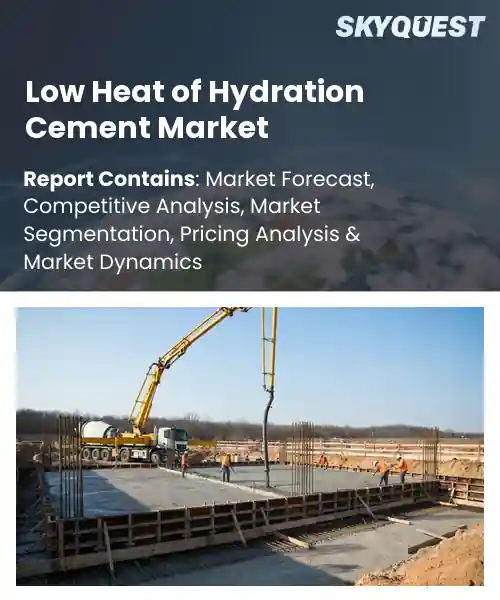
Low Heat of Hydration Cement Market
Report ID: SQMIG15F2438
Report ID: SQMIG15F2438
[email protected]
USA +1 351-333-4748
Report ID:
SQMIG15F2438 |
Region:
Global |
Published Date: August, 2026
Pages:
157
|Tables:
144
|Figures:
78


Global Low Heat Of Hydration Cement Market size was valued at USD 2.41 Billion in 2024 and is poised to grow from USD 2.54 Billion in 2025 to USD 3.81 Billion by 2033, growing at a CAGR of 5.2% during the forecast period (2026-2033).
The low heat of hydration cement market supplies specially formulated binders that release significantly less thermal energy during the setting process, a characteristic essential for massive concrete pours such as dams, nuclear cores and deep foundations. By limiting temperature rise, these cements reduce the risk of thermal cracking, extending service life and lowering maintenance costs.
Over the last two decades, adoption accelerated across the Middle East and Southeast Asia, where mega‑projects demand durability under harsh climatic conditions. Rising environmental regulations now act as a catalyst for market growth because low‑heat cements reduce the carbon footprint of massive concrete works by eliminating the need for supplementary cooling and extensive repairs. This efficiency cut operational costs on projects such as the Three Gorges reservoir expansion, where the cement’s lower heat output minimized temperature differentials and removed expensive thermal‑stress mitigation. Simultaneously, green‑construction incentives in Europe and China push developers toward low‑heat blends, creating a steady flow of contracts for specialized producers. Consequently, firms that invest in advanced admixtures and expand capacity can capture emerging demand while supporting global sustainability goals.
How is AI-driven formulation optimization impacting the low-heat-of-hydration cement market?
AI‑driven formulation optimization is reshaping the low‑heat‑of‑hydration cement market by replacing traditional trial‑and‑error with data‑rich predictive tools. Machine‑learning models analyze raw material properties, hydration kinetics and environmental conditions to suggest mix ratios that achieve slower temperature rise while maintaining strength. This approach shortens development cycles, cuts material waste and enables engineers to tailor blends for large infrastructure projects where thermal control is critical. Recent pilot programs have demonstrated that AI can identify alternative pozzolans and supplementary cementitious materials that lower heat release without compromising durability. As adoption spreads, manufacturers gain confidence that digital mix design can deliver consistent performance across diverse climates.
In June 2024, a leading cement producer launched an AI‑guided low‑heat cement blend, accelerating project timelines and reducing thermal cracking risk, demonstrating how digital formulation drives efficiency and supports market growth. The new mix leverages real‑time sensor data and machine‑learning predictions to fine‑tune binder ratios, delivering consistent low temperature profiles across varied construction sites.
Market snapshot - (2026-2033)
Global Market Size
USD 2.41 Billion
Largest Segment
Portland Low Heat Cement
Fastest Growth
Blended Low Heat Cement
Growth Rate
5.2% CAGR
To get more insights on this market click here to Request a Free Sample Report
Global low heat of hydration cement market is segmented by product type, strength grade, application, end user, distribution channel and region. Based on product type, the market is segmented into Portland Low Heat Cement and Blended Low Heat Cement. Based on strength grade, the market is segmented into Below 40 MPa, 40–60 MPa and Above 60 MPa. Based on application, the market is segmented into Dams & Reservoirs, Bridges & Marine Structures, Nuclear Power Plants, Mass Concrete Foundations and Tunnels & Underground Structures. Based on end user, the market is segmented into Infrastructure Contractors, Industrial Construction Companies and Government & Public Agencies. Based on distribution channel, the market is segmented into Direct Sales and Distributors & Dealers. Based on region, the market is segmented into North America, Europe, Asia Pacific, Latin America and Middle East & Africa.
Blended Low Heat Cement segment dominates because its formula incorporates industrial by‑products such as fly ash or slag, which replace a portion of traditional clinker and thus lower the embodied carbon of the mix. The reduced clinker demand not only cuts greenhouse gas emissions but also improves workability and long‑term durability, making it a preferred choice for environmentally conscious specifications. These attributes foster broader acceptance among designers seeking to meet stringent sustainability targets while maintaining essential thermal control.
However, blended low heat cement emerges as the fastest growing area because its incorporation of supplementary materials enhances sustainability and reduces carbon footprints. This appeals to environmentally conscious stakeholders and aligns with green construction standards, encouraging wider adoption in projects seeking both thermal control and eco‑friendly credentials, thereby expanding market opportunities.
Below 40 MPa segment dominates because its lower strength formulation inherently limits heat generation, making it ideal for voluminous pours where thermal cracking is a primary concern. The reduced cement content simplifies mix designs and curtails heat of hydration, fostering confidence among engineers to specify it for massive structures that prioritize thermal safety over early strength, especially in regions with limited cooling infrastructure and where long‑term durability is paramount.
Meanwhile, high performance 40–60 MPa range experiences rapid expansion because it balances adequate early strength with moderated heat evolution, meeting the evolving design criteria of complex structures. Advances in admixture technology enable temperature control while delivering strength, attracting projects that demand both structural robustness and thermal management, thus propelling market growth.
To get detailed segments analysis, Request a Free Sample Report
Asia Pacific leads the global low heat of hydration cement market due to a confluence of advanced manufacturing capabilities, strong demand from large‑scale infrastructure projects, and early adoption of sustainable construction practices. The region benefits from a deep pool of technical expertise and a robust supply chain that supports the production of specialty cement blends with controlled thermal profiles. Strategic collaborations between cement producers and research institutions accelerate product innovation, while government incentives promote the use of low‑heat materials in high‑rise and mass concrete applications. Moreover, the presence of major construction hubs in Japan and South Korea creates a feedback loop of demand and refinement, reinforcing the region’s position as a benchmark for quality and performance in low heat cement solutions.
Low Heat of Hydration Cement Market in Japan is propelled by stringent building codes that prioritize durability and thermal stability in seismic zones. Local manufacturers leverage sophisticated kiln technologies to fine‑tune cement chemistry, delivering products that mitigate temperature rise in massive pours. Collaborative research with universities fosters continuous improvement, while major infrastructure programs adopt low‑heat solutions to enhance structural longevity and reduce cracking risk, reinforcing Japan’s reputation for high‑performance cement.
Low Heat of Hydration Cement Market in South Korea benefits from a regulatory environment that encourages the use of responsible construction materials. Domestic producers integrate advanced process controls to achieve precise heat‑release characteristics, supporting the nation’s extensive high‑rise and tunnel projects. Strong ties between industry and universities accelerate knowledge transfer, while pilot projects showcase the advantages of low‑heat cement in reducing thermal stress and extending service life of critical infrastructure.
Europe’s rapid expansion of the low heat of hydration cement market is anchored in rigorous environmental standards, a mature construction sector, and a strong emphasis on durability in large‑scale civil works. Policy frameworks across the region incentivize the adoption of low‑heat solutions to lower carbon footprints and mitigate thermal cracking in massive concrete structures such as bridges and tunnels. Collaborative networks among cement producers, research institutes, and engineering firms accelerate the development of tailored blends that meet both performance and sustainability criteria. The presence of leading construction firms that prioritize innovative material usage further fuels demand, while the region’s focus on circular economy principles drives continuous improvement in cement manufacturing processes, reinforcing Europe’s position as a hub for advanced low‑heat cement technologies.
Low Heat of Hydration Cement Market in Germany is shaped by stringent energy‑efficiency regulations that demand high performance from concrete in residential and industrial projects. German manufacturers employ precision engineering and digital monitoring to control heat evolution, ensuring structural integrity in deep foundations and large‑scale infrastructure. Cooperation with universities drives refinement of cement chemistry, while construction consortia adopt low‑heat products to meet sustainability targets and extend service life of assets.
Low Heat of Hydration Cement Market in United Kingdom is experiencing accelerated adoption driven by policies and a surge in high‑rise residential developments. British firms prioritize low‑heat cement to mitigate thermal cracking in deep‑pile foundations and to meet sustainability certifications. Partnerships with research councils enable testing of blends, while infrastructure programs integrate low‑heat solutions to improve durability and reduce emissions, positioning United Kingdom as a leading growth market in Europe.
Low Heat of Hydration Cement Market in France is emerging as manufacturers respond to demand for durable, low‑temperature concrete in public works and renewable energy infrastructure. French producers combine expertise with process controls to deliver cement that limits heat generation, supporting construction of long‑span bridges and offshore wind foundations. Initiatives with engineering schools foster innovation, while government incentives encourage adoption of low‑heat solutions to improve lifecycle performance and environmental compliance.
North America is reinforcing its position in the low heat of hydration cement market through a combination of advanced manufacturing investments, strong demand from infrastructure renewal projects, and a regulatory focus on reducing thermal cracking in large concrete pours. Industry leaders are integrating digital analytics and real‑time monitoring to fine‑tune cement formulations, delivering consistent low‑heat performance across diverse climate zones. Collaboration with research universities accelerates the development of high‑efficiency blends that meet stringent durability criteria. Government programs that prioritize resilient construction and lower carbon footprints further stimulate adoption, while major contractors incorporate low‑heat cement to extend service life of bridges, tunnels, and high‑rise structures, cementing the region’s reputation for innovation and reliability in this specialized segment and across the continent.
Low Heat of Hydration Cement Market in United States is driven by high‑rise construction and infrastructure renewal that demand cement with controlled thermal profiles. American producers leverage advanced kiln technologies and data‑driven quality systems to ensure consistent low‑heat performance, supporting deep foundations and long‑span bridge projects. Partnerships with research labs foster rapid development of blends, while sustainability guidelines encourage adoption of low‑heat solutions to enhance durability and reduce lifecycle emissions.
Low Heat of Hydration Cement Market in Canada is shaped by emphasis on cold‑climate construction and durable concrete for remote infrastructure. Canadian manufacturers adopt precise temperature‑control processes to produce cement that minimizes heat buildup, essential for long‑duration pours in harsh environments. Collaboration with Arctic research institutes drives blends optimized for low‑temperature performance, while federal sustainability programs promote low‑heat cement to extend service life of bridges, pipelines, and critical public facilities.
To know more about the market opportunities by region and country, click here to
Buy The Complete Report
Growing Adoption of Low-Heat Cement
Increasing Focus on Sustainable Construction
Higher Production Costs Present Challenge
Limited Awareness Among Stakeholders
Request Free Customization of this report to help us to meet your business objectives.
The market is shaped by intense competition among major cement producers who are pursuing mergers and acquisitions, strategic partnerships with research institutes, and technology innovations such as advanced clinker formulations and supplementary cementitious materials to reduce hydration heat and meet sustainability targets.
Recent Developments
SkyQuest’s ABIRAW (Advanced Business Intelligence, Research & Analysis Wing) is our Business Information Services team that Collects, Collates, Correlates, and Analyses the Data collected by means of Primary Exploratory Research backed by robust Secondary Desk research.
As per SkyQuest analysis, the market is propelled primarily by the growing adoption of low‑heat cement as engineers seek to curb thermal cracking in massive pours, while a second major catalyst is the heightened focus on sustainable construction that rewards low‑carbon blends. The Asia Pacific region leads the market due to its large infrastructure pipeline and early uptake of green practices, and within the product mix the blended low‑heat cement segment dominates because it substitutes clinker with fly ash or slag, lowering both heat and emissions. However, higher production costs remain a restraint, limiting price competitiveness and slowing broader acceptance in cost‑sensitive markets.
| Report Metric | Details |
|---|---|
| Market size value in 2024 | USD 2.41 Billion |
| Market size value in 2033 | USD 3.81 Billion |
| Growth Rate | 5.2% |
| Base year | 2024 |
| Forecast period | (2026-2033) |
| Forecast Unit (Value) | USD Billion |
| Segments covered |
|
| Regions covered | North America (US, Canada), Europe (Germany, France, United Kingdom, Italy, Spain, Rest of Europe), Asia Pacific (China, India, Japan, Rest of Asia-Pacific), Latin America (Brazil, Rest of Latin America), Middle East & Africa (South Africa, GCC Countries, Rest of MEA) |
| Companies covered |
|
| Customization scope | Free report customization with purchase. Customization includes:-
|
To get a free trial access to our platform which is a one stop solution for all your data requirements for quicker decision making. This platform allows you to compare markets, competitors who are prominent in the market, and mega trends that are influencing the dynamics in the market. Also, get access to detailed SkyQuest exclusive matrix.
Table Of Content
Executive Summary
Market overview
Parent Market Analysis
Market overview
Market size
KEY MARKET INSIGHTS
COVID IMPACT
MARKET DYNAMICS & OUTLOOK
Market Size by Region
KEY COMPANY PROFILES
Methodology
For the Low Heat of Hydration Cement Market, our research methodology involved a mixture of primary and secondary data sources. Key steps involved in the research process are listed below:
1. Information Procurement: This stage involved the procurement of Market data or related information via primary and secondary sources. The various secondary sources used included various company websites, annual reports, trade databases, and paid databases such as Hoover's, Bloomberg Business, Factiva, and Avention. Our team did 45 primary interactions Globally which included several stakeholders such as manufacturers, customers, key opinion leaders, etc. Overall, information procurement was one of the most extensive stages in our research process.
2. Information Analysis: This step involved triangulation of data through bottom-up and top-down approaches to estimate and validate the total size and future estimate of the Low Heat of Hydration Cement Market.
3. Report Formulation: The final step entailed the placement of data points in appropriate Market spaces in an attempt to deduce viable conclusions.
4. Validation & Publishing: Validation is the most important step in the process. Validation & re-validation via an intricately designed process helped us finalize data points to be used for final calculations. The final Market estimates and forecasts were then aligned and sent to our panel of industry experts for validation of data. Once the validation was done the report was sent to our Quality Assurance team to ensure adherence to style guides, consistency & design.
Analyst Support
Customization Options
With the given market data, our dedicated team of analysts can offer you the following customization options are available for the Low Heat of Hydration Cement Market:
Product Analysis: Product matrix, which offers a detailed comparison of the product portfolio of companies.
Regional Analysis: Further analysis of the Low Heat of Hydration Cement Market for additional countries.
Competitive Analysis: Detailed analysis and profiling of additional Market players & comparative analysis of competitive products.
Go to Market Strategy: Find the high-growth channels to invest your marketing efforts and increase your customer base.
Innovation Mapping: Identify racial solutions and innovation, connected to deep ecosystems of innovators, start-ups, academics, and strategic partners.
Category Intelligence: Customized intelligence that is relevant to their supply Markets will enable them to make smarter sourcing decisions and improve their category management.
Public Company Transcript Analysis: To improve the investment performance by generating new alpha and making better-informed decisions.
Social Media Listening: To analyze the conversations and trends happening not just around your brand, but around your industry as a whole, and use those insights to make better Marketing decisions.
REQUEST FOR SAMPLE
 REQUEST FREE CUSTOMIZATION
Global Low Heat Of Hydration Cement Market size was valued at USD 2.41 Billion in 2024 and is poised to grow from USD 2.54 Billion in 2025 to USD 3.81 Billion by 2033, growing at a CAGR of 5.2% during the forecast period (2026-2033).
The market is shaped by intense competition among major cement producers who are pursuing mergers and acquisitions, strategic partnerships with research institutes, and technology innovations such as advanced clinker formulations and supplementary cementitious materials to reduce hydration heat and meet sustainability targets. 'Holcim Ltd.', 'Heidelberg Materials AG', 'Cemex, S.A.B. de C.V.', 'CRH plc', 'Buzzi S.p.A.', 'Votorantim Cimentos S.A.', 'UltraTech Cement Limited', 'Shree Cement Limited', 'Dalmia Bharat Limited', 'JK Cement Limited', 'Taiheiyo Cement Corporation', 'Taiwan Cement Corporation', 'Anhui Conch Cement Company Limited', 'China National Building Material Co., Ltd.', 'China Resources Building Materials Technology Holdings Limited', 'Asia Cement Corporation', 'Adani Cement Limited', 'Nuvoco Vistas Corporation Limited', 'Dangote Cement Plc', 'Vicat S.A.'
The rising emphasis on energy‑efficient buildings drives architects and contractors to select low‑heat of hydration cement, which reduces thermal cracking and lowers cooling loads, thereby extending service life of structures while meeting green building certifications. This material aligns with evolving codes that prioritize reduced carbon footprints, encouraging its integration in residential and commercial projects. Consequently, the market benefits from heightened awareness of sustainable construction practices, fostering broader acceptance and encouraging manufacturers to expand product portfolios to satisfy this growing demand.
Carbon‑Neutral Mixes Expansion: The industry is rapidly integrating low‑heat cement into carbon‑neutral concrete blends, driven by stringent emissions regulations and green‑building certifications. Manufacturers are reformulating formulations to combine supplementary cementitious materials with low‑heat clinker, achieving comparable strength while markedly reducing heat evolution and CO2 footprint. This shift enables large‑scale infrastructure projects to meet sustainability targets without sacrificing durability, prompting developers to prioritize suppliers that demonstrate verifiable low‑carbon performance throughout the material lifecycle and contribute to climate resilience strategies across regions and societal benefits.
Why does Asia Pacific Dominate the Global Low Heat of Hydration Cement Market? |@12


Want to customize this report? This report can be personalized according to your needs. Our analysts and industry experts will work directly with you to understand your requirements and provide you with customized data in a short amount of time. We offer $1000 worth of FREE customization at the time of purchase.
Feedback From Our Clients


 USA (+1) 351-333-4748

