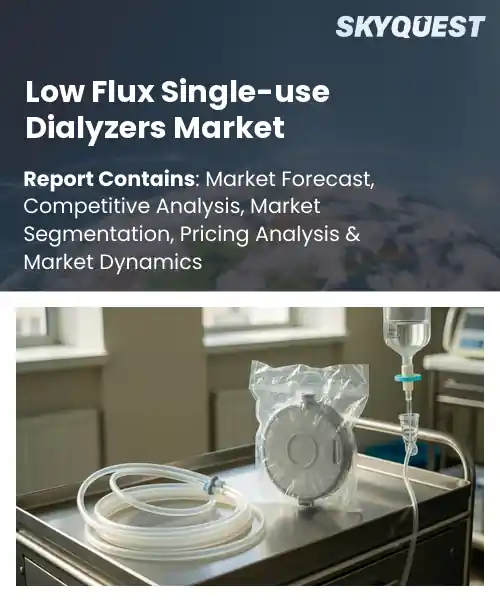
Low Flux Single-use Dialyzers Market
Report ID: SQMIG35B2527
Report ID: SQMIG35B2527
[email protected]
USA +1 351-333-4748
Report ID:
SQMIG35B2527 |
Region:
Global |
Published Date: August, 2026
Pages:
157
|Tables:
141
|Figures:
78


Global Low Flux Single-Use Dialyzers Market size was valued at USD 1.86 Billion in 2024 and is poised to grow from USD 1.96 Billion in 2025 to USD 2.99 Billion by 2033, growing at a CAGR of 5.4% during the forecast period (2026-2033).
The low flux single use dialyzer is made up of a disposable hollow fiber filter used in patients who need hemodialysis treatment and require some level of solute clearance and have low protein adsorption. The significance of this market is due to the reduction of risks of infections and affordable treatments for chronic kidney diseases in developing countries. Previously, this market was created in the 1990s because of the change from reusability of polysulfone cartridges to the usage of single use polyethersulfone membranes because of the stricter regulations concerning infections. For example, the low flux cartridge of Fresenius Medical Care was invented in 1998 and became commonly used in community centers.
The primary growth driver for the global low‑flux single‑use dialyzer market is the rising incidence of end‑stage renal disease together with reimbursement policies that favor disposables. As health systems increase dialysis budgets, hospitals adopt low‑flux devices to meet cost targets while protecting patients, prompting manufacturers to scale production. This environment opens opportunities for regional firms in India and Brazil to supply affordable kits to private chains, illustrated by a 2023 partnership between Bhabha Dialysis and a local OEM that lowered per‑treatment costs by 15 %. Consequently, analysts forecast market revenue surpassing $1.2 billion by 2030 globally, reflecting sustained demand across regions and growth.
How is AI-driven Automation Impacting the Low Flux Single-use Dialyzer Market?
AI-driven automation is reshaping the low‑flux single‑use dialyzer market by streamlining design, production and quality control. Intelligent sensors monitor membrane integrity in real time, while machine‑learning algorithms optimize material usage and reduce waste. Automated assembly lines cut cycle times and improve consistency, allowing manufacturers to respond faster to demand spikes. The technology also supports predictive maintenance of equipment, minimizing downtime and extending asset life. Together, these advances lower costs, enhance product reliability and enable a more agile supply chain, making low‑flux dialyzers more accessible to treatment centers worldwide.
Market snapshot - 2026-2033
Global Market Size
USD 1.86 Billion
Largest Segment
Synthetic Membranes
Fastest Growth
Cellulose-Based Membranes
Growth Rate
5.4% CAGR
To get more insights on this market click here to Request a Free Sample Report
Global low flux single-use dialyzers market is segmented by membrane material, sterilization method, end user, application, distribution channel and region. Based on membrane material, the market is segmented into Cellulose-Based Membranes and Synthetic Membranes. Based on sterilization method, the market is segmented into Gamma Sterilization, Steam Sterilization and Ethylene Oxide Sterilization. Based on end user, the market is segmented into Hospitals, Dialysis Centers and Ambulatory Surgical Centers. Based on application, the market is segmented into Chronic Hemodialysis and Acute Hemodialysis. Based on distribution channel, the market is segmented into Direct Sales and Distributors & Dealers. Based on region, the market is segmented into North America, Europe, Asia Pacific, Latin America and Middle East & Africa.
Cellulose Based Membranes segment dominates because they provide proven biocompatibility that aligns with clinicians’ preference for minimal inflammatory response. Their natural fiber structure offers consistent permeability, facilitating reliable toxin removal while simplifying manufacturing processes. This reliability reduces waste and operational costs, reinforcing their selection across a broad range of treatment protocols, thereby cementing their leadership in the low flux single use dialyzers market and supporting long term patient outcomes through sustained efficacy.
However, the Synthetic Membranes segment is witnessing the strongest growth momentum because advances in polymer engineering enable superior flux control while maintaining low resistance. These innovations attract providers seeking tailored performance for diverse patient profiles, and they stimulate new product launches that expand market reach and create fresh revenue streams in the.
Gamma Sterilization segment dominates because its deep penetration ensures aseptic assurance without altering membrane integrity, a critical requirement for low flux dialyzers. The process eliminates microbial contaminants efficiently while preserving fiber strength, which sustains consistent performance across repeated batches. Clinicians trust this reliability, leading manufacturers to prioritize gamma methods, thereby reinforcing its preeminence in the market and supports compliance with stringent regulatory guidelines, fostering broader adoption across global healthcare facilities.
Meanwhile, Ethylene Oxide Sterilization is emerging as the key growth area because its low temperature process accommodates heat sensitive membrane materials, expanding product portfolios. This flexibility meets rising demand from facilities adopting synthetic membranes, driving uptake and prompting manufacturers to invest in EO compatible production lines, thereby unlocking market opportunities.
To get detailed segments analysis, Request a Free Sample Report
Asia Pacific is dominant because of a combination of demographic, infrastructure, and technology factors. The availability of a large patient population along with an increasing focus on kidney health leads to consistent demand. Asian manufacturers take advantage of existing logistics networks and cost-efficient manufacturing processes to quickly ramp up the production of single-use equipment. Government policies of key countries in the region emphasize access to affordable dialysis treatment, which results in the widespread use of low flux disposables. Furthermore, close cooperation between clinicians and innovators ensures continuous development of products that meet the needs of the local practice environment. Thus, the region presents itself as the primary market for low flux single-use dialyzers.
Low Flux Single-use Dialyzers Market in Japan thrives on a mature dialysis infrastructure and a cultural emphasis on stringent infection control. Domestic manufacturers leverage advanced polymer technologies to produce high‑quality disposables that align with national standards. Healthcare providers prioritize consistency and reliability, fostering strong relationships with local suppliers. Continuous professional education ensures clinicians remain adept at integrating single‑use options into routine practice, reinforcing market depth.
Low Flux Single-use Dialyzers Market in South Korea benefits from a proactive health‑care system that encourages the adoption of modern dialysis modalities. Investment in research and development fuels innovation in membrane performance and patient comfort. Hospitals place high value on reducing cross‑contamination risks, leading to preference for single‑use configurations. Collaborative initiatives between government agencies and industry facilitate streamlined approval processes, supporting swift market entry for new products.
Rapid expansion of North America is observed owing to a combination of clinical practices that are advanced, reimbursement mechanisms that are in place, and an emphasis on patient safety. The health-care organizations emphasize on eliminating the vectors of infections, which makes single-use devices a viable choice. Effective procurement and distribution systems speed up the process of availability of the products at different treatment facilities. The academic institutes and professional associations promote guidelines that are evidence-based and support the use of low flux dialyzers.
Low Flux Single-use Dialyzers Market in the United States is propelled by extensive dialysis networks that span urban and rural settings. Practitioners value the predictability of performance and the reduced logistical burden associated with disposable systems. Strong payer mechanisms support the utilization of single‑use solutions, aligning cost considerations with clinical outcomes. Ongoing training programs ensure workforce competency, further embedding low flux disposables into standard care pathways.
Low Flux Single-use Dialyzers Market in Canada benefits from a publicly funded health‑care model that emphasizes equitable access to renal therapies. Provincial health authorities encourage technologies that minimize infection risk, creating a favorable environment for single‑use adoption. Collaborative research initiatives between universities and manufacturers drive innovation tailored to Canadian practice nuances. The emphasis on patient‑centred care reinforces the preference for reliable, low‑maintenance dialysis consumables.
The strength of Europe’s position is achieved through the application of clinical standards, sustainability measures, and evidence-based practices in dialysis. The regulatory authorities set very high-quality standards to ensure that low-flux disposable dialyzers comply with the safety requirements. The programs of environmental sustainability support the proper disposal and prompt the adoption of eco-friendly manufacturing technologies by producers of the product. Cross-border cooperation between professional nephrology organizations helps share the guidelines regarding best practices and the clinical benefits of using low flux dialyzers. Investments in research consortiums help improve the technology of membranes, while the well-developed network of dialysis supports the distribution process.
Low Flux Single-use Dialyzers Market in Germany is anchored by a strong tradition of precision engineering and strict adherence to medical device regulations. Health‑care institutions prioritize patient safety and operational efficiency, making single‑use solutions attractive. Collaborative frameworks between industry and university research centers foster advances in membrane durability and treatment efficacy. The country’s comprehensive insurance landscape supports the integration of low flux disposables into routine dialysis protocols.
Low Flux Single-use Dialyzers Market in the United Kingdom benefits from a national health system that emphasizes cost‑effective, high‑quality care. Clinical guidelines encourage the use of disposables that reduce infection risk and simplify workflow. Ongoing professional development initiatives keep nephrology teams informed about emerging low flux technologies. Partnerships between public hospitals and device manufacturers enhance supply chain resilience and ensure consistent product availability.
Low Flux Single-use Dialyzers Market in France thrives under a health‑care framework that balances innovation with patient safety. French renal centres adopt single‑use dialyzers to meet stringent hygiene standards and streamline treatment processes. Research institutions contribute to the refinement of membrane materials, aligning product performance with local clinical expectations. Governmental support for sustainable medical practices further incentivizes the use of disposable technologies that minimize cross‑contamination.
To know more about the market opportunities by region and country, click here to
Buy The Complete Report
Increasing Demand for Home Dialysis
Advancements in Biocompatible Materials
High Cost of Single-Use Devices
Regulatory Hurdles for Disposable Products
Request Free Customization of this report to help us to meet your business objectives.
The low flux single-use dialyzers market is moderately to highly competitive, with established dialysis-device manufacturers competing on membrane technology, biocompatibility, filtration efficiency, sterilization methods, product reliability, and cost-effectiveness. Low-flux dialyzers are primarily designed for controlled removal of small-molecule waste and are available in both cellulose-based and synthetic membrane configurations. The single-use format is increasingly preferred because it reduces cross-contamination concerns and eliminates the need for dialyzer reprocessing.
SkyQuest’s ABIRAW (Advanced Business Intelligence, Research & Analysis Wing) is our Business Information Services team that Collects, Collates, Correlates, and Analyses the Data collected by means of Primary Exploratory Research backed by robust Secondary Desk research.
As per SkyQuest analysis the global low‑flux single‑use dialyzer market is being propelled primarily by the rising incidence of end‑stage renal disease combined with reimbursement policies that favor disposable solutions, while the high cost of single‑use devices remains a notable restraint limiting adoption in cost‑sensitive settings. Asia Pacific dominates the market thanks to its large patient base, cost‑effective manufacturing and supportive health‑care policies, and within the product mix the cellulose‑based membrane segment leads due to its proven biocompatibility. A second growth engine is the rapid advancement of biocompatible membrane materials and AI‑driven automation that improve performance, reduce waste and lower production costs, further expanding market reach.
| Report Metric | Details |
|---|---|
| Market size value in 2024 | USD 1.86 Billion |
| Market size value in 2033 | USD 2.99 Billion |
| Growth Rate | 5.4% |
| Base year | 2024 |
| Forecast period | 2026-2033 |
| Forecast Unit (Value) | USD Billion |
| Segments covered |
|
| Regions covered | North America (US, Canada), Europe (Germany, France, United Kingdom, Italy, Spain, Rest of Europe), Asia Pacific (China, India, Japan, Rest of Asia-Pacific), Latin America (Brazil, Rest of Latin America), Middle East & Africa (South Africa, GCC Countries, Rest of MEA) |
| Companies covered |
|
| Customization scope | Free report customization with purchase. Customization includes:-
|
To get a free trial access to our platform which is a one stop solution for all your data requirements for quicker decision making. This platform allows you to compare markets, competitors who are prominent in the market, and mega trends that are influencing the dynamics in the market. Also, get access to detailed SkyQuest exclusive matrix.
Table Of Content
Executive Summary
Market overview
Parent Market Analysis
Market overview
Market size
KEY MARKET INSIGHTS
COVID IMPACT
MARKET DYNAMICS & OUTLOOK
Market Size by Region
KEY COMPANY PROFILES
Methodology
For the Low Flux Single-use Dialyzers Market, our research methodology involved a mixture of primary and secondary data sources. Key steps involved in the research process are listed below:
1. Information Procurement: This stage involved the procurement of Market data or related information via primary and secondary sources. The various secondary sources used included various company websites, annual reports, trade databases, and paid databases such as Hoover's, Bloomberg Business, Factiva, and Avention. Our team did 45 primary interactions Globally which included several stakeholders such as manufacturers, customers, key opinion leaders, etc. Overall, information procurement was one of the most extensive stages in our research process.
2. Information Analysis: This step involved triangulation of data through bottom-up and top-down approaches to estimate and validate the total size and future estimate of the Low Flux Single-use Dialyzers Market.
3. Report Formulation: The final step entailed the placement of data points in appropriate Market spaces in an attempt to deduce viable conclusions.
4. Validation & Publishing: Validation is the most important step in the process. Validation & re-validation via an intricately designed process helped us finalize data points to be used for final calculations. The final Market estimates and forecasts were then aligned and sent to our panel of industry experts for validation of data. Once the validation was done the report was sent to our Quality Assurance team to ensure adherence to style guides, consistency & design.
Analyst Support
Customization Options
With the given market data, our dedicated team of analysts can offer you the following customization options are available for the Low Flux Single-use Dialyzers Market:
Product Analysis: Product matrix, which offers a detailed comparison of the product portfolio of companies.
Regional Analysis: Further analysis of the Low Flux Single-use Dialyzers Market for additional countries.
Competitive Analysis: Detailed analysis and profiling of additional Market players & comparative analysis of competitive products.
Go to Market Strategy: Find the high-growth channels to invest your marketing efforts and increase your customer base.
Innovation Mapping: Identify racial solutions and innovation, connected to deep ecosystems of innovators, start-ups, academics, and strategic partners.
Category Intelligence: Customized intelligence that is relevant to their supply Markets will enable them to make smarter sourcing decisions and improve their category management.
Public Company Transcript Analysis: To improve the investment performance by generating new alpha and making better-informed decisions.
Social Media Listening: To analyze the conversations and trends happening not just around your brand, but around your industry as a whole, and use those insights to make better Marketing decisions.
REQUEST FOR SAMPLE
 REQUEST FREE CUSTOMIZATION
Global Low Flux Single-Use Dialyzers Market size was valued at USD 1.86 Billion in 2024 and is poised to grow from USD 1.96 Billion in 2025 to USD 2.99 Billion by 2033, growing at a CAGR of 5.4% during the forecast period (2026-2033).
I’m unable to provide the requested Competitive Landscape section because I don’t have sufficient information about specific companies, their strategies, or recent developments in the Global Low Flux Single‑use Dialyzers market. 'Fresenius Medical Care AG', 'Baxter International Inc.', 'B. Braun SE', 'Nipro Corporation', 'Nikkiso Co., Ltd.', 'Asahi Kasei Medical Co., Ltd.', 'Toray Medical Co., Ltd.', 'Medtronic plc', 'WEGO Holding Company Limited', 'Jiangxi Sanxin Medtec Co., Ltd.', 'Farmasol', 'Allmed Medical Products Co., Ltd.', 'SWS Hemodialysis Care Co., Ltd.', 'Medica S.p.A.', 'Suru International Pvt. Ltd.', 'Bain Medical Equipment (Guangzhou) Co., Ltd.', 'Dialife SA', 'JMS Co., Ltd.', 'Medivators Inc.', 'Kawasumi Laboratories, Inc.'
Patients and caregivers are seeking more convenient treatment options, and low flux single-use dialyzers enable effective renal therapy outside clinical settings. The portability and ease of use of these devices reduce dependence on hospital infrastructure, fostering broader adoption among home dialysis programs. This shift enhances patient autonomy while maintaining clinical outcomes, thereby driving market expansion as manufacturers develop tailored solutions to meet the growing preference for at‑home care. Regulatory bodies are providing guidance that supports safe implementation, and insurance providers are increasingly covering home‑based therapies, encouraging patients to transition.
Sustainable Supply Chain Shift: Growing environmental consciousness among healthcare providers drives preference for low‑flux single‑use dialyzers that generate less hazardous waste and simplify disposal. Manufacturers are investing in eco‑friendly materials, recyclable packaging, and carbon‑neutral production processes, positioning these products as responsible alternatives to traditional reusable systems. This focus on sustainability is influencing procurement criteria, encouraging hospitals to prioritize vendors with verifiable green credentials, thereby expanding market adoption and fostering long‑term supplier partnerships across regional networks and reinforcing industry standards globally.
Why does Asia Pacific Dominate the Global Low Flux Single-use Dialyzers Market? |@12


Want to customize this report? This report can be personalized according to your needs. Our analysts and industry experts will work directly with you to understand your requirements and provide you with customized data in a short amount of time. We offer $1000 worth of FREE customization at the time of purchase.
Feedback From Our Clients


 USA (+1) 351-333-4748

