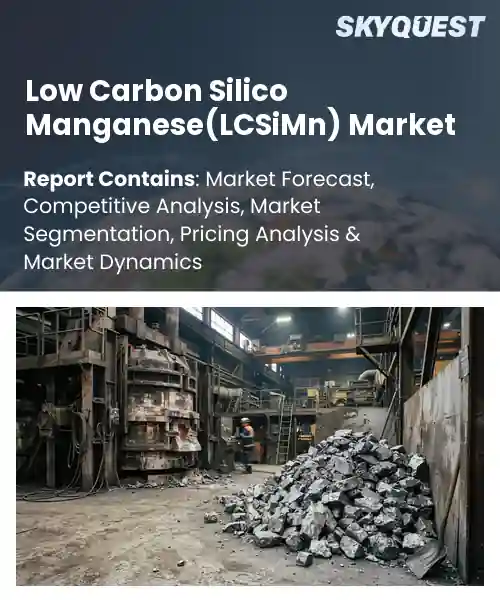
Low Carbon Silico Manganese(LCSiMn) Market
Report ID: SQMIG15J2243
Report ID: SQMIG15J2243
[email protected]
USA +1 351-333-4748
Report ID:
SQMIG15J2243 |
Region:
Global |
Published Date: August, 2026
Pages:
157
|Tables:
146
|Figures:
78


Global Low Carbon Silico Manganese(Lcsimn) Market size was valued at USD 764.0 Million in 2024 and is poised to grow from USD 828.18 Million in 2025 to USD 1578.91 Million by 2033, growing at a CAGR of 8.4% during the forecast period (2026-2033).
The low‑carbon silico‑manganese (LCSiMn) market supplies a ferro‑alloy that blends manganese, silicon and carbon at carbon levels below 2 % by weight. It matters because tighter emissions standards and steel producers’ drive for cleaner processes make LCSiMn a preferred substitute for high‑carbon silico‑manganese. Demand accelerated after the 2015 Paris Agreement, prompting major players such as South Korea and Brazil to retrofit plants with electric‑arc furnaces and adopt renewable electricity. This transition cut carbon intensity dramatically; a leading Chinese facility reported a 30 % emissions decline from 2018 to 2022, underscoring LCSiMn’s role in the steel sector’s decarbonisation roadmap and global competitiveness for investors. One pivotal growth factor is the expanding demand for steel in automotive and green infrastructure, which requires manganese‑silicon blends with minimal carbon to achieve superior tensile properties. As manufacturers shift toward lightweight vehicle frames and wind‑turbine towers, LCSiMn consumption rises, prompting suppliers to secure contracts with OEMs such as Tesla and Vestas. This chain continues as lower carbon input reduces slag volume, lowering furnace energy consumption and waste disposal costs, thereby improving profit margins for producers. Consequently, investment in green‑smelting projects and strategic alliances between alloy makers and steel mills represents a lucrative opportunity that reshapes the global market landscape.
How is AI-driven automation impacting the low carbon silico manganese market growth?
AI‑driven automation is reshaping the low carbon silico manganese market by streamlining production steps that traditionally required intensive manual oversight. Machine‑learning models predict optimal furnace temperatures, adjust feed rates in real time, and flag anomalies before they cause downtime. This reduces energy consumption, cuts greenhouse‑gas output, and improves overall yield, making low‑carbon processes more economically viable. Plant operators are seeing smoother workflows and faster decision cycles, which encourages investment in greener technologies and expands capacity without proportionally increasing costs. The integration of sensors, predictive analytics, and autonomous controls is turning sustainability goals into operational advantages, accelerating market momentum.In September 2025, a leading producer introduced an AI‑driven furnace control system, which optimizes energy use and reduces carbon emissions, illustrating how automation supports market growth.
Market snapshot - (2026-2033)
Global Market Size
USD 764.0 Million
Largest Segment
Standard Grade
Fastest Growth
Customized Grade
Growth Rate
8.4% CAGR
To get more insights on this market click here to Request a Free Sample Report
Global low carbon silico manganese(lcsimn) market is segmented by grade, production process, application, end user industry, distribution channel and region. Based on grade, the market is segmented into Standard Grade, Premium Grade and Customized Grade. Based on production process, the market is segmented into Electric Arc Furnace and Blast Furnace. Based on application, the market is segmented into Carbon Steel, Stainless Steel, Alloy Steel and Specialty Steel. Based on end user industry, the market is segmented into Automotive, Construction, Machinery & Equipment, Shipbuilding, Energy and Other Industrial Applications. Based on distribution channel, the market is segmented into Direct Sales and Distributors & Traders. Based on region, the market is segmented into North America, Europe, Asia Pacific, Latin America and Middle East & Africa.
Premium Grade segment dominates because producers prioritize low carbon footprints while delivering superior alloy performance, aligning with stringent steelmaker specifications. The high manganese purity and refined silicon content enable consistent deoxidation and grain refinement, reducing defect rates. Consequently, manufacturers gravitate toward premium offerings to meet quality standards and environmental commitments, reinforcing its leading position in the low carbon silico manganese market and fostering long term supplier relationships through collaborative R&D initiatives globally today.
However, Standard Grade segment is witnessing the strongest growth momentum because cost sensitive manufacturers seek affordable low carbon inputs for high volume steel production. Its balance of acceptable purity and reduced pricing encourages broader adoption across commodity grades, spurring demand as producers scale operations and integrate greener materials, thereby propelling market expansion.
Electric Arc Furnace segment leads because it offers precise temperature control and rapid melt cycles, essential for maintaining the low carbon integrity of silico manganese. The process minimizes oxidation of silicon and manganese, preserving the intended composition while reducing energy waste. Its flexibility to incorporate recycled scrap aligns with sustainability targets, making it the preferred choice for manufacturers committed to green steel production and high quality output in today’s competitive landscape globally.
Meanwhile, Blast Furnace segment is emerging as the key high growth area because rising availability of low carbon coke substitutes enables cleaner furnace operations. This adaptation expands capacity for bulk silico manganese production, attracting large steelmakers seeking cost effective scale while meeting emissions benchmarks, thereby unlocking new market opportunities through strategic partnerships globally.
To get detailed segments analysis, Request a Free Sample Report
The region benefits from a confluence of abundant raw material supplies, sophisticated metallurgical expertise, and a deep‑rooted steel manufacturing base that places strong emphasis on emissions reduction. Strategic government initiatives promote low‑carbon technologies and incentivize the adoption of cleaner production processes, while leading automotive and infrastructure sectors demand high‑performance, low‑emission alloys. Collaborative research institutions and integrated supply chains accelerate innovation, allowing manufacturers to rapidly scale environmentally friendly production. This combination of resource availability, policy backing, industrial demand, and technological leadership creates a resilient ecosystem that sustains the region’s dominant market position.
Japan Low Carbon Silico Manganese(LCSiMn) Market
Low Carbon Silico Manganese(LCSiMn) Market in Japan is driven by the country’s rigorous environmental standards and its reliance on advanced high‑strength steel for automotive and construction applications. Domestic producers leverage cutting‑edge processing techniques to align with stringent emissions targets, while close collaboration between industry and research institutes fosters continuous improvement. The emphasis on sustainability and the presence of major steel converters ensure a steady demand for low‑carbon inputs, reinforcing Japan’s role as a pivotal market within the region.
South Korea Low Carbon Silico Manganese(LCSiMn) Market
Low Carbon Silico Manganese(LCSiMn) Market in South Korea is propelled by a strong focus on green steel initiatives and the nation’s expansive shipbuilding and automotive sectors. Government policies encourage the transition to low‑carbon raw materials, prompting manufacturers to adopt cleaner production routes. Advanced engineering capabilities and a dense network of specialty steel producers enable rapid integration of low‑carbon silico manganese, positioning South Korea as a key contributor to the region’s overall market leadership.
Europe’s expansion is anchored by aggressive decarbonisation agendas, stringent emissions regulations, and a mature steel industry eager to transition to greener inputs. Collaborative frameworks between governments, research bodies, and industry leaders accelerate the development and commercialization of low‑carbon technologies. Strong demand from automotive, renewable energy infrastructure, and high‑value alloy applications fuels market momentum, while substantial investment in circular economy practices and recycling enhances resource efficiency. This strategic alignment of policy, innovation, and demand propels Europe’s rapid market growth.
Germany Low Carbon Silico Manganese(LCSiMn) Market
Low Carbon Silico Manganese(LCSiMn) Market in Germany benefits from a well‑established steel manufacturing base and dedicated green‑steel initiatives that prioritize carbon‑neutral production pathways. Robust industrial clusters combine deep expertise with substantial research funding, enabling the scaling of low‑carbon raw material solutions. Close cooperation between major steel producers and technology providers ensures seamless integration, while stringent national environmental targets sustain strong and consistent demand for cleaner silico manganese inputs.
United Kingdom Low Carbon Silico Manganese(LCSiMn) Market
Low Carbon Silico Manganese(LCSiMn) Market in United Kingdom experiences rapid growth due to proactive climate policies and significant investment in low‑carbon manufacturing. The country’s focus on modernising legacy steel facilities, combined with a thriving automotive sector seeking lightweight, low‑emission alloys, creates a dynamic demand environment. Partnerships between academia, industry, and government accelerate technology adoption, positioning the United Kingdom as a fastest‑growing hub for low‑carbon silico manganese.
France Low Carbon Silico Manganese(LCSiMn) Market
Low Carbon Silico Manganese(LCSiMn) Market in France is emerging as a focal point for sustainable alloy production, supported by national incentives for carbon reduction and a growing renewable energy infrastructure. French steelmakers are increasingly incorporating low‑carbon inputs to meet environmental commitments, while collaborative research programs explore innovative processing routes. This supportive policy landscape and progressive industry mindset nurture the early‑stage expansion of the market within France.
North America advances its role through a strategic blend of policy encouragement, substantial capital investment, and a strong tradition of industrial innovation. The region’s extensive steel production capacity aligns with heightened corporate sustainability commitments, prompting a shift toward low‑carbon inputs. Government incentives and tax structures favor the adoption of cleaner technologies, while cross‑border collaboration enhances supply chain resilience. Moreover, growing demand from automotive, infrastructure, and renewable energy projects intensifies the need for environmentally responsible silico manganese, reinforcing the region’s competitive edge.
United States Low Carbon Silico Manganese(LCSiMn) Market
Low Carbon Silico Manganese(LCSiMn) Market in United States is driven by expansive steel manufacturing operations and an overarching emphasis on reducing carbon footprints across industrial sectors. Federal and state initiatives provide financial support for green technology deployment, encouraging producers to integrate low‑carbon silico manganese into their processes. The convergence of robust demand from automotive, construction, and renewable energy markets with a strong innovation ecosystem accelerates adoption and solidifies the United States as a pivotal market.
Canada Low Carbon Silico Manganese(LCSiMn) Market
Low Carbon Silico Manganese(LCSiMn) Market in Canada leverages abundant natural resources and a growing emphasis on renewable energy to foster low‑carbon alloy production. Provincial incentives and national climate objectives motivate steelmakers to transition toward greener raw materials. Collaborative efforts with research institutions focus on optimizing processing efficiencies and reducing emissions, while the country’s commitment to sustainable industrial practices creates a favorable environment for expanding low‑carbon silico manganese usage.
To know more about the market opportunities by region and country, click here to
Buy The Complete Report
Increasing Demand for Green Steel
Policy Support for Low‑Carbon Materials
High Production Energy Requirements
Stringent Environmental Permitting
Request Free Customization of this report to help us to meet your business objectives.
The competitive landscape of the global low‑carbon silico manganese market is shaped by a handful of established producers such as Eramet, Sabayek, Shanhe Special Steel and Jinlin, each leveraging strategic acquisitions and joint ventures to secure low‑carbon feedstock and expand capacity, while investing in advanced smelting technologies to meet stringent emissions standards and differentiate on sustainability.
Top Player’s Company Profile
Recent Developments
SkyQuest’s ABIRAW (Advanced Business Intelligence, Research & Analysis Wing) is our Business Information Services team that Collects, Collates, Correlates, and Analyses the Data collected by means of Primary Exploratory Research backed by robust Secondary Desk research. As per SkyQuest analysis, the global low carbon silico manganese market is being propelled primarily by the rising demand for green steel, as manufacturers seek low‑carbon alloying agents to meet decarbonisation targets. Policy incentives and subsidies for low‑carbon materials further accelerate adoption. However, the energy‑intensive nature of production and high electricity costs can limit competitiveness. Asia Pacific continues to lead the market, driven by abundant raw materials, strong steel bases and supportive government programs. Within the product mix, the premium‑grade segment holds the largest share, offering superior purity and performance that align with stringent steelmaker specifications and is expected to sustain growth through 2033 as demand expands.
| Report Metric | Details |
|---|---|
| Market size value in 2024 | USD 764.0 Million |
| Market size value in 2033 | USD 1578.91 Million |
| Growth Rate | 8.4% |
| Base year | 2024 |
| Forecast period | (2026-2033) |
| Forecast Unit (Value) | USD Million |
| Segments covered |
|
| Regions covered | North America (US, Canada), Europe (Germany, France, United Kingdom, Italy, Spain, Rest of Europe), Asia Pacific (China, India, Japan, Rest of Asia-Pacific), Latin America (Brazil, Rest of Latin America), Middle East & Africa (South Africa, GCC Countries, Rest of MEA) |
| Companies covered |
|
| Customization scope | Free report customization with purchase. Customization includes:-
|
To get a free trial access to our platform which is a one stop solution for all your data requirements for quicker decision making. This platform allows you to compare markets, competitors who are prominent in the market, and mega trends that are influencing the dynamics in the market. Also, get access to detailed SkyQuest exclusive matrix.
Table Of Content
Executive Summary
Market overview
Parent Market Analysis
Market overview
Market size
KEY MARKET INSIGHTS
COVID IMPACT
MARKET DYNAMICS & OUTLOOK
Market Size by Region
KEY COMPANY PROFILES
Methodology
For the Low Carbon Silico Manganese(LCSiMn) Market, our research methodology involved a mixture of primary and secondary data sources. Key steps involved in the research process are listed below:
1. Information Procurement: This stage involved the procurement of Market data or related information via primary and secondary sources. The various secondary sources used included various company websites, annual reports, trade databases, and paid databases such as Hoover's, Bloomberg Business, Factiva, and Avention. Our team did 45 primary interactions Globally which included several stakeholders such as manufacturers, customers, key opinion leaders, etc. Overall, information procurement was one of the most extensive stages in our research process.
2. Information Analysis: This step involved triangulation of data through bottom-up and top-down approaches to estimate and validate the total size and future estimate of the Low Carbon Silico Manganese(LCSiMn) Market.
3. Report Formulation: The final step entailed the placement of data points in appropriate Market spaces in an attempt to deduce viable conclusions.
4. Validation & Publishing: Validation is the most important step in the process. Validation & re-validation via an intricately designed process helped us finalize data points to be used for final calculations. The final Market estimates and forecasts were then aligned and sent to our panel of industry experts for validation of data. Once the validation was done the report was sent to our Quality Assurance team to ensure adherence to style guides, consistency & design.
Analyst Support
Customization Options
With the given market data, our dedicated team of analysts can offer you the following customization options are available for the Low Carbon Silico Manganese(LCSiMn) Market:
Product Analysis: Product matrix, which offers a detailed comparison of the product portfolio of companies.
Regional Analysis: Further analysis of the Low Carbon Silico Manganese(LCSiMn) Market for additional countries.
Competitive Analysis: Detailed analysis and profiling of additional Market players & comparative analysis of competitive products.
Go to Market Strategy: Find the high-growth channels to invest your marketing efforts and increase your customer base.
Innovation Mapping: Identify racial solutions and innovation, connected to deep ecosystems of innovators, start-ups, academics, and strategic partners.
Category Intelligence: Customized intelligence that is relevant to their supply Markets will enable them to make smarter sourcing decisions and improve their category management.
Public Company Transcript Analysis: To improve the investment performance by generating new alpha and making better-informed decisions.
Social Media Listening: To analyze the conversations and trends happening not just around your brand, but around your industry as a whole, and use those insights to make better Marketing decisions.
REQUEST FOR SAMPLE
 REQUEST FREE CUSTOMIZATION


Want to customize this report? This report can be personalized according to your needs. Our analysts and industry experts will work directly with you to understand your requirements and provide you with customized data in a short amount of time. We offer $1000 worth of FREE customization at the time of purchase.
Feedback From Our Clients


 USA (+1) 351-333-4748

