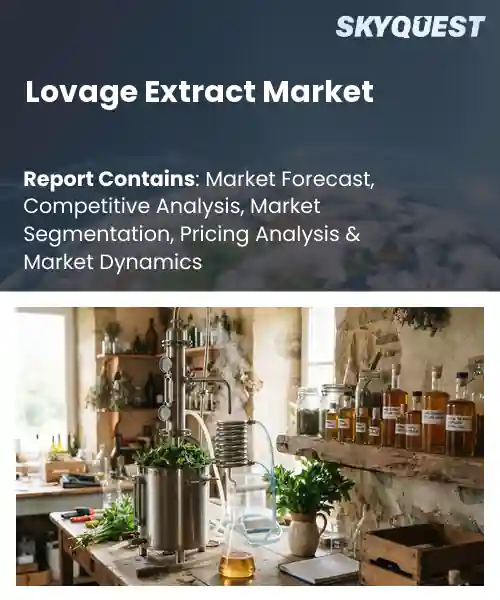
Lovage Extract Market
Report ID: SQMIG30L2623
Report ID: SQMIG30L2623
[email protected]
USA +1 351-333-4748
Report ID:
SQMIG30L2623 |
Region:
Global |
Published Date: August, 2026
Pages:
157
|Tables:
143
|Figures:
78


Global Lovage Extract Market size was valued at USD 184.6 Million in 2024 and is poised to grow from USD 196.05 Million in 2025 to USD 317.22 Million by 2033, growing at a CAGR of 6.2% during the forecast period (2026-2033).
Lovage extract, derived from the leaves and roots of Apiaceae’s Levisticum officinale, has evolved into a niche segment of the broader botanical ingredients market. Its primary driver is the rising consumer preference for natural flavor enhancers that deliver both taste and perceived health benefits. Historically, lovisk extracts were confined to traditional European cuisine, but the past decade has witnessed their integration into processed soups, snack seasonings, and functional beverages as manufacturers chase clean‑label credentials. This shift matters because it allows food producers to replace synthetic additives with a plant‑based alternative, thereby meeting regulatory pressures while tapping into the wellness narrative. The expanding clean‑label movement acts as a catalyst for the lovage extract market, translating heightened consumer scrutiny into industry investment. As retailers impose stricter disclosure rules, manufacturers source lovage to achieve flavor complexity without artificial enhancers, which in turn drives demand across North American snack producers and Asian beverage firms seeking novel aromatics. Advances in supercritical CO₂ extraction lower production costs, enabling growers to join the supply chain and broaden sourcing beyond Eastern‑European farms. This confluence of regulatory impetus, cost‑efficient technology, and diversified applications creates a feedback loop that accelerates market penetration and opens revenue streams for suppliers and end‑users.
How is AI-driven automation influencing the global Lovage extract market?
AI-driven automation is reshaping the Lovage extract market by streamlining extraction processes, improving consistency, and reducing waste. Machine‑learning models optimize temperature and solvent ratios, leading to higher purity without manual trial‑and‑error. Robotics handle large‑scale batch handling, freeing skilled technicians to focus on formulation and quality control. Real‑time data analytics enable producers to predict demand spikes and adjust output swiftly, enhancing supply chain resilience. These technologies also support sustainable practices by minimizing energy consumption and chemical use, aligning producers with growing consumer expectations for environmentally responsible ingredients.
Market snapshot - (2026-2033)
Global Market Size
USD 184.6 Million
Largest Segment
Leaf Extract
Fastest Growth
Seed Extract
Growth Rate
6.2% CAGR
To get more insights on this market click here to Request a Free Sample Report
Global lovage extract market is segmented by extract type, form, application, end-use industry, extraction method and region. Based on extract type, the market is segmented into Root Extract, Leaf Extract and Seed Extract. Based on form, the market is segmented into Liquid Extract and Powder Extract. Based on application, the market is segmented into Food & Beverages, Pharmaceuticals and Cosmetics & Personal Care. Based on end-use industry, the market is segmented into Food & Beverage, Pharmaceutical and Cosmetics. Based on extraction method, the market is segmented into Solvent Extraction, Steam Distillation and Supercritical Fluid Extraction. Based on region, the market is segmented into North America, Europe, Asia Pacific, Latin America and Middle East & Africa.
Root extract segment dominates because lovage’s aromatic profile and high concentration of bioactive compounds are primarily sourced from the root, making it the preferred raw material for manufacturers seeking potency and consistency. This dominance is reinforced by traditional culinary uses and established supply chains that favor root harvesting, which ensures reliable quality. Moreover, the root’s robust flavor supports diverse applications, reinforcing its central role in market development.
However, leaf extract segment is witnessing the strongest growth momentum because food‑and‑beverage manufacturers are exploring fresh, greener flavor notes that appeal to health‑conscious consumers. The leaf’s milder aroma facilitates innovative product formulations, and rising interest in natural preservatives amplifies demand, positioning leaf extract as a catalyst for expanding market opportunities.
Solvent extraction segment leads because it offers a cost‑effective, scalable approach to isolate lovage’s essential oils and phenolics, meeting the volume requirements of industrial producers. Its versatility with various solvents enables fine‑tuning of potency and purity, aligning with established processing infrastructure. Consequently, manufacturers favor solvent extraction to maintain consistent supply and product performance across applications. Additionally, regulatory acceptance of common solvents simplifies compliance, reinforcing its preferred status among formulators seeking reliable extraction outcomes.
On the other hand, supercritical fluid extraction segment emerges as the fastest expanding because it delivers solvent‑free extracts with superior purity, appealing to cosmetics and pharmaceutical developers. The technology’s ability to preserve heat‑sensitive constituents aligns with increasing demand for clean‑label ingredients, and its environmental credentials attract sustainability‑focused brands, accelerating market penetration.
To get detailed segments analysis, Request a Free Sample Report
Europe leads the Lovage Extract market because the region blends deep culinary heritage with advanced food‑manufacturing capabilities. Consumers value natural flavor enhancers, prompting manufacturers to integrate lovage into a broad range of processed foods and beverages. Strong research institutions drive continuous innovation in extraction techniques and applications, while clear regulatory guidance facilitates market entry. Well‑established distribution networks and close collaboration between ingredient suppliers and food producers reinforce Europe’s leadership, allowing the region to set quality benchmarks adopted globally. Moreover, the emphasis on sustainable sourcing and organic certification aligns with clean‑label demand, encouraging adoption of lovage as a natural alternative to synthetic additives. Trade frameworks within the European bloc simplify cross‑border movement of raw materials and finished products, enhancing supply‑chain efficiency and cementing Europe’s position at the forefront of the global market.
Lovage Extract Market in Germany benefits from a culture that values herb notes and an emphasis on natural ingredient sourcing. French food producers incorporate lovage to enhance the aromatic profile of sauces, charcuterie and meals, aligning with consumer taste preferences. Partnerships between research institutes and ingredient manufacturers drive refinement of extraction methods that preserve compounds. Regulatory pathways encourage the use of lovage as a clean‑label flavor, reinforcing France’s role as a contributor to the European market.
Lovage Extract Market in United Kingdom draws on a tradition of herb‑infused foods and a food‑innovation ecosystem. Manufacturers prioritize natural flavor solutions to satisfy consumers seeking clean‑label products. Collaborative research between universities and ingredient firms advances extraction efficiency while maintaining sensory qualities. Regulatory guidance supports the adoption of lovage as a permissible natural additive, facilitating its integration into processed meals, beverages and confectionery. These factors reinforce United Kingdom’s influential position within the regional market.
Lovage Extract Market in France is bolstered by a culture that values herb notes and an emphasis on natural ingredient sourcing. French food producers incorporate lovage to enhance the aromatic profile of sauces, charcuterie and meals, aligning with consumer taste preferences. Partnerships between research institutes and ingredient manufacturers drive refinement of extraction methods that preserve compounds. Regulatory pathways encourage the use of lovage as a clean‑label flavor, reinforcing France’s role as a contributor to the European market.
North America experiences rapid expansion of the Lovage Extract market driven by heightened consumer interest in natural flavor enhancers and innovative product development across the food and beverage sector. Manufacturers seek alternatives to synthetic additives to meet clean‑label expectations, positioning lovage as an attractive botanical solution. Strong research capabilities in the United States facilitate advancements in extraction efficiency and sensory profiling, while regulatory frameworks provide clarity for natural ingredient approvals. In Canada, rising demand for plant‑based and functional foods amplifies the need for authentic herb extracts. Collaborative supply‑chain initiatives between growers, processors and ingredient distributors ensure consistent quality and sustainable sourcing, further accelerating market growth throughout the region. The region’s expansive retail landscape, encompassing both large‑scale supermarkets and specialty health stores, creates multiple channels for introducing lovage‑based products. Additionally, consumer education campaigns highlighting the antioxidant and digestive benefits of lovage reinforce its appeal across demographic segments.
Lovage Extract Market in United States benefits from a strong tradition of herb‑based cuisine and a ingredients sector. Food manufacturers leverage sourcing to meet consumer expectations for authenticity and traceability. Research centers collaborate with industry to refine extraction processes that preserve flavor integrity. Regulatory frameworks provide pathways for natural additives, encouraging manufacturers to replace synthetic options. This blend of culinary heritage, innovation focus and policy sustains United States’ pivotal role in the European supply chain.
Lovage Extract Market in Canada draws on a tradition of herb‑infused foods and a food‑innovation ecosystem. Manufacturers prioritize natural flavor solutions to satisfy consumers seeking clean‑label products. Collaborative research between universities and ingredient firms advances extraction efficiency while maintaining sensory qualities. Regulatory guidance supports the adoption of lovage as a permissible natural additive, facilitating its integration into processed meals, beverages and confectionery. These factors reinforce Canada’s influential position within the regional market.
Asia Pacific is strengthening its position in the Lovage Extract market through a combination of culinary tradition, rapid product innovation and supportive regulatory environments. Japan’s sophisticated food industry embraces botanical ingredients to enhance umami and aromatic notes, driving demand for high‑purity lovage extracts. South Korea leverages its vibrant cosmetics and functional‑food sectors, exploring lovage’s natural antioxidant properties for novel applications. Government initiatives promoting sustainable agriculture encourage growers to cultivate lovage under environmentally friendly practices, ensuring a reliable raw‑material base. Cross‑border collaborations between research institutions and multinational ingredient firms accelerate technology transfer, improving extraction efficiency and product stability. Growing consumer openness to natural flavor solutions across the region further fuels market momentum, positioning Asia Pacific as an emerging hub for lovage‑based innovations.
Lovage Extract Market in Japan thrives on an appreciation for herbal flavors and a quality‑control culture. Food manufacturers integrate lovage to accentuate umami and aromatic depth in sauces, snack foods and meals, aligning with consumer demand for taste. Scientific collaborations between universities and ingredient producers refine extraction techniques that retain volatile compounds. Clear regulatory guidance supports the use of lovage as a natural additive, reinforcing Japan’s role as a leader in high‑quality botanical ingredients.
Lovage Extract Market in South Korea benefits from a functional‑food sector and interest in wellness ingredients. Manufacturers incorporate lovage into beverages, teas and snack formulations to leverage its antioxidant and digestive benefits. Partnerships between local growers and research institutes advance sustainable cultivation practices and extraction methods that preserve bioactive properties. Regulatory frameworks that clearly define natural flavor usage enable product launches, positioning South Korea as an innovator in the regional lovage landscape.
To know more about the market opportunities by region and country, click here to
Buy The Complete Report
Rising Demand for Clean Label
Functional Benefits Driving Ingredient Adoption
Limited Supply Chain Infrastructure
Regulatory Uncertainty Across Regions
Request Free Customization of this report to help us to meet your business objectives.
The competitive landscape of the global lovage extract market is shaped by a tight group of ten leading producers, including Changsha Vigorous-Tech, Carrubba, Aunutra Industries, Bio Botanica and International firms, all racing to capture rising demand for natural flavor ingredients. Market drivers such as consumer preference for clean‑label products have spurred companies to pursue technology innovation, strategic partnerships and selective M&A to broaden their extraction capabilities and geographic reach.
SkyQuest’s ABIRAW (Advanced Business Intelligence, Research & Analysis Wing) is our Business Information Services team that Collects, Collates, Correlates, and Analyses the Data collected by means of Primary Exploratory Research backed by robust Secondary Desk research.
As per SkyQuest analysis, the global lovage extract market is driven primarily by the rising demand for clean‑label products which encourages manufacturers to replace synthetic flavorings with natural lovage while the strong functional benefits such as antioxidant and digestive support act as a second catalyst expanding its use across foods, beverages and cosmetics. Europe remains the dominating region thanks to its culinary heritage, robust research base and clear regulations, and within the market the root extract segment holds the largest share because it delivers the highest potency and consistency. However, the market’s expansion is restrained by limited supply‑chain infrastructure that curtails steady raw‑material availability and raises price volatility.
| Report Metric | Details |
|---|---|
| Market size value in 2024 | USD 184.6 Million |
| Market size value in 2033 | USD 317.22 Million |
| Growth Rate | 6.2% |
| Base year | 2024 |
| Forecast period | (2026-2033) |
| Forecast Unit (Value) | USD Million |
| Segments covered |
|
| Regions covered | North America (US, Canada), Europe (Germany, France, United Kingdom, Italy, Spain, Rest of Europe), Asia Pacific (China, India, Japan, Rest of Asia-Pacific), Latin America (Brazil, Rest of Latin America), Middle East & Africa (South Africa, GCC Countries, Rest of MEA) |
| Companies covered |
|
| Customization scope | Free report customization with purchase. Customization includes:-
|
To get a free trial access to our platform which is a one stop solution for all your data requirements for quicker decision making. This platform allows you to compare markets, competitors who are prominent in the market, and mega trends that are influencing the dynamics in the market. Also, get access to detailed SkyQuest exclusive matrix.
Table Of Content
Executive Summary
Market overview
Parent Market Analysis
Market overview
Market size
KEY MARKET INSIGHTS
COVID IMPACT
MARKET DYNAMICS & OUTLOOK
Market Size by Region
KEY COMPANY PROFILES
Methodology
For the Lovage Extract Market, our research methodology involved a mixture of primary and secondary data sources. Key steps involved in the research process are listed below:
1. Information Procurement: This stage involved the procurement of Market data or related information via primary and secondary sources. The various secondary sources used included various company websites, annual reports, trade databases, and paid databases such as Hoover's, Bloomberg Business, Factiva, and Avention. Our team did 45 primary interactions Globally which included several stakeholders such as manufacturers, customers, key opinion leaders, etc. Overall, information procurement was one of the most extensive stages in our research process.
2. Information Analysis: This step involved triangulation of data through bottom-up and top-down approaches to estimate and validate the total size and future estimate of the Lovage Extract Market.
3. Report Formulation: The final step entailed the placement of data points in appropriate Market spaces in an attempt to deduce viable conclusions.
4. Validation & Publishing: Validation is the most important step in the process. Validation & re-validation via an intricately designed process helped us finalize data points to be used for final calculations. The final Market estimates and forecasts were then aligned and sent to our panel of industry experts for validation of data. Once the validation was done the report was sent to our Quality Assurance team to ensure adherence to style guides, consistency & design.
Analyst Support
Customization Options
With the given market data, our dedicated team of analysts can offer you the following customization options are available for the Lovage Extract Market:
Product Analysis: Product matrix, which offers a detailed comparison of the product portfolio of companies.
Regional Analysis: Further analysis of the Lovage Extract Market for additional countries.
Competitive Analysis: Detailed analysis and profiling of additional Market players & comparative analysis of competitive products.
Go to Market Strategy: Find the high-growth channels to invest your marketing efforts and increase your customer base.
Innovation Mapping: Identify racial solutions and innovation, connected to deep ecosystems of innovators, start-ups, academics, and strategic partners.
Category Intelligence: Customized intelligence that is relevant to their supply Markets will enable them to make smarter sourcing decisions and improve their category management.
Public Company Transcript Analysis: To improve the investment performance by generating new alpha and making better-informed decisions.
Social Media Listening: To analyze the conversations and trends happening not just around your brand, but around your industry as a whole, and use those insights to make better Marketing decisions.
REQUEST FOR SAMPLE
 REQUEST FREE CUSTOMIZATION
Global Lovage Extract Market size was valued at USD 184.6 Million in 2024 and is poised to grow from USD 196.05 Million in 2025 to USD 317.22 Million by 2033, growing at a CAGR of 6.2% during the forecast period (2026-2033).
The competitive landscape of the global lovage extract market is shaped by a tight group of ten leading producers, including Changsha Vigorous-Tech, Carrubba, Aunutra Industries, Bio Botanica and International firms, all racing to capture rising demand for natural flavor ingredients. Market drivers such as consumer preference for clean‑label products have spurred companies to pursue technology innovation, strategic partnerships and selective M&A to broaden their extraction capabilities and geographic reach. 'Martin Bauer Group', 'Kräuter Mix GmbH', 'Kalsec Inc.', 'Givaudan SA', 'IFF', 'Symrise AG', 'Sensient Technologies Corporation', 'Robertet Group', 'Takasago International Corporation', 'Mane Kancor Ingredients Pvt. Ltd.', 'Döhler GmbH', 'Nactarome', 'Naturex', 'Lipoid GmbH', 'Indena S.p.A.', 'Hänseler AG', 'Azelis Group NV', 'Gurjar Phytochemicals', 'Botanicals International', 'Nutra Green Life Science'
Consumers are increasingly seeking products with transparent ingredient lists, and lovage extract offers a recognizable, plant‑based flavor that aligns with clean‑label aspirations. This preference drives food manufacturers to incorporate lovage as a natural alternative to synthetic additives, enhancing product appeal while meeting regulatory expectations. The shift toward authenticity encourages brand differentiation, prompting companies to invest in sourcing and formulating with lovage extract, thereby expanding its market presence across diverse food categories and supporting sustainable sourcing practices that resonate with environmentally conscious shoppers.
Wellness‑Driven Culinary Innovation: Consumers are increasingly seeking functional foods that combine taste with health benefits, prompting chefs and food manufacturers to incorporate lovage extract’s mild celery‑like flavor and antioxidant properties into ready‑to‑eat meals, sauces, and beverages. This shift is driven by heightened awareness of natural ingredients, a desire for plant‑based nutrition, and a willingness to explore traditional culinary heritage. Consequently, product developers are prioritizing lovage extract for its perceived support of digestion and immunity, expanding its application beyond niche gourmet segments.
Why does Europe Dominate the Global Lovage Extract Market? |@12


Want to customize this report? This report can be personalized according to your needs. Our analysts and industry experts will work directly with you to understand your requirements and provide you with customized data in a short amount of time. We offer $1000 worth of FREE customization at the time of purchase.
Feedback From Our Clients


 USA (+1) 351-333-4748

