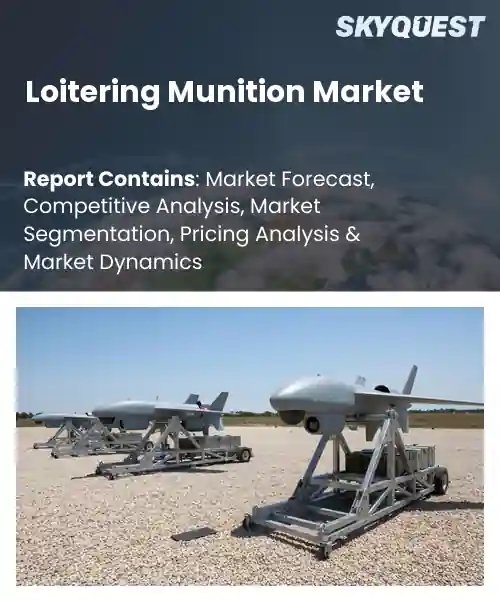
Loitering Munition Market
Report ID: SQMIG20A2699
Report ID: SQMIG20A2699
[email protected]
USA +1 351-333-4748
Report ID:
SQMIG20A2699 |
Region:
Global |
Published Date: June, 2026
Pages:
157
|Tables:
142
|Figures:
78


Global Loitering Munition Market size was valued at USD 2.52 Billion in 2024 and is poised to grow from USD 2.84 Billion in 2025 to USD 7.52 Billion by 2033, growing at a CAGR of 12.82% during the forecast period (2026-2033).
The loitering‑munition market comprises precision weapons that can hover over a battlefield for periods before striking a target, blending drone and cruise‑missile capabilities. Its importance stems from the demand for affordable, rapid‑response strike options that reduce collateral damage and limit exposure of manned aircraft. The sector originated in the early 2000s when Israel deployed the Harpy system to suppress radars, and it expanded as conflict zones such as Syria and Yemen demonstrated the utility of autonomous, time‑on‑target attacks. Over the past decade the market has matured, driven by advances in miniaturized sensors, AI guidance, and the proliferation of UAV platforms.
One key trend driving the global loitering‑munition sector is the integration of artificial‑intelligence algorithms that enable autonomous target recognition and mission planning. As AI improves, operators can program a swarm of loitering drones to patrol an area, identify assets, and engage without human intervention, which reduces decision latency and manpower costs. This capability has prompted defense ministries in Europe and Asia to allocate budgets toward systems like the Switchblade‑300 and the KARGU‑2, creating a surge in procurement contracts. Manufacturers are expanding production lines and investing in payload designs, opening opportunities for civilian uses such as border surveillance and infrastructure protection.
How is AI Enhancing Target Identification in the Loitering Munition Market?
AI is reshaping how loitering munitions locate and verify targets. Machine learning algorithms process high resolution sensor feeds in real time, allowing the weapon to distinguish between combatants, civilian objects and background clutter. Integrated data fusion combines visual infrared and radar signatures, reducing false engagements. Adaptive neural networks learn from each sortie, improving accuracy as operational data accumulates. The technology also enables dynamic re targeting, letting operators shift focus mid flight without manual input. As defense forces seek higher precision while minimizing collateral damage, AI driven identification has become a cornerstone of modern loitering munition design, supporting the market’s rapid expansion.
In January 2026 , MBDA announced a new naval loitering munition, featuring onboard AI that fuses sonar and electro optical data to lock onto hostile vessels while ignoring friendly traffic. This capability shortens engagement cycles and illustrates how AI driven target identification is accelerating adoption across the sector.
Market snapshot - (2026-2033)
Global Market Size
USD 2.52 Billion
Largest Segment
Man-Portable Loitering Munitions
Fastest Growth
Swarm Munitions
Growth Rate
12.82% CAGR
To get more insights on this market click here to Request a Free Sample Report
Global loitering munition market is segmented by type, platform, guidance, end-user, distribution and region. Based on type, the market is segmented into man-portable loitering munitions, vehicle-launched loitering munitions and swarm munitions. Based on platform, the market is segmented into fixed-wing and rotary-wing. Based on guidance, the market is segmented into GPS/INS, AI-enabled vision and man-in-the-loop. Based on end-user, the market is segmented into army, special operations forces and naval forces. Based on distribution, the market is segmented into government defense contracts and FMS (foreign military sales). Based on region, the market is segmented into North America, Europe, Asia Pacific, Latin America and Middle East & Africa.
Based on the global loitering‑munition market growth, man-portable loitering munitions segment dominates because it offers the highest operational flexibility for dismounted troops, enabling rapid on demand strike capability without dependence on vehicle platforms. Its lightweight design and easy integration with individual soldier equipment reduce logistical footprints, while intuitive launch interfaces accelerate mission planning. These attributes align with modern expeditionary doctrines that prioritize agility, low observable footprint, and decentralized firepower, cementing its primacy in the market and sustaining long term operational relevance.
However, vehicle launched loitering munitions is witnessing the strongest growth momentum as armored platforms seek organic precision strike options that complement existing firepower. Advances in modular payload bays and autonomous flight controls enable seamless integration, while heightened emphasis on networked warfare drives demand for vehicle borne loitering capabilities, expanding future market opportunities.
AI enabled vision segment leads because its ability to interpret complex visual scenes in real time grants loitering munitions autonomous target discrimination and adaptive engagement. Machine learning algorithms continuously refine recognition accuracy, reducing collateral risk and operator workload. This intelligence layer synergizes with GPS INS data, delivering precise strike decisions even in contested electromagnetic environments, making it the preferred guidance choice for advanced armed forces seeking decisive low visibility effects and operational sustainability.
Meanwhile, man in the loop is emerging as the key high growth area as militaries balance autonomy with legal and ethical oversight. Real time human supervision leverages situational awareness while retaining final kill authority, satisfying rules of engagement constraints. Secure video links and responsive control consoles fuel adoption, positioning this guidance mode to propel broader market expansion.
To get detailed segments analysis, Request a Free Sample Report
As per the global loitering‑munition market share, North America benefits from deep‑rooted defense innovation ecosystems, extensive research institutions, and substantial industrial capacity that prioritize advanced autonomous systems. A mature procurement landscape encourages early adoption of cutting‑edge capabilities, while robust supply chains ensure rapid integration into operational forces. Collaborative partnerships between government agencies and private sector firms foster continual refinement of sensors, communications, and strike precision. The strategic emphasis placed on maintaining technological superiority reinforces sustained investment, positioning the region as a benchmark for performance, reliability, and interoperability across allied networks.
United States Loitering Munition Market
Loitering munition market development in the United States is propelled by a strong emphasis on next‑generation warfare concepts and an extensive network of defense contractors. Continuous experimentation within joint training environments enables rapid feedback loops that refine system agility and lethality. Integration with broader combat platforms enhances cross‑domain synergy, while policy frameworks facilitate flexible acquisition pathways, allowing emerging designs to transition swiftly from prototype to fielded capability.
Canada Loitering Munition Market
Loitering munition market activity in Canada reflects a commitment to interoperable solutions that align with North Atlantic alliance standards. Investment in domestic research hubs encourages collaboration with allied partners, fostering technology transfer and joint development initiatives. Emphasis on modular architecture supports adaptability across diverse operational scenarios, while procurement strategies prioritize cost‑effective sustainment and long‑term lifecycle support for evolving threat environments.
Based on global loitering‑munition regional forecast, European growth is fueled by a coordinated emphasis on defence modernization and collective security mandates that prioritize autonomous precision strike assets. Strong collaborative frameworks among member states stimulate shared research ventures, accelerating technology maturation and reducing development risk. Policies encouraging indigenous production and strategic autonomy drive investment in next‑generation platforms, while close alignment with NATO standards ensures seamless integration across multinational forces. The region’s focus on balancing capability advancement with fiscal responsibility creates a conducive environment for sustained market expansion and innovative ecosystem development.
Germany Loitering Munition Market
Loitering munition market progress in Germany is anchored by a robust industrial base renowned for engineering excellence and a growing emphasis on digital battlefield concepts. Partnerships between leading aerospace firms and research institutes cultivate advanced sensor fusion and autonomous navigation capabilities. Integration with existing combat systems enhances operational flexibility, while national procurement strategies promote incremental acquisition that validates performance in realistic training environments.
United Kingdom Loitering Munition Market
Loitering munition market momentum in the United Kingdom is driven by a proactive stance on rapid capability delivery and a vibrant defence innovation sector. Close cooperation between governmental agencies and start‑up enterprises accelerates prototype iteration, fostering agile response to emerging threats. Emphasis on network‑centric operations ensures seamless data sharing across air, land, and maritime domains, while export‑oriented policies expand market reach and reinforce strategic partnerships with allied forces.
France Loitering Munition Market
Loitering munition market evolution in France benefits from a longstanding tradition of aerospace leadership and a focused national defence strategy that emphasizes autonomous strike solutions. Integrated research programmes combine expertise in artificial intelligence, propulsion, and miniaturized payloads, delivering sophisticated systems tailored to diverse mission sets. Commitment to sovereign capability development supports a resilient supply chain and reinforces France’s role as a key contributor to collective European security initiatives.
As per global loitering‑munition regional outlook, Asia Pacific region is advancing its role through heightened awareness of regional security dynamics and a concerted push for indigenous capability development. Nations are investing in advanced research ecosystems that blend traditional aerospace expertise with emerging digital technologies, fostering rapid prototyping and iterative testing. Collaborative defence initiatives encourage cross‑border knowledge exchange, while strategic emphasis on versatile, low‑cost solutions aligns with varied operational requirements. This combination of technological ambition, regional cooperation, and adaptable procurement approaches consolidates the region’s emerging influence in the global loitering munition landscape.
Japan Loitering Munition Market
Loitering munition market activity in Japan integrates cutting‑edge electronics with precision engineering, reflecting the nation’s strong heritage in high‑reliability systems. Government‑industry alliances prioritize modular designs that can be tailored to both defensive and expeditionary roles, while extensive maritime focus expands operational concepts. Continuous investment in autonomous navigation and sensor technologies ensures relevance across evolving threat spectrums, supporting Japan’s broader commitment to regional stability.
South Korea Loitering Munition Market
Loitering munition market development in South Korea is characterized by a rapid adoption mindset and a vibrant defence tech sector. Close coordination between military research establishments and commercial manufacturers accelerates the transition from concept to fielded system. Emphasis on compact, high‑mobility platforms aligns with the country’s terrain and doctrinal needs, while integration with networked command structures enhances real‑time targeting and situational awareness.
To know more about the market opportunities by region and country, click here to
Buy The Complete Report
Increasing Demand for Precision Strike
Advancements in Miniaturization Technology
Regulatory Restrictions on Autonomous Weapons
High Production Costs and Complexity
Request Free Customization of this report to help us to meet your business objectives.
The competitive landscape in the global loitering‑munition market outlook is shaped by aggressive M&A activity, strategic partnerships, and rapid tech innovation, with firms acquiring niche sensor developers, teaming with aerospace integrators, and field‑testing AI‑driven loitering platforms to outpace rivals and secure defense contracts. Recent examples include a major European defense contractor acquiring a UAV‑swarm specialist and a leading missile maker partnering with a Silicon Valley AI startup to enhance autonomous target‑recognition capabilities.
Top Player’s Company Profile
Recent Developments
SkyQuest’s ABIRAW (Advanced Business Intelligence, Research & Analysis Wing) is our Business Information Services team that Collects, Collates, Correlates, and Analyses the Data collected by means of Primary Exploratory Research backed by robust Secondary Desk research.
As per SkyQuest analysis, the global loitering‑munition industry is being propelled primarily by the rising demand for precision‑strike capabilities that promise lower collateral damage, while a second engine of growth is the rapid advance in miniaturisation that lets these weapons be carried by individual soldiers. The market’s pace is tempered by regulatory restrictions on autonomous weapons, which add compliance costs and slow deployments. North America remains the dominant region thanks to its deep defence‑innovation ecosystem and robust procurement budgets, and within the product mix the man‑portable segment leads because of its unmatched flexibility for dismounted units. Together these forces shape the market’s trajectory through 2033.
| Report Metric | Details |
|---|---|
| Market size value in 2024 | USD 2.52 Billion |
| Market size value in 2033 | USD 7.52 Billion |
| Growth Rate | 12.82% |
| Base year | 2024 |
| Forecast period | (2026-2033) |
| Forecast Unit (Value) | USD Billion |
| Segments covered |
|
| Regions covered | North America (US, Canada), Europe (Germany, France, United Kingdom, Italy, Spain, Rest of Europe), Asia Pacific (China, India, Japan, Rest of Asia-Pacific), Latin America (Brazil, Rest of Latin America), Middle East & Africa (South Africa, GCC Countries, Rest of MEA) |
| Companies covered |
|
| Customization scope | Free report customization with purchase. Customization includes:-
|
To get a free trial access to our platform which is a one stop solution for all your data requirements for quicker decision making. This platform allows you to compare markets, competitors who are prominent in the market, and mega trends that are influencing the dynamics in the market. Also, get access to detailed SkyQuest exclusive matrix.
Table Of Content
Executive Summary
Market overview
Parent Market Analysis
Market overview
Market size
KEY MARKET INSIGHTS
COVID IMPACT
MARKET DYNAMICS & OUTLOOK
Market Size by Region
KEY COMPANY PROFILES
Methodology
For the Loitering Munition Market, our research methodology involved a mixture of primary and secondary data sources. Key steps involved in the research process are listed below:
1. Information Procurement: This stage involved the procurement of Market data or related information via primary and secondary sources. The various secondary sources used included various company websites, annual reports, trade databases, and paid databases such as Hoover's, Bloomberg Business, Factiva, and Avention. Our team did 45 primary interactions Globally which included several stakeholders such as manufacturers, customers, key opinion leaders, etc. Overall, information procurement was one of the most extensive stages in our research process.
2. Information Analysis: This step involved triangulation of data through bottom-up and top-down approaches to estimate and validate the total size and future estimate of the Loitering Munition Market.
3. Report Formulation: The final step entailed the placement of data points in appropriate Market spaces in an attempt to deduce viable conclusions.
4. Validation & Publishing: Validation is the most important step in the process. Validation & re-validation via an intricately designed process helped us finalize data points to be used for final calculations. The final Market estimates and forecasts were then aligned and sent to our panel of industry experts for validation of data. Once the validation was done the report was sent to our Quality Assurance team to ensure adherence to style guides, consistency & design.
Analyst Support
Customization Options
With the given market data, our dedicated team of analysts can offer you the following customization options are available for the Loitering Munition Market:
Product Analysis: Product matrix, which offers a detailed comparison of the product portfolio of companies.
Regional Analysis: Further analysis of the Loitering Munition Market for additional countries.
Competitive Analysis: Detailed analysis and profiling of additional Market players & comparative analysis of competitive products.
Go to Market Strategy: Find the high-growth channels to invest your marketing efforts and increase your customer base.
Innovation Mapping: Identify racial solutions and innovation, connected to deep ecosystems of innovators, start-ups, academics, and strategic partners.
Category Intelligence: Customized intelligence that is relevant to their supply Markets will enable them to make smarter sourcing decisions and improve their category management.
Public Company Transcript Analysis: To improve the investment performance by generating new alpha and making better-informed decisions.
Social Media Listening: To analyze the conversations and trends happening not just around your brand, but around your industry as a whole, and use those insights to make better Marketing decisions.
REQUEST FOR SAMPLE
 REQUEST FREE CUSTOMIZATION
Global Loitering Munition Market size was valued at USD 2.52 Billion in 2024 and is poised to grow from USD 2.84 Billion in 2025 to USD 7.52 Billion by 2033, growing at a CAGR of 12.82% during the forecast period (2026-2033).
The competitive landscape is shaped by aggressive M&A activity, strategic partnerships, and rapid tech innovation, with firms acquiring niche sensor developers, teaming with aerospace integrators, and field‑testing AI‑driven loitering platforms to outpace rivals and secure defense contracts. Recent examples include a major European defense contractor acquiring a UAV‑swarm specialist and a leading missile maker partnering with a Silicon Valley AI startup to enhance autonomous target‑recognition capabilities. 'AeroVironment (Switchblade)', 'Elbit Systems (Rotem)', 'IAI (Harop)', 'Raytheon Technologies', 'L3Harris Technologies (Hero)', 'Textron Systems (Cottonmouth)', 'MBDA Missile Systems', 'Teledyne FLIR (Altius)', 'Anduril Industries (Altius)', 'Hi-Sonics Aerospace', 'STM (Turkish)', 'ROKETSAN AS', 'Emarat Al Najma (EAD)', 'WB Group', 'Shanghai Aerospace Science & Industry', 'CASC (China)', 'Denel SOC (South Africa)', 'Rafael Advanced Defense Systems', 'Northrop Grumman', 'Boeing Defense'
The growing demand for precision strike capabilities drives market expansion as militaries seek to minimize collateral damage while achieving mission objectives. Loitering munitions enable engagement of high‑value targets with greater accuracy, offering a cost‑effective alternative to conventional missiles. Their ability to loiter and select targets in real time aligns with modern doctrines that prioritize surgical effects, thereby encouraging procurement programmes. This focus on precision enhances operational relevance and stimulates continuous investment in development and acquisition across defense forces worldwide global.
Ai-Driven Targeting Evolution: The integration of advanced artificial intelligence algorithms into loitering munition systems is reshaping engagement strategies. Machine‑learning models enable real‑time analysis of sensor inputs, improving target discrimination and reducing collateral damage. Operators benefit from adaptive flight paths that autonomously respond to dynamic battlefield conditions. This capability shortens decision cycles and enhances mission efficacy, positioning AI‑enabled platforms as preferred assets for precision‑strike doctrines across diverse operational theaters and supporting joint force interoperability while maintaining low logistical footprints through modular payload designs today.
Why does North America Dominate the Global Loitering Munition Market? |@12


Want to customize this report? This report can be personalized according to your needs. Our analysts and industry experts will work directly with you to understand your requirements and provide you with customized data in a short amount of time. We offer $1000 worth of FREE customization at the time of purchase.
Feedback From Our Clients


 USA (+1) 351-333-4748

