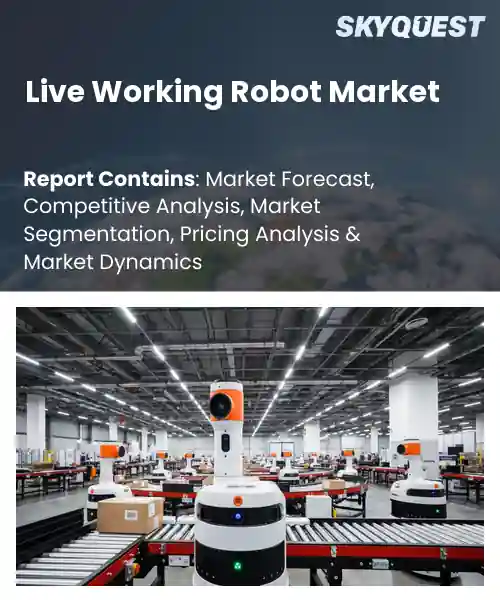
Live Working Robot Market
Report ID: SQMIG20E2249
Report ID: SQMIG20E2249
[email protected]
USA +1 351-333-4748
Report ID:
SQMIG20E2249 |
Region:
Global |
Published Date: August, 2026
Pages:
157
|Tables:
171
|Figures:
79


Global Live Working Robot Market size was valued at USD 1.1 Billion in 2024 and is poised to grow from USD 1.26 Billion in 2025 to USD 3.81 Billion by 2033, growing at a CAGR of 14.8% during the forecast period (2026-2033).
Building on this foundation, the main growth catalyst for the live‑working robot market is the convergence of Industry 4.0 digital twins with real‑time analytics, enabling robots to adapt instantly to changing conditions. When factories integrate sensor‑rich environments, robots receive continuous feedback, allowing predictive maintenance that reduces downtime and justifies upfront investment. This capability has opened opportunities in sectors such as pharmaceuticals, where dispensing units coordinate with inventory systems to meet sterility standards, and in logistics, where picking robots synchronize with warehouse software to accelerate order fulfillment. Consequently, firms embedding analytics into robot platforms capture larger market shares and drive efficiency gains.
How is AI-driven automation reshaping the live working robot market?
AI driven automation is turning live working robots from simple repeaters into adaptive partners that sense, learn and react in real time. In the collaborative robot market, manufacturers embed machine learning models that predict human motion, optimize tool paths and adjust force on the fly. This shift expands deployment beyond assembly lines into logistics, healthcare and field service, where safety and flexibility are paramount. Companies such as Universal Robots, ABB and FANUC now offer cobots equipped with vision systems and predictive analytics, allowing workers to share space without cages. The result is faster cycle times, reduced downtime and a smoother human machine workflow that fuels broader adoption.Universal Robots announced in March 2024, a new UR10e cobot with AI driven adaptive motion that continuously learns from operator behavior. The system shortens setup time and improves safety, showing how AI automation accelerates market growth by making live working robots more intuitive and efficient.
Market snapshot - (2026-2033)
Global Market Size
USD 1.1 Billion
Largest Segment
Ground-Based Robots
Fastest Growth
Aerial Robots
Growth Rate
14.8% CAGR
To get more insights on this market click here to Request a Free Sample Report
Global live working robot market is segmented by robot type, voltage level, application, end user, operation mode, distribution channel and region. Based on robot type, the market is segmented into Ground-Based Robots, Climbing Robots and Aerial Robots. Based on voltage level, the market is segmented into Low Voltage, Medium Voltage and High Voltage. Based on application, the market is segmented into Transmission Lines, Distribution Lines and Substations. Based on end user, the market is segmented into Utilities, EPC Contractors and Industrial Facilities. Based on operation mode, the market is segmented into Teleoperated, Semi-Autonomous and Autonomous. Based on distribution channel, the market is segmented into Direct Sales, System Integrators and Others. Based on region, the market is segmented into North America, Europe, Asia Pacific, Latin America and Middle East & Africa.
Ground-Based Robots segment dominates because they provide the most robust platform for handling heavy equipment and complex maintenance tasks on transmission infrastructure, allowing precise manipulation in confined spaces. Their proven reliability, high payload capacity, and compatibility with existing utility tools foster confidence among operators, driving widespread adoption. This dominance is reinforced by continuous improvements in mobility, durability, and integration with safety monitoring systems, which collectively elevate operational effectiveness and resilience.
Meanwhile, aerial robots emerge as the most rapidly expanding area because their ability to access remote line sections without physical contact accelerates inspection and cleaning processes. Innovative drone based tooling, enhanced flight autonomy, and regulatory encouragement for aerial work amplify adoption, unlocking new service models and fueling market expansion.
Semi autonomous operation segment leads because it blends human oversight with algorithmic decision making, delivering higher productivity while preserving safety safeguards. Operators can intervene during complex tasks, reducing error rates, and the system can optimize routes and tool usage autonomously, shortening job cycles. Continuous learning from field data refines performance, fostering trust among utilities and contractors, which drives extensive deployment across diverse maintenance scenarios and improves overall operational resilience significantly.
Conversely, autonomous operation emerges as the fastest growing area because fully self directed robots eliminate the need for constant human monitoring, enabling deployment on long transmission corridors. Breakthroughs in AI perception, edge computing, and battery technology expand use cases, attracting investment and opening new service contracts that accelerate market scale.
To get detailed segments analysis, Request a Free Sample Report
North America’s dominance stems from a combination of advanced manufacturing ecosystems, strong research and development infrastructure, and early adoption of automation technologies across diverse sectors. The presence of leading technology firms and a supportive regulatory environment encourages rapid integration of live working robots into production lines. Collaboration between academia and industry accelerates innovation, while robust supply chains ensure reliable component availability. Moreover, a culture of operational efficiency and strategic investment in workforce training reinforces the region’s ability to leverage live working robots for competitive advantage, sustaining its leading market position.
Live Working Robot Market in the United States benefits from extensive industrial diversity, deep venture capital support, and a tradition of pioneering automation solutions. Companies across aerospace, automotive, and consumer goods sectors actively integrate live working robots to enhance precision and throughput. A strong ecosystem of technology providers, research institutions, and skilled engineering talent drives continuous improvement, while collaborative standards initiatives streamline integration across complex production environments.
Live Working Robot Market in Canada is propelled by a focus on advanced manufacturing and a commitment to sustainable production practices. Provincial innovation hubs and government incentives encourage adoption of live working robots in sectors such as renewable energy, automotive components, and food processing. Close cross‑border collaboration with United States partners facilitates technology transfer, and a skilled workforce trained in robotics engineering supports the region’s growing implementation efforts.
Europe’s rapid expansion is fueled by strong regulatory emphasis on safety and efficiency, coupled with a mature industrial base that values high‑precision automation. Collaborative research networks across the continent foster shared advancements in sensor technology and artificial intelligence, enhancing robot adaptability. The region’s commitment to environmental sustainability encourages the use of live working robots to reduce waste and energy consumption. Additionally, strategic public‑private partnerships accelerate deployment in sectors ranging from automotive to pharmaceuticals, positioning Europe as a hub for innovative, compliant robotic solutions.
Live Working Robot Market in Germany reflects the country’s status as a manufacturing powerhouse with a deep engineering heritage. German firms integrate live working robots to achieve high levels of product quality and operational reliability, particularly in automotive and machinery sectors. Robust standards bodies and a culture of precision engineering support seamless robot integration, while close collaboration between industry and research institutes accelerates technology refinement.
Live Working Robot Market in the United Kingdom is characterized by a swift uptake across aerospace, defense, and advanced materials industries. The UK’s vibrant tech startup scene, combined with strong academic research, drives innovative applications of live working robots. Government initiatives that promote digital transformation and skills development further empower enterprises to adopt robotic solutions, establishing the United Kingdom as a dynamic and fast‑growing market.
Live Working Robot Market in France is emerging through focused efforts on high‑value manufacturing and food processing sectors. French companies leverage live working robots to enhance product customization and reduce manual labor intensity. National research programs and industry clusters facilitate knowledge sharing, while incentives for automation adoption encourage broader implementation across medium‑sized enterprises.
Asia Pacific strengthens its position by capitalizing on rapid industrial modernization and a growing appetite for high‑tech automation across diverse economies. The region benefits from a confluence of cost‑effective manufacturing capabilities, strong governmental support for smart factories, and increasing expertise in robotics engineering. Collaborative initiatives among regional technology hubs accelerate the development of adaptable robot platforms, while expanded training programs cultivate a skilled workforce ready to operate and maintain live working robots. This integrated approach enhances competitiveness and expands the footprint of live working robots throughout the Asia Pacific landscape.
Live Working Robot Market in Japan is driven by a legacy of precision manufacturing and a cultural emphasis on technological excellence. Japanese firms adopt live working robots to improve assembly accuracy and maintain high productivity in electronics, automotive, and robotics sectors. Close ties between industry and research universities foster continuous innovation, while government policies encouraging smart factory adoption reinforce the market’s growth trajectory.
Live Working Robot Market in South Korea reflects the country’s aggressive push toward automation in semiconductor, automotive, and heavy‑industry domains. Korean enterprises integrate live working robots to boost production efficiency and maintain global competitiveness. Strong government incentives for digital transformation, combined with a vibrant ecosystem of robotics startups, support rapid adoption and iterative advancement of robotic capabilities.
To know more about the market opportunities by region and country, click here to
Buy The Complete Report
Increasing Demand for Remote Operations
Advancements in Collaborative Robotics
High Initial Capital Investment
Complex Integration with Legacy Systems
Request Free Customization of this report to help us to meet your business objectives.
Top Player’s Company Profile
Recent Developments
SkyQuest’s ABIRAW (Advanced Business Intelligence, Research & Analysis Wing) is our Business Information Services team that Collects, Collates, Correlates, and Analyses the Data collected by means of Primary Exploratory Research backed by robust Secondary Desk research. As per SkyQuest analysis, the live‑working robot market is being propelled primarily by the rising demand for remote operations that let specialists work from afar, while a second strong driver is the rapid advancement of AI‑driven adaptive navigation which lets robots learn from sensor data and adjust routes instantly. The main restraint remains the high initial capital investment required for hardware, software and integration, slowing adoption among smaller firms. North America dominates the market thanks to its advanced manufacturing ecosystem and supportive regulatory framework. Within the segment landscape, ground‑based robots lead due to their payload capacity, reliability and safety features, securing the largest share of deployments worldwide.
| Report Metric | Details |
|---|---|
| Market size value in 2024 | USD 1.1 Billion |
| Market size value in 2033 | USD 3.81 Billion |
| Growth Rate | 14.8% |
| Base year | 2024 |
| Forecast period | (2026-2033) |
| Forecast Unit (Value) | USD Billion |
| Segments covered |
|
| Regions covered | North America (US, Canada), Europe (Germany, France, United Kingdom, Italy, Spain, Rest of Europe), Asia Pacific (China, India, Japan, Rest of Asia-Pacific), Latin America (Brazil, Rest of Latin America), Middle East & Africa (South Africa, GCC Countries, Rest of MEA) |
| Companies covered |
|
| Customization scope | Free report customization with purchase. Customization includes:-
|
To get a free trial access to our platform which is a one stop solution for all your data requirements for quicker decision making. This platform allows you to compare markets, competitors who are prominent in the market, and mega trends that are influencing the dynamics in the market. Also, get access to detailed SkyQuest exclusive matrix.
Table Of Content
Executive Summary
Market overview
Parent Market Analysis
Market overview
Market size
KEY MARKET INSIGHTS
COVID IMPACT
MARKET DYNAMICS & OUTLOOK
Market Size by Region
KEY COMPANY PROFILES
Methodology
For the Live Working Robot Market, our research methodology involved a mixture of primary and secondary data sources. Key steps involved in the research process are listed below:
1. Information Procurement: This stage involved the procurement of Market data or related information via primary and secondary sources. The various secondary sources used included various company websites, annual reports, trade databases, and paid databases such as Hoover's, Bloomberg Business, Factiva, and Avention. Our team did 45 primary interactions Globally which included several stakeholders such as manufacturers, customers, key opinion leaders, etc. Overall, information procurement was one of the most extensive stages in our research process.
2. Information Analysis: This step involved triangulation of data through bottom-up and top-down approaches to estimate and validate the total size and future estimate of the Live Working Robot Market.
3. Report Formulation: The final step entailed the placement of data points in appropriate Market spaces in an attempt to deduce viable conclusions.
4. Validation & Publishing: Validation is the most important step in the process. Validation & re-validation via an intricately designed process helped us finalize data points to be used for final calculations. The final Market estimates and forecasts were then aligned and sent to our panel of industry experts for validation of data. Once the validation was done the report was sent to our Quality Assurance team to ensure adherence to style guides, consistency & design.
Analyst Support
Customization Options
With the given market data, our dedicated team of analysts can offer you the following customization options are available for the Live Working Robot Market:
Product Analysis: Product matrix, which offers a detailed comparison of the product portfolio of companies.
Regional Analysis: Further analysis of the Live Working Robot Market for additional countries.
Competitive Analysis: Detailed analysis and profiling of additional Market players & comparative analysis of competitive products.
Go to Market Strategy: Find the high-growth channels to invest your marketing efforts and increase your customer base.
Innovation Mapping: Identify racial solutions and innovation, connected to deep ecosystems of innovators, start-ups, academics, and strategic partners.
Category Intelligence: Customized intelligence that is relevant to their supply Markets will enable them to make smarter sourcing decisions and improve their category management.
Public Company Transcript Analysis: To improve the investment performance by generating new alpha and making better-informed decisions.
Social Media Listening: To analyze the conversations and trends happening not just around your brand, but around your industry as a whole, and use those insights to make better Marketing decisions.
REQUEST FOR SAMPLE
 REQUEST FREE CUSTOMIZATION


Want to customize this report? This report can be personalized according to your needs. Our analysts and industry experts will work directly with you to understand your requirements and provide you with customized data in a short amount of time. We offer $1000 worth of FREE customization at the time of purchase.
Feedback From Our Clients


 USA (+1) 351-333-4748

