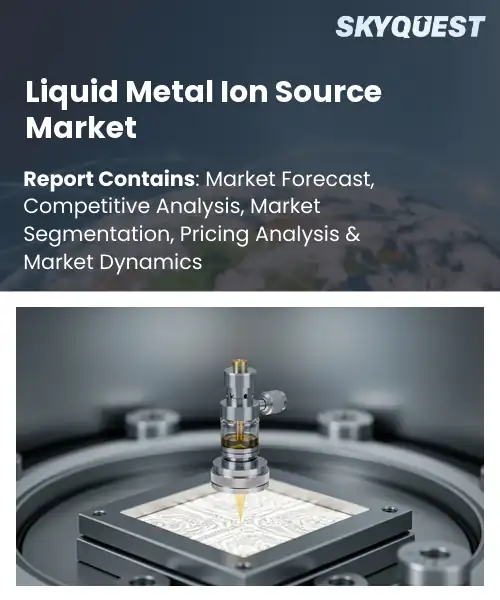
Liquid Metal Ion Source Market
Report ID: SQMIG45N2270
Report ID: SQMIG45N2270
[email protected]
USA +1 351-333-4748
Report ID:
SQMIG45N2270 |
Region:
Global |
Published Date: July, 2026
Pages:
157
|Tables:
118
|Figures:
77


Global Liquid Metal Ion Source Market size was valued at USD 238.4 Million in 2024 and is poised to grow from USD 253.42 Million in 2025 to USD 413.15 Million by 2033, growing at a CAGR of 6.3% during the forecast period (2026-2033).
The global liquid metal ion source (LMIS) market encompasses specialized devices that generate focused ion beams by extracting ions from a heated liquid metal alloy, a technology central to semiconductor lithography, focused ion beam milling, and space‑craft propulsion. Its importance lies in enabling nanometer patterning and precise material removal, capabilities that underpin chip manufacturing and nanoscale device prototyping. Historically, the market emerged in the 1970s alongside early ion‑beam microscopy, accelerated in the 1990s when semiconductor fabs adopted LMIS for ultraviolet lithography. Since then, demand has risen as Moore’s Law pushes feature sizes downward and applications such as quantum‑dot fabrication appear. The rapid expansion of three‑dimensional integrated circuits (3D‑ICs) drives the LMIS market because these chips rely on precise ion implantation to form vertical interconnects and through‑silicon vias. This requirement pushes manufacturers toward LMIS tools capable of sub‑20‑nm beams with stable current, fueling equipment sales and service agreements. At the same time, additive manufacturing of metallic nanostructures creates a secondary opportunity, as researchers use LMIS‑based focused ion beam deposition to build 5G antenna arrays and miniature biomedical sensors. The resulting demand for customized ion sources stimulates R&D, which lowers costs and expands market reach across multiple industry sectors worldwide, boosting adoption.
What impact does AI‑enabled automation have on the liquid metal ion source market?
AI‑enabled automation reshapes the liquid metal ion source market by embedding intelligent control loops that continuously adjust beam parameters for optimal performance. Machine learning models predict wear patterns and suggest maintenance before failures occur, which keeps equipment running longer and reduces downtime. Real‑time data analytics allow operators to fine‑tune ion currents without manual trial and error, speeding up prototyping cycles and lowering material waste. The technology also streamlines integration with downstream processes such as nanofabrication and semiconductor inspection, making the overall workflow more cohesive. As manufacturers adopt these smart systems, the market sees heightened demand for sources that can communicate with broader automation ecosystems, driving both innovation and adoption rates.Thermo Fisher Scientific June 2024, unveiled an AI‑driven ion source platform that automatically calibrates emission profiles, demonstrating how intelligent automation can boost efficiency and accelerate market growth.
Market snapshot - (2026-2033)
Global Market Size
USD 238.4 Million
Largest Segment
Gallium
Fastest Growth
Alloy-Based
Growth Rate
6.3% CAGR
To get more insights on this market click here to Request a Free Sample Report
Global liquid metal ion source market is segmented by metal type, source type, application, end user and region. Based on metal type, the market is segmented into Gallium, Gold, Indium and Alloy-Based. Based on source type, the market is segmented into Single Element and Alloy. Based on application, the market is segmented into Focused Ion Beam Systems, Semiconductor Manufacturing, Nanofabrication and Materials Analysis. Based on end user, the market is segmented into Semiconductor Manufacturers, Electronics Manufacturers and Research Institutes. Based on region, the market is segmented into North America, Europe, Asia Pacific, Latin America and Middle East & Africa.
Gallium segment dominates because its low melting point and stable ionization efficiency make it the preferred choice for high resolution ion beam generation. Engineers favor gallium for its predictable beam profile, ease of source handling, and compatibility with existing system architectures. These attributes reduce operational complexity and maintenance costs, reinforcing gallium’s central position in the liquid metal ion source market throughout product development cycles and long term reliability considerations.
However, gold segment is witnessing the strongest growth momentum because emerging quantum computing research demands ultra fine patterning that leverages gold’s high atomic mass and superior sputtering characteristics. Investments in specialized equipment and collaborations with academic laboratories accelerate its adoption, creating new opportunities and expanding the overall market’s technological frontier.
Focused ion beam systems segment dominates because they represent the primary vehicle for delivering precise material modification and inspection across diverse manufacturing workflows. Their ability to achieve nanoscale etching and imaging aligns with critical quality control requirements, prompting widespread integration into production lines. This entrenched role drives continuous demand for reliable ion sources, reinforcing the centrality of focused ion beam applications within the liquid metal ion source ecosystem and customer satisfaction metrics.
Meanwhile, nanofabrication segment is emerging as the key high growth area because modern packaging and sensor technologies need intricate three dimensional structures. The drive for smaller devices raises demand for ion sources that provide fine pitch patterning, prompting manufacturers to adopt dedicated nanofabrication solutions. This surge broadens market scope and fuels further innovation.
To get detailed segments analysis, Request a Free Sample Report
North America maintains a leadership position because of a mature semiconductor ecosystem, extensive research collaborations, and robust funding mechanisms that encourage technology adoption. The region benefits from a concentration of advanced manufacturing facilities that require precise ion source capabilities, driving demand for high‑performance solutions. Strong intellectual property frameworks and the presence of leading instrument manufacturers foster continuous innovation and rapid product rollout. Academic institutions and industry labs work closely, accelerating development cycles and ensuring that emerging applications receive early attention. The aerospace and defense sectors leverage the precision of liquid metal ion sources for surface modification, adding another layer of demand. Likewise, medical imaging within the region benefits from the reliability and fine beam control offered by these technologies, further cementing North America’s dominant market stance.
United States Liquid Metal Ion Source Market
Liquid Metal Ion Source Market activity in the United States is propelled by a dense network of semiconductor fabs and research institutions that demand high‑precision ion tools. Collaboration between equipment manufacturers and leading universities accelerates technology transfer, while defense and aerospace programs provide additional application pathways. The regulatory landscape encourages investment in advanced manufacturing, ensuring that domestic stakeholders maintain a competitive edge in product development and system integration.
Canada Liquid Metal Ion Source Market
Liquid Metal Ion Source Market growth in Canada benefits from strong government support for clean technology initiatives and a collaborative research ecosystem centered on universities and national laboratories. Canadian semiconductor and photonics firms integrate ion source solutions to enhance device performance, while the aerospace sector explores precision machining applications. The focus on sustainable manufacturing and cross‑border partnerships with U.S. entities amplifies market momentum and reinforces Canada’s role as a key contributor to regional innovation.
Europe experiences rapid expansion driven by a convergence of advanced research programs, strong industrial clusters, and proactive policy frameworks that prioritize precision manufacturing. The presence of world‑class engineering hubs in Germany, the United Kingdom, and France fuels demand for sophisticated ion source technologies across semiconductor, aerospace, and medical device sectors. Collaborative initiatives between multinational corporations and academic institutions accelerate product refinement, while sustainability mandates encourage the adoption of efficient ion sources. An integrated supply chain and a focus on high‑value niche applications further reinforce Europe’s position as a dynamic growth engine for the market. The region’s emphasis on collaborative standard‑setting and open innovation platforms also reduces time‑to‑market for emerging applications, enabling companies to respond swiftly to evolving customer needs. Moreover, strong intellectual property protection and a skilled engineering workforce attract foreign investment, further energizing the ecosystem.
Germany Liquid Metal Ion Source Market
Liquid Metal Ion Source Market activity in Germany is anchored by a dense network of precision engineering firms and a longstanding tradition of high‑tech manufacturing. German companies integrate ion sources into semiconductor fabrication and advanced optics production, while research consortia focus on next‑generation beam control. The country’s strong emphasis on engineering excellence and robust funding for applied research sustains a pipeline of innovative solutions that reinforce its leadership within the European landscape.
United Kingdom Liquid Metal Ion Source Market
Liquid Metal Ion Source Market development in the United Kingdom is accelerated by vibrant start‑up ecosystems and intensive government incentives aimed at high‑value manufacturing. British research institutions collaborate closely with industry leaders to explore novel ion beam applications in nanotechnology and quantum device fabrication. The focus on flexible, modular ion source designs enables rapid adaptation to emerging market needs, while strong intellectual property frameworks and a skilled workforce provide a solid foundation for sustained expansion.
France Liquid Metal Ion Source Market
Liquid Metal Ion Source Market presence in France benefits from strong academic research programs and a growing emphasis on precision instrumentation for aerospace and defense. French companies are increasingly adopting ion source technologies to enhance surface treatment processes and micro‑fabrication capabilities. Collaborative projects between universities and industrial partners foster knowledge exchange, while national initiatives supporting advanced manufacturing help to nurture a supportive environment for technology adoption and incremental market growth.
Asia Pacific is steadily strengthening its role by leveraging rapid industrial diversification, substantial investment in semiconductor capacity, and a focus on cutting‑edge research in materials science. Japan’s mature manufacturing base and South Korea’s aggressive expansion of memory and display production create a fertile environment for adopting liquid metal ion sources across a range of high‑precision applications. Regional collaborations between multinational corporations and specialized research institutes accelerate technology refinement, while government policies that promote advanced equipment acquisition further stimulate demand. The combined effect of a skilled technical workforce and a growing ecosystem of component suppliers positions Asia Pacific as an increasingly influential contributor to global market dynamics. In addition, emerging demand from automotive electronics and renewable energy sectors is prompting manufacturers to explore ion source solutions for next‑generation sensor and power device fabrication, further broadening the region’s market footprint.
Japan Liquid Metal Ion Source Market
Liquid Metal Ion Source Market activity in Japan is driven by its world‑renowned precision manufacturing sector and strong emphasis on research collaboration between industry and university laboratories. Japanese semiconductor and display producers integrate ion sources to achieve tighter feature control, while aerospace and medical device firms explore advanced surface modification techniques. Government initiatives that support high‑tech equipment acquisition, along with a deep talent pool in micro‑fabrication, reinforce Japan’s capacity to innovate and sustain market leadership.
South Korea Liquid Metal Ion Source Market
Liquid Metal Ion Source Market growth in South Korea is propelled by the country’s aggressive expansion of memory, logic and display manufacturing, which demand ever‑finer patterning capabilities. Korean research centers focus on enhancing ion beam stability and throughput, supporting domestic fabs in achieving higher yields. Strong government backing for advanced equipment and a collaborative industry landscape enable rapid technology adoption, while a highly skilled engineering workforce ensures that innovative ion source solutions are effectively integrated into production lines.
To know more about the market opportunities by region and country, click here to
Buy The Complete Report
Advanced Semiconductor Manufacturing Is Boosting Adoption
Emerging Precision Imaging Techniques And Research
High Capital Investment And Equipment Costs
Stringent Safety Regulations And Handling Constraints
Request Free Customization of this report to help us to meet your business objectives.
Top Player’s Company Profile
Recent Developments
SkyQuest’s ABIRAW (Advanced Business Intelligence, Research & Analysis Wing) is our Business Information Services team that Collects, Collates, Correlates, and Analyses the Data collected by means of Primary Exploratory Research backed by robust Secondary Desk research. As per SkyQuest analysis, the market is propelled primarily by advanced semiconductor manufacturing that demands ever‑smaller feature sizes, while a second important catalyst is the rapid growth of precision imaging and research applications which expand demand for high‑resolution ion beams. The Gallium‑based metal segment remains dominant because of its low melting point and stable ionization, and focused ion‑beam systems drive the bulk of equipment sales. North America leads the market thanks to its mature semiconductor ecosystem and strong R&D links. However, the high capital outlay required for source systems poses a notable restraint, limiting uptake among smaller labs and emerging economies.
| Report Metric | Details |
|---|---|
| Market size value in 2024 | USD 238.4 Million |
| Market size value in 2033 | USD 413.15 Million |
| Growth Rate | 6.3% |
| Base year | 2024 |
| Forecast period | (2026-2033) |
| Forecast Unit (Value) | USD Million |
| Segments covered |
|
| Regions covered | North America (US, Canada), Europe (Germany, France, United Kingdom, Italy, Spain, Rest of Europe), Asia Pacific (China, India, Japan, Rest of Asia-Pacific), Latin America (Brazil, Rest of Latin America), Middle East & Africa (South Africa, GCC Countries, Rest of MEA) |
| Companies covered |
|
| Customization scope | Free report customization with purchase. Customization includes:-
|
To get a free trial access to our platform which is a one stop solution for all your data requirements for quicker decision making. This platform allows you to compare markets, competitors who are prominent in the market, and mega trends that are influencing the dynamics in the market. Also, get access to detailed SkyQuest exclusive matrix.
Table Of Content
Executive Summary
Market overview
Parent Market Analysis
Market overview
Market size
KEY MARKET INSIGHTS
COVID IMPACT
MARKET DYNAMICS & OUTLOOK
Market Size by Region
KEY COMPANY PROFILES
Methodology
For the Liquid Metal Ion Source Market, our research methodology involved a mixture of primary and secondary data sources. Key steps involved in the research process are listed below:
1. Information Procurement: This stage involved the procurement of Market data or related information via primary and secondary sources. The various secondary sources used included various company websites, annual reports, trade databases, and paid databases such as Hoover's, Bloomberg Business, Factiva, and Avention. Our team did 45 primary interactions Globally which included several stakeholders such as manufacturers, customers, key opinion leaders, etc. Overall, information procurement was one of the most extensive stages in our research process.
2. Information Analysis: This step involved triangulation of data through bottom-up and top-down approaches to estimate and validate the total size and future estimate of the Liquid Metal Ion Source Market.
3. Report Formulation: The final step entailed the placement of data points in appropriate Market spaces in an attempt to deduce viable conclusions.
4. Validation & Publishing: Validation is the most important step in the process. Validation & re-validation via an intricately designed process helped us finalize data points to be used for final calculations. The final Market estimates and forecasts were then aligned and sent to our panel of industry experts for validation of data. Once the validation was done the report was sent to our Quality Assurance team to ensure adherence to style guides, consistency & design.
Analyst Support
Customization Options
With the given market data, our dedicated team of analysts can offer you the following customization options are available for the Liquid Metal Ion Source Market:
Product Analysis: Product matrix, which offers a detailed comparison of the product portfolio of companies.
Regional Analysis: Further analysis of the Liquid Metal Ion Source Market for additional countries.
Competitive Analysis: Detailed analysis and profiling of additional Market players & comparative analysis of competitive products.
Go to Market Strategy: Find the high-growth channels to invest your marketing efforts and increase your customer base.
Innovation Mapping: Identify racial solutions and innovation, connected to deep ecosystems of innovators, start-ups, academics, and strategic partners.
Category Intelligence: Customized intelligence that is relevant to their supply Markets will enable them to make smarter sourcing decisions and improve their category management.
Public Company Transcript Analysis: To improve the investment performance by generating new alpha and making better-informed decisions.
Social Media Listening: To analyze the conversations and trends happening not just around your brand, but around your industry as a whole, and use those insights to make better Marketing decisions.
REQUEST FOR SAMPLE
 REQUEST FREE CUSTOMIZATION


Want to customize this report? This report can be personalized according to your needs. Our analysts and industry experts will work directly with you to understand your requirements and provide you with customized data in a short amount of time. We offer $1000 worth of FREE customization at the time of purchase.
Feedback From Our Clients


 USA (+1) 351-333-4748

