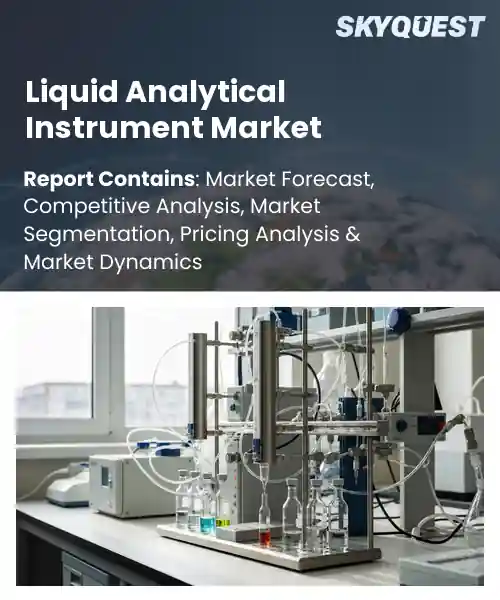
Liquid Analytical Instrument Market
Report ID: SQMIG45J2486
Report ID: SQMIG45J2486
[email protected]
USA +1 351-333-4748
Report ID:
SQMIG45J2486 |
Region:
Global |
Published Date: June, 2026
Pages:
157
|Tables:
130
|Figures:
77


Global Liquid Analytical Instrument Market size was valued at USD 495.0 Million in 2024 and is poised to grow from USD 525.19 Million in 2025 to USD 843.42 Million by 2033, growing at a CAGR of 6.1% during the forecast period (2026-2033).
Growing investments in pharmaceutical research, increasing demand for environmental testing, rising focus on food and beverage quality assurance, advancements in analytical technologies, and stringent regulatory requirements are driving sales of liquid analytical instruments.
Rising need for precise and reliable liquid analysis across multiple industries is expected to primarily drive liquid analytical instrument market growth. Increasing regulatory focus, along with complexity of analysis is another critical trend pushing market growth. High sensitivity and automated liquid analytical systems with high throughput are being adopted in laboratories in response to growing demands of testing. Growing need to detect trace impurities, monitor biologics and adhere to rigid quality standards, are replacing traditional and dated liquid analytical systems with state-of-the-art LC-MS and ion chromatography platforms, increasing the replacement business. Thus, need for consumables, software, and maintenance will grow, as there is recurrent demand and increased demand from the sector of vendors offering complete workflows and cloud enabled data management capabilities. Increased testing needs of pharmaceutical industry, environmental analysis, food & safety and biotech industry will boost market growth and stimulate innovation in this sector.
On the contrary, high instrument acquisition and maintenance costs, shortage of skilled laboratory professionals, complexity of analytical workflows, and stringent regulatory compliance requirements are anticipated to slow down liquid analytical instrument market penetration across the study period and beyond.
How is AI Improving Data Accuracy of Liquid Analytical Instruments?
AI improves the data accuracy of liquid analytical instrument market by standardizing the analysis performed manually before. Such technologies assist laboratories in providing reliable analysis results without human errors and high efficiency. AI-based software is capable of analyzing complicated chromatography and mass spectrometry data much faster and reliably compared with manual analysis. Most of instrument manufacturers have added AI in their chromatography and mass spectrometry instruments in order to simplify their routine data review and achieve excellent instrument-to-instrument (I2I) data consistency in laboratories, eliminate the operator-to-operator (O2O) variations, and enhance laboratory productivity. Such a system also ensures better cross-laboratory comparability of analysis results. Furthermore, in a regulated laboratory, AI improves the audit trail, compliance, and re-testing by increasing confidence in analysis results.
Market snapshot - (2026-2033)
Global Market Size
USD 495.0 Million
Largest Segment
pH/ORP
Fastest Growth
Nutrient Analyzers
Growth Rate
6.1% CAGR
To get more insights on this market click here to Request a Free Sample Report
Global liquid analytical instrument market is segmented by measurement parameter, instrument form factor, component, end-user industry, and region. Based on measurement parameter, the market is segmented into pH/ORP, Conductivity, Dissolved Oxygen (DO), turbidity, total organic carbon/COD/BOD, Chlorine and residual chlorine, sodium and silicate, nutrient analyzers, and others. Based on instrument form factor, the market is segmented into in-line/on-line analyzers, portable/hand-held, laboratory/benchtop, and others. Based on component, the market is segmented into analyzer unit, sensor/probe, display/controller, reagents and consumables, software and integration services, and others. Based on end-user industry, the market is segmented into water and wastewater treatment, pharmaceuticals and biotechnology, food and beverages, power and utilities, chemicals and petrochemicals, and others. Based on region, the market is segmented into North America, Europe, Asia Pacific, Latin America, and Middle East & Africa.
The pH/ORP segment is slated to account for the highest global liquid analytical instrument market share going forward. pH and ORP measurements form the basis of almost every liquid monitoring procedure and are used for instant process control and regulatory compliance. The widespread application to treatment, industrial process and lab applications along with proven low-cost sensor technology and simple controller integration fuels acquisition decisions. Their omnipresent nature sustains steady demand and established buying habits, thus guaranteeing further acquisition.
However, Dissolved Oxygen (DO) is the most rapidly expanding measurement segment. Tightened effluent constraints, emphasis on the biological process optimization and advances in optical DO sensors promote its use. Increased reliability, less maintenance and higher data accuracy unlock new applications in wastewater treatment, aquaculture, process monitoring and fresh instrument upgrade and service business.
The software and integration services segment is anticipated to lead the global liquid analytical instrument market revenue generation over the coming years. Digitalization has placed data management and connectivity at the forefront of the instrument value propositions, allowing for remote data monitoring, centralized data analytics, and automated compliance reporting. Tight integration with the control system, cloud and reduced complexity of operation and predictive maintenance allow the demand to shift toward bundled instrument and software solutions, thus generating new revenue streams for services and suppliers providing a full digital workflow over the portfolio.
Conversely, sensor/probe is emerging as the fastest growing component segment as per this liquid analytical instrument industry analysis. Fluctuations fueled by breakthroughs in miniaturized optics, low power electronics and tough materials that extend life of the equipment into field and process environments formerly constrained. The pace of innovation, availability of replacement instruments and parts and rising demand for high-quality measurement is driving development of new instruments, aftermarket services and other industries that widen market size.
To get detailed segments analysis, Request a Free Sample Report
Advanced research institutions, sophisticated pharmaceutical and biotechnology clusters, and a mature regulatory and laboratory infrastructure are helping cement the dominance of this region. An extensive original equipment manufacturer (OEM), service provider, and specialty distributor ecosystem allows for swift deployment and long-term utilization of advanced instrumentation by users. The broad-based and cross-sector use of advanced instrumentation by healthcare, environmental monitoring, food safety, and industrial quality assurance produces a diverse customer base that is receptive to innovations and premium products. Industry & academia's strong collaboration accelerates application development, and existing aftermarket and calibration services provide long-term instrument support. These components' combination of innovative capabilities, institutional demand, and service depth continues to establish the region as an anchor for future growth.
Liquid analytical instrument market in the United States reflects a commanding presence of instrument makers, contract research organizations, and major end users in pharma and clinical research. High demand for advanced separations, spectrometry, and chromatography solutions is driven by complex testing needs and cutting edge research initiatives. Well developed procurement channels and extensive service networks facilitate adoption of specialized platforms. The market environment favors customization, integrated workflows, and long term service agreements that support continuous innovation.
Liquid analytical instrument demand in Canada is characterized by concentrated centers of excellence within public laboratories, academic institutions, and resource testing facilities. The focus on environmental monitoring, health surveillance, and food safety results in a stable market requirement for robust analytical instrumentation. The market is supported by close, cross-border interaction with adjacent suppliers and by the existing service infrastructures. Laboratories value user friendly, rugged platforms coupled with technical support and application development.
Strong regulatory focus on product safety and environmental protection, coupled with a diverse industrial base spanning pharmaceuticals, chemicals, food, and advanced materials, are helping boost liquid analytical instrument sales in Europe. Increased harmonized standards and rules regarding market surveillance for products, which increase demands for high-performance analytical capabilities to be utilized by both private and public laboratories. The presence of a dense network of specialized manufacturers of analytical instruments, service companies, and application laboratories allows quick implementation of new technology within the local environment. The need for validated methods of analysis and/or custom-designed analytical methods within complex matrices has been facilitated using collaborative partnerships between research institutions and manufactures. Sustainability and traceability are also being strongly emphasized at the regional level, which creates additional applications for liquid analytical instruments. Cross-border trading and an export-based market also contribute to increased demand for locally produced, internationally compliant analytical procedures.
Sales of liquid analytical instruments in Germany is dominated by precision engineering and instrument manufacturing traditions that emphasize reliability and technical excellence. Strong ties between industrial laboratories, research institutes, and equipment suppliers promote continuous refinement of analytical platforms suited for chemical and pharmaceutical quality control. The market values rigorous validation, robust service capabilities, and export-oriented solutions that meet stringent regulatory requirements. German laboratories often drive demand for high throughput, automated systems and comprehensive method support.
Vibrant life science clusters, contract research expansion, and an evolving analytical services sector are helping shape liquid analytical instrument demand in the United Kingdom. This demand is driven by clinical studies, biotech development, and the large application research lab community which requires sensitive, high-performance instrumentation. This market desires a highly responsive supply chain, speed in deployment of instrumentation, and extensive application knowledge to help in method development. Customers want partnerships which can help speed up the commercialization of analytical methods.
Liquid analytical instrument market in France is emerging with a focus on food safety, cosmetics testing, and public health surveillance, supported by investment in modern laboratory infrastructure. Growing collaboration between national research centers and local suppliers fosters adoption of tailored analytical solutions. Laboratories seek instruments that combine robustness with regulatory compliance and user friendly operation. The market increasingly values integrated service offerings that include method support and maintenance.
Expanding research capabilities, growing industrial quality control needs, and rising local manufacturing capacity for analytical instruments are helping boost business scope in Asia Pacific. Within various countries of the region, the focus is on developing the pharmaceutical, biotechnology, and electronics industries; these industries need sophisticated, liquid analysis for research, production, and quality control. Governments and private entities are helping to create laboratory infrastructure and develop training programs to establish a well-trained technical workforce to provide high-quality laboratory results. Global manufacturers are forming strategic partnerships with local companies to transfer technology and customize solutions for regional matrices. Additionally, providing cost effective, compact and automated solutions increases accessibility, while supporting aftermarket and calibration service helps improve the reliability of analysis equipment and reduce the total cost of ownership for all types of end users.
Sales of liquid analytical instruments in Japan are anchored by strong precision manufacturing and a culture of continuous improvement that drives high quality instrumentation and automation. The demand is created by the pharmaceutical, chemical and electronics industry requiring strict analytical performance and workflows integration. Local instrument manufacturers and service providers deliver sophisticated platforms highlighting reliability, reproducibility and full system integration. Method development and long term technical support are crucial aspects of the lab choice regarding vendors.
Liquid analytical instrument market in South Korea is advancing rapidly with strong demand from semiconductor, biotechnology, and chemical testing applications that require sensitive and high throughput analysis. The market is demanding suppliers that are flexible in offering tailored solutions and fast responses. A co-operation between industry and academic research centers and domestic manufacturers will be crucial for a quick diffusion of new analytical instruments and methodologies. Focus on speed of deployment and local service is the key for the continuity of the laboratory user's work.
To know more about the market opportunities by region and country, click here to
Buy The Complete Report
Rising Demand For High Throughput Analysis
Advancements In Detection and Automation
High Capital and Operational Costs
Regulatory Compliance Complexity
Request Free Customization of this report to help us to meet your business objectives.
Competitive landscape in the global liquid analytical instrument market is driven by consolidation through targeted acquisitions, strategic software integrations, and platform innovation that reshapes service bundles. Notable moves include Waters acquisition of Wyatt Technology, vendors launching next generation LC MS platforms, and specialist firms offering retrofit upgrade kits to accelerate adoption and lower operating costs.
SkyQuest’s ABIRAW (Advanced Business Intelligence, Research & Analysis Wing) is our Business Information Services team that Collects, Collates, Correlates, and Analyses the Data collected by means of Primary Exploratory Research backed by robust Secondary Desk research.
As per SkyQuest analysis, high investments in pharmaceutical research, increasing demand for environmental testing, rising focus on food and beverage quality assurance, advancements in analytical technologies, and stringent regulatory requirements are anticipated to drive the demand for liquid analytical instruments going forward. However, high instrument acquisition and maintenance costs, shortage of skilled laboratory professionals, complexity of analytical workflows, and stringent regulatory compliance requirements are slated to slow down the adoption of liquid analytical instruments in the future. North America is slated to spearhead the demand for liquid analytical instruments owing to strong pharmaceutical and biotechnology research activities, well-established laboratory infrastructure, high regulatory compliance standards, and substantial investments in advanced analytical technologies. Development of AI-powered data analysis solutions, integration of cloud-enabled laboratory workflows, and increasing adoption of advanced chromatography and mass spectrometry platforms are anticipated to be key trends driving the liquid analytical instrument sector through 2033.
| Report Metric | Details |
|---|---|
| Market size value in 2024 | USD 495.0 Million |
| Market size value in 2033 | USD 843.42 Million |
| Growth Rate | 6.1% |
| Base year | 2024 |
| Forecast period | (2026-2033) |
| Forecast Unit (Value) | USD Million |
| Segments covered |
|
| Regions covered | North America (US, Canada), Europe (Germany, France, United Kingdom, Italy, Spain, Rest of Europe), Asia Pacific (China, India, Japan, Rest of Asia-Pacific), Latin America (Brazil, Rest of Latin America), Middle East & Africa (South Africa, GCC Countries, Rest of MEA) |
| Companies covered |
|
| Customization scope | Free report customization with purchase. Customization includes:-
|
To get a free trial access to our platform which is a one stop solution for all your data requirements for quicker decision making. This platform allows you to compare markets, competitors who are prominent in the market, and mega trends that are influencing the dynamics in the market. Also, get access to detailed SkyQuest exclusive matrix.
Table Of Content
Executive Summary
Market overview
Parent Market Analysis
Market overview
Market size
KEY MARKET INSIGHTS
COVID IMPACT
MARKET DYNAMICS & OUTLOOK
Market Size by Region
KEY COMPANY PROFILES
Methodology
For the Liquid Analytical Instrument Market, our research methodology involved a mixture of primary and secondary data sources. Key steps involved in the research process are listed below:
1. Information Procurement: This stage involved the procurement of Market data or related information via primary and secondary sources. The various secondary sources used included various company websites, annual reports, trade databases, and paid databases such as Hoover's, Bloomberg Business, Factiva, and Avention. Our team did 45 primary interactions Globally which included several stakeholders such as manufacturers, customers, key opinion leaders, etc. Overall, information procurement was one of the most extensive stages in our research process.
2. Information Analysis: This step involved triangulation of data through bottom-up and top-down approaches to estimate and validate the total size and future estimate of the Liquid Analytical Instrument Market.
3. Report Formulation: The final step entailed the placement of data points in appropriate Market spaces in an attempt to deduce viable conclusions.
4. Validation & Publishing: Validation is the most important step in the process. Validation & re-validation via an intricately designed process helped us finalize data points to be used for final calculations. The final Market estimates and forecasts were then aligned and sent to our panel of industry experts for validation of data. Once the validation was done the report was sent to our Quality Assurance team to ensure adherence to style guides, consistency & design.
Analyst Support
Customization Options
With the given market data, our dedicated team of analysts can offer you the following customization options are available for the Liquid Analytical Instrument Market:
Product Analysis: Product matrix, which offers a detailed comparison of the product portfolio of companies.
Regional Analysis: Further analysis of the Liquid Analytical Instrument Market for additional countries.
Competitive Analysis: Detailed analysis and profiling of additional Market players & comparative analysis of competitive products.
Go to Market Strategy: Find the high-growth channels to invest your marketing efforts and increase your customer base.
Innovation Mapping: Identify racial solutions and innovation, connected to deep ecosystems of innovators, start-ups, academics, and strategic partners.
Category Intelligence: Customized intelligence that is relevant to their supply Markets will enable them to make smarter sourcing decisions and improve their category management.
Public Company Transcript Analysis: To improve the investment performance by generating new alpha and making better-informed decisions.
Social Media Listening: To analyze the conversations and trends happening not just around your brand, but around your industry as a whole, and use those insights to make better Marketing decisions.
REQUEST FOR SAMPLE
 REQUEST FREE CUSTOMIZATION
Global Liquid Analytical Instrument Market size was valued at USD 495.0 Million in 2024 and is poised to grow from USD 525.19 Million in 2025 to USD 843.42 Million by 2033, growing at a CAGR of 6.1% during the forecast period (2026-2033).
Competitive landscape in the global liquid analytical instrument market is driven by consolidation through targeted acquisitions, strategic software integrations, and platform innovation that reshapes service bundles. Notable moves include Waters acquisition of Wyatt Technology, vendors launching next generation LC MS platforms, and specialist firms offering retrofit upgrade kits to accelerate adoption and lower operating costs. 'Emerson Electric', 'ABB', 'Endress+Hauser', 'Yokogawa Electric', 'Honeywell', 'Thermo Fisher Scientific', 'Danaher', 'Schneider Electric', 'Teledyne Technologies', 'Ametek', 'Shimadzu Corporation', 'Mettler Toledo', 'Metrohm', 'Agilent Technologies', 'Horiba', 'Xylem', 'Hach', 'Suez', 'Krohne', 'Analytical Sensors'
Rising demand for higher sample throughput and faster turnaround times prompts laboratories and industrial users to invest in advanced liquid analytical instruments. Manufacturers respond by expanding product portfolios with automated, multiplexed systems and improved workflows, which encourages adoption across pharmaceutical development, clinical diagnostics, environmental testing, and food safety. This cycle of user requirements driving supplier innovation strengthens market growth by increasing procurement, service, and maintenance activity, fostering long-term vendor relationships and motivating continuous technological refinement that aligns capabilities with evolving laboratory operational needs.
Ai-Driven Analytical Workflows: Adoption of artificial intelligence and advanced software is reshaping liquid analytical workflows by automating instrument control, accelerating data interpretation, enabling predictive maintenance, and enhancing method development. Seamless integration with laboratory information systems and cloud platforms supports remote operation and centralized monitoring while improving reproducibility and throughput. Machine learning-driven analysis refines signal processing and anomaly detection, elevating decision confidence and reducing manual intervention. Vendors increasingly offer software suites that scale across laboratories, fostering collaborative analytics and faster time-to-insight and standardized validation.
Why does North America Dominate the Global Liquid Analytical Instrument Market? |@12


Want to customize this report? This report can be personalized according to your needs. Our analysts and industry experts will work directly with you to understand your requirements and provide you with customized data in a short amount of time. We offer $1000 worth of FREE customization at the time of purchase.
Feedback From Our Clients


 USA (+1) 351-333-4748

