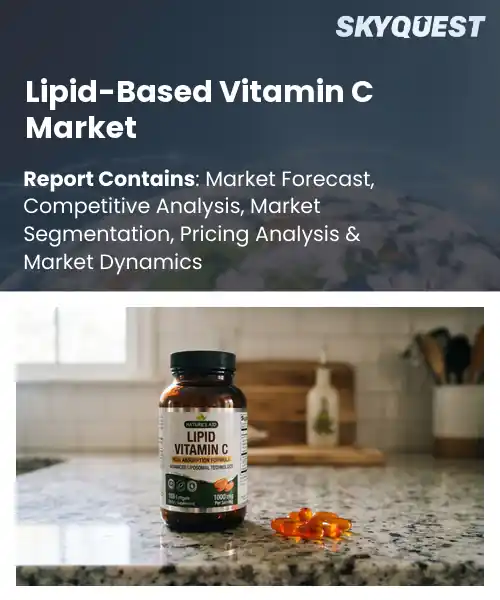
Lipid-Based Vitamin C Market
Report ID: SQMIG30L2635
Report ID: SQMIG30L2635
[email protected]
USA +1 351-333-4748
Report ID:
SQMIG30L2635 |
Region:
Global |
Published Date: September, 2026
Pages:
157
|Tables:
152
|Figures:
78


Global Lipid-Based Vitamin C Market size was valued at USD 1.19 Billion in 2024 and is poised to grow from USD 1.34 Billion in 2025 to USD 3.52 Billion by 2033, growing at a CAGR of 12.8% during the forecast period (2026-2033).
The global lipid‑based vitamin C market comprises formulations that encapsulate ascorbic acid in liposomes, nano‑emulsions or phospholipid vesicles to improve stability and bioavailability. This segment matters because conventional vitamin C degrades rapidly under heat, light, and oxygen, limiting its efficacy in functional foods, cosmetics and nutraceuticals. Development began in the early 2000s when research demonstrated that liposomal delivery could protect ascorbate and enhance cellular uptake, prompting early adopters such as the skin‑care brand SkinCeuticals to launch liposomal serums. Since then, consumer demand for high‑performance antioxidants and regulatory encouragement of advanced delivery systems have propelled steady, significant growth across the market. The dominant growth factor now is the expanding use of lipid‑based vitamin C in sports nutrition and anti‑aging formulations, where enhanced absorption translates into measurable performance and skin‑repair outcomes. When athletes incorporate liposomal C into recovery drinks, faster collagen synthesis reduces joint soreness, encouraging brand partnerships such as Red Bull’s trial with a nano‑emulsion product. Likewise, dermatologists prescribe liposomal serums to patients with photodamage, observing quicker reduction of hyperpigmentation compared with tablets, which drives premium pricing and repeat purchases. These cause‑effect dynamics attract venture capital, spur R&D into hybrid carriers, and open distribution channels from specialty pharmacies to e‑commerce platforms.
How is AI-driven formulation improving the lipid-based vitamin C market?
AI‑driven formulation applies machine‑learning models to predict how vitamin C will interact with various lipid carriers, streamlining the design of stable, high‑absorption complexes. By analyzing molecular properties and processing parameters, the technology identifies optimal emulsifiers, particle sizes and encapsulation techniques without exhausting physical experiments. This reduces development cycles, cuts waste and delivers products that retain potency longer. The lipid‑based vitamin C sector, traditionally challenged by rapid oxidation and low solubility, now benefits from faster iteration and more reliable performance data. Brands can launch innovative serums and nutraceuticals with confidence, meeting consumer demand for effective, natural‑looking solutions.BASF June 2023 announced an AI‑driven lipid encapsulation platform for vitamin C that shortened formulation time and enhanced oxidative stability, helping manufacturers bring more effective products to market faster. The system leverages predictive algorithms to select carrier oils and surfactants, reducing trial cycles and supporting scalable production across cosmetics and dietary‑supplement lines.
Market snapshot - (2026-2033)
Global Market Size
USD 1.19 Billion
Largest Segment
Liposomal Vitamin C
Fastest Growth
Vitamin C-Loaded Lipid Nanoparticles
Growth Rate
12.8% CAGR
To get more insights on this market click here to Request a Free Sample Report
Global lipid-based vitamin c market is segmented by product type, form, application, distribution channel, end user and region. Based on product type, the market is segmented into Liposomal Vitamin C, Vitamin C Esters, Lipid-Soluble Vitamin C Derivatives, Vitamin C-Loaded Lipid Nanoparticles and Others. Based on form, the market is segmented into Powder, Capsules, Tablets, Liquid, Gummies and Others. Based on application, the market is segmented into Dietary Supplements, Functional Foods and Beverages, Cosmetics and Personal Care, Pharmaceuticals and Others. Based on distribution channel, the market is segmented into Pharmacies and Drugstores, Supermarkets and Hypermarkets, Specialty Stores and Online Retail. Based on end user, the market is segmented into Adults, Children and Elderly. Based on region, the market is segmented into North America, Europe, Asia Pacific, Latin America and Middle East & Africa.
Liposomal Vitamin C segment dominates because its encapsulation technology markedly improves bioavailability, allowing consumers to experience faster antioxidant effects. The protective lipid bilayer shields the vitamin from gastric degradation, creating a premium offering that aligns with health aware preferences. Manufacturers benefit from scalable production methods, while marketers promote the perceived superiority over traditional forms, reinforcing demand across supplement and cosmetic applications. This advantage also supports higher price points, enhancing profit margins for brands.
However, Vitamin C Loaded Lipid Nanoparticles segment is witnessing the strongest growth momentum because emerging research highlights its ability to deliver sustained release and targeted skin penetration, attracting formulators in advanced cosmetics. The novelty drives collaborative R&D projects, expanding market entry opportunities and positioning this technology as a future growth engine.
Gummies segment dominates because they combine palatable taste with convenient dosing, removing barriers for regular intake among health aware adults. The chewable format aligns with snack culture, facilitating integration into daily routines without water. Manufacturers exploit sugar free formulations and natural flavor trends, enhancing acceptability for parents seeking child friendly options, thereby expanding the consumer base and reinforcing market leadership. Additionally, the packaging supports purchases, while clarity on dosage ensures safety, further solidifying its dominant position.
Meanwhile, Liquid segment is emerging as the key high growth area because its rapid dissolution enhances intestinal absorption, appealing to athletes and busy professionals. The ease of mixing into beverages drives formulation innovation, while clean label trends push companies toward natural solvents, creating fresh revenue streams and accelerating market expansion.
To get detailed segments analysis, Request a Free Sample Report
The region benefits from a mature consumer base that values premium health and cosmetic products, driving strong demand for advanced delivery technologies. Extensive research infrastructure and a high concentration of innovative firms support continual product development and differentiation. Robust regulatory frameworks provide clear pathways for product approval, encouraging investment. In addition, well‑established distribution networks and a high level of consumer awareness about antioxidant benefits reinforce market leadership, positioning North America as a benchmark for quality and efficacy in lipid‑based vitamin C solutions.
Lipid-Based Vitamin C Market in the United States thrives on a culture of nutritional transparency and a preference for scientifically backed formulations. Companies leverage cutting‑edge encapsulation techniques to meet consumer expectations for stability and bioavailability. The presence of leading research universities and biotech hubs fuels collaboration, accelerating innovation cycles and reinforcing the market’s premium positioning.
Lipid-Based Vitamin C Market in Canada reflects a strong commitment to natural health solutions and regulatory confidence. Consumer confidence is bolstered by rigorous safety standards, encouraging adoption of sophisticated delivery systems. Collaborative initiatives between industry and academia promote advancements in lipid encapsulation, while an increasing focus on personalized nutrition drives product diversification across the market.
Europe’s expansion is propelled by heightened consumer demand for functional cosmetics and preventive health products, coupled with sophisticated regulatory environments that reward innovation. A deep‑rooted tradition of scientific research encourages collaboration between pharmaceutical, nutraceutical, and cosmetic sectors, fostering the development of highly stable lipid‑based formulations. Growing awareness of sustainability and clean‑label trends motivates manufacturers to adopt greener emulsification methods, enhancing market appeal. Furthermore, well‑integrated supply chains and proactive consumer education programs amplify product visibility, establishing Europe as a dynamic hub for next‑generation vitamin C delivery.
Lipid-Based Vitamin C Market in Germany is characterized by a strong emphasis on scientific validation and high‑quality standards. Leading research institutions partner with technology firms to refine lipid encapsulation, ensuring product efficacy. Consumer preference for evidence‑based skincare and dietary supplements drives demand for sophisticated delivery formats, reinforcing Germany’s position as a dominant market within the region.
Lipid-Based Vitamin C Market in the United Kingdom is experiencing accelerated growth due to a vibrant wellness culture and rapid adoption of innovative nutraceuticals. Retail channels emphasize premium antioxidant products, while regulatory clarity supports seamless market entry for new lipid‑based solutions. Collaborative ecosystems between start‑ups and established firms stimulate product diversification, positioning the UK as the fastest growing market in Europe.
Lipid-Based Vitamin C Market in France is emerging as a niche yet influential segment, driven by a growing appetite for natural beauty and health solutions. French consumers prioritize elegant formulations that combine efficacy with sensory appeal, encouraging manufacturers to explore novel lipid carriers. Ongoing research initiatives and a supportive regulatory landscape nurture early‑stage innovation, laying the groundwork for future market expansion.
Asia Pacific is leveraging a surge in health‑conscious consumer behavior and rapid urbanization to reinforce its role in lipid‑based vitamin C innovation. Investments in advanced manufacturing capabilities and a focus on cost‑effective encapsulation technologies enable scalable production. Strong government support for nutraceutical research encourages collaborations that bridge traditional ingredients with modern delivery systems. Growing e‑commerce platforms amplify product reach, while rising disposable income fuels demand for premium antioxidant solutions, collectively advancing the region’s competitive standing on the global stage.
Lipid-Based Vitamin C Market in Japan blends a sophisticated consumer preference for high‑performance skincare with cutting‑edge technology adoption. Companies prioritize nano‑emulsion techniques to enhance skin penetration and stability, responding to meticulous quality expectations. Collaborative research between cosmetic manufacturers and academic institutes sustains a pipeline of innovative lipid‑based formulations that resonate with the Japanese market’s demand for efficacy and safety.
Lipid-Based Vitamin C Market in South Korea thrives amid a vibrant beauty culture and rapid adoption of functional cosmetics. The market emphasizes sleek, fast‑absorbing lipid carriers that align with consumer expectations for visible results. Strong alignment between biotech firms and cosmetic brands accelerates product development, while aggressive digital marketing channels expand consumer awareness, solidifying South Korea’s role as a dynamic contributor to the regional market.
To know more about the market opportunities by region and country, click here to
Buy The Complete Report
Rising Demand for Natural Antioxidants
Advancements In Lipid Encapsulation Technology
High Production Cost Challenges
Regulatory Uncertainty Across Regions
Request Free Customization of this report to help us to meet your business objectives.
The lipid‑based vitamin C market is shaped by intense rivalry as major nutraceutical groups and boutique innovators vie for differentiated delivery platforms; recent M&A such as BASF’s acquisition of a micro‑encapsulation specialist, and strategic partnerships like DSM teaming with a nanotech firm to co‑develop stable lipid vesicles, exemplify how companies use consolidation, collaborations and technology breakthroughs to secure premium formulations and expand distribution channels.
Top Player’s Company Profile
Recent Developments
SkyQuest’s ABIRAW (Advanced Business Intelligence, Research & Analysis Wing) is our Business Information Services team that Collects, Collates, Correlates, and Analyses the Data collected by means of Primary Exploratory Research backed by robust Secondary Desk research. As per SkyQuest analysis, the global lipid‑based vitamin C market is being propelled primarily by a rising demand for natural antioxidants, as consumers seek clean‑label, high‑performance solutions, while recent advancements in lipid encapsulation technology are further accelerating product innovation and shelf‑life stability. The market is led by North America, where premium health and beauty consumers drive strong adoption, and the liposomal vitamin C segment remains dominant due to its superior bioavailability and premium pricing power. However, high production‑cost challenges continue to constrain broader price competitiveness and limit entry for smaller players, tempering overall growth momentum. These dynamics are expected to shape market trajectories in the coming years.
| Report Metric | Details |
|---|---|
| Market size value in 2024 | USD 1.19 Billion |
| Market size value in 2033 | USD 3.52 Billion |
| Growth Rate | 12.8% |
| Base year | 2024 |
| Forecast period | (2026-2033) |
| Forecast Unit (Value) | USD Billion |
| Segments covered |
|
| Regions covered | North America (US, Canada), Europe (Germany, France, United Kingdom, Italy, Spain, Rest of Europe), Asia Pacific (China, India, Japan, Rest of Asia-Pacific), Latin America (Brazil, Rest of Latin America), Middle East & Africa (South Africa, GCC Countries, Rest of MEA) |
| Companies covered |
|
| Customization scope | Free report customization with purchase. Customization includes:-
|
To get a free trial access to our platform which is a one stop solution for all your data requirements for quicker decision making. This platform allows you to compare markets, competitors who are prominent in the market, and mega trends that are influencing the dynamics in the market. Also, get access to detailed SkyQuest exclusive matrix.
Table Of Content
Executive Summary
Market overview
Parent Market Analysis
Market overview
Market size
KEY MARKET INSIGHTS
COVID IMPACT
MARKET DYNAMICS & OUTLOOK
Market Size by Region
KEY COMPANY PROFILES
Methodology
For the Lipid-Based Vitamin C Market, our research methodology involved a mixture of primary and secondary data sources. Key steps involved in the research process are listed below:
1. Information Procurement: This stage involved the procurement of Market data or related information via primary and secondary sources. The various secondary sources used included various company websites, annual reports, trade databases, and paid databases such as Hoover's, Bloomberg Business, Factiva, and Avention. Our team did 45 primary interactions Globally which included several stakeholders such as manufacturers, customers, key opinion leaders, etc. Overall, information procurement was one of the most extensive stages in our research process.
2. Information Analysis: This step involved triangulation of data through bottom-up and top-down approaches to estimate and validate the total size and future estimate of the Lipid-Based Vitamin C Market.
3. Report Formulation: The final step entailed the placement of data points in appropriate Market spaces in an attempt to deduce viable conclusions.
4. Validation & Publishing: Validation is the most important step in the process. Validation & re-validation via an intricately designed process helped us finalize data points to be used for final calculations. The final Market estimates and forecasts were then aligned and sent to our panel of industry experts for validation of data. Once the validation was done the report was sent to our Quality Assurance team to ensure adherence to style guides, consistency & design.
Analyst Support
Customization Options
With the given market data, our dedicated team of analysts can offer you the following customization options are available for the Lipid-Based Vitamin C Market:
Product Analysis: Product matrix, which offers a detailed comparison of the product portfolio of companies.
Regional Analysis: Further analysis of the Lipid-Based Vitamin C Market for additional countries.
Competitive Analysis: Detailed analysis and profiling of additional Market players & comparative analysis of competitive products.
Go to Market Strategy: Find the high-growth channels to invest your marketing efforts and increase your customer base.
Innovation Mapping: Identify racial solutions and innovation, connected to deep ecosystems of innovators, start-ups, academics, and strategic partners.
Category Intelligence: Customized intelligence that is relevant to their supply Markets will enable them to make smarter sourcing decisions and improve their category management.
Public Company Transcript Analysis: To improve the investment performance by generating new alpha and making better-informed decisions.
Social Media Listening: To analyze the conversations and trends happening not just around your brand, but around your industry as a whole, and use those insights to make better Marketing decisions.
REQUEST FOR SAMPLE
 REQUEST FREE CUSTOMIZATION


Want to customize this report? This report can be personalized according to your needs. Our analysts and industry experts will work directly with you to understand your requirements and provide you with customized data in a short amount of time. We offer $1000 worth of FREE customization at the time of purchase.
Feedback From Our Clients


 USA (+1) 351-333-4748

