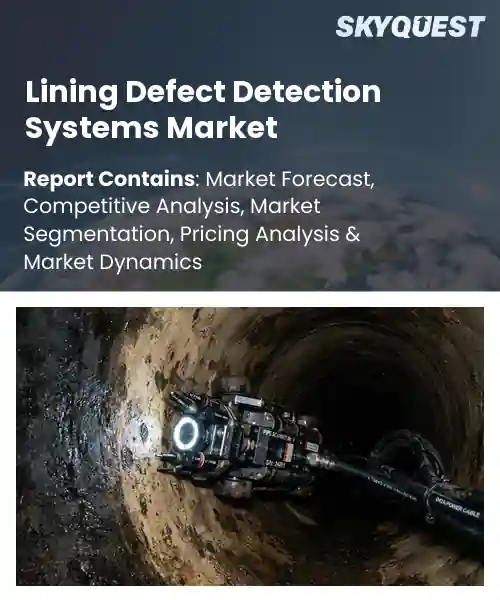
Lining Defect Detection Systems Market
Report ID: SQMIG45J2936
Report ID: SQMIG45J2936
[email protected]
USA +1 351-333-4748
Report ID:
SQMIG45J2936 |
Region:
Global |
Published Date: August, 2026
Pages:
157
|Tables:
121
|Figures:
77


Global Lining Defect Detection Systems Market size was valued at USD 624.0 Million in 2024 and is poised to grow from USD 679.54 Million in 2025 to USD 1344.12 Million by 2033, growing at a CAGR of 8.9% during the forecast period (2026-2033).
The global lining defect detection systems market supplies technologies that locate cracks, corrosion, and delamination in linings of pipelines, tanks, and aerospace structures. Its importance stems from the cost of unplanned failures, which can trigger environmental damage, production downtime, and legal liability. The market emerged in the early 2000s when ultrasonic and infrared scanners replaced visual inspections, offering higher sensitivity and faster throughput. Over the past decade, adoption accelerated as regulators in Europe and North America mandated integrity standards for oil‑and‑gas and aerospace assets. Consequently, manufacturers have invested in advanced sensor arrays and AI‑driven analytics to meet these compliance pressures.
Digital transformation drives the lining defect detection systems market because data‑rich sensors enable predictive maintenance that lowers outage risk and cost. When a pipeline operator combines real‑time ultrasonic imaging with cloud analytics, early corrosion is flagged before pressure limits are breached, prompting targeted repairs and avoiding shutdowns. This capability has spurred demand in offshore oil fields, where remote monitoring reduces crew exposure to hazards. AI‑enhanced pattern recognition speeds defect classification, allowing service firms to offer subscription inspection services that generate recurring revenue. Tightening regulatory reporting further expands the global market, prompting significant investment in modular platforms that retrofit legacy infrastructure.
How are AI and IoT enhancing the lining defect detection systems market?
AI and IoT are transforming lining defect detection by shifting the industry from periodic manual checks toward continuous automated monitoring. Machine vision and deep learning algorithms now analyze sensor data in real time, spotting cracks, corrosion, and delamination with greater accuracy and fewer false alarms than human inspectors, even on reflective or uneven surfaces. Manufacturers have invested in advanced sensor arrays and AI driven analytics to meet compliance pressures from regulators in Europe and North America. IoT devices embedded across pipelines, tanks, and vessels feed continuous data streams into cloud platforms, enabling predictive maintenance that flags deterioration before failures occur.
When a pipeline operator combines real time ultrasonic imaging with cloud analytics, early corrosion can be identified sooner than traditional methods allow. This connectivity reduces unplanned downtime, lowers inspection costs, and supports remote asset monitoring across distributed infrastructure. Integration of IoT devices for real time monitoring enables predictive maintenance and minimizes downtime, further driving market growth. Together, these technologies are pushing the market toward smarter, self learning inspection systems that improve safety, extend asset lifespans, and help industries meet increasingly strict integrity standards.
Market snapshot - (2026-2033)
Global Market Size
USD 624.0 Million
Largest Segment
Hardware
Fastest Growth
Software
Growth Rate
8.9% CAGR
To get more insights on this market click here to Request a Free Sample Report
Global lining defect detection systems market is segmented by component, technology, application, end user and region. Based on component, the market is segmented into Hardware, Software and Services. Based on technology, the market is segmented into Machine Vision, Ultrasonic Inspection, Laser Inspection and Eddy Current Inspection. Based on application, the market is segmented into Pipeline Inspection, Tank Inspection, Industrial Equipment Inspection and Manufacturing Quality Inspection. Based on end user, the market is segmented into Oil & Gas, Chemical, Water & Wastewater, Manufacturing and Mining. Based on region, the market is segmented into North America, Europe, Asia Pacific, Latin America and Middle East & Africa.
Hardware segment dominates because it provides the physical sensors and rugged enclosures essential for reliable detection of lining defects in harsh industrial environments. The robustness of advanced cameras, ultrasonic probes, and laser scanners enables continuous operation despite temperature extremes, vibration and corrosive chemicals. This foundational capability underpins system accuracy, reduces downtime and meets stringent safety standards, making hardware the critical driver of market adoption throughout the value chain globally today.
Meanwhile, Software segment is witnessing the strongest growth momentum as artificial intelligence algorithms enhance defect classification and predictive maintenance. Integrated analytics platforms enable real time visualization, remote troubleshooting and learning from inspection data. This digital layer expands system versatility, attracts users and accelerates market expansion by unlocking productivity and cost efficiency.
Machine vision technology leads because it delivers high resolution imaging that captures subtle surface anomalies on liners, enabling precise identification of cracks, corrosion and wear. Optical sensors combined with advanced image processing translate visual cues into actionable insights, supporting rapid decision making. Its adaptability to diverse lighting conditions and ability to integrate with existing control systems make it the preferred choice for operators seeking reliable non intrusive inspection solutions.
On the other hand, Laser inspection emerges as the most rapidly expanding area as manufacturers adopt fiber laser scanners for their ability to penetrate coatings and detect subsurface anomalies. Continuous advancements in laser pulse modulation improve detection depth and accuracy, meeting demanding regulatory standards. This technology opens new use cases in thick walled vessels, driving broader adoption and fostering innovative service models that accelerate market growth.
To get detailed segments analysis, Request a Free Sample Report
North America’s leadership stems from a convergence of advanced manufacturing ecosystems, strong engineering talent pools, and robust investment in automation technologies. Major industrial players prioritize asset reliability, driving demand for sophisticated defect detection solutions that minimize unplanned downtime. Regulatory frameworks encouraging safety and environmental stewardship further reinforce adoption of proactive inspection tools. Collaboration between technology providers and research institutions accelerates innovation, ensuring a pipeline of next‑generation sensors and analytics platforms. The region also benefits from well‑established supply chains and a culture of continuous improvement, enabling rapid integration of new detection systems across petrochemical, power generation, and infrastructure sectors. These combined factors create a fertile environment where market participants can scale offerings efficiently, reinforcing North America’s dominant position.
Lining Defect Detection Systems Market in the United States is propelled by a deep focus on operational resilience within large‑scale energy and manufacturing facilities. Industry leaders emphasize predictive maintenance to extend equipment life, fostering early adoption of high‑resolution imaging and AI‑driven analysis tools. Strong collaboration between academia and technology firms fuels a steady stream of innovative solutions tailored to complex infrastructure challenges. Additionally, a mature regulatory climate promotes rigorous inspection standards, encouraging investment in state‑of‑the‑art detection equipment across the country.
Lining Defect Detection Systems Market in Canada reflects a strategic emphasis on sustainability and safety within its expanding industrial base. Companies prioritize advanced inspection technologies to meet stringent environmental guidelines and to protect critical infrastructure in remote and harsh operating conditions. Partnerships between local engineering firms and global technology vendors enable customization of detection systems that address specific climatic and logistical challenges. The collaborative approach and commitment to reliability underpin steady growth of market adoption throughout the nation.
Europe’s rapid expansion is anchored by stringent environmental regulations and a strong commitment to industrial digitalization. Leaders in the region invest heavily in smart manufacturing initiatives that integrate real‑time monitoring and data analytics, creating a fertile ground for sophisticated lining defect detection solutions. Collaborative research networks across borders accelerate the development of cutting‑edge sensor technologies and machine‑learning algorithms tailored to complex process environments. Moreover, a tradition of engineering excellence and a supportive policy framework encourage adoption across the petrochemical, power, and infrastructure sectors. This synergy of regulatory pressure, innovation ecosystems, and a proactive industrial mindset fuels Europe’s accelerating market trajectory.
Lining Defect Detection Systems Market in Germany benefits from a robust engineering heritage and a focus on precision manufacturing. Companies prioritize high‑performance inspection tools to uphold rigorous quality standards and to maintain competitiveness in global supply chains. Strong ties between research institutes and industrial conglomerates foster continuous enhancement of sensor accuracy and data processing capabilities. This ecosystem supports widespread deployment of advanced detection solutions across chemical, automotive, and energy facilities throughout the country.
Lining Defect Detection Systems Market in the United Kingdom is driven by an accelerated shift toward digital transformation and heightened safety expectations within ageing industrial assets. Enterprises adopt intelligent detection platforms that combine remote monitoring with predictive analytics to mitigate risk and optimize maintenance schedules. Growing collaboration between start‑ups and established engineering firms yields innovative, cost‑effective technologies suited to diverse operational environments. The emphasis on agility and resilience positions the United Kingdom as a dynamic market leader in the sector.
Lining Defect Detection Systems Market in France is emerging through a focused effort on energy transition and infrastructure modernization. Stakeholders seek advanced defect detection to ensure compliance with evolving environmental standards while safeguarding critical plant integrity. Partnerships between French research laboratories and technology providers drive the creation of tailored solutions that address specific process challenges. This emerging momentum, supported by policy incentives for sustainability, is steadily expanding market uptake across the nation.
Asia Pacific is strengthening its position by leveraging rapid industrial expansion and a growing emphasis on operational excellence. Nations in the region are investing in automation and smart factory initiatives, creating demand for precise, reliable defect detection technologies that enhance asset performance. Collaborative ventures between local manufacturers and multinational technology firms accelerate knowledge transfer and localization of advanced sensor systems. Additionally, a focus on workforce upskilling and digital integration supports the adoption of AI‑enabled inspection tools across energy, chemical, and infrastructure sectors. This combination of investment, partnership, and skill development drives the region’s rising influence in the global market.
Lining Defect Detection Systems Market in Japan is shaped by a culture of meticulous quality control and a strong push toward Industry 4.0 adoption. Major players integrate high‑resolution imaging with sophisticated analytics to monitor complex process lines and extend equipment lifespan. Collaborative research between universities and equipment manufacturers spurs innovation in sensor miniaturization and real‑time data interpretation. This commitment to precision and technological advancement underpins steady market growth throughout the country.
Lining Defect Detection Systems Market in South Korea is propelled by a dynamic manufacturing sector that emphasizes smart automation and predictive maintenance. Companies adopt integrated detection platforms that combine IoT connectivity with advanced algorithmic analysis to preempt failures and optimize throughput. Close cooperation between technology startups and established industrial firms fosters rapid development of customized solutions suited to high‑speed production environments. This strategic focus on efficiency and innovation reinforces South Korea’s expanding role in the regional market.
To know more about the market opportunities by region and country, click here to
Buy The Complete Report
Adopting Advanced Imaging Technologies
Leveraging Cloud‑Based Analytics Platforms
High Initial Capital Investment
Complex Integration With Legacy Systems
Request Free Customization of this report to help us to meet your business objectives.
The competitive landscape is shaped by intense rivalry among technology providers leveraging advanced imaging, AI‑driven analytics, and integrated IoT platforms to secure tunnel and infrastructure integrity; recent M&A activity sees larger engineering firms absorbing niche sensor specialists, while strategic partnerships link detector manufacturers with construction conglomerates to embed real‑time monitoring into new projects, accelerating adoption across global transit networks.
Top Player’s Company Profile
SkyQuest’s ABIRAW (Advanced Business Intelligence, Research & Analysis Wing) is our Business Information Services team that Collects, Collates, Correlates, and Analyses the Data collected by means of Primary Exploratory Research backed by robust Secondary Desk research.
As per SkyQuest analysis, the global lining defect detection systems market is projected to driven primarily by the adoption of advanced imaging technologies that enable real‑time flaw identification and reduce downtime, while a second catalyst comes from cloud‑based analytics platforms that centralize data, accelerate learning and support scalable deployments. The hardware segment remains the dominant force because rugged sensors and enclosures are essential for reliable operation in harsh environments. North America leads the market due to strong industrial ecosystems, regulatory support and heavy investment in automation. However, high initial capital costs continue to restrain adoption, especially among smaller producers, tempering the overall growth pace.
| Report Metric | Details |
|---|---|
| Market size value in 2024 | USD 624.0 Million |
| Market size value in 2033 | USD 1344.12 Million |
| Growth Rate | 8.9% |
| Base year | 2024 |
| Forecast period | (2026-2033) |
| Forecast Unit (Value) | USD Million |
| Segments covered |
|
| Regions covered | North America (US, Canada), Europe (Germany, France, United Kingdom, Italy, Spain, Rest of Europe), Asia Pacific (China, India, Japan, Rest of Asia-Pacific), Latin America (Brazil, Rest of Latin America), Middle East & Africa (South Africa, GCC Countries, Rest of MEA) |
| Companies covered |
|
| Customization scope | Free report customization with purchase. Customization includes:-
|
To get a free trial access to our platform which is a one stop solution for all your data requirements for quicker decision making. This platform allows you to compare markets, competitors who are prominent in the market, and mega trends that are influencing the dynamics in the market. Also, get access to detailed SkyQuest exclusive matrix.
Table Of Content
Executive Summary
Market overview
Parent Market Analysis
Market overview
Market size
KEY MARKET INSIGHTS
COVID IMPACT
MARKET DYNAMICS & OUTLOOK
Market Size by Region
KEY COMPANY PROFILES
Methodology
For the Lining Defect Detection Systems Market, our research methodology involved a mixture of primary and secondary data sources. Key steps involved in the research process are listed below:
1. Information Procurement: This stage involved the procurement of Market data or related information via primary and secondary sources. The various secondary sources used included various company websites, annual reports, trade databases, and paid databases such as Hoover's, Bloomberg Business, Factiva, and Avention. Our team did 45 primary interactions Globally which included several stakeholders such as manufacturers, customers, key opinion leaders, etc. Overall, information procurement was one of the most extensive stages in our research process.
2. Information Analysis: This step involved triangulation of data through bottom-up and top-down approaches to estimate and validate the total size and future estimate of the Lining Defect Detection Systems Market.
3. Report Formulation: The final step entailed the placement of data points in appropriate Market spaces in an attempt to deduce viable conclusions.
4. Validation & Publishing: Validation is the most important step in the process. Validation & re-validation via an intricately designed process helped us finalize data points to be used for final calculations. The final Market estimates and forecasts were then aligned and sent to our panel of industry experts for validation of data. Once the validation was done the report was sent to our Quality Assurance team to ensure adherence to style guides, consistency & design.
Analyst Support
Customization Options
With the given market data, our dedicated team of analysts can offer you the following customization options are available for the Lining Defect Detection Systems Market:
Product Analysis: Product matrix, which offers a detailed comparison of the product portfolio of companies.
Regional Analysis: Further analysis of the Lining Defect Detection Systems Market for additional countries.
Competitive Analysis: Detailed analysis and profiling of additional Market players & comparative analysis of competitive products.
Go to Market Strategy: Find the high-growth channels to invest your marketing efforts and increase your customer base.
Innovation Mapping: Identify racial solutions and innovation, connected to deep ecosystems of innovators, start-ups, academics, and strategic partners.
Category Intelligence: Customized intelligence that is relevant to their supply Markets will enable them to make smarter sourcing decisions and improve their category management.
Public Company Transcript Analysis: To improve the investment performance by generating new alpha and making better-informed decisions.
Social Media Listening: To analyze the conversations and trends happening not just around your brand, but around your industry as a whole, and use those insights to make better Marketing decisions.
REQUEST FOR SAMPLE
 REQUEST FREE CUSTOMIZATION
Global Lining Defect Detection Systems Market size was valued at USD 624.0 Million in 2024 and is poised to grow from USD 679.54 Million in 2025 to USD 1344.12 Million by 2033, growing at a CAGR of 8.9% during the forecast period (2026-2033).
The competitive landscape is shaped by intense rivalry among technology providers leveraging advanced imaging, AI‑driven analytics, and integrated IoT platforms to secure tunnel and infrastructure integrity; recent M&A activity sees larger engineering firms absorbing niche sensor specialists, while strategic partnerships link detector manufacturers with construction conglomerates to embed real‑time monitoring into new projects, accelerating adoption across global transit networks. 'Cognex Corporation', 'Keyence Corporation', 'Teledyne Technologies Incorporated', 'Omron Corporation', 'Basler AG', 'ISRA VISION GmbH', 'Hexagon AB', 'Zebra Technologies Corporation', 'SICK AG', 'Vitronic GmbH', 'MVTec Software GmbH', 'Advantech Co., Ltd.', 'TKH Group N.V.', 'Datalogic S.p.A.', 'Stemmer Imaging AG', 'National Instruments Corporation', 'Qualitas Technologies', 'Integro Technologies Corp.', 'Vision Components GmbH', 'LMI Technologies Inc.'
Adoption of high‑resolution cameras and hyperspectral sensors enables real‑time detection of microscopic lining flaws, allowing manufacturers to intervene before defects propagate. This capability reduces scrap rates and rework, fostering confidence in automated production lines. By integrating these technologies with AI‑driven analytics, operators gain actionable insights without extensive manual inspection, shortening cycle times and supporting continuous improvement initiatives across the sector. The resulting efficiency gains also encourage broader implementation of digital quality management frameworks, further embedding defect detection systems within enterprise operational strategies.
Ai‑Driven Predictive Quality: Manufacturers are integrating advanced AI algorithms that continuously learn from sensor data to anticipate lining defects before they manifest. By correlating process variables with historical failure patterns, these systems enable proactive adjustments to material flow, temperature, and pressure, reducing scrap rates and downtime. The shift from reactive inspection to predictive quality management enhances operational resilience and aligns with broader Industry 4.0 initiatives, delivering higher throughput without compromising product integrity and supporting continuous improvement cycles across the entire manufacturing ecosystem globally.
Why does North America Dominate the Global Lining Defect Detection Systems Market? |@12


Want to customize this report? This report can be personalized according to your needs. Our analysts and industry experts will work directly with you to understand your requirements and provide you with customized data in a short amount of time. We offer $1000 worth of FREE customization at the time of purchase.
Feedback From Our Clients


 USA (+1) 351-333-4748

