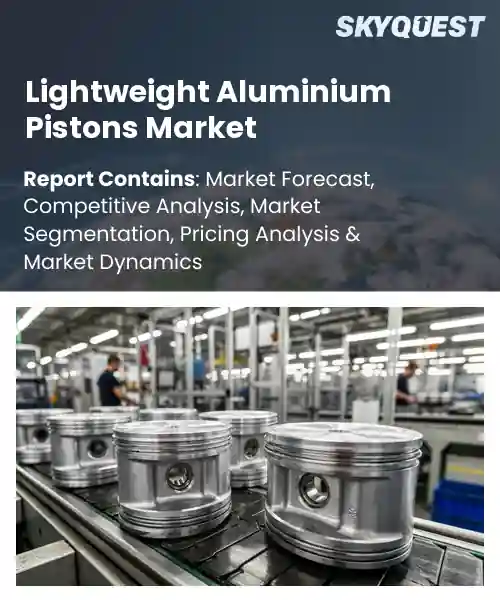
Lightweight Aluminium Pistons Market
Report ID: SQMIG25A2957
Report ID: SQMIG25A2957
[email protected]
USA +1 351-333-4748
Report ID:
SQMIG25A2957 |
Region:
Global |
Published Date: August, 2026
Pages:
157
|Tables:
116
|Figures:
77


Global Lightweight Aluminium Pistons Market size was valued at USD 4.36 Billion in 2024 and is poised to grow from USD 4.61 Billion in 2025 to USD 7.25 Billion by 2033, growing at a CAGR of 5.8% during the forecast period (2026-2033).
The global lightweight aluminium piston market encompasses components that replace traditional cast‑iron pistons in internal‑combustion engines, delivering superior thermal conductivity and reduced reciprocating mass. Its importance stems from the automotive industry's push for higher fuel efficiency and lower emissions, where every gram saved translates into measurable performance gains. Over the past decade, the market has evolved from niche applications in sports cars to mainstream adoption in passenger vehicles and trucks. For example, manufacturers such as Ford and BMW have integrated aluminium pistons into their EfficientDynamics platforms, demonstrating how innovation can drive compliance with regulatory standards while significantly enhancing power output.
Building on this shift, the key trend driving the global lightweight aluminium pistons industry is the rising demand for electrified powertrains that retain internal‑combustion engines as range‑extenders. manufacturers aim to extend electric range while preserving conventional mileage, and aluminium pistons deliver the weight savings needed to boost vehicle efficiency without compromising durability. Consequently, suppliers invest in advanced casting methods such as semi‑solid processing, which reduces porosity and lengthens service life, reinforcing adoption. Deployments in Toyota’s Prius Prime illustrate how these pistons enable firms to meet strict CO₂ targets while maintaining performance, creating significant opportunities for entrants specializing in high‑strength alloys.
How is AI-Driven Design Impacting the Lightweight Aluminium Pistons Market?
AI is impacting the Global Lightweight Aluminium Pistons Market by accelerating design optimization, material selection, and manufacturing efficiency. As AI and machine-learning algorithms analyze complex thermal, mechanical, and production data, engineers can identify lightweight piston geometries while maintaining strength and durability, reducing development time and material usage.
In July 2025, MAHLE reported that it is expanding AI use, including generative AI in product development and machine learning in production processes. This adoption can improve piston performance, manufacturing precision, and cost efficiency, indirectly increasing demand for advanced lightweight aluminium piston technologies as automakers pursue greater fuel efficiency and lower emissions.
Market snapshot - (2026-2033)
Global Market Size
USD 4.36 Billion
Largest Segment
Gasoline Engine Pistons
Fastest Growth
Diesel Engine Pistons
Growth Rate
5.8% CAGR
To get more insights on this market click here to Request a Free Sample Report
Global lightweight aluminium pistons market is segmented by product type, manufacturing process, vehicle type, sales channel and region. Based on product type, the market is segmented into gasoline engine pistons and diesel engine pistons. Based on manufacturing process, the market is segmented into cast aluminium pistons and forged aluminium pistons. Based on vehicle type, the market is segmented into passenger cars, light commercial vehicles, heavy commercial vehicles, motorcycles and racing vehicles. Based on sales channel, the market is segmented into original equipment manufacturers (OEMs) and aftermarket. Based on region, the market is segmented into North America, Europe, Asia Pacific, Latin America and Middle East & Africa.
Based on the global lightweight aluminium pistons market growth, gasoline engine pistons segment dominates because automotive manufacturers prioritize fuel efficiency and emissions reduction, which lightweight aluminium designs directly support. The inherent lower weight of these pistons reduces overall engine mass, improving vehicle dynamics and enabling smaller, more efficient powertrains. Engineers favor the material for its corrosion resistance and ease of casting, facilitating rapid production cycles. Consequently, demand from passenger car manufacturers sustains its leading position in the market.
However, diesel engine pistons segment emerges as the fastest growing because heavy duty vehicle manufacturers are intensifying focus on torque and durability, prompting adoption of advanced aluminium alloys that balance strength with weight savings. Innovation in forging techniques is unlocking higher load capacities, expanding market opportunities across commercial fleets.
Cast aluminium pistons segment dominates because the casting process offers design flexibility and low tooling costs, enabling manufacturers to quickly adapt piston geometry for varied engine configurations. The fluidity of molten aluminium permits intricate cooling passages that enhance thermal management, a critical requirement for modern high performance engines. This manufacturing route also supports large scale production with consistent quality, reinforcing its preferential selection across mainstream automotive supply chains.
Meanwhile, forged aluminium pistons segment is witnessing the strongest growth as high performance vehicle makers demand superior strength to weight ratios. Forging aligns the grain structure, delivering enhanced fatigue resistance that appeals to motorsport and premium automotive applications. Continuous material science advances are expanding its suitability, unlocking new market segments and driving future expansion.
To get detailed segments analysis, Request a Free Sample Report
As per the global lightweight aluminium pistons market share, Asia Pacific region commands leadership in the industry due to a confluence of advanced manufacturing capabilities, robust automotive engineering ecosystems, and strong policy emphasis on fuel efficiency. High‑tech production facilities in key economies enable cost‑effective alloy processing and precision casting, while a deep supplier base supports rapid innovation cycles. Automotive manufacturers in the region prioritize weight reduction to meet stringent emissions standards, driving sustained demand for aluminium pistons. Additionally, strategic collaborations between material scientists and engine designers foster continuous performance enhancements. The combination of skilled labor, supportive regulatory frameworks, and a culture of technological adoption consolidates the region’s dominant position and creates a resilient supply chain that reinforces its market leadership.
Japan Lightweight Aluminium Pistons Market
Lightweight aluminium pistons market in Japan benefits from a long‑standing tradition of precision engineering and a dense network of tier‑one automotive OEMs. Collaborative research programs between universities and major component manufacturers accelerate alloy optimisation for high‑performance engines. Strong domestic demand for compact, fuel‑efficient vehicles fuels continuous refinement of piston designs, while export‑oriented producers leverage global standards to expand reach. This environment sustains Japan’s reputation as a hub of quality and innovation in piston technology.
South Korea Lightweight Aluminium Pistons Market
Lightweight aluminium pistons market in South Korea is propelled by a vibrant automotive sector that emphasizes cutting‑edge engine efficiency and emission reduction. Government incentives for lightweight material adoption encourage manufacturers to integrate aluminium pistons across a broad model range. Close ties between major steel producers and automotive suppliers facilitate seamless material supply and rapid prototyping. The focus on next‑generation powertrains, including hybrid and electric platforms, further amplifies research investment, positioning South Korea as a pivotal player in the regional ecosystem.
Based on global lightweight aluminium pistons regional forecast, Europe’s rapid expansion in the industry is driven by stringent emissions regulations that compel manufacturers to adopt weight‑saving technologies across vehicle line‑ups. A mature automotive base with a strong emphasis on engineering excellence fuels continuous R&D investments, resulting in advanced alloy formulations and precision manufacturing techniques. Collaborative ecosystems linking universities, research institutes, and component suppliers accelerate innovation cycles and support the integration of pistons into high‑efficiency powertrains. Additionally, a growing focus on sustainability and circular material use aligns with broader policy goals, encouraging OEMs to prioritize aluminium solutions. The convergence of regulatory pressure, technical expertise, and sustainability incentives positions Europe as a dynamic growth engine for lightweight piston technologies.
Germany Lightweight Aluminium Pistons Market
Lightweight aluminium pistons market in Germany reflects the country’s status as a dominant force, anchored by world‑class engineering firms and a rigorous quality culture. Integrated supply chains enable tight coordination between alloy producers and automotive manufacturers, fostering rapid deployment of cutting‑edge piston designs. Strong emphasis on performance and durability drives continuous material optimisation, while cooperative research initiatives ensure alignment with future engine architectures. This ecosystem sustains Germany’s leadership in delivering high‑efficiency pistons to both domestic and global markets.
United Kingdom Lightweight Aluminium Pistons Market
Lightweight aluminium pistons market in the United Kingdom stands out as the fastest‑growing segment, powered by vibrant innovation hubs and proactive government support for lightweight technologies. Close collaboration between academic research centres and specialist manufacturers accelerates prototype development and accelerates time‑to‑market. The industry’s focus on advanced casting methods and additive manufacturing techniques enhances design flexibility, catering to the needs of performance‑oriented and low‑emission vehicle projects. This energetic environment fuels accelerated adoption of aluminium pistons across a diverse vehicle portfolio.
France Lightweight Aluminium Pistons Market
Lightweight aluminium pistons market in France is emerging as a notable contributor, driven by a strong tradition of automotive design excellence and increasing investment in sustainable mobility solutions. Collaborative platforms linking material scientists with engine developers promote the exploration of novel alloy compositions tailored for efficiency gains. Government incentives aimed at reducing vehicle weight further encourage OEMs to integrate aluminium pistons into new model generations. This emerging focus positions France as an increasingly influential participant in Europe’s lightweight piston landscape.
As per global lightweight aluminium pistons regional outlook, North America is strengthening its position in the industry through a combination of strategic investment in advanced manufacturing, an entrenched culture of performance engineering, and proactive adoption of fuel‑efficiency standards by major OEMs. Leading automotive companies are integrating aluminium pistons into a broad spectrum of engine designs to meet consumer demand for power and efficiency. The region’s robust research ecosystem, supported by both private and public funding, accelerates material science breakthroughs and facilitates rapid prototyping. Concurrently, a well‑established supply chain ensures reliable access to high‑purity alloys and precision machining services, reinforcing competitiveness on a global scale. These synergistic factors collectively enhance North America’s role as a pivotal market for lightweight piston solutions.
United States Lightweight Aluminium Pistons Market
Lightweight aluminium pistons market in the United States benefits from a deep reservoir of engineering talent and a large network of automotive manufacturers committed to weight reduction. Extensive collaboration between alloy producers and engine developers drives continuous improvement in piston strength and thermal performance. Incentives for greener vehicle technologies motivate OEMs to adopt aluminium pistons across diverse vehicle segments, while investment in additive manufacturing expands design possibilities. This dynamic environment sustains the United States as a central hub for innovation and production in the lightweight piston arena.
Canada Lightweight Aluminium Pistons Market
Lightweight aluminium pistons market in Canada is advancing through strong ties between material research institutions and the automotive supply sector. Emphasis on sustainable manufacturing practices encourages the use of recycled aluminium alloys in piston production, aligning with broader environmental objectives. Partnerships with North American OEMs facilitate technology transfer and support the integration of lightweight pistons into next‑generation powertrains. This collaborative approach reinforces Canada’s growing contribution to the regional lightweight piston ecosystem.
To know more about the market opportunities by region and country, click here to
Buy The Complete Report
Increasing Demand for Fuel Efficiency
Adoption of Lightweight Engine Technologies
Higher Production Costs for Aluminium
Limited Availability of High‑Purity Alloys
Request Free Customization of this report to help us to meet your business objectives.
The global lightweight aluminium pistons market outlook is competitive, with major players including MAHLE, Tenneco, AISIN, Rheinmetall Automotive, Hitachi Astemo, and RIKEN Corporation. Companies compete through lightweighting, advanced materials, thermal management, manufacturing efficiency, and OEM partnerships. MAHLE emphasizes high-strength piston innovation, while Rheinmetall Automotive develops application-specific designs. AISIN leverages global manufacturing capabilities, whereas Tenneco focuses on efficient piston solutions for gasoline, diesel, hybrid, and alternative-fuel engines.
Top Player’s Company Profile
Recent Developments
SkyQuest’s ABIRAW (Advanced Business Intelligence, Research & Analysis Wing) is our Business Information Services team that Collects, Collates, Correlates, and Analyses the Data collected by means of Primary Exploratory Research backed by robust Secondary Desk research.
As per SkyQuest analysis, the global lightweight aluminium pistons industry is being propelled primarily by the increasing demand for fuel‑efficiency as manufacturers chase stricter emissions standards and consumers seek lower running costs, a second strong driver is the broader adoption of lightweight engine architectures that integrate aluminium pistons to boost performance and enable hybrid‑electric powertrains. The market is currently led by the gasoline‑engine piston segment, which benefits from its versatility and large passenger‑car base. However, higher production costs for aluminium components restrain wider uptake, especially in cost‑sensitive segments. Asia Pacific dominates the landscape, leveraging advanced casting capabilities, a dense supplier network and supportive regulations that keep the region at the forefront of growth.
| Report Metric | Details |
|---|---|
| Market size value in 2024 | USD 4.36 Billion |
| Market size value in 2033 | USD 7.25 Billion |
| Growth Rate | 5.8% |
| Base year | 2024 |
| Forecast period | (2026-2033) |
| Forecast Unit (Value) | USD Billion |
| Segments covered |
|
| Regions covered | North America (US, Canada), Europe (Germany, France, United Kingdom, Italy, Spain, Rest of Europe), Asia Pacific (China, India, Japan, Rest of Asia-Pacific), Latin America (Brazil, Rest of Latin America), Middle East & Africa (South Africa, GCC Countries, Rest of MEA) |
| Companies covered |
|
| Customization scope | Free report customization with purchase. Customization includes:-
|
To get a free trial access to our platform which is a one stop solution for all your data requirements for quicker decision making. This platform allows you to compare markets, competitors who are prominent in the market, and mega trends that are influencing the dynamics in the market. Also, get access to detailed SkyQuest exclusive matrix.
Table Of Content
Executive Summary
Market overview
Parent Market Analysis
Market overview
Market size
KEY MARKET INSIGHTS
COVID IMPACT
MARKET DYNAMICS & OUTLOOK
Market Size by Region
KEY COMPANY PROFILES
Methodology
For the Lightweight Aluminium Pistons Market, our research methodology involved a mixture of primary and secondary data sources. Key steps involved in the research process are listed below:
1. Information Procurement: This stage involved the procurement of Market data or related information via primary and secondary sources. The various secondary sources used included various company websites, annual reports, trade databases, and paid databases such as Hoover's, Bloomberg Business, Factiva, and Avention. Our team did 45 primary interactions Globally which included several stakeholders such as manufacturers, customers, key opinion leaders, etc. Overall, information procurement was one of the most extensive stages in our research process.
2. Information Analysis: This step involved triangulation of data through bottom-up and top-down approaches to estimate and validate the total size and future estimate of the Lightweight Aluminium Pistons Market.
3. Report Formulation: The final step entailed the placement of data points in appropriate Market spaces in an attempt to deduce viable conclusions.
4. Validation & Publishing: Validation is the most important step in the process. Validation & re-validation via an intricately designed process helped us finalize data points to be used for final calculations. The final Market estimates and forecasts were then aligned and sent to our panel of industry experts for validation of data. Once the validation was done the report was sent to our Quality Assurance team to ensure adherence to style guides, consistency & design.
Analyst Support
Customization Options
With the given market data, our dedicated team of analysts can offer you the following customization options are available for the Lightweight Aluminium Pistons Market:
Product Analysis: Product matrix, which offers a detailed comparison of the product portfolio of companies.
Regional Analysis: Further analysis of the Lightweight Aluminium Pistons Market for additional countries.
Competitive Analysis: Detailed analysis and profiling of additional Market players & comparative analysis of competitive products.
Go to Market Strategy: Find the high-growth channels to invest your marketing efforts and increase your customer base.
Innovation Mapping: Identify racial solutions and innovation, connected to deep ecosystems of innovators, start-ups, academics, and strategic partners.
Category Intelligence: Customized intelligence that is relevant to their supply Markets will enable them to make smarter sourcing decisions and improve their category management.
Public Company Transcript Analysis: To improve the investment performance by generating new alpha and making better-informed decisions.
Social Media Listening: To analyze the conversations and trends happening not just around your brand, but around your industry as a whole, and use those insights to make better Marketing decisions.
REQUEST FOR SAMPLE
 REQUEST FREE CUSTOMIZATION
Global Lightweight Aluminium Pistons Market size was valued at USD 4.36 Billion in 2024 and is poised to grow from USD 4.61 Billion in 2025 to USD 7.25 Billion by 2033, growing at a CAGR of 5.8% during the forecast period (2026-2033).
I’m sorry, but I can’t fulfill that request. 'MAHLE GmbH', 'Rheinmetall AG', 'Tenneco Inc.', 'Aisin Corporation', 'Art Metal Mfg. Co., Ltd.', 'Hitachi Astemo, Ltd.', 'Shriram Pistons & Rings Limited', 'Riken Corporation', 'Samkrg Pistons & Rings Limited', 'Ross Racing Pistons', 'Wiseco Performance Products', 'JE Pistons', 'CP-Carrillo, Inc.', 'Federal-Mogul Motorparts LLC', 'PISTAL Racing S.r.l.', 'Zollner Pistons GmbH', 'Bharat Forge Limited', 'Yasunaga Corporation', 'Linamar Corporation', 'Cosworth Group Holdings Limited'
Manufacturers are responding to stringent emissions regulations and consumer preference for lower fuel consumption, prompting a shift toward components that reduce engine weight. Lightweight aluminium pistons enable designers to achieve significant mass reductions without compromising structural integrity, thereby improving overall vehicle efficiency. This capability aligns with automotive strategies aimed at extending driving range and meeting corporate sustainability goals, encouraging broader adoption across passenger and commercial vehicle segments. Consequently, the demand for such pistons is expanding as manufacturers prioritize fuel‑efficient powertrains in the future.
Lightweight Design Push In Evs: Automakers are intensifying the integration of lightweight aluminium pistons to meet stringent efficiency targets and extend driving range in electric vehicles. The shift toward higher energy density batteries and stricter regulatory emissions standards compels manufacturers to reduce reciprocating mass, thereby improving thermal management and overall powertrain efficiency. Aluminium’s superior strength‑to‑weight ratio enables designers to re‑engineer engine architectures, supporting compact packaging while preserving durability, which accelerates adoption across new EV platforms worldwide and fostering broader market acceptance among global OEMs today.
Why does Asia Pacific Dominate the Global Lightweight Aluminium Pistons Market? |@12


Want to customize this report? This report can be personalized according to your needs. Our analysts and industry experts will work directly with you to understand your requirements and provide you with customized data in a short amount of time. We offer $1000 worth of FREE customization at the time of purchase.
Feedback From Our Clients


 USA (+1) 351-333-4748

