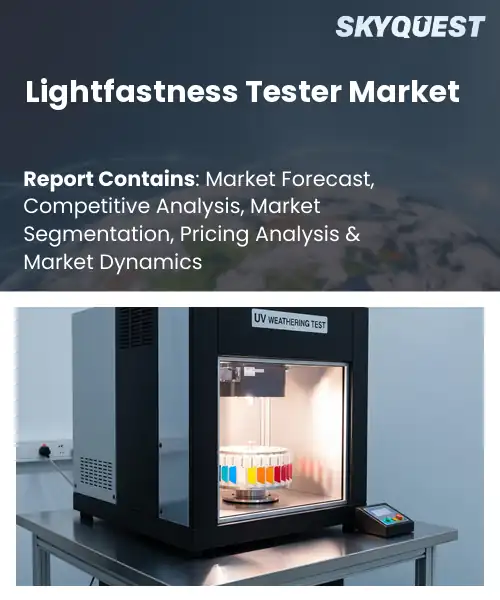
Lightfastness Tester Market
Report ID: SQMIG45J2706
Report ID: SQMIG45J2706
[email protected]
USA +1 351-333-4748
Report ID:
SQMIG45J2706 |
Region:
Global |
Published Date: July, 2026
Pages:
157
|Tables:
146
|Figures:
78


Global Lightfastness Tester Market size was valued at USD 146.3 Million in 2024 and is poised to grow from USD 154.64 Million in 2025 to USD 240.95 Million by 2033, growing at a CAGR of 5.7% during the forecast period (2026-2033).
The global market of lightfastness testers provides measuring devices for assessing pigment, ink, and coating lightfastness. The significance of the market is derived from the needs of the producers of automotive products, textiles, and fine arts who require the durability of their products and conformity to standards such as ISO 105-B02. The market appeared in the early 2000s amid the development of digital printing and inadequacy of conventional color matching. Companies such as X-Rite and BYK-Gardner started developing portable spectrophotometers equipped with accelerated aging units that allowed for quick lightfastness assessment. In recent years, the increasing demand of consumers for longevity and environmental consciousness have driven the usage of lightfastness tests.
Extending from the quality control aspect of the market, the driver for its growth is the rise in sustainable packaging and low-VOC ink, where documentation on color stability is needed in order to satisfy the criteria of sustainability. With the implementation of the outdoor exposure requirements by the government, more film producers are conducting accelerated UV tests to validate their products, leading instrument suppliers to install modular LED chambers and predictive software. A renowned makeup company has even installed portable lightfastness testers in order to validate their colors for lipsticks and save up 12 percent in rework cycles.
How are AI and IoT Integration Shaping the Lightfastness Tester Market?
AI and the Internet of Things (IoT) have been creating intelligent lightfastness testers, which connect and self-optimize. Sensors are collecting real-time data on spectra, while edge AI algorithms clean the data from noise and forecast the deterioration process. Cloud platforms collect the data from several labs at once, providing remote access and quick calibration changes. All these features minimize human labor, reduce test times and increase accuracy, making the technology highly valuable for companies that need more productivity and tracking abilities. Thus, the market is gradually moving from simple hardware to software-driven services.
Market snapshot - (2026-2033)
Global Market Size
USD 146.3 Million
Largest Segment
UV Lightfastness Testers
Fastest Growth
Xenon Arc Lightfastness Testers
Growth Rate
5.7% CAGR
To get more insights on this market click here to Request a Free Sample Report
Global lightfastness tester market is segmented by product type, test standard, application, end user, installation and region. Based on product type, the market is segmented into Xenon Arc Lightfastness Testers, UV Lightfastness Testers and Carbon Arc Lightfastness Testers. Based on test standard, the market is segmented into ISO, ASTM, AATCC and DIN. Based on application, the market is segmented into Textiles, Paints & Coatings, Plastics, Automotive Materials and Printing Inks. Based on end user, the market is segmented into Testing Laboratories, Manufacturing Industries and Research Institutes. Based on installation, the market is segmented into Benchtop and Floor-Standing. Based on region, the market is segmented into North America, Europe, Asia Pacific, Latin America and Middle East & Africa.
Xenon Arc Lightfastness Testers segment is dominant since it provides an accurate imitation of the wide range of the natural sunlight spectrum, making it possible to precisely evaluate the light resistance of materials in various conditions. The reliability and consistency of the devices in terms of intensity and spectrum make them more preferred for high-end testing applications.
On the other hand, UV Lightfastness Testers segment is the fastest-growing one, mainly because of the rising need for smaller, more energy-efficient testing devices in portable or inline quality control processes. The ability of UV light testers to focus on specific bands of the UV spectrum corresponds with modern material compositions.
The Plastics Segment is the largest as the extensive usage of plastic material in everyday consumer packaging, automobile parts, and medical devices calls for the same shade of color throughout the life span of the material. As the range of polymers varies, different conditions of exposure become necessary, and therefore the producers turn to complex testing systems.
Regulatory pressures associated with product durability and sustainability create the need for proof of performance, while product differentiation through visual stability makes testing indispensable, thus making light fastness testing an essential aspect of product development process in the industry. The Automotive Materials Segment is the fastest growing one as more and more advanced paint technologies are being used.
To get detailed segments analysis, Request a Free Sample Report
North America dominates the Lightfastness Tester market due to the presence of an advanced research landscape, supply chain efficiency, and the high number of innovators in printing, textiles, and art preservation industries. This region enjoys great synergy between academics and businesses, resulting in accelerated growth of innovative testing techniques. An advanced regulatory framework promotes adherence to stringent quality standards, thereby increasing the need for precise measuring instruments. Advanced investments in digitization enable the adoption of data analytics techniques, adding more value to sophisticated testers. In addition, the presence of top brands and a competent engineering force ensures a continuous cycle of product improvement and acceptance, contributing further to the dominant position of North America in this market.
US Lightfastness Tester Market is fueled by the existence of a multitude of laboratories as well as the presence of innovation that drives the use of advanced technology. The synergy that exists between universities and commercial manufacturers ensures timely transfer of technology, while end users from various industries provide sustained demand for testing equipment. Regulations stress the need for reliability of products, which results in manufacturers focusing on validation processes.
Lightfastness Tester Market in Canada benefits from a collaborative environment that merges governmental research funding with private sector expertise. Strong emphasis on sustainable practices drives interest in testing solutions that verify durability of eco‑friendly pigments and coatings. Academic institutions renowned for material science contribute to a pipeline of skilled professionals, while close proximity to the United States supply network ensures access to the latest instrumentation, supporting steady market growth.
The European Lightfastness Tester market thrives on the synergy of tough quality demands, rich traditions of art preservation and progressive industry standards. The concern for environmental protection drives suppliers of lightfastness testing systems to produce technologies that confirm sustainability of pigment and coating products used. Research hubs, located in Germany, the UK and France provide a platform for fast innovation process, and the presence of professional distribution channels guarantees smooth market entry. Digitalization of the data management process in the course of testing adds value to the product for the user and contributes to the image of Europe as the center of quality testing technologies.
German Lightfastness Tester Market is indeed the most powerful one in all of Europe due to its history of precise engineering and abundance of institutes of material science research. Manufacturers attach great importance to strict testing and standardization because they supply their products to such industries as automobile paint and heritage conservation, where high quality is critical. Industry organizations and policymakers collaborate tightly and form an environment that favors reliability.
The Lightfastness Tester Market in the UK has the highest growth rate, fueled by a dynamic combination of the creative industry and high technology industry. Academic collaboration speeds up the process of coming up with new technologies, and innovations are encouraged by incentives from the government. Leading institutes in the field of art restoration give rise to a niche demand for precision testers, and the increasing digital fabrication industry requires an integrated testing solution.
Market for Lightfastness Tester in France is evolving into an energetic sector, thanks to increasing focus on preservation of cultural heritage and rising interest in the development of sustainable materials. French research labs give importance to cross‑discipline research involving chemistry, physics, and conservation science, which leads to the requirement of equipment used for testing purposes. New start-ups specializing in pigments verification through eco-friendly means add their unique insights to this rising market.
Asia Pacific is growing as a force to reckon with in the Lightfastness Tester industry due to a variety of factors, including fast-paced industrial development, creativity in the region, and the backing by governments in the use of technologies. The rising electronics and printing industries in the region need accurate testing to measure the longevity of their products, hence leading to investments in testing solutions that are of high precision. There are collaborations within university and research parks together with new firms within the region that spur innovation and affordable testing solutions.
Lightfastness Tester Market in Japan benefits from a culture of meticulous quality assurance and a strong foundation in optical instrumentation. Established manufacturers integrate sophisticated sensor technologies with robust data analytics, serving demanding applications in automotive coatings, electronics and fine arts. Government‑backed research programs encourage continuous improvement of testing standards, while close ties between academia and industry ensure a pipeline of technical talent that sustains market sophistication.
South Korean Lightfastness Tester Market is marked by an exciting combination of advanced manufacturing skills and increasing value of art conservation. Fast development in the semiconductor and display industries makes the need for accurate tests of pigment longevity and coating efficiency grow. Innovation networks enable collaborative development of miniaturized and high-resolution testers while policy environments encourage investments in research.
To know more about the market opportunities by region and country, click here to
Buy The Complete Report
Increasing Demand for Durable Prints
Advancements in UV Simulation Technology
High Cost of Precision Instruments
Limited Standardization Across Regions
Request Free Customization of this report to help us to meet your business objectives.
The competition is led by major IT service providers like Cognizant, IBM, Hewlett-Packard, Capgemini, Tata Consultancy Services and Infosys, who are creating competitive advantage through acquisitions, strategic alliances with material makers and integration of AI-based testing technologies.
Recent Developments in the Lightfastness Tester Market
SkyQuest’s ABIRAW (Advanced Business Intelligence, Research & Analysis Wing) is our Business Information Services team that Collects, Collates, Correlates, and Analyses the Data collected by means of Primary Exploratory Research backed by robust Secondary Desk research.
As per SkyQuest analysis, the global lightfastness tester market is driven primarily by the increasing need for color stability tests on durable prints, while another critical factor driving the market is the growing trend toward sustainable ink and coating solutions requiring certification in terms of their resistance to fading. The high cost of precision equipment continues to be one of the primary constraints restricting small businesses from adopting them. North America dominates the market due to the highly developed research environment and regulations, and in terms of products, the xenon arc lightfastness tester sub-segment commands the highest market share owing to its sun-simulation capabilities.
| Report Metric | Details |
|---|---|
| Market size value in 2024 | USD 146.3 Million |
| Market size value in 2033 | USD 240.95 Million |
| Growth Rate | 5.7% |
| Base year | 2024 |
| Forecast period | (2026-2033) |
| Forecast Unit (Value) | USD Million |
| Segments covered |
|
| Regions covered | North America (US, Canada), Europe (Germany, France, United Kingdom, Italy, Spain, Rest of Europe), Asia Pacific (China, India, Japan, Rest of Asia-Pacific), Latin America (Brazil, Rest of Latin America), Middle East & Africa (South Africa, GCC Countries, Rest of MEA) |
| Companies covered |
|
| Customization scope | Free report customization with purchase. Customization includes:-
|
To get a free trial access to our platform which is a one stop solution for all your data requirements for quicker decision making. This platform allows you to compare markets, competitors who are prominent in the market, and mega trends that are influencing the dynamics in the market. Also, get access to detailed SkyQuest exclusive matrix.
Table Of Content
Executive Summary
Market overview
Parent Market Analysis
Market overview
Market size
KEY MARKET INSIGHTS
COVID IMPACT
MARKET DYNAMICS & OUTLOOK
Market Size by Region
KEY COMPANY PROFILES
Methodology
For the Lightfastness Tester Market, our research methodology involved a mixture of primary and secondary data sources. Key steps involved in the research process are listed below:
1. Information Procurement: This stage involved the procurement of Market data or related information via primary and secondary sources. The various secondary sources used included various company websites, annual reports, trade databases, and paid databases such as Hoover's, Bloomberg Business, Factiva, and Avention. Our team did 45 primary interactions Globally which included several stakeholders such as manufacturers, customers, key opinion leaders, etc. Overall, information procurement was one of the most extensive stages in our research process.
2. Information Analysis: This step involved triangulation of data through bottom-up and top-down approaches to estimate and validate the total size and future estimate of the Lightfastness Tester Market.
3. Report Formulation: The final step entailed the placement of data points in appropriate Market spaces in an attempt to deduce viable conclusions.
4. Validation & Publishing: Validation is the most important step in the process. Validation & re-validation via an intricately designed process helped us finalize data points to be used for final calculations. The final Market estimates and forecasts were then aligned and sent to our panel of industry experts for validation of data. Once the validation was done the report was sent to our Quality Assurance team to ensure adherence to style guides, consistency & design.
Analyst Support
Customization Options
With the given market data, our dedicated team of analysts can offer you the following customization options are available for the Lightfastness Tester Market:
Product Analysis: Product matrix, which offers a detailed comparison of the product portfolio of companies.
Regional Analysis: Further analysis of the Lightfastness Tester Market for additional countries.
Competitive Analysis: Detailed analysis and profiling of additional Market players & comparative analysis of competitive products.
Go to Market Strategy: Find the high-growth channels to invest your marketing efforts and increase your customer base.
Innovation Mapping: Identify racial solutions and innovation, connected to deep ecosystems of innovators, start-ups, academics, and strategic partners.
Category Intelligence: Customized intelligence that is relevant to their supply Markets will enable them to make smarter sourcing decisions and improve their category management.
Public Company Transcript Analysis: To improve the investment performance by generating new alpha and making better-informed decisions.
Social Media Listening: To analyze the conversations and trends happening not just around your brand, but around your industry as a whole, and use those insights to make better Marketing decisions.
REQUEST FOR SAMPLE
 REQUEST FREE CUSTOMIZATION
Global Lightfastness Tester Market size was valued at USD 146.3 Million in 2024 and is poised to grow from USD 154.64 Million in 2025 to USD 240.95 Million by 2033, growing at a CAGR of 5.7% during the forecast period (2026-2033).
The market is dominated by large IT service firms such as Cognizant, IBM, Hewlett‑Packard, Capgemini, Tata Consultancy Services and Infosys, which are leveraging strategic acquisitions, joint ventures with material manufacturers and rapid integration of AI‑driven testing platforms to differentiate their lightfastness testing services and capture high‑value contracts. 'Atlas Material Testing Technology LLC', 'Q-Lab Corporation', 'Ametek, Inc.', 'SDL Atlas LLC', 'James Heal Ltd.', 'Texcare Instruments Ltd.', 'Labthink Instruments Co., Ltd.', 'TESTEX Textile Testing Equipment', 'Qualitest International Inc.', 'Presto Stantest Pvt. Ltd.', 'Uster Technologies AG', 'Roaches International Ltd.', 'Haida International Equipment Co., Ltd.', 'Gester International Co., Ltd.', 'ChiuVention Intelligence Technology Co., Ltd.', 'SUGA Test Instruments Co., Ltd.', 'Shirley Technologies Limited', 'Dongguan Hongtuo Instrument Co., Ltd.', 'Torontech Group International', 'Tinius Olsen Testing Machine Company'
Manufacturers of textiles, signage and packaging seek solutions that keep colors vibrant despite prolonged sunlight exposure, prompting adoption of lightfastness testing equipment. This need drives investment in advanced testers that simulate real‑world UV conditions, enabling product developers to validate formulations before launch. As brand reputation increasingly depends on long‑term visual quality, companies prioritize reliable testing, thereby expanding the market for instruments that provide precise, repeatable measurements of color stability under accelerated aging. These instruments also support compliance and facilitate product cycles, reinforcing their strategic importance across industry segments.
Sustainable Ink Formulations Driving Demand: Manufacturers of printing inks and coatings are prioritizing low‑environmental‑impact formulations, prompting customers to require rigorous verification of colour stability under prolonged light exposure. Lightfastness testers enable rapid screening of eco‑friendly pigments, ensuring compliance with emerging green certifications and consumer expectations for durability. This shift elevates the importance of portable, energy‑efficient testing equipment that integrates seamlessly with digital workflow platforms, fostering broader adoption across textile, packaging, and graphic arts sectors seeking to balance performance with sustainability commitments through strategic supplier collaboration.
Why does North America Dominate the Global Lightfastness Tester Market? |@12


Want to customize this report? This report can be personalized according to your needs. Our analysts and industry experts will work directly with you to understand your requirements and provide you with customized data in a short amount of time. We offer $1000 worth of FREE customization at the time of purchase.
Feedback From Our Clients


 USA (+1) 351-333-4748

