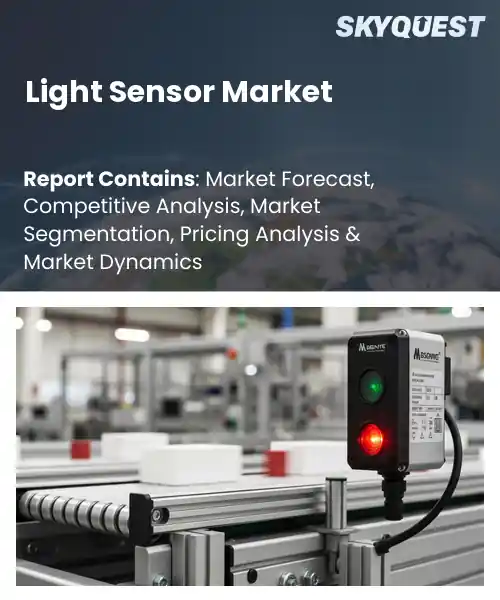
Light Sensor Market
Report ID: SQMIG20X2030
Report ID: SQMIG20X2030
[email protected]
USA +1 351-333-4748
Report ID:
SQMIG20X2030 |
Region:
Global |
Published Date: June, 2026
Pages:
157
|Tables:
115
|Figures:
77


Global Light Sensor Market size was valued at USD 8.7 Billion in 2024 and is poised to grow from USD 9.23 Billion in 2025 to USD 14.82 Billion by 2033, growing at a CAGR of 6.1% during the forecast period (2026-2033).
High adoption of consumer electronics, increasing deployment of smart lighting systems, rising demand for advanced automotive safety technologies, advancements in sensor manufacturing, and expanding use of IoT-enabled devices are driving sales of light sensors.
Growing penetration of connected and smart technologies is a driver for this market. Low sensor costs and advancements in semiconductor fabrication technologies is likely to be a key factor, fueling the growth of this market. Increased efficiency in manufacturing processes and sensors integration allows the manufacturers to integrate latest ambient light, spectral and proximity sensors into smart phones, wearables, AR/VR devices, automotive and industrial applications. An increased focus on energy conservation will drive the deployment of smart lighting systems and automated building controls integrated with ambient light sensors. Light sensors in precision agriculture, healthcare devices, and automotive safety applications will create growth opportunities. Rising integration of light sensing technologies across consumer electronics, automotive systems, and smart infrastructure is expected to primarily drive light sensor market growth.
However, pricing pressures, performance limitations in challenging environmental conditions, integration complexities, and intense competition among sensor manufacturers are anticipated to slow down light sensor market penetration through 2033.
How is IoT Driving Innovation In The Global Light Sensor Market?
The rise of the Internet of Things (IoT) is sparking innovation in the light sensor market, creating a surge of demand for small, low power, smarter solutions. This technology is helping to create more connected light sensors being applied in more connected devices than ever before, and the market is transitioning away from stand-alone light sensors toward combined sensing modules such as ambient light sensors, color sensors, proximity sensors, and distance sensors that provide context and adapt light control, predictive maintenance, and richer user experiences based on real time data. Leading suppliers of these technologies are currently developing intelligent modules which not only capture sensor data but also preprocess it locally prior to sending the information over the network, reducing network traffic, enabling quicker deployment of connected solutions and lowering operational costs for organizations.
Market snapshot - (2026-2033)
Global Market Size
USD 8.7 Billion
Largest Segment
Photodiodes
Fastest Growth
Photodiodes
Growth Rate
6.1% CAGR
To get more insights on this market click here to Request a Free Sample Report
Global light sensor market is segmented by type of light sensor, application, technology, end-user industry, and region. Based on type of light sensor, the market is segmented into photodiodes, phototransistors, and light-to-frequency converters. Based on application, the market is segmented into consumer electronics, automotive, and industrial automation. Based on technology, the market is segmented into analog light sensors and digital light sensors. Based on end-user industry, the market is segmented into healthcare and agriculture. Based on region, the market is segmented into North America, Europe, Asia Pacific, Latin America, and Middle East & Africa.
The photodiodes segment is anticipated to lead the global light sensor market revenue generation across the study period. High sensitivity, low noise, and small footprint characteristics are the key to these devices to match diverse consumer and industrial applications. Mature, linear and predictable response profile allow light sensing in camera, display and ambient system in a calibration-free manner, resulting in simple system and fast time to market. The familiar supply chain and widespread OEMs adoption drive the design choice and enduring demand.
However, light-to-frequency converters are emerging as the fastest-growing segment since their digital-compatible pulse outputs allow for easy long-range transmission and low-power wireless nodes. The improved accuracy of the conversions and integration into the microcontrollers is enabling new applications in remote sensing and wireless lighting controls, thus speeding up development of unique products.
The digital light sensors segment is anticipated to account for the highest global light sensor market share through 2033. Built-in ADCs and standard digital interfaces facilitate sensor to host communication and cut down on the overall system engineering requirements. The ease of integration with microcontrollers and sensor hubs simplify firmware development, reduce calibration needs, and enhance signal strength at variable light levels-therefore enabling architects to design them into smart devices and automated systems. Ease of integration with platform architectures helps make them a preferred component.
meanwhile, analog light sensors are witnessing the strongest growth momentum as per this light sensor industry analysis. As designers look for ultra-low-latency and low cost sensing in legacy equipment and simple control loops. By improving the noise performance and allowing tight integration with power management IC's designers are now able to use them in low-power IoT nodes and feedback systems, and the opportunities for low cost retrofit and high volume new products.
To get detailed segments analysis, Request a Free Sample Report
Dense technology ecosystem, deep integration with consumer electronics, and concentrated manufacturing capabilities are helping this region lead light sensor production. Close collaboration between semiconductor foundries, electronic manufacturers and research institutions enables a rapid rate of product refinement and development of application opportunities. Increasing levels of adoption across the mobile device sector, industrial automation, and the automotive sensor suite further reinforce the Asia Pacific’s ongoing leadership position. A robust supply chain and proximity to a vast number of original equipment manufacturers enable fast rate of scaling and iterative innovation to support competitiveness, thereby attracting investment and talent, while providing a comprehensive environment for the advancement of sensors. Collectively, this combination will support the long term momentum of this market. Device manufacturers and component suppliers throughout the Asia Pacific have identified miniaturisation, low power consumption, and integration with imaging and display systems as key areas of development for advanced sensing solutions, creating a high demand for such products.
Light Sensor Market Japan benefits from a concentration of precision electronics expertise and mature supplier networks that support high quality sensor development. Strong application demand from imaging, display optimization, and industrial instrumentation encourages engineering focus on integration and reliability. Collaborative R&D between manufacturers and academic centers advances material science and packaging techniques. The local culture of quality control and emphasis on component miniaturization helps produce sensors suited for premium segments.
Light Sensor demand in South Korea leverages a strong semiconductor manufacturing base and system expertise to drive sensor innovation. Tight co-working among foundry manufacturers, module assemblers and consumer electronics companies accelerate prototyping and time-to-market of miniaturized, high-performance sensors. Cost and quality of sensors are ensured through high volume production and innovative packaging. Local companies endeavor to ensure camera modules and display compatibility. Camera systems, in mobile, automotive, industrial contexts.
Strong demand for integration of sensing technologies in consumer electronics, automotive safety systems, and industrial automation shapes sales of light sensors in the region. Venture capital funding and corporate R&D support for startups and established companies developing new material, packaging, and signal processing algorithms will also contribute to the rapid expansion of the light sensor market in North America. Additionally, increased regulatory focus on vehicle safety and energy-efficient building systems will drive the adoption of advanced sensing technologies such as light sensors. In addition to being positioned close to major end-market customers, the region offers a culture of collaboration across hardware/software teams, which will provide a large pool of innovative ideas and an environment conducive to commercialization of these new products. development of differentiated sensor solutions by a strong design house, fabless semiconductor company, and systems integrators ecosystem, focusing on high-performance and low power consumption sensors also creates new business scope in the region.
Light Sensor Market United States benefits from a dense network of semiconductor designers and system integrators that focus on high performance and software enabled sensor solutions. Strong collaboration between industry and research institutions helps translate advanced algorithms and novel materials into manufacturable products. Startups and established companies pursue differentiated offerings for automotive sensing, industrial monitoring, and consumer electronics, emphasizing prototyping, supply chain integration, and system validation for broad market readiness.
Light Sensor Market Canada benefits from a collaborative innovation environment with research institutions and industry focusing on sensor reliability and adaptation to harsh operating environments. Emphasis on systems that support energy efficient buildings, precision agriculture, and industrial monitoring drives tailored development. Local companies prioritize integration with IoT platforms and ruggedized packaging and calibration. This orientation supports commercialization strategies and partnerships aimed at scaling sensor applications for domestic and export markets.
Coordinated efforts in industrial modernization, automotive sensor adoption, and cross border research collaboration support steady light sensor adoption in Europe. With strong manufacturing capabilities and a strong focus on quality and long term reliability of sensor solutions, this will allow for the continued development of solid, durable sensor solutions suited for demanding applications. Additionally, by emphasizing energy efficiency and sustainable technologies in their policies, they will encourage the use of sensors in smart buildings and industrial ecosystems (i.e., smart manufacturing). The combination of advanced materials investments, precision fabrication technologies and system level testing, plus the existence of an increasing number of Small and Medium-sized Enterprises (SMEs) and research organizations closely tied to Tier suppliers and OEMs, creates an ecosystem that enables incremental innovation, modularity in sensor design, and alignment of the standards across industries that provide the region with greater capability to produce highly competitive, application-oriented solutions for the automotive, industrial and consumer marketplaces.
Light Sensor Market Germany builds on a strong industrial automation base and precision engineering tradition, driving demand for high reliability sensors in factory environments. Emphasis on rigorous testing, electromagnetic compatibility, and durability shapes product development priorities. German suppliers focus on rugged packaging, system integration with industrial controllers, and collaboration with automation equipment manufacturers. This orientation supports delivery of sensors designed for continuous operation and seamless integration into established industrial ecosystems.
Light Sensor Market United Kingdom draws on strengths in automotive electronics, photonics research, and a dynamic startup community to advance sensor capabilities. Universities work together with technology companies and suppliers to achieve application-oriented sensors with emphasis on software-controlled signal processing. The push to smart city solutions and buildings efficiency stimulates pilot studies and system integration tests. The market approach prefers flexible design, compatibility to the cloud services and alliances to accelerate deployment.
Light Sensor Market France leverages optics and photonics research alongside a growing industrial electronics sector to develop specialized sensing solutions. For scientific, medical, and industrial applications, French companies focus on high precision measurement, custom calibration and integration with imaging systems. In addition, those research laboratories working with the industry work to develop new materials and packaging which will improve the sensitivity and stability of the sensor. This whole environment makes it possible to develop new product lines for niche market sectors with advanced technological concepts.
To know more about the market opportunities by region and country, click here to
Buy The Complete Report
Proliferation Of Smart Devices
Automotive Lighting And Sensing Integration
Complexity Of Integration Requirements
Supply Chain And Material Constraints
Request Free Customization of this report to help us to meet your business objectives.
Consolidation and technology-led differentiation define the competitive landscape in the global light sensor market, driven by strategic M and A moves and OEM supply partnerships that secure design wins and scale. For example, ams OSRAM’s 2020 acquisition of OSRAM reshaped supplier capacity and product breadth. Major suppliers deepen OEM partnerships for behind display and spectral sensing, while deep tech spin outs push optics and infrared emitter innovation.
SkyQuest’s ABIRAW (Advanced Business Intelligence, Research & Analysis Wing) is our Business Information Services team that Collects, Collates, Correlates, and Analyses the Data collected by means of Primary Exploratory Research backed by robust Secondary Desk research.
As per SkyQuest analysis, increasing deployment of smart lighting systems, rising demand for advanced automotive safety technologies, advancements in sensor manufacturing, and expanding use of IoT-enabled devices are anticipated to drive the demand for light sensors going forward. However, pricing pressures, performance limitations in challenging environmental conditions, integration complexities, and intense competition among sensor manufacturers are slated to slow down the adoption of light sensors in the future. Asia Pacific is slated to spearhead the demand for light sensors owing to its strong consumer electronics manufacturing base, growing automotive production, rapid adoption of smart devices, and increasing investments in IoT infrastructure. Development of IoT-enabled sensing modules, integration of ambient light, color, and proximity sensing technologies, and increasing adoption of edge processing and smart lighting control solutions are anticipated to be key trends driving the light sensor industry in the long run.
| Report Metric | Details |
|---|---|
| Market size value in 2024 | USD 8.7 Billion |
| Market size value in 2033 | USD 14.82 Billion |
| Growth Rate | 6.1% |
| Base year | 2024 |
| Forecast period | (2026-2033) |
| Forecast Unit (Value) | USD Billion |
| Segments covered |
|
| Regions covered | North America (US, Canada), Europe (Germany, France, United Kingdom, Italy, Spain, Rest of Europe), Asia Pacific (China, India, Japan, Rest of Asia-Pacific), Latin America (Brazil, Rest of Latin America), Middle East & Africa (South Africa, GCC Countries, Rest of MEA) |
| Companies covered |
|
| Customization scope | Free report customization with purchase. Customization includes:-
|
To get a free trial access to our platform which is a one stop solution for all your data requirements for quicker decision making. This platform allows you to compare markets, competitors who are prominent in the market, and mega trends that are influencing the dynamics in the market. Also, get access to detailed SkyQuest exclusive matrix.
Table Of Content
Executive Summary
Market overview
Parent Market Analysis
Market overview
Market size
KEY MARKET INSIGHTS
COVID IMPACT
MARKET DYNAMICS & OUTLOOK
Market Size by Region
KEY COMPANY PROFILES
Methodology
For the Light Sensor Market, our research methodology involved a mixture of primary and secondary data sources. Key steps involved in the research process are listed below:
1. Information Procurement: This stage involved the procurement of Market data or related information via primary and secondary sources. The various secondary sources used included various company websites, annual reports, trade databases, and paid databases such as Hoover's, Bloomberg Business, Factiva, and Avention. Our team did 45 primary interactions Globally which included several stakeholders such as manufacturers, customers, key opinion leaders, etc. Overall, information procurement was one of the most extensive stages in our research process.
2. Information Analysis: This step involved triangulation of data through bottom-up and top-down approaches to estimate and validate the total size and future estimate of the Light Sensor Market.
3. Report Formulation: The final step entailed the placement of data points in appropriate Market spaces in an attempt to deduce viable conclusions.
4. Validation & Publishing: Validation is the most important step in the process. Validation & re-validation via an intricately designed process helped us finalize data points to be used for final calculations. The final Market estimates and forecasts were then aligned and sent to our panel of industry experts for validation of data. Once the validation was done the report was sent to our Quality Assurance team to ensure adherence to style guides, consistency & design.
Analyst Support
Customization Options
With the given market data, our dedicated team of analysts can offer you the following customization options are available for the Light Sensor Market:
Product Analysis: Product matrix, which offers a detailed comparison of the product portfolio of companies.
Regional Analysis: Further analysis of the Light Sensor Market for additional countries.
Competitive Analysis: Detailed analysis and profiling of additional Market players & comparative analysis of competitive products.
Go to Market Strategy: Find the high-growth channels to invest your marketing efforts and increase your customer base.
Innovation Mapping: Identify racial solutions and innovation, connected to deep ecosystems of innovators, start-ups, academics, and strategic partners.
Category Intelligence: Customized intelligence that is relevant to their supply Markets will enable them to make smarter sourcing decisions and improve their category management.
Public Company Transcript Analysis: To improve the investment performance by generating new alpha and making better-informed decisions.
Social Media Listening: To analyze the conversations and trends happening not just around your brand, but around your industry as a whole, and use those insights to make better Marketing decisions.
REQUEST FOR SAMPLE
 REQUEST FREE CUSTOMIZATION
Global Light Sensor Market size was valued at USD 8.7 Billion in 2024 and is poised to grow from USD 9.23 Billion in 2025 to USD 14.82 Billion by 2033, growing at a CAGR of 6.1% during the forecast period (2026-2033).
Consolidation and technology-led differentiation define the competitive landscape in the global light sensor market, driven by strategic M and A moves and OEM supply partnerships that secure design wins and scale. For example, ams OSRAM’s 2020 acquisition of OSRAM reshaped supplier capacity and product breadth. Major suppliers deepen OEM partnerships for behind display and spectral sensing, while deep tech spin outs push optics and infrared emitter innovation. 'Texas Instruments', 'Analog Devices', 'ON Semiconductor', 'Shenzen Sunlord Electronics', 'ROHM Semiconductor', 'Vishay Intertechnology', 'ams AG', 'Broadcom Inc.', 'STMicroelectronics', 'Infineon Technologies', 'OmniVision Technologies', 'Osram Opto Semiconductors', 'Panasonic Corporation', 'Sharp Corporation', 'Siemens AG', 'Cree, Inc.', 'Koninklijke Philips N.V.', 'Edwin Technologies', 'SensiML', 'Lite-On Technology Corporation'
The widespread adoption of smart consumer electronics and connected devices has increased demand for compact, low-power light sensing components that enhance user experience and enable energy efficiency. Manufacturers prioritize integration of light sensors into displays, cameras, wearables, and IoT endpoints to provide adaptive brightness control, scene detection, and proximity functions. This push toward embedded sensing fosters investment in sensor design, packaging, and supply chain capacity, encouraging suppliers to expand offerings and driving broader application of light sensors across multiple product categories and end-use industries.
Iot And Smart Lighting Integration: IoT-driven integration is accelerating demand for light sensors that offer networked connectivity, contextual awareness, and seamless interoperability with smart lighting ecosystems. Manufacturers are prioritizing sensors with software-defined features, remote calibration, and edge processing capabilities to enable adaptive illumination, predictive maintenance, and value-added services. This trend fosters new business models centered on data analytics and lighting-as-a-service, encourages partnerships across device makers and platform providers, and raises emphasis on standardized interfaces, security-by-design, and long-term lifecycle support for deployed sensor networks and scalability.
Why does Asia Pacific Dominate the Global Light Sensor Market? |@12


Want to customize this report? This report can be personalized according to your needs. Our analysts and industry experts will work directly with you to understand your requirements and provide you with customized data in a short amount of time. We offer $1000 worth of FREE customization at the time of purchase.
Feedback From Our Clients


 USA (+1) 351-333-4748

