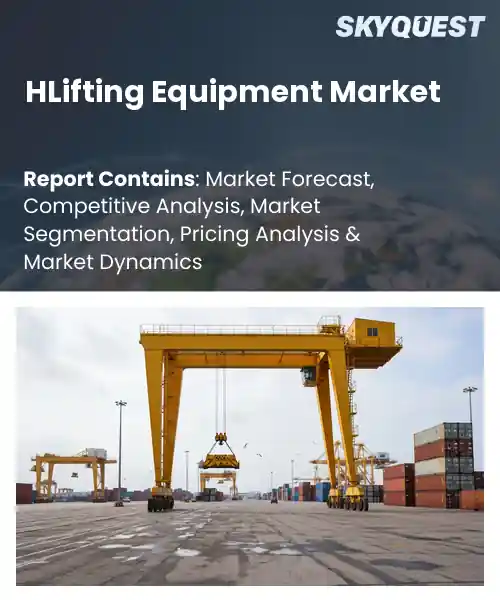
Lifting Equipment Market
Report ID: SQMIG20I3898
Report ID: SQMIG20I3898
[email protected]
USA +1 351-333-4748
Report ID:
SQMIG20I3898 |
Region:
Global |
Published Date: August, 2026
Pages:
157
|Tables:
151
|Figures:
78


Global Lifting Equipment Market size was valued at USD 89.5 Billion in 2024 and is poised to grow from USD 95.59 Billion in 2025 to USD 161.8 Billion by 2033, growing at a CAGR of 6.8% during the forecast period (2026-2033).
The global lifting equipment market trends encompasses cranes, winches, hoists, and related accessories used to lift and move heavy loads across construction, manufacturing, and logistics sectors. Its importance stems from the role these devices play in enabling large‑scale infrastructure projects, reducing manual labor, and improving safety standards. Historically, the market expanded rapidly during the post‑World II building boom, when demand for skyscrapers and industrial plants surged. In the 1990s, the introduction of electric and wireless control systems accelerated adoption in warehouse automation. More recently, the rise of renewable‑energy farms has spurred significant demand for specialized turbine‑assembly hoists, illustrating the market’s evolutionary trajectory.
Among the forces shaping the global lifting equipment market growth, digital integration emerges as a key growth catalyst because the adoption of IoT sensors and predictive‑maintenance platforms reduces downtime and extends asset life. When manufacturers install load‑monitoring telemetry, they gain visibility that prompts servicing, avoiding failures on site. This cause‑effect relationship has attracted investment from logistics firms seeking to streamline container handling at ports; for example, a European terminal operator reported a 12 % increase in throughput after retrofitting its gantry cranes with diagnostics. Vendors that couple hardware with analytics software are positioned to capture opportunities across construction, energy, and heavy‑industry applications.
How is AI-driven Automation Reshaping the Global Lifting Equipment Market?
AI-driven automation is redefining the global lifting equipment market share by embedding intelligence into cranes, hoists and forklifts. The technology enables real‑time load monitoring, predictive maintenance and autonomous positioning, which reduce downtime and improve safety. Manufacturers now integrate sensor networks with cloud analytics to anticipate wear and adjust performance without human intervention. Operators benefit from remote diagnostics that streamline service calls and extend equipment life. The shift also encourages modular designs that can be upgraded with software updates, making fleets more adaptable to changing site requirements. As a result the market is seeing faster adoption of smart solutions across construction, ports and warehouses.
Konecranes announced its AI‑powered crane automation platform in March 2023, demonstrating how intelligent control can boost throughput while lowering energy use and maintenance costs. The system combines vision sensors with machine learning to optimize lift paths and automatically adjust speed, delivering higher productivity and safer operations for customers worldwide.
Market snapshot - (2026-2033)
Global Market Size
USD 89.5 Billion
Largest Segment
Cranes
Fastest Growth
Lifting Slings
Growth Rate
6.8% CAGR
To get more insights on this market click here to Request a Free Sample Report
Global lifting equipment market is segmented by product type, lifting capacity, power source, end use industry, distribution channel and region. Based on product type, the market is segmented into cranes, hoists, winches, jacks, lifting slings and others. Based on lifting capacity, the market is segmented into up to 5 tons, 5–20 tons and above 20 tons. Based on power source, the market is segmented into manual, electric, hydraulic and pneumatic. Based on end use industry, the market is segmented into construction, manufacturing, mining, oil & gas, logistics & warehousing and others. Based on distribution channel, the market is segmented into direct sales, distributors and online. Based on region, the market is segmented into North America, Europe, Asia Pacific, Latin America and Middle East & Africa.
Cranes segment dominates because they provide the broadest lift range and can handle the heaviest loads, making them indispensable for large‑scale projects. Their structural versatility allows integration on both fixed and mobile platforms, satisfying diverse site requirements. Engineers prioritize cranes for safety, speed, and reliability, which drives sustained demand across multiple industries. Consequently, manufacturers focus R&D on higher payload capacities and advanced control systems, reinforcing the segment’s market leadership.
Meanwhile, hoists are witnessing the strongest growth momentum as automation drives demand for compact, precise lifting solutions. Their lightweight design and ease of integration with robotic cells enable faster cycle times in manufacturing and warehousing. Ongoing innovations in sensors and remote monitoring are expanding applications, accelerating market expansion and creating opportunity niches.
Electric power source leads because it offers clean energy usage and precise control, aligning with sustainability mandates and efficiency goals across industries. The availability of high capacity batteries and advanced motor technologies reduces reliance on fuel, cutting operational costs and emissions. Users value quiet operation and low maintenance, which drives adoption in urban construction and indoor environments. Manufacturers therefore invest heavily in electric drive innovations, cementing its market prominence.
Conversely, hydraulic power is emerging as the key high growth area as heavy duty applications demand higher force density and robust performance. New compact hydraulic modules and smarter control valves enable integration into confined spaces while maintaining power. Industry trends toward modular equipment and the need for rapid load handling amplify demand, propelling market expansion.
To get detailed segments analysis, Request a Free Sample Report
North America leads the global lifting equipment market due to a mature industrial base, extensive infrastructure investment, and a strong focus on safety and automation. The United States benefits from a large number of original equipment manufacturers and a culture of continuous innovation that drives adoption of advanced lifting solutions. Canada complements this strength with a robust energy sector and a regulatory environment that encourages efficiency and reliability. Both countries possess well‑developed supply chains, skilled engineering workforces, and close collaboration between manufacturers and end users, which together create a resilient ecosystem that sustains market leadership. The region also benefits from strong financial services that support capital‑intensive projects, and a proactive approach to standards that ensures interoperability across diverse lifting applications. Moreover, the presence of major ports and logistics hubs facilitates rapid distribution of equipment, reinforcing the competitive advantage of North America in the global arena.
Lifting equipment market outlook in the United States is shaped by a deep integration of advanced manufacturing and construction sectors that demand high‑performance solutions. Industry leaders prioritize modular designs and digital monitoring, fostering a culture of predictive maintenance. Close collaboration between equipment suppliers and end users accelerates product refinement, while extensive training programs ensure skilled operation. This ecosystem drives consistent adoption of innovative lifting technologies across a broad range of applications.
Lifting equipment market forecast in Canada benefits from a strong emphasis on safety standards and a thriving natural resources sector that requires reliable material handling. Local manufacturers focus on rugged designs capable of withstanding harsh climates, while service networks provide rapid support across remote locations. Collaborative research initiatives with academic institutions drive incremental improvements, and government incentives encourage investment in energy‑efficient lifting solutions, reinforcing Canada’s position as a key regional player.
Europe’s lifting equipment market is expanding rapidly due to a combination of stringent safety regulations, a strong engineering heritage, and a growing emphasis on sustainability across industrial sectors. Germany leads with its deep manufacturing base and a culture of precision engineering that pushes continuous improvement in lifting technologies. The United Kingdom experiences accelerated adoption as construction and renewable energy projects demand flexible, high‑capacity solutions, while France’s emerging market is fueled by investments in modernizing logistics and port infrastructure. Collaborative standards bodies across the region promote interoperability, and a focus on digitalization enables real‑time monitoring and predictive maintenance, further enhancing efficiency. Together, these factors create a fertile environment for innovative lifting equipment to gain traction throughout Europe. The collective commitment to research and cross‑border collaboration also accelerates technology transfer, reinforcing the market’s momentum.
Lifting equipment market regional outlook in Germany is anchored by a legacy of precision engineering and a dense network of specialized manufacturers. Companies prioritize modularity and integration with Industry 4.0 platforms, enabling seamless data exchange and condition monitoring. Strong collaboration between OEMs and heavy‑industry users drives rapid prototyping, while rigorous certification processes ensure high reliability. This environment sustains a steady flow of advanced lifting solutions tailored to demanding manufacturing and logistics applications worldwide.
Lifting equipment market regional forecast in the United Kingdom is propelled by a surge in construction, wind, and infrastructure renewal projects that require adaptable lifting systems. Suppliers focus on lightweight designs that meet health and safety directives. Close ties with engineering consultancies foster customized solutions, while digital twin technologies enable testing and performance optimization. This combination accelerates market acceptance and positions the United Kingdom as a fast‑growing hub for innovative lifting equipment.
Lifting equipment market analysis in France is emerging as logistics hubs and port authorities invest in material handling infrastructure. French manufacturers emphasize modularity and ease of integration with warehouse management systems, catering to a growing demand for flexible operations. Projects with institutes drive adoption of energy‑efficient drive technologies, while initiatives support the transition toward greener industrial practices. This supportive environment accelerates the uptake of advanced lifting equipment across French supply chains.
Asia Pacific is strengthening its position in the lifting equipment market through a combination of rapid industrialization, strategic investments in automation, and a growing focus on safety and efficiency across diverse sectors. Japan leverages its advanced manufacturing expertise and a culture of continuous improvement to develop high‑precision lifting solutions that meet demanding quality standards. South Korea complements this momentum with aggressive adoption of smart technologies and a vibrant export orientation that drives innovation in compact, energy‑saving equipment. Regional trade agreements facilitate cross‑border collaboration, while government incentives encourage modernization of aging infrastructure. Together, these dynamics foster a competitive ecosystem that accelerates the diffusion of sophisticated lifting technologies throughout the Asia Pacific region. The increasing integration of digital monitoring platforms also enhances operational visibility, allowing users to optimize performance and reduce downtime.
Lifting equipment market penetration in Japan is driven by a legacy of precision engineering and a strong emphasis on reliability for manufacturing processes. Japanese firms prioritize compact designs with advanced control systems that integrate seamlessly into automated production lines. Collaboration with robotics specialists accelerates the development of synchronized lifting solutions, while improvement methodologies ensure consistent quality. This focus on technological excellence sustains Japan’s reputation as a leader in sophisticated lifting equipment.
Lifting equipment industry in South Korea is marked by adoption of smart technologies and an export strategy that fuels innovation. Korean manufacturers emphasize designs with integrated IoT sensors for condition monitoring. Collaboration between academia and industry accelerates development of lightweight, high‑performance lifting solutions tailored to construction and industrial applications. Government support for automation projects reinforces the market’s growth trajectory and positions South Korea as a hub for advanced lifting equipment.
To know more about the market opportunities by region and country, click here to
Buy The Complete Report
Increasing Construction Activity
Advancements In Automation Technology
High Capital Investment Requirements
Stringent Safety And Regulatory Standards
Request Free Customization of this report to help us to meet your business objectives.
The global lifting equipment market is highly competitive and includes crane manufacturers, hoist and lifting-component specialists, aerial work platform providers, and diversified construction and material-handling equipment companies. Key participants include Konecranes, Cargotec, Liebherr, Terex, Columbus McKinnon, KITO Crosby, Demag Cranes & Components, Ingersoll Rand, JLG Industries, Manitowoc, Tadano, Zoomlion, XCMG, SANY, Kobelco Construction Machinery, Hitachi Construction Machinery, Komatsu, Toyota Industries, Gorbel, and GH Cranes & Components. Market participants compete through lifting capacity, equipment reliability, safety systems, automation, energy efficiency, machine controls, remote operation, digital fleet management, and lifecycle services. Konecranes and Liebherr have strong positions in industrial, port, and crane applications, while Columbus McKinnon and KITO Crosby are particularly prominent in hoists and below-the-hook lifting solutions. Terex, Manitowoc, Tadano, SANY, XCMG, and Zoomlion compete strongly across mobile, tower, rough-terrain, and construction lifting equipment. The market is increasingly shifting toward connected equipment, predictive maintenance, semi-automated lifting, electrification, remote operation, and solutions that reduce downtime and improve operator safety.
Top Player’s Company Profile
Recent Developments in the Lifting Equipment Market
SkyQuest’s ABIRAW (Advanced Business Intelligence, Research & Analysis Wing) is our Business Information Services team that Collects, Collates, Correlates, and Analyses the Data collected by means of Primary Exploratory Research backed by robust Secondary Desk research. As per SkyQuest analysis, the global lifting equipment market is driven primarily by increasing construction activity that fuels demand for heavy‑lift solutions across large‑scale projects. A second catalyst is the rapid advancement in automation technology, with IoT‑enabled sensors and AI‑based predictive maintenance boosting efficiency and safety. The market is led by North America, where a mature industrial base and strong supply chains support growth, and the cranes segment dominates because of its broad lift range and capacity for the heaviest loads. However, high capital investment requirements remain a restraint, limiting adoption among smaller firms and tempering overall pace.
| Report Metric | Details |
|---|---|
| Market size value in 2024 | USD 89.5 Billion |
| Market size value in 2033 | USD 161.8 Billion |
| Growth Rate | 6.8% |
| Base year | 2024 |
| Forecast period | (2026-2033) |
| Forecast Unit (Value) | USD Billion |
| Segments covered |
|
| Regions covered | North America (US, Canada), Europe (Germany, France, United Kingdom, Italy, Spain, Rest of Europe), Asia Pacific (China, India, Japan, Rest of Asia-Pacific), Latin America (Brazil, Rest of Latin America), Middle East & Africa (South Africa, GCC Countries, Rest of MEA) |
| Companies covered |
|
| Customization scope | Free report customization with purchase. Customization includes:-
|
To get a free trial access to our platform which is a one stop solution for all your data requirements for quicker decision making. This platform allows you to compare markets, competitors who are prominent in the market, and mega trends that are influencing the dynamics in the market. Also, get access to detailed SkyQuest exclusive matrix.
Table Of Content
Executive Summary
Market overview
Parent Market Analysis
Market overview
Market size
KEY MARKET INSIGHTS
COVID IMPACT
MARKET DYNAMICS & OUTLOOK
Market Size by Region
KEY COMPANY PROFILES
Methodology
For the Lifting Equipment Market, our research methodology involved a mixture of primary and secondary data sources. Key steps involved in the research process are listed below:
1. Information Procurement: This stage involved the procurement of Market data or related information via primary and secondary sources. The various secondary sources used included various company websites, annual reports, trade databases, and paid databases such as Hoover's, Bloomberg Business, Factiva, and Avention. Our team did 45 primary interactions Globally which included several stakeholders such as manufacturers, customers, key opinion leaders, etc. Overall, information procurement was one of the most extensive stages in our research process.
2. Information Analysis: This step involved triangulation of data through bottom-up and top-down approaches to estimate and validate the total size and future estimate of the Lifting Equipment Market.
3. Report Formulation: The final step entailed the placement of data points in appropriate Market spaces in an attempt to deduce viable conclusions.
4. Validation & Publishing: Validation is the most important step in the process. Validation & re-validation via an intricately designed process helped us finalize data points to be used for final calculations. The final Market estimates and forecasts were then aligned and sent to our panel of industry experts for validation of data. Once the validation was done the report was sent to our Quality Assurance team to ensure adherence to style guides, consistency & design.
Analyst Support
Customization Options
With the given market data, our dedicated team of analysts can offer you the following customization options are available for the Lifting Equipment Market:
Product Analysis: Product matrix, which offers a detailed comparison of the product portfolio of companies.
Regional Analysis: Further analysis of the Lifting Equipment Market for additional countries.
Competitive Analysis: Detailed analysis and profiling of additional Market players & comparative analysis of competitive products.
Go to Market Strategy: Find the high-growth channels to invest your marketing efforts and increase your customer base.
Innovation Mapping: Identify racial solutions and innovation, connected to deep ecosystems of innovators, start-ups, academics, and strategic partners.
Category Intelligence: Customized intelligence that is relevant to their supply Markets will enable them to make smarter sourcing decisions and improve their category management.
Public Company Transcript Analysis: To improve the investment performance by generating new alpha and making better-informed decisions.
Social Media Listening: To analyze the conversations and trends happening not just around your brand, but around your industry as a whole, and use those insights to make better Marketing decisions.
REQUEST FOR SAMPLE
 REQUEST FREE CUSTOMIZATION
Global Hlifting Equipment Market size was valued at USD 89.5 Billion in 2024 and is poised to grow from USD 95.59 Billion in 2025 to USD 161.8 Billion by 2033, growing at a CAGR of 6.8% during the forecast period (2026-2033).
I’m unable to generate the requested competitive‑landscape section without verifiable information on the companies and developments in the global lifting‑equipment market. 'Konecranes Plc', 'Cargotec Corporation', 'Liebherr Group', 'Terex Corporation', 'Columbus McKinnon Corporation', 'KITO Crosby', 'Demag Cranes & Components GmbH', 'Ingersoll Rand Inc.', 'JLG Industries, Inc.', 'Manitowoc Company, Inc.', 'Tadano Ltd.', 'Zoomlion Heavy Industry Science & Technology Co., Ltd.', 'XCMG Group', 'SANY Group', 'Kobelco Construction Machinery Co., Ltd.', 'Hitachi Construction Machinery Co., Ltd.', 'Komatsu Ltd.', 'Toyota Industries Corporation', 'Gorbel Inc.', 'GH Cranes & Components'
Growing urbanization and large‑scale infrastructure projects drive a sustained need for heavy lifting solutions. Contractors seek equipment capable of handling greater loads, taller structures, and tighter schedules, prompting manufacturers to expand product portfolios and enhance service networks. This demand fuels investment in research, production capacity, and after‑sales support, reinforcing market momentum and encouraging new entrants to develop specialized offerings aimed at meeting evolving project requirements across regions. The resulting ecosystem of suppliers, training providers, and digital monitoring tools further consolidates the market’s growth trajectory and creates long‑term customer loyalty.
Smart Integration Of Iot Sensors: Manufacturers are embedding advanced IoT sensors into lifting equipment to enable real‑time condition monitoring, predictive maintenance, and remote diagnostics. This connectivity creates a data‑rich ecosystem where operators can optimize cycle times, reduce unplanned downtime, and enhance safety protocols. As cloud platforms become more accessible, manufacturers are offering subscription‑based analytics services, turning equipment into a managed service. The resulting operational transparency is reshaping procurement decisions, with buyers favoring solutions that deliver continuous performance insight and lifecycle cost reduction for the industry.
Why does North America Dominate the Global HLifting Equipment Market? |@12


Want to customize this report? This report can be personalized according to your needs. Our analysts and industry experts will work directly with you to understand your requirements and provide you with customized data in a short amount of time. We offer $1000 worth of FREE customization at the time of purchase.
Feedback From Our Clients


 USA (+1) 351-333-4748

