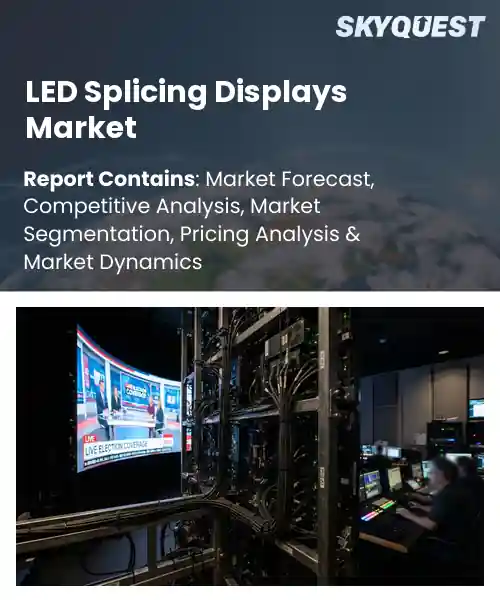
LED Splicing Displays Market
Report ID: SQMIG45I2537
Report ID: SQMIG45I2537
[email protected]
USA +1 351-333-4748
Report ID:
SQMIG45I2537 |
Region:
Global |
Published Date: October, 2026
Pages:
157
|Tables:
122
|Figures:
77


Global Led Splicing Displays Market size was valued at USD 2.1 Billion in 2024 and is poised to grow from USD 2.29 Billion in 2025 to USD 4.6 Billion by 2033, growing at a CAGR of 9.1% during the forecast period (2026-2033).
The LED splicing display market produces modular LED panels that can be cut, joined, and configured into custom shapes for signage, advertising, and architectural illumination. Its significance lies in creating large‑format, high‑resolution visuals while reducing installation time and material waste. The market emerged in the early 2010s as manufacturers sought alternatives to fixed‑size panels; Leyard and Absen introduced splice‑capable modules that enabled curved façades in Shanghai’s West Bund. Over the past decade adoption accelerated as urban planners prioritized dynamic façades, and falling LED chip costs drove broader diffusion across retail, transport hubs, and stadiums throughout major metropolitan areas worldwide now. One key factor driving the global LED splicing displays market is the surge in demand for immersive, data‑driven advertising in public spaces. Brands favor real‑time content that reacts to audience metrics, prompting venue operators to install splice‑ready screens that form continuous curves around pillars, escalators, and arena roofs, turning blank surfaces into revenue‑generating canvases. This reduces project lead time because designers can pre‑plan module layouts in 3‑D software, order quantities, and avoid on‑site trimming. Consequently, transit authorities and stadium managers see ad fill rates and lower maintenance costs, creating a virtuous cycle that fuels investment in installations for smart‑city projects.
How is AI enhancing the LED splicing displays market?
AI is reshaping the LED splicing displays market by automating image alignment, optimizing power use, and enabling dynamic content adaptation. Machine learning models analyze pixel data in real time to correct color drift and ensure seamless seams, which reduces manual tuning and shortens installation cycles. Predictive analytics monitor temperature and voltage, alerting technicians before failures occur and extending panel life. Integration with edge computing allows advertisers to tailor visuals to audience movement, creating more engaging experiences. These capabilities are attracting system integrators and venue owners who seek higher reliability and lower operating costs, driving broader adoption across entertainment, transportation and retail sectors.In August 2023 Leyard Optoelectronic launched an AI driven splicing platform that automatically balances brightness and corrects seam artifacts, cutting setup time and boosting display reliability, which fuels market growth. The solution integrates with control systems and provides diagnostics, allowing operators to maintain performance and encouraging wider deployment in large scale venues.
Market snapshot - (2026-2033)
Global Market Size
USD 2.1 Billion
Largest Segment
Outdoor LED Splicing Displays
Fastest Growth
Fine-Pitch LED Splicing Displays
Growth Rate
9.1% CAGR
To get more insights on this market click here to Request a Free Sample Report
Global led splicing displays market is segmented by display type, pixel pitch, application, end user and region. Based on display type, the market is segmented into Indoor LED Splicing Displays, Outdoor LED Splicing Displays and Fine-Pitch LED Splicing Displays. Based on pixel pitch, the market is segmented into Fine Pixel Pitch, Standard Pixel Pitch and Large Pixel Pitch. Based on application, the market is segmented into Control Rooms, Broadcast & Production Studios, Retail & Advertising, Corporate & Conference Facilities, Entertainment Venues and Other Applications. Based on end user, the market is segmented into Government & Public Safety, Corporate Enterprises, Media & Entertainment Companies, Retailers & Advertising Companies and Other End Users. Based on region, the market is segmented into North America, Europe, Asia Pacific, Latin America and Middle East & Africa.
Outdoor LED Splicing Displays segment dominates because it aligns with the growing demand for high‑visibility, weather‑resistant visual solutions in public and commercial spaces. These displays withstand harsh environmental conditions while delivering bright, consistent imagery, making them essential for large‑scale signage and event installations. Their durability reduces total cost of ownership, and manufacturers benefit from mature supply chains that accelerate rollout, reinforcing their market leadership. Furthermore, ongoing advancements in modular designs simplify maintenance and scaling, further cementing their appeal.
Meanwhile, Fine‑Pitch LED Splicing Displays emerge as the most rapidly expanding area because their ultra‑dense pixel arrangement enables seamless, high‑resolution visuals on irregular surfaces. This capability fuels adoption in premium retail façades and immersive installations, driving innovation and opening new revenue streams for manufacturers seeking differentiated offerings.
Retail & Advertising segment leads because brands rely on eye‑catching, dynamic content to attract customers in highly competitive environments. LED splicing displays provide scalable, vivid canvases that can be customized to fit storefront dimensions, enhancing visual impact and consumer engagement. Their ability to integrate real‑time data feeds supports targeted promotions, while decreasing installation time and energy consumption makes them a cost‑effective choice for widespread deployment.
On the other hand, Entertainment Venues become the fastest growing area because immersive experiences demand large, seamless visual backdrops that traditional screens cannot provide. LED splicing technology enables architects to craft dramatic stage settings and arena displays, attracting audiences seeking high‑definition spectacle. This trend spurs investment in advanced control systems and drives manufacturers to develop lighter, more versatile modules, expanding market potential.
To get detailed segments analysis, Request a Free Sample Report
The Asia Pacific region benefits from a blend of advanced manufacturing capabilities, deep engineering talent pools, and a cultural emphasis on technological adoption. Strong ecosystem linkages between component suppliers, system integrators, and end‑user industries create efficient supply chains and rapid innovation cycles. Market participants leverage cost‑effective production facilities while maintaining high quality standards, enabling widespread deployment across entertainment venues, transportation hubs, and commercial signage. Government initiatives that support smart city projects and digital infrastructure further accelerate demand, positioning the region as a hub of both supply excellence and consumption growth.
LED Splicing Displays Market in Japan thrives on a tradition of precision engineering and a mature electronics sector that supplies high‑performance modules and control solutions. Demand is reinforced by sophisticated event production firms and a vibrant retail environment that values cutting‑edge visual experiences. Collaborative research between universities and industry drives continual improvements in brightness, durability, and integration flexibility, reinforcing Japan’s role as a benchmark for quality in the global supply chain.
LED Splicing Displays Market in South Korea is propelled by a dynamic consumer electronics landscape and strong governmental support for digital signage initiatives. The country’s expertise in semiconductor manufacturing translates into reliable, high‑efficiency display components that attract broadcasters, advertisers, and public venues. Aggressive investment in smart‑city infrastructure and a culture that embraces immersive media experiences further stimulate adoption, cementing South Korea’s position as a pivotal growth engine within the Asia Pacific dominance.
Europe’s expansion is fueled by a convergence of sustainability goals, premium content production, and a regulatory environment that encourages energy‑efficient technologies. Strong design and engineering cultures across key markets foster innovative applications in sports arenas, cultural institutions, and transport terminals. The emphasis on high‑resolution, adaptable displays aligns with the European emphasis on audience engagement and brand differentiation. Collaborative industry networks and cross‑border trade frameworks ease market entry, while public‑private partnerships in smart‑city projects create continuous demand, propelling the region toward a leading position.
LED Splicing Displays Market in Germany benefits from a robust engineering tradition and a deep base of specialized manufacturers focused on reliability and performance. Industrial clusters provide integrated solutions that combine precision optics with advanced control software, appealing to automotive showrooms, trade fairs, and high‑end entertainment venues. Commitment to energy efficiency and rigorous quality standards reinforces Germany’s reputation as a dominant force shaping European market direction.
LED Splicing Displays Market in the United Kingdom experiences rapid growth driven by a vibrant events sector and a strong appetite for immersive advertising experiences. Creative agencies and production houses adopt flexible splicing technologies to deliver dynamic visual storytelling across stadiums, concert halls, and urban installations. Supportive policy frameworks encouraging digital transformation in public spaces accelerate deployment, positioning the United Kingdom as the fastest growing market within Europe.
LED Splicing Displays Market in France is emerging through a blend of cultural investment and progressive urban initiatives. Museums, theaters, and tourism destinations leverage high‑impact visual solutions to enhance visitor experiences and differentiate offerings. Collaborative projects between technology providers and design firms foster bespoke installations that reflect French aesthetic sensibilities, nurturing a growing ecosystem that signals France’s rising prominence in the European landscape.
North America advances its market position through a combination of cutting‑edge content creation, extensive venue infrastructure, and a business climate supportive of technological experimentation. Deep talent pools in media production and software development drive forward‑looking applications that integrate splicing displays with interactive experiences. Strong demand from sports franchises, concert promoters, and retail chains fuels continuous innovation, while collaborative research initiatives between industry and academic institutions accelerate performance enhancements. The region’s focus on scalability and integration with emerging digital platforms ensures sustained relevance and competitive advantage.
LED Splicing Displays Market in the United States thrives on a prolific entertainment ecosystem and a widespread network of large‑scale venues that prioritize immersive visual storytelling. Leading production studios and advertising agencies adopt flexible splicing solutions to meet high‑impact demands, while technology incubators foster rapid prototyping and integration with augmented reality. The market benefits from a culture of innovation and substantial capital investment that drives continual advancement and broad adoption across sectors.
LED Splicing Displays Market in Canada grows through strategic investments in cultural venues and public‑sector signage projects that emphasize visual excellence and energy efficiency. Collaborative efforts between regional technology hubs and government programs promote the adoption of adaptable display solutions for sports arenas, concert venues, and transportation hubs. A focus on sustainability and high‑quality user experiences positions Canada as an emerging contributor to the North American market narrative.
To know more about the market opportunities by region and country, click here to
Buy The Complete Report
Increasing Demand for Energy Efficiency
Advancements in Flexible LED Materials
High Initial Capital Expenditure
Limited Availability of Technical Expertise
Request Free Customization of this report to help us to meet your business objectives.
The LED splicing displays market is intensely competitive, with major OEMs accelerating product roll‑outs while leveraging strategic M&A to broaden portfolio breadth; for example, a leading Asian manufacturer acquired a niche European splicing specialist to integrate advanced modular technology. Partnerships are reshaping supply chains, as a top display maker teamed with a semiconductor firm to embed higher‑efficiency drivers. Continuous tech innovation, such as the introduction of ultra‑thin seamless panels, is driving differentiation and prompting rivals to invest heavily in R&D collaborations.
Top Player’s Company Profile
Recent Developments
SkyQuest’s ABIRAW (Advanced Business Intelligence, Research & Analysis Wing) is our Business Information Services team that Collects, Collates, Correlates, and Analyses the Data collected by means of Primary Exploratory Research backed by robust Secondary Desk research. As per SkyQuest analysis the global LED splicing displays market is being propelled by the rising demand for energy‑efficient visual solutions while advances in flexible LED materials are opening new architectural applications. The outdoor LED splicing displays segment leads the market, benefiting from weather‑resistant, high‑visibility panels that suit public‑space signage. Asia Pacific dominates the landscape, driven by strong manufacturing capabilities, smart‑city initiatives and rapid adoption across retail and transport hubs. However, the high initial capital expenditure required for specialized modules and integration tools remains a notable restraint, tempering uptake among smaller operators. Together, these dynamics shape a market poised for robust growth through 2033.
| Report Metric | Details |
|---|---|
| Market size value in 2024 | USD 2.1 Billion |
| Market size value in 2033 | USD 4.6 Billion |
| Growth Rate | 9.1% |
| Base year | 2024 |
| Forecast period | (2026-2033) |
| Forecast Unit (Value) | USD Billion |
| Segments covered |
|
| Regions covered | North America (US, Canada), Europe (Germany, France, United Kingdom, Italy, Spain, Rest of Europe), Asia Pacific (China, India, Japan, Rest of Asia-Pacific), Latin America (Brazil, Rest of Latin America), Middle East & Africa (South Africa, GCC Countries, Rest of MEA) |
| Companies covered |
|
| Customization scope | Free report customization with purchase. Customization includes:-
|
To get a free trial access to our platform which is a one stop solution for all your data requirements for quicker decision making. This platform allows you to compare markets, competitors who are prominent in the market, and mega trends that are influencing the dynamics in the market. Also, get access to detailed SkyQuest exclusive matrix.
Table Of Content
Executive Summary
Market overview
Parent Market Analysis
Market overview
Market size
KEY MARKET INSIGHTS
COVID IMPACT
MARKET DYNAMICS & OUTLOOK
Market Size by Region
KEY COMPANY PROFILES
Methodology
For the LED Splicing Displays Market, our research methodology involved a mixture of primary and secondary data sources. Key steps involved in the research process are listed below:
1. Information Procurement: This stage involved the procurement of Market data or related information via primary and secondary sources. The various secondary sources used included various company websites, annual reports, trade databases, and paid databases such as Hoover's, Bloomberg Business, Factiva, and Avention. Our team did 45 primary interactions Globally which included several stakeholders such as manufacturers, customers, key opinion leaders, etc. Overall, information procurement was one of the most extensive stages in our research process.
2. Information Analysis: This step involved triangulation of data through bottom-up and top-down approaches to estimate and validate the total size and future estimate of the LED Splicing Displays Market.
3. Report Formulation: The final step entailed the placement of data points in appropriate Market spaces in an attempt to deduce viable conclusions.
4. Validation & Publishing: Validation is the most important step in the process. Validation & re-validation via an intricately designed process helped us finalize data points to be used for final calculations. The final Market estimates and forecasts were then aligned and sent to our panel of industry experts for validation of data. Once the validation was done the report was sent to our Quality Assurance team to ensure adherence to style guides, consistency & design.
Analyst Support
Customization Options
With the given market data, our dedicated team of analysts can offer you the following customization options are available for the LED Splicing Displays Market:
Product Analysis: Product matrix, which offers a detailed comparison of the product portfolio of companies.
Regional Analysis: Further analysis of the LED Splicing Displays Market for additional countries.
Competitive Analysis: Detailed analysis and profiling of additional Market players & comparative analysis of competitive products.
Go to Market Strategy: Find the high-growth channels to invest your marketing efforts and increase your customer base.
Innovation Mapping: Identify racial solutions and innovation, connected to deep ecosystems of innovators, start-ups, academics, and strategic partners.
Category Intelligence: Customized intelligence that is relevant to their supply Markets will enable them to make smarter sourcing decisions and improve their category management.
Public Company Transcript Analysis: To improve the investment performance by generating new alpha and making better-informed decisions.
Social Media Listening: To analyze the conversations and trends happening not just around your brand, but around your industry as a whole, and use those insights to make better Marketing decisions.
REQUEST FOR SAMPLE
 REQUEST FREE CUSTOMIZATION


Want to customize this report? This report can be personalized according to your needs. Our analysts and industry experts will work directly with you to understand your requirements and provide you with customized data in a short amount of time. We offer $1000 worth of FREE customization at the time of purchase.
Feedback From Our Clients


 USA (+1) 351-333-4748

