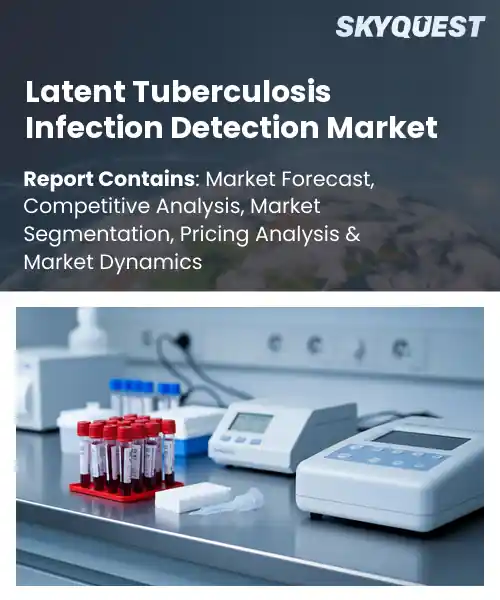
Latent Tuberculosis Infection Detection Market
Report ID: SQMIG35A3677
Report ID: SQMIG35A3677
[email protected]
USA +1 351-333-4748
Report ID:
SQMIG35A3677 |
Region:
Global |
Published Date: June, 2026
Pages:
157
|Tables:
91
|Figures:
76


Global Latent Tuberculosis Infection Detection Market size was valued at USD 2.01 Billion in 2024 and is poised to grow from USD 2.13 Billion in 2025 to USD 3.37 Billion by 2033, growing at a CAGR of 5.9% during the forecast period (2026-2033).
Latent tuberculosis infection detection market is driven primarily by the imperative to identify asymptomatic carriers who can later develop active tuberculosis, and this surveillance imperative shapes the value chain. The market comprises diagnostic assays, point-of-care tests, laboratory infrastructure, and software for interpretation and surveillance, and matters because early detection reduces transmission, informs preventive therapy, and lowers long-term healthcare costs. Historically the field evolved from tuberculin skin testing to interferon-gamma release assays and now toward next-generation molecular and digital solutions, as public health programs in high-burden countries adopted more sensitive diagnostics exemplified by national screening initiatives in the UK and India.Building on diagnostic evolution, a decisive growth driver is shifting policy and financing that prioritize systematic latent screening, which generates demand for scalable, accurate tests. When national programs allocate funds and update guidelines to recommend interferon-gamma release assays for high-risk cohorts, procurement rises, manufacturers scale, and laboratories automate. Expanded migrant screening in Europe, employer testing in hospitals, and pre-immigration checks increase need for point-of-care and lab-based options while electronic health record integration supports testing-to-treatment cascades. As a result, firms that combine validated assays, service contracts, and data platforms can win public tenders and private contracts across high-burden and resource-constrained settings.
How is AI enhancing sensitivity in the latent tuberculosis infection detection market?
AI improves sensitivity in latent tuberculosis infection detection by refining signal detection in immune assays and by enhancing image interpretation for radiology and microscopy. Machine learning models learn subtle patterns that human readers miss and they can combine laboratory markers with patient history to flag likely infections. In the current market vendors are embedding AI into interferon gamma release assays and digital chest imaging to reduce missed cases and to prioritize samples for follow up. These improvements make screening more reliable and help labs manage growing test volumes while supporting deployment in settings with limited specialist expertise.QIAGEN May 2026, announced plans to advance its QuantiFERON latent TB testing with a fully automated sample to insight workflow and an AI enabled risk stratification tool, enhancing lab efficiency and supporting wider screening by improving case detection and follow up.
Market snapshot - (2026-2033)
Global Market Size
USD 2.01 Billion
Largest Segment
Tuberculin Skin Test (TST)
Fastest Growth
Interferon-Gamma Release Assay (IGRA)
Growth Rate
5.9% CAGR
To get more insights on this market click here to Request a Free Sample Report
Global latent tuberculosis infection detection market is segmented by test type, application, end-user focus and region. Based on test type, the market is segmented into Tuberculin Skin Test (TST) and Interferon-Gamma Release Assay (IGRA). Based on application, the market is segmented into Diagnostic Centers, Hospitals and Clinics, Research Institutes and Others. Based on end-user focus, the market is segmented into High-Risk Populations, Healthcare Workers, Immigrants and Travelers and Others. Based on region, the market is segmented into North America, Europe, Asia Pacific, Latin America and Middle East & Africa.
Tuberculin Skin Test segment dominates because its long standing role, low operational complexity and widespread availability create persistent demand across clinical settings. Familiar administration and established workflows allow large scale screening without specialized laboratory infrastructure, prompting providers and procurement teams to favor this approach. These practical strengths sustain test volumes and reinforce supplier investment in manufacturing and distribution, entrenching its leadership position in the market.
However, Interferon-Gamma Release Assay is witnessing the strongest growth momentum because its greater specificity and laboratory integration appeal to clinical laboratories. Advances in assay automation and increasing interest from private providers and research programs drive adoption, spur product innovation and open new service offerings that accelerate market expansion and generate developer opportunities.
Healthcare Workers segment dominates because occupational exposure concerns and institutional screening policies create continuous, prioritized testing demand within medical facilities. Mandatory employment health programs and centralized occupational health services embed regular screening into routine workflows, ensuring reliable test procurement and sustained laboratory throughput. This predictable, institutionally driven demand influences diagnostic choices and vendor relationships, making healthcare worker testing a cornerstone of market stability and supplier planning.
Meanwhile, High Risk Populations emerge as the key high-growth area due to targeted public health initiatives and expanded screening among people with comorbidities. Outreach programs and tailored testing strategies increase demand for accessible, sensitive assays in community settings. This focus stimulates innovation in point of care options and partnerships that expand testing reach and future opportunities.
To get detailed segments analysis, Request a Free Sample Report
North America commands a leading role due to well integrated healthcare infrastructure, concentrated market access, and sustained investment in diagnostic innovation. Robust reimbursement frameworks, strong presence of diagnostic manufacturers, and close collaboration between research institutions and clinical laboratories accelerate adoption of advanced latent tuberculosis infection detection methods. Established public health programs and emphasis on preventive screening enhance market penetration while regulatory clarity reduces barriers for novel assays. Commercialization expertise and mature distribution networks facilitate rapid scaling. Additionally, private sector engagement and targeted educational initiatives among healthcare professionals support consistent utilization of screening tools, reinforcing North America position as a dominant market and a focal point for product launches and clinical validation activities. Provider familiarity with evidence based guidelines and coordinated surveillance systems further sustain demand while collaboration with global public health stakeholders promotes international trial and distribution strategies.
Latent Tuberculosis Infection Detection Market in United States is characterized by rapid uptake of advanced diagnostic assays driven by robust laboratory networks, sector participation and strong clinical awareness. Public health screening programs support widespread testing pathways. Strategic partnerships among manufacturers, clinical centers and payers enable efficient product introduction. Focused educational outreach to clinicians and investment in laboratory capacity enhance consistent utilization of detection technologies across care settings.
Latent Tuberculosis Infection Detection Market in Canada reflects strong public health engagement and centralized laboratory networks supporting coordinated screening initiatives. Guideline driven testing and collaboration between provincial programs and clinical laboratories facilitates adoption of standardized assays. Manufacturers leverage procurement processes and academic partnerships to validate technologies. Outreach to primary care providers and community clinics improves case finding. Focus on interoperability of laboratory systems supports efficient reporting and clinical decision integration.
Europe is experiencing rapid expansion driven by a combination of evolving public health priorities, harmonized regulatory pathways, and increasing investment in diagnostic capabilities. Strong national screening programs, coupled with cross border collaboration among health agencies and research consortia, facilitate broader deployment of latent tuberculosis infection detection tools. Market growth is supported by competitive local manufacturing, emphasis on assay standardization, and growing clinician awareness of detection value within preventive care models. Reimbursement landscapes, while varied, are progressively accommodating novel diagnostics through policy updates and pilot programs. Strategic partnerships between industry, academic centers, and public health institutions accelerate clinical validation and adoption. Focused training initiatives for healthcare workers and enhanced laboratory infrastructure further underpin the region expansion and strengthen its strategic position in the global market.
Latent Tuberculosis Infection Detection Market in Germany is driven by a strong diagnostics industry and healthcare networks that support clinical validation and adoption. Established laboratories and collaboration between academic centers and manufacturers enable assay evaluation. Reimbursement pathways and institutional procurement promote uptake in hospital and community settings. Training programs for clinicians and laboratory staff and modernization of laboratory infrastructure support consistent implementation of detection technologies and integration into care pathways.
Latent Tuberculosis Infection Detection Market in United Kingdom is marked by dynamic adoption driven by proactive public health initiatives supporting incorporation of innovative diagnostics. Strong partnerships among health agencies, research institutions and private innovators promote clinical evaluation and pilot programs. Emphasis on community based screening, clinician training and streamlined procurement supports broader deployment. Investment in laboratory modernization and digital reporting enhances effective integration of detection tools into patient management pathways.
Latent Tuberculosis Infection Detection Market in France is emerging through public health initiatives and collaboration between clinical laboratories and academic research units. Focus on assay standardization and regional pilots fosters evaluation of new detection technologies in practice. Manufacturers engage hospital networks and public procurement channels to build clinical credibility. Training for primary care clinicians and improved laboratory coordination support case identification and integration of detection workflows into routine care practices.
Asia Pacific is strengthening its role through strategic investments in laboratory capacity, targeted public health programs, and growing adoption of molecular and immunologic diagnostics suited to diverse clinical environments. Regional manufacturers and multinational companies increasingly tailor solutions to local needs, combining affordability with performance. Collaborative efforts between governments, industry and research institutions accelerate technology transfer, clinical validation and scale up across urban and rural settings. Training initiatives enhance laboratory proficiency and clinician awareness while digital health platforms improve reporting and surveillance linkages. Policy focus on early detection and preventive care, together with improvements in procurement and distribution channels, supports deeper market penetration. These collective actions position Asia Pacific as an increasingly important contributor to global latent tuberculosis infection detection capabilities and innovation.
Latent Tuberculosis Infection Detection Market in Japan is characterized by advanced laboratory infrastructure and emphasis on quality assay performance that supports clinical validation. Strong industry research and close links between academic centers and manufacturers facilitate development of tailored detection solutions. Integration with hospital based screening programs and clinician education promote appropriate utilization. Digital reporting systems and timely data flow and support clinical decision making across care settings.
Latent Tuberculosis Infection Detection Market in South Korea advances through public private collaboration and adoption of innovative diagnostic platforms suited to efficient laboratory workflows. Health agencies partner with manufacturers and academic institutions to validate assays. Focus on laboratory automation, quality control and clinician training supports consistent use of detection technologies. Integrated data systems and streamlined procurement facilitate distribution and reporting, strengthening connection between testing and patient management across healthcare networks.
To know more about the market opportunities by region and country, click here to
Buy The Complete Report
Rising Focus on Early Detection
Advances In Molecular Diagnostic Platforms
Limited Access To Confirmatory Testing
High Cost Of Advanced Assays
Request Free Customization of this report to help us to meet your business objectives.
Competitive landscape in the global latent tuberculosis infection detection market is shaped by established diagnostics firms and agile entrants racing to deliver decentralized, faster LTBI solutions. Competition is driven by the need to shift IGRAs and molecular assays to point of care and to integrate into automated platforms. Firms pursue partnerships and consortium funding such as SMART4TB, platform integrations like QuantiFERON on clinical analyzers, and targeted product innovations.
Top Player’s Company Profile
Recent Developments
SkyQuest’s ABIRAW (Advanced Business Intelligence, Research & Analysis Wing) is our Business Information Services team that Collects, Collates, Correlates, and Analyses the Data collected by means of Primary Exploratory Research backed by robust Secondary Desk research. As per SkyQuest analysis, the global latent tuberculosis infection detection market is propelled by rising focus on early detection as a key driver and strengthened by advances in molecular diagnostic platforms as a second driver. However, high cost of advanced assays remains a significant restraint that limits adoption in resource-constrained settings. North America dominates the market due to integrated healthcare systems, reimbursement support and strong diagnostic innovation, while the Tuberculin Skin Test (TST) is the dominating segment because of its low complexity, wide availability and entrenched clinical workflows. Together these forces shape near-term growth opportunities for automated IGRAs, point-of-care molecular tests and digital integration.
| Report Metric | Details |
|---|---|
| Market size value in 2024 | USD 2.01 Billion |
| Market size value in 2033 | USD 3.37 Billion |
| Growth Rate | 5.9% |
| Base year | 2024 |
| Forecast period | (2026-2033) |
| Forecast Unit (Value) | USD Billion |
| Segments covered |
|
| Regions covered | North America (US, Canada), Europe (Germany, France, United Kingdom, Italy, Spain, Rest of Europe), Asia Pacific (China, India, Japan, Rest of Asia-Pacific), Latin America (Brazil, Rest of Latin America), Middle East & Africa (South Africa, GCC Countries, Rest of MEA) |
| Companies covered |
|
| Customization scope | Free report customization with purchase. Customization includes:-
|
To get a free trial access to our platform which is a one stop solution for all your data requirements for quicker decision making. This platform allows you to compare markets, competitors who are prominent in the market, and mega trends that are influencing the dynamics in the market. Also, get access to detailed SkyQuest exclusive matrix.
Table Of Content
Executive Summary
Market overview
Parent Market Analysis
Market overview
Market size
KEY MARKET INSIGHTS
COVID IMPACT
MARKET DYNAMICS & OUTLOOK
Market Size by Region
KEY COMPANY PROFILES
Methodology
For the Latent Tuberculosis Infection Detection Market, our research methodology involved a mixture of primary and secondary data sources. Key steps involved in the research process are listed below:
1. Information Procurement: This stage involved the procurement of Market data or related information via primary and secondary sources. The various secondary sources used included various company websites, annual reports, trade databases, and paid databases such as Hoover's, Bloomberg Business, Factiva, and Avention. Our team did 45 primary interactions Globally which included several stakeholders such as manufacturers, customers, key opinion leaders, etc. Overall, information procurement was one of the most extensive stages in our research process.
2. Information Analysis: This step involved triangulation of data through bottom-up and top-down approaches to estimate and validate the total size and future estimate of the Latent Tuberculosis Infection Detection Market.
3. Report Formulation: The final step entailed the placement of data points in appropriate Market spaces in an attempt to deduce viable conclusions.
4. Validation & Publishing: Validation is the most important step in the process. Validation & re-validation via an intricately designed process helped us finalize data points to be used for final calculations. The final Market estimates and forecasts were then aligned and sent to our panel of industry experts for validation of data. Once the validation was done the report was sent to our Quality Assurance team to ensure adherence to style guides, consistency & design.
Analyst Support
Customization Options
With the given market data, our dedicated team of analysts can offer you the following customization options are available for the Latent Tuberculosis Infection Detection Market:
Product Analysis: Product matrix, which offers a detailed comparison of the product portfolio of companies.
Regional Analysis: Further analysis of the Latent Tuberculosis Infection Detection Market for additional countries.
Competitive Analysis: Detailed analysis and profiling of additional Market players & comparative analysis of competitive products.
Go to Market Strategy: Find the high-growth channels to invest your marketing efforts and increase your customer base.
Innovation Mapping: Identify racial solutions and innovation, connected to deep ecosystems of innovators, start-ups, academics, and strategic partners.
Category Intelligence: Customized intelligence that is relevant to their supply Markets will enable them to make smarter sourcing decisions and improve their category management.
Public Company Transcript Analysis: To improve the investment performance by generating new alpha and making better-informed decisions.
Social Media Listening: To analyze the conversations and trends happening not just around your brand, but around your industry as a whole, and use those insights to make better Marketing decisions.
REQUEST FOR SAMPLE
 REQUEST FREE CUSTOMIZATION


Want to customize this report? This report can be personalized according to your needs. Our analysts and industry experts will work directly with you to understand your requirements and provide you with customized data in a short amount of time. We offer $1000 worth of FREE customization at the time of purchase.
Feedback From Our Clients


 USA (+1) 351-333-4748

